
On this page
Start here
Quick answer
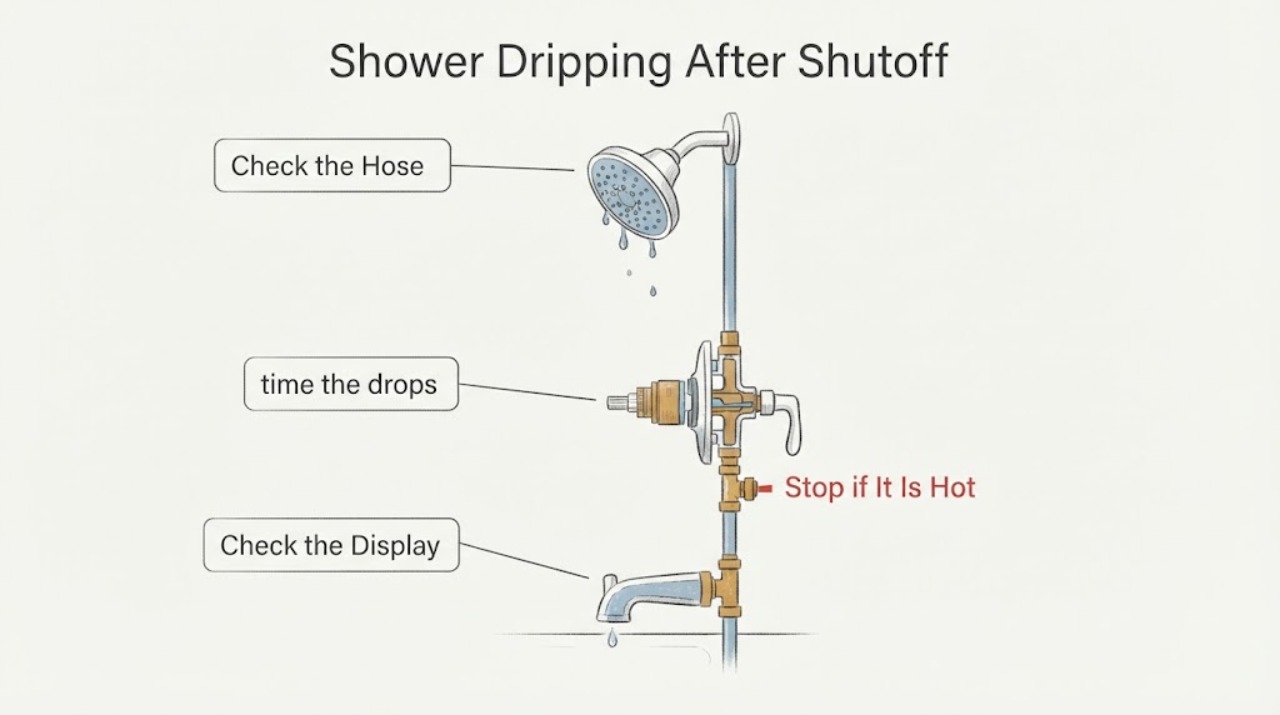
A few drops from the showerhead immediately after shutoff can be residual water draining from the head, especially when it stops after a short period. A drip that continues long after use, becomes a continuous stream, comes from the handle or wall, or appears from a non-selected outlet is a leak until proven otherwise. First note exactly where the water appears, how long it continues, whether the shower has a tub spout, and whether the valve is single-handle or multi-handle. Do not overtighten trim, pry the showerhead, or disassemble a valve without the exact model instructions. You may clean accessible spray nozzles using the manufacturer's care guidance, but a continuing off-position drip commonly needs a model-specific cartridge, seal, valve, diverter, or concealed-leak diagnosis. If water is entering the wall, the trim is hot, the flow is continuous, or you cannot isolate the valve, shut off the local or household water supply if safe and arrange a licensed plumber.
Work through in order
Diagnostic checks
Use only checks that match the exact appliance or system and its official guide.
-
Check 1
Turn the shower control fully off and inspect from a dry, safe position. Identify whether water comes from the showerhead spray holes, tub spout, handle, escutcheon/wall, hose connection, ceiling, or a nearby supply; keep the area dry and do not touch hot trim or open the wall.
Expected result: Only the spray holes drip, water runs continuously, the handle or wall is wet, water comes from an outlet that should be closed, or the leak is near electrical equipment or causing wall/ceiling damage.
Next step: For continuous flow, a wall/ceiling leak, or water near electrical equipment, shut off the local or household water supply only if safe and arrange a licensed plumber; use local emergency guidance for an immediate hazard. Otherwise continue with timing and valve identification without disassembly.
Stop if: Stop immediately for a hot uncontrolled stream, water entering a wall or ceiling, structural damage, water near electricity, or any need to pry trim or access concealed piping.
Why this matters
Why: Spray-hole drops may be retained water; continuous flow or water outside the outlet suggests a valve, seal, diverter, connection, or concealed leak. Wall or ceiling moisture can cause damage beyond the visible drip.
-
Check 2
After the shower is off, time the drops from the spray holes without changing the valve or repeatedly reopening it. Note whether individual drops have noticeable pauses, whether the drip stops after a short drain-down for the model, or whether it continues as a steady flow long after use.
Expected result: The drops stop after about a minute or the model's documented short period, continue for much longer, have no pauses, or recur whenever the valve is closed.
Next step: If it stops within the model's normal short period and comes only from spray holes, monitor it. If it continues or is continuous, identify the valve and arrange model-specific repair or plumbing service rather than tightening the handle harder.
Stop if: Stop testing after a continuous stream, a sudden increase in flow, or any drip from the handle, wall, or non-selected outlet.
Why this matters
Why: A short, spaced drip is consistent with water retained in the showerhead; Kohler gives up to 90 seconds for applicable models. A persistent or continuous drip is more consistent with water passing a valve seal, cartridge, diverter, or another leak path.
-
Check 3
Identify whether the shower is shower-only or has both a tub spout and showerhead, and whether the control has one handle or separate hot/cold handles. Read the model or valve instructions if available; do not remove the handle, bonnet, cartridge, or escutcheon merely to guess the valve family.
Expected result: The valve design and model are known, the showerhead is connected to a tub-and-shower diverter, the shower uses multiple handles, or the valve identity is uncertain.
Next step: Use only the exact model instructions for any trim or cartridge work. If the model is unknown, the valve is concealed, or hot/cold isolation is not clear, keep the water use limited and arrange a licensed plumber.
Stop if: Stop if identification requires removing trim, disturbing a seal, exposing the valve body, or working without a safe water shutoff.
Why this matters
Why: Residual water and valve-leak tests differ by configuration. Kohler's drip guidance is specific to a single-control valve, while Delta's multi-handle procedure requires isolating hot and cold supplies and warns inexperienced users to use a licensed plumber.
-
Check 4
If the drip is limited to the spray holes and the head is accessible without forcing a fitting, inspect and clean visible mineral buildup according to the showerhead manufacturer's care instructions. Do not use a sharp object, apply excessive force, or treat nozzle cleaning as a valve repair.
Expected result: The spray pattern is uneven or the nozzles have visible deposits, the short residual drip improves, or the drip continues unchanged after the accessible cleaning.
Next step: If cleaning does not stop the long drip, leave the valve off when not in use and arrange model-specific shower valve or plumbing service. Do not dismantle the valve or use a generic cartridge without confirming the exact model.
Stop if: Stop for a cracked head, damaged hose, leak at the wall connection, seized fitting, a continuous stream, or any need to use force or tools near concealed plumbing.
Why this matters
Why: Mineral deposits can alter spray behavior and may affect how water remains in the head, but unchanged or long-running off-position dripping points to a valve or internal seal rather than a nozzle-only issue.
-
Check 5
For a drip that continues after the documented short drain-down, check from outside the trim for a handle/escutcheon leak, simultaneous water from tub spout and showerhead, temperature/pressure changes, or moisture returning when the shower is unused. Do not remove the trim or attempt an internal cartridge repair unless the exact manual and a safe shutoff support it.
Expected result: Water passes a closed valve, appears around the handle or wall, comes from two outlets at once, or stops only when the household water is isolated.
Next step: Shut off the local or household water supply if safe, protect the area, and arrange a licensed plumber with the valve model and drip pattern. Do not keep the valve pressurized to see whether the leak worsens.
Stop if: Stop for water in the wall, ceiling staining, a leak that cannot be isolated, scalding risk, or any need to open the wall or alter pressure controls.
Why this matters
Why: The pattern makes an internal seal/cartridge, diverter, pressure/back-pressure, installation, or concealed supply problem more likely than residual showerhead water. A leak that stops only with supply isolation needs repair rather than repeated use.
Use your observations
Decision map
Find the observation that best matches what you see, then follow the next safe action.
-
PATH 01Safety boundary
What you see
Does water stop after a short, spaced drain-down and come only from the showerhead spray holes?
Do this next
Treat it as residual showerhead water for that model and monitor; Kohler describes up to 90 seconds for applicable valves and Delta describes about a minute for its guidance.
Why this path and its safety boundary
Why it matters: Time, spacing, and location separate a reservoir emptying from water passing a closed valve.
Safety stop: Treat a persistent, continuous, or off-location drip as a leak and continue to valve/service triage.
-
PATH 02Next step
What you see
The showerhead drips long after use, the flow has no pause, or water comes from the handle, escutcheon, wall, or tub spout with the control off.
Do this next
Limit use, isolate the water supply if safe, and arrange model-specific shower repair or a licensed plumber. Do not overtighten the handle or force the trim.
Why this path and its safety boundary
Why it matters: The result makes an internal seal/cartridge, valve body, diverter, or concealed leak more likely than residual water.
-
PATH 03Next step
What you see
A tub-and-shower setup sends water from the showerhead and tub spout together, or changing the diverter changes the drip without a normal short drain-down.
Do this next
Stop forcing the diverter and use the exact valve instructions or arrange a licensed plumber, especially if the valve is concealed or water reaches the wall.
Why this path and its safety boundary
Why it matters: This pattern can involve diverter behavior, back-pressure, outlet restriction, valve installation, or an internal seal; it is not confirmed by cleaning the spray nozzles.
-
PATH 04Next step
What you see
The valve model is unknown, the drip requires trim removal, the leak stops only when the household water is shut off, or water damage is visible.
Do this next
Keep the supply isolated if safe, document the model and leak location, and arrange a licensed plumber; do not open the wall or continue trial repairs.
Why this path and its safety boundary
Why it matters: The repair path is model-specific or concealed, and continued pressure can worsen water damage. A generic cartridge or seal instruction may be wrong.
Helpful context
Understand the symptom
Separate retained showerhead water from a valve leak
A showerhead can retain enough water to drip briefly after the control is closed. Delta calls a short post-shutoff drip the head emptying its reservoir, and Kohler describes residual drips as individual drops with space between them. A continuous flow, a drip that persists beyond the normal short drain-down for that model, or water appearing at the handle, escutcheon, wall, or another outlet points to a valve, seal, cartridge, diverter, pressure, or concealed supply issue instead.
The drip location is more useful than the sound
Drips from the spray holes after a shower are not classified the same way as water from the handle or behind the trim. On a tub-and-shower setup, whether the showerhead is still connected can help distinguish water retained in the head from water passing the valve, but do not force fittings or open the wall. Mineral deposits can alter the spray pattern, while a worn internal seal or cartridge can allow water through when the handle is off.
Valve parts are model-specific and water isolation matters
Kohler's guidance applies to its single-control Rite-Temp valve and Delta's repair guidance applies to particular valve arrangements. A generic cartridge or seat procedure can be wrong for another shower. Identify the valve and use its instructions; if access requires removing the escutcheon, isolating hot and cold supplies, or working inside the wall, stop unless you are experienced and can protect against scalding and water damage. A licensed plumber is the safer boundary when the valve type or leak path is uncertain.
Safety boundary
Stop conditions
- Stop and isolate the water supply if safe for a continuous stream, water entering a wall or ceiling, visible water damage, or water near electrical equipment; use local emergency guidance for immediate hazards.
- Do not overtighten the handle, pry the escutcheon, remove concealed trim, or open the wall without the exact valve instructions and a safe shutoff.
- Do not use a generic cartridge, seal, pressure adjustment, chemical cleaner, or sharp tool to force a repair; valve designs and parts are model-specific.
- Stop testing after the first clear persistent leak or sudden increase in flow; do not repeatedly reopen the valve to compare drips.
Common questions
FAQ
How long should a showerhead drip after the shower is turned off?
A short series of spaced drops can be residual water draining from the showerhead. Delta describes about a minute, and Kohler gives up to 90 seconds for applicable showerheads, but the model and installation can vary. A continuous stream or a drip that persists much longer is a leak diagnosis, not normal drain-down.
How can I tell residual water from a leaking shower valve?
Residual water usually comes only from the spray holes and arrives as individual drops with pauses before stopping. A valve leak is more likely when water runs continuously, continues long after the model's short period, comes from the handle/wall, or appears at another outlet with the control off. Record the location and timing without repeatedly reopening the shower.
Why does my shower drip from the handle or wall after shutoff?
Water outside the spray holes points away from simple showerhead emptying and toward a valve seal, cartridge, connection, diverter, or concealed leak. Limit use, isolate the supply if safe, and arrange a licensed plumber, especially for wall moisture or a continuous flow.
Can mineral buildup cause a shower to drip after shutoff?
Mineral deposits can affect spray nozzles and the spray pattern, and cleaning the accessible head according to its manufacturer instructions may help a head-only residual drip. If the drip continues long after use or comes from the handle, spout, or wall, nozzle cleaning will not establish or repair the valve fault.
Do I need a plumber for a shower that keeps dripping after use?
Arrange a licensed plumber when the drip is continuous, persists beyond the model's short residual period, comes from the handle or wall, involves a concealed or unknown valve, returns after cleaning, or requires shutting off the household supply. Do not use a generic cartridge or disassemble the valve without exact model instructions.
Read the exact guide
Official sources
- Rite-Temp Valve Dripping from Showerhead or SpoutKohler Assist · Kohler single-control shower-valve guidance distinguishing residual showerhead dripping from persistent valve leaks, outlet interactions, and model-specific service
- What do I do about water dripping from the spout of my two-handle (or three-handle) tub/shower faucet?Delta Faucet · Delta multi-handle tub/shower leak guidance on hot/cold isolation, valve seals/stems, body leaks, and licensed-plumber boundary
- After turning off my shower, water continues to drip from the shower head for a minute or so. Is something wrong?Delta Faucet · Delta explanation of short post-shutoff showerhead dripping as the head emptying its water reservoir
Community feedback
Share a repair observation
Share a plain-text repair observation. Accepted observations are published automatically; this page may take a moment to update.