
On this page
Start here
Quick answer
A few drops that taper off right after a shower can be normal drain-down: water is leaving the shower head and riser after the valve closes. A drip that continues, returns after the fixture has emptied, or appears around the handle, tub spout, trim, or wall is more consistent with a valve, cartridge, diverter, connection, or concealed-leak problem. Observe the timing and location from a dry, stable position; do not force the control or open concealed plumbing. If the drip is persistent or there is any wall or ceiling moisture, stop using the shower and arrange a plumbing service call.
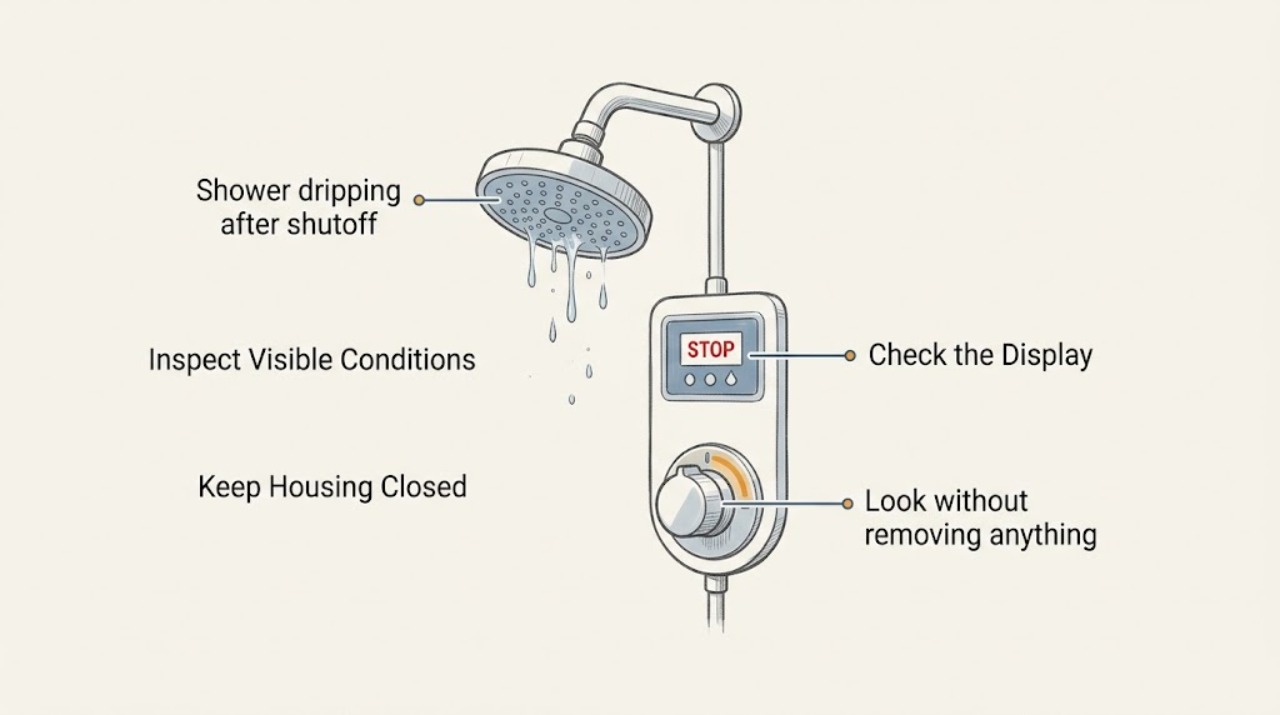
Work through in order
Diagnostic checks
Use only checks that match the exact appliance or system and its official guide.
-
Check 1
After one normal shower shutoff, watch the shower head from a dry, stable position and note whether the drops taper off or continue at a similar rate. Do not repeatedly cycle a stiff control or try to make the drip stop by force.
Expected result: Drops that become less frequent and stop point toward residual water draining from the shower head or riser. A steady drip, a continuing thin stream, or a drip that returns after the head appeared empty is a different pattern.
Next step: If it tapers and stops with no other moisture, dry the visible area and monitor on the next normal use. If it remains steady or returns, record the pattern and continue with the location and control observations before calling a plumber.
Stop if: Stop using the shower and arrange service if the flow increases, does not taper, or leaves ongoing wetness outside the shower head.
Why this matters
Why: Tapering drain-down is usually not a valve failure. A persistent or recurring drip needs a valve or shower-faucet diagnosis rather than a timing guess.
-
Check 2
Look without removing anything to identify the exact wet point: shower-head spray openings, the exposed head-to-arm connection, tub spout or diverter, handle or trim, or the wall and ceiling around the fixture.
Expected result: Moisture only at the spray openings after use supports drain-down. Water at a connection while the shower is running, at the handle or trim when off, or outside the fixture points to a different leak path.
Next step: Take a clear photo from the room side and tell the plumber exactly where the first wet point appears. Do not remove trim or open the wall to look for the source.
Stop if: Stop the inspection and stop using the fixture if water reaches the wall, ceiling, floor outside the wet area, or an adjacent room.
Why this matters
Why: The source location separates a shower-head or exposed seal issue from a valve, diverter, or concealed plumbing issue. A wet wall or ceiling cannot be safely diagnosed from the room side alone.
-
Check 3
Observe the control's normal closed position and note whether it is a single handle, separate hot and cold handles, or a tub/shower diverter. Without forcing or disassembling it, note any unusual looseness, hard movement, incomplete-feeling closure, or water from the handle area.
Expected result: A control that closes normally but still drips continuously is different from one that feels misaligned or cannot reach its normal off position. A shower head that drips while a tub spout or another outlet is selected can involve the valve or diverter rather than residual water.
Next step: Record the handle arrangement, visible brand or model marking, and which outlet was selected. Give those details to the manufacturer or plumber instead of ordering a cartridge from a generic photograph.
Stop if: Do not force a handle, remove a trim plate, or continue using the fixture if the control binds, leaks around the handle, or changes the leak into a stream.
Why this matters
Why: Control behavior helps a professional choose whether to investigate a cartridge, valve, diverter, or trim-seal path. It does not identify a replacement part by appearance alone.
-
Check 4
Check the surrounding dry surfaces for a new stain, soft-looking finish, pooled water, or moisture that appears when the shower has not recently been used. Keep this check at the visible surface; do not probe, drill, or open the wall.
Expected result: No surrounding moisture with a brief tapering drip supports a localized drain-down symptom. A stain, recurring dampness, or moisture that spreads beyond the fixture raises concern for a concealed connection or valve leak.
Next step: Stop using the shower and contact a plumber promptly; provide photos, when the moisture appears, and whether it changes after the shower is shut off. Do not attempt concealed-pipe repair.
Stop if: Treat active flow, ceiling bubbling, electrical-area moisture, or water entering another room as urgent: keep clear of the affected area and seek prompt professional help.
Why this matters
Why: Visible building moisture changes this from a nuisance drip to a water-damage risk, even if the shower head itself is only dripping slowly.
Use your observations
Decision map
Find the observation that best matches what you see, then follow the next safe action.
-
PATH 01Next step
What you see
The drops taper off and stop after one normal shutoff, and no other wet point is visible.
Do this next
Treat it as likely residual drain-down. Dry the visible surface, avoid unnecessary part replacement, and monitor whether the same tapering pattern occurs on the next normal use.
-
PATH 02Next step
What you see
The shower head continues dripping steadily, the drip returns after it stopped, or water remains present when the shower has not been used.
Do this next
Stop using the shower and arrange a plumbing diagnosis. A valve or cartridge may not be sealing, but the correct part cannot be selected without identifying the valve and confirming the leak path.
-
PATH 03Next step
What you see
Water appears at the handle, trim, tub spout or diverter, wall, ceiling, floor outside the wet area, or an adjacent room.
Do this next
Treat it as a possible connection, valve, or concealed leak. Stop use, protect nearby belongings without disturbing the plumbing, and seek prompt professional service.
-
PATH 04Next step
What you see
The control is hard to turn, will not reach its normal closed position, or requires force.
Do this next
Do not force or disassemble it. Stop use and tell the plumber the control behavior, fixture type, and exact leak location.
Helpful context
Understand the symptom
What the pattern usually means
The useful distinction is tapering drain-down versus a continuing supply leak. A shower head can retain water after shutoff, so a short series of drops that steadily becomes less frequent is different from a drip that continues at a similar rate or starts again later. The fixture design and installation affect how long drain-down lasts, so use the trend and the source location rather than an arbitrary time limit.
Stay within a safe inspection boundary
Keep the inspection visual and observational. Do not remove the handle, escutcheon, cartridge, shower arm, or wall covering, and do not apply force, caustic cleaner, or an uncontrolled water shutoff procedure. Valve and concealed-pipe work should be isolated and diagnosed by a qualified plumber using the fixture's model information.
Only after diagnosis
Potential parts
- shower cartridge
Consider this only if a professional identifies a persistent off-position drip as a failed cartridge and confirms the valve family and model.
Cartridges are not universal; confirm the exact valve manufacturer, series, and model before ordering. - shower head washer
Consider this only when the visible leak is at the exposed shower-head connection and the fixture documentation identifies a replaceable washer or seal.
Match the washer to the connection and fixture documentation; a connection seal will not correct a valve leak that continues with the water off. - shower valve repair kit
Consider a repair kit only after the valve or diverter fault and the required service parts have been identified by model-specific diagnosis.
Verify the valve series and included components before purchase; do not assume a kit fits from appearance or handle style alone.
When checks do not resolve it
Need a professional?
Call a qualified plumber for a drip that persists or returns after drain-down, a leak at the handle or trim, a hard-to-operate control, or any wall, ceiling, floor, or adjacent-room moisture. Active flow or expanding water damage warrants prompt service.
Have this ready
- Provide the fixture brand or model marking if visible, handle and outlet arrangement, whether the drops taper or stay steady, the exact first wet point, photos, and whether moisture appears when the shower has not been used.
Common questions
FAQ
Is a shower head dripping briefly after shutoff normal?
It can be. A shower head may empty retained water after the valve closes. A tapering pattern that stops is less concerning than a steady or recurring drip, and fixture layout means there is no universal time limit.
What if the drip continues after the shower has emptied?
Stop using the shower and arrange a plumbing diagnosis. A valve, cartridge, diverter, connection, or concealed leak may be involved; do not choose a replacement part until the valve and leak path are identified.
Does a drip from the tub spout mean the shower head is defective?
Not necessarily. The outlet and diverter behavior can point to a valve or diverter path rather than the shower head itself. Note which outlet was selected and where the first water appears for the plumber.
Should I remove the shower handle or open the wall to find the leak?
No. Keep this check visual and stop if water reaches the wall, ceiling, floor outside the wet area, or another room. Concealed valve and pipe work should be isolated and handled by a qualified plumber.
Read the exact guide
Official sources
- Shower Faucet: Leaking- Standard ValveMoen Solutions · Manufacturer example that continuous dripping with a control in the off position can indicate a valve cartridge issue, while outlet-specific symptoms can involve a diverter; model-specific diagnosis is required.
- How to Fix a Leaky Shower HeadDelta Faucet · Supports distinguishing brief post-shutoff dripping from persistent leaking and checking the visible source location; the article's repair procedures are not reproduced here.
- Shower Faucet: Leaking-M-Core 4 Series ValveMoen Solutions · Supports separating a continuous shutoff leak from a concealed leak and considering installation history; details are specific to that valve family and are not generalized as a repair procedure.
- After turning off my shower, water continues to drip from the shower head for a minute or so. Is something wrong?Delta Faucet · General explanation that a shower head may empty its retained water after shutoff; use the tapering pattern as context, not as a universal time limit.
Community feedback
Share a repair observation
Share a plain-text repair observation. Accepted observations are published automatically; this page may take a moment to update.