
On this page
Start here
Quick answer
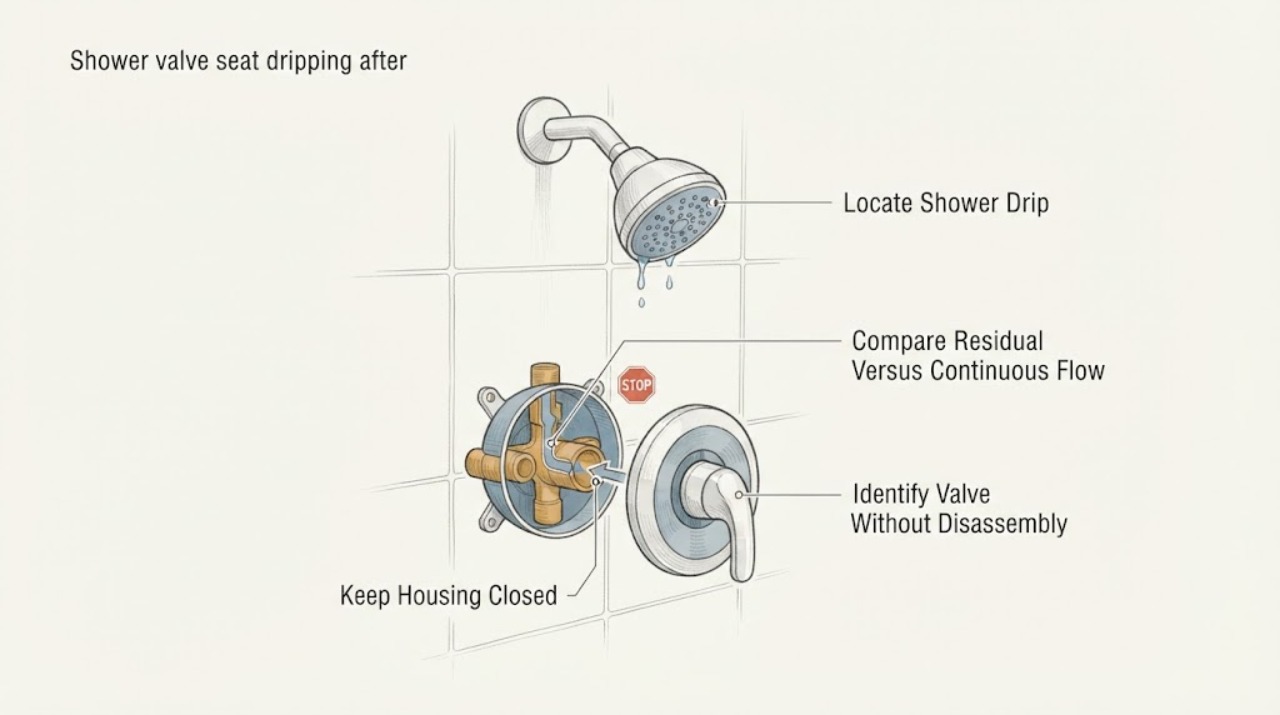
A shower that drips after shutoff usually has water passing the valve's internal sealing parts, but the visible drip does not identify the correct cartridge, seat, washer, or valve body. Confirm that the water is coming from the shower outlet rather than the handle, trim, wall, or tub diverter, note whether it is a few residual drops or a continuous stream, and identify the faucet brand and model from existing markings or paperwork. If the drip is continuous, concealed behind the wall, damaging finishes, or cannot be isolated safely, close the accessible water supply only if you know it and can reach it without a hazard, then arrange plumbing service. Do not remove trim or valve parts until the water is shut off and the correct service procedure is known.
Before you begin
Safety first
- The article provides observation and water-isolation guidance only. The plumber determines the valve design, failed seal, compatible part, and repair procedure.
Work through in order
Diagnostic checks
Use only checks that match the exact appliance or system and its official guide.
-
Check 1
After the shower control is turned fully off, observe the showerhead or tub spout, handle, trim plate, and wall from a dry standing position; do not remove the trim or put a finger into the outlet.
Expected result: Water may stop after residual drops, continue as a slow drip or stream from the outlet, appear around the handle or trim, or emerge from the wall or ceiling below.
Next step: Photograph the location, note how long water continues after shutoff, and arrange plumbing assessment if dripping persists or any concealed moisture is visible.
Stop if: Stop if water is entering the wall, ceiling, floor, or electrical area, if finishes are soft or damaged, or if closer inspection would require removing trim or opening a surface.
Why this matters
Why: Outlet-only dripping suggests the closed valve is allowing water through, while handle, trim, wall, or ceiling moisture suggests a different sealing or concealed-pipe path. The location alone cannot identify the replacement part.
-
Check 2
Without operating the fixture repeatedly, observe whether the outlet gives a few declining drops or maintains a steady drip or stream after the control has been off; use a container only if it can be placed without touching the valve or creating a slip hazard.
Expected result: The flow may stop quickly, decline slowly, remain steady, increase, or return whenever the supply is used elsewhere.
Next step: Record duration and pattern, limit shower use until assessed if the flow is continuous, and request a plumber when the symptom repeats.
Stop if: Stop for a continuous stream, an inability to contain water safely, a wet floor, or any need to operate hidden shutoffs or dismantle the control.
Why this matters
Why: A short declining release can be residual water in the outlet path, while steady or recurring flow means the system is still supplying water past a seal or has another leak path. This observation is not a test of valve condition.
-
Check 3
Read any brand, model, series, or date marking that is already visible on the handle, trim, fixture paperwork, or accessible exterior; do not remove the handle, escutcheon, retaining nut, cartridge, seat, or spring to look for a number.
Expected result: The fixture may have a clear brand and series, only a partial marking, no visible identification, or a previous repair record.
Next step: Save the markings and photos, include the fixture age and prior work if known, and ask the plumber to verify compatibility before ordering a cartridge, seat, or kit.
Stop if: Stop if identification requires prying, loosening screws, scraping a finish, entering the wall, or exposing the water-control body.
Why this matters
Why: A complete identification can narrow compatible repair categories, but a partial name or similar-looking trim does not prove the valve body or internal parts. No marking means the plumber may need to identify it during service.
-
Check 4
If the dedicated shower supply shutoff is clearly identified and reachable from a dry, safe position, note whether closing it changes the drip; otherwise leave the controls alone and record the home's accessible main-shutoff location for the plumber.
Expected result: The drip may stop, reduce, continue, or be impossible to isolate without shutting water to the home or entering an inaccessible area.
Next step: Keep the area dry, note which shutoff was used and the result, and arrange plumbing service with the photos, valve identity, and flow pattern.
Stop if: Do not force a stuck valve, work on a main shutoff you cannot identify, or remove plumbing parts while water pressure remains.
Why this matters
Why: A change after a known supply isolation supports a pressurized shower-valve path but does not distinguish the internal seal or confirm that the shutoff is fully closed. Continued flow may indicate another supply, crossover, or concealed leak.
Use your observations
Decision map
Find the observation that best matches what you see, then follow the next safe action.
-
PATH 01Safety boundary
What you see
Does the outlet release only a short series of declining drops and remain dry afterward, with no handle, trim, wall, or ceiling moisture?
Do this next
Document the event and monitor whether it recurs or becomes continuous; arrange service if the pattern changes or water is wasted repeatedly.
Why this path and its safety boundary
Safety stop: Do not assume a continuous drip is harmless or attempt to mask it with a cap or caulk.
-
PATH 02Safety boundary
What you see
Does water continue steadily from the shower outlet after shutoff?
Do this next
Limit use, close a clearly identified local supply if safe, and arrange plumbing service to verify the valve and internal seal.
Why this path and its safety boundary
Safety stop: Do not disassemble the valve while the supply is on or without the correct model-specific procedure.
-
PATH 03Safety boundary
What you see
Is there staining, soft drywall, damp trim, a wet floor, or water emerging behind the handle or wall?
Do this next
Stop using the shower, close the known accessible supply if safe, protect the area from further wetting, and request prompt plumbing and water-damage assessment.
Why this path and its safety boundary
Safety stop: Do not open the wall, remove tile, or seal over the moisture before the source is found.
-
PATH 04Safety boundary
What you see
Can you identify the valve and isolate its water supply without removing parts or entering an unsafe area?
Do this next
Give the plumber the marking, shutoff result, photos, and flow duration so the correct repair category can be verified.
Why this path and its safety boundary
Safety stop: Do not force an unknown shutoff, enter a wall or crawlspace, or guess a cartridge or seat from appearance.
Helpful context
Understand the symptom
Confirm what is actually dripping
A small amount of water can remain in the shower riser or head after use, but continued dripping after the control is fully off points toward a valve-sealing or related plumbing condition. Water at the handle, escutcheon, or wall has a different path and may indicate a concealed leak. EPA WaterSense treats leaking valves and fixtures as household leaks worth addressing, while manufacturer parts guidance shows that the matching repair part depends on the valve design and model.
Use observation before choosing a part
Look at the outlet, handle, trim plate, and wall only from normal safe positions. Do not use a guessed cartridge or washer: seats, springs, cartridges, and repair kits are not interchangeable across all shower valves. Record markings and photographs, then let the plumber verify the valve family and shutoff arrangement before disassembly.
Protect the wall and stop concealed leaks early
A drip that appears only at the outlet may waste water without wetting the wall, but moisture around the handle or trim can enter the wall cavity. Persistent flow, staining, soft finishes, or a leak that continues after a known local shutoff is closed calls for prompt plumbing assessment. Keep the area dry and do not caulk over an active leak.
Only after diagnosis
Potential parts
- shower cartridge
Consider this category only if the plumber identifies a cartridge-style valve and confirms that the cartridge is the source of the shutoff drip.
Match the exact valve brand, series, configuration, and dimensions; similar trim does not establish cartridge compatibility. - shower head washer
Consider this category only if inspection shows a connection washer leak at the showerhead rather than water passing through the closed valve.
Confirm connection size and washer material with the fixture instructions or plumber; a washer cannot correct a valve-seat or concealed-pipe leak. - shower valve repair kit
Consider this category only after the valve design and failed sealing component are identified; a kit may contain seats, springs, seals, or other model-specific pieces.
Use the manufacturer's fit information and the plumber's identification before ordering; do not assume a universal kit fits a concealed valve.
When checks do not resolve it
Need a professional?
Arrange plumbing service for a steady or recurring drip after shutoff, water around the handle or wall, staining or soft finishes, a failed or unknown shutoff, inability to identify the valve, or any symptom that requires disassembly. Escalate promptly for active concealed leakage or water damage.
Safety scope: The article provides observation and water-isolation guidance only. The plumber determines the valve design, failed seal, compatible part, and repair procedure.
Have this ready
- Where water appears: outlet, handle, trim, wall, ceiling, or floor
- Whether flow stops, declines, or remains continuous after shutoff
- Visible brand, series, model markings, fixture age, and prior repair history
- Photos from safe positions and any staining, dampness, or finish damage
- Which known shutoff was closed and whether the drip changed
Common questions
FAQ
Could a few drops after turning off the shower be normal?
A short, declining release can be residual water in the outlet path. A steady, recurring drip, water at the handle or wall, staining, or a stream that does not decline should be assessed by a plumber rather than dismissed.
Is a dripping shower valve always a bad cartridge?
No. Possible paths include a valve cartridge or seat, a connection washer, a diverter, a concealed connection, or another valve issue. Identify where the water appears and verify the valve model before selecting a part.
Can I replace the shower cartridge while water is still on?
No. Valve service requires the relevant water supply to be shut off and verified, and the correct procedure depends on the model. If the shutoff is unknown, inaccessible, or stuck, leave the fixture intact and arrange plumbing service.
When is a shower drip an urgent plumbing problem?
Treat continuous flow, water behind the trim or wall, staining or soft finishes, an active floor leak, an inability to isolate water, or damage near electrical equipment as reasons for prompt professional help and limited fixture use.
Read the exact guide
Official sources
- Shower Faucet: Leaking-M-Core 4 Series ValveMoen · Used only as an official example that a shutoff drip can have different causes in new versus existing installations and that the water supplies must be off before valve service; it is not model guidance for this unidentified shower.
- Repair Parts that can Fix Leaks in Bath Tub/ShowerDelta Faucet · Supports the model-dependent distinction among shower repair kits, seats, springs, seals, and cartridges; the article does not claim that Delta parts fit an unidentified valve.
- Home MaintenanceU.S. Environmental Protection Agency WaterSense · Supports prompt attention to leaking valves and fixtures and the use of observation or a professional when the source is uncertain.
- Bath and Shower DivertersU.S. Environmental Protection Agency WaterSense · Supports the distinction between fixture diversion leakage and water waste; it is not used as a universal allowable-drip rule for every shower valve.
Community feedback
Share a repair observation
Share a plain-text repair observation. Accepted observations are published automatically; this page may take a moment to update.