
On this page
Start here
Quick answer
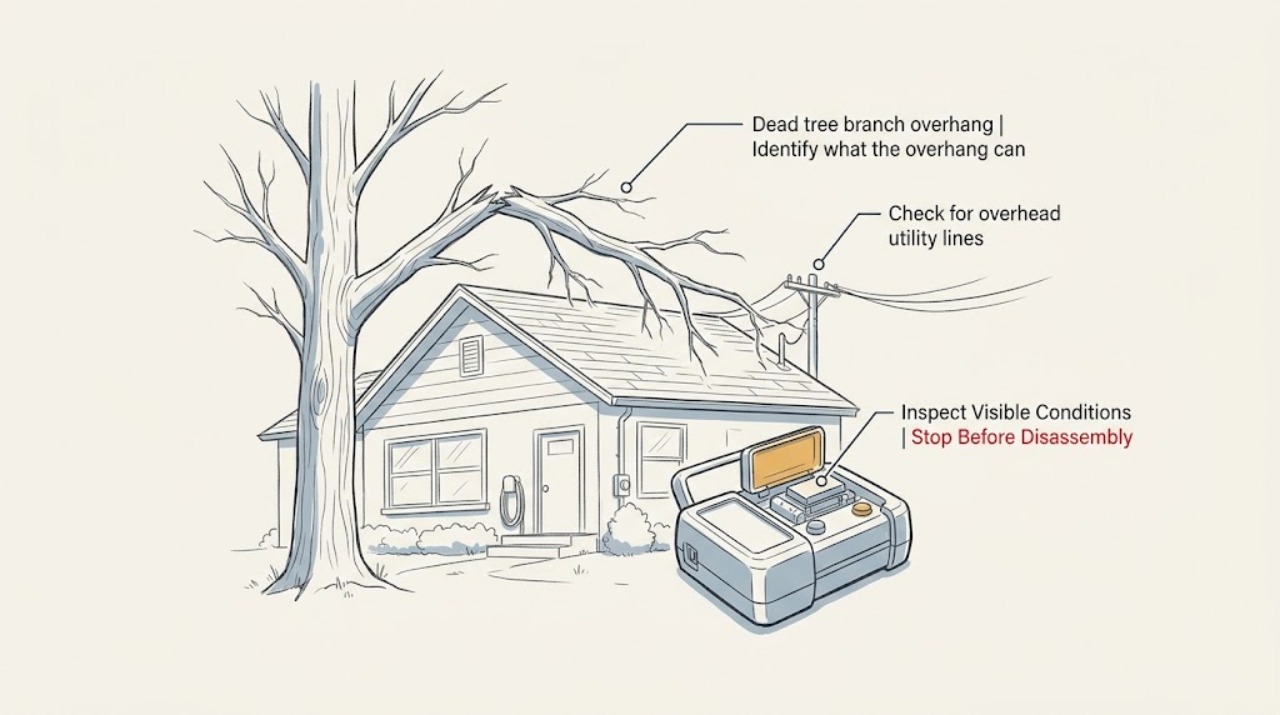
Treat a dead branch hanging over a roof or other occupied area as a falling-object hazard, not a routine pruning job. Keep people, pets, vehicles, and movable items out of the drop zone, and do not climb, use a ladder, or cut the branch yourself. From a safe position on the ground, note whether power lines, cracks, a leaning trunk, or recent movement are involved. If the branch is above ground reach, over a structure, near wires, moving in wind, or attached to a tree with decay, stop the inspection and arrange qualified tree-removal help. If any line may be involved, contact the utility first.
Work through in order
Diagnostic checks
Use only checks that match the exact appliance or system and its official guide.
-
Identify what the overhang can hit
From a distant ground position, identify the roof, vehicles, driveway, sidewalk, play area, fence, or other target beneath or close to the branch's apparent fall path.
Expected result: A target is within the apparent fall path, or the branch is suspended, split, lodged, or touching another limb.
Next step: Keep the area closed and request qualified tree-care assessment; do not pull, shake, support, or lower the branch.
Stop if: Stop if seeing more would require entering the drop zone.
Why this matters
Why: A dead branch plus a target is a falling-object hazard, and a suspended or lodged branch can shift without warning.
-
Check for overhead utility lines
From the ground and well away from the tree, scan for electrical or other overhead utility lines, service drops, poles, or equipment.
Expected result: A line is present, its clearance is uncertain, or the branch may contact it; or no line is visible from the safe viewing position.
Next step: For yes or uncertain, contact the local utility first and use qualified tree-care help; for no visible line, continue only with distant ground observation.
Stop if: Stop if anything would come near a line.
Why this matters
Why: A present or uncertain line makes this specialized utility-line tree work; a clear view still does not authorize cutting.
-
Look for signs that the tree or attachment is failing
From several safe ground-level angles, look for cracks, missing bark, cavities, visible decay, a leaning trunk, raised soil, or a branch that changes position.
Expected result: Any crack, cavity, decay, weak-looking attachment, leaning or shifted tree, or multiple dead branches is visible; or no obvious defect is visible from the safe distance.
Next step: Keep the area closed and give the professional the observed defect or the limitation of the inconclusive view; do not cut based on appearance alone.
Stop if: Stop if movement, falling bark or wood, or cracking occurs.
Why this matters
Why: Visible defects increase failure concern, while no visible defect cannot prove that hidden decay or internal damage is absent.
-
Check whether conditions are changing
From shelter or a safe distant position, note wind, lightning, icing, heavy rain, recent storm damage, or new branch or trunk movement.
Expected result: Changing or severe weather or new movement is present; or conditions are calm and unchanged.
Next step: Stay clear during changing conditions; in calm conditions, schedule qualified tree-care service and share the observations.
Stop if: Do not approach during wind, lightning, ice, or after fresh movement.
Why this matters
Why: Changing conditions can make a marginal branch fail and can make tree work hazardous; calm conditions only make observation easier.
Helpful context
Understand the symptom
Secure the area before looking closer
Stay outside the area where the branch could fall, and keep others out as well. If it is safe to do so without approaching the tree, move a patio item or vehicle that is clearly outside the danger zone; do not walk beneath the branch to retrieve anything. Temporary barrier tape can mark a no-entry boundary, but it does not make the tree safe. Do not brace the branch with rope, wire, or other improvised supports.
What to tell the tree-care professional
Provide the address or access point, the target below the overhang, whether the branch is dead, broken, suspended, or touching another limb, the approximate direction of the overhang, any visible cracks or decay, recent weather, and whether utility lines are present or uncertain. Ask for a ground-based hazard assessment and a controlled removal plan. Local permits, property boundaries, and utility easements vary, so the professional or relevant authority must confirm those details.
Only after diagnosis
Potential parts
- barrier-tapeNo tree or model compatibility claim; use local signage or barriers as appropriate.
When checks do not resolve it
Need a professional?
Call now when the branch could hit people or property, has shifted or cracked, is above ground reach, or the tree is over or adjacent to power lines. Contact the local utility first when a line may be involved.
Common questions
FAQ
Can I remove a dead branch that hangs over my roof myself?
Do not climb, use a ladder, or cut it yourself when it is above ground reach, over a roof, suspended, cracked, or close to a line. Keep the area empty and arrange qualified tree-care service.
What if no power line is visible?
Continue only with a distant, ground-level visual check. A clear view does not prove the tree is sound; a dead overhang above a structure still warrants professional assessment, and any uncertain line clearance should be treated as a utility hazard.
Should I tie or brace the branch while waiting?
No. Improvised rope, wire, cable, bolts, or other supports can create another hazard and do not establish that the tree is safe. Mark the exclusion zone and wait for qualified help.
What observations help the professional decide what to do?
Share the target below the branch, its approximate direction and height, any crack, cavity, decay, leaning, fresh movement, recent weather, and the presence or uncertainty of utility lines.
Read the exact guide
Official sources
- Line-Clearance Tree Trimming OperationsOccupational Safety and Health Administration · Determining when a dead branch overhang is a utility-line hazard
- Managing Risk In Urban TreesNew York State Department of Environmental Conservation · Ground-level observations around a dead branch over a structure or occupied area
Community feedback
Share a repair observation
Share a plain-text repair observation. Accepted observations are published automatically; this page may take a moment to update.