
On this page
Start here
Quick answer
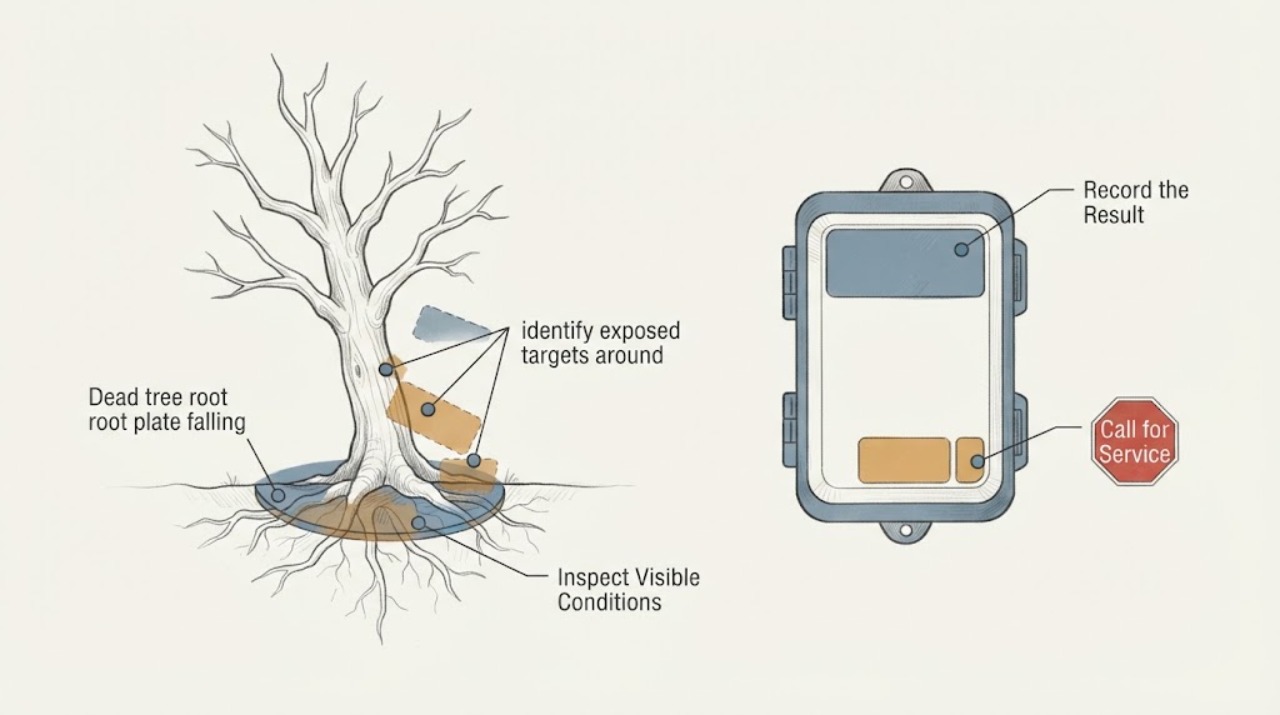
Treat a lifted root plate or root wad on a dead tree as an urgent, unstable hazard. Keep people, pets, vehicles, and equipment well away; do not approach the root plate, climb the tree, cut the trunk, pull it with rope or a vehicle, or try to push it back. From a safe location, look for power lines, roads, buildings, and other exposed targets, establish a visible exclusion boundary without entering the hazard area, and call a qualified hazardous-tree removal professional. If a line, structure, roadway, or person is immediately threatened, use the appropriate utility or emergency response instead of attempting a home removal.
Work through in order
Diagnostic checks
Use only checks that match the exact appliance or system and its official guide.
-
Check 1
From an established safe location, look at the tree and root plate without walking closer, touching soil or roots, stepping over the trunk, or standing beneath hanging limbs.
Expected result: Record whether the root mass is lifted, tilted, cracked, or partly detached; whether the trunk is still attached; and whether branches remain hung up or move in wind.
Next step: Keep everyone outside the hazard area and tell the tree-removal professional exactly what is visible from the safe location.
Stop if: Stop the observation and move farther away if the root plate shifts, soil cracks grow, branches move, wind increases, or you cannot maintain a clear escape route.
Why this matters
Why: Any lifted or partly detached root plate, leaning trunk, hanging limb, or fresh soil crack means the tree and root mass must be treated as unstable, not as a normal fallen log.
-
Check 2
From the same safe position, identify exposed targets around the tree without entering the possible fall or roll area: overhead or downed lines, buildings, fences, roads, paths, vehicles, play areas, and neighboring property.
Expected result: Note whether the trunk, root plate, or any limb is near a utility line or could reach a structure, public route, occupied area, or parked vehicle if it shifts.
Next step: Keep people out, contact the relevant utility or emergency authority for an immediate line or roadway threat, and tell the tree professional about every target.
Stop if: Do not approach, touch, move, or inspect a line or a tree touching a line. Assume a downed or contacted line may be energized.
Why this matters
Why: A utility or public-access conflict changes this from a private cleanup question to an urgent hazard-coordination problem; trees and limbs near lines can create electrical and struck-by hazards.
-
Check 3
Observe conditions from indoors or a safe ground position and record wind, rain, slope, nearby soil movement, and whether the root plate or trunk position changes over time; do not wait beside the tree to monitor it.
Expected result: Movement after a gust, rainfall, thaw, vibration, or a change in the surrounding soil indicates that the load or support is changing; no visible movement does not prove stability.
Next step: Pass the timing, weather, slope, and movement notes to the professional and keep the area closed until it has been assessed and made safe.
Stop if: Stop monitoring from outside if weather worsens, the tree or root mass moves, or you would need to enter the hazard area for a better view.
Why this matters
Why: A changing position or worsening soil separation increases the urgency and supports a wider exclusion area. A quiet period is not permission to approach or work on the tree.
-
Check 4
Confirm from a safe distance whether people, pets, vehicles, or routine foot traffic can still reach the area, and keep them away without entering the tree's possible movement zone.
Expected result: If the area can be closed from an existing safe access point, use a visible barrier or warning marker at that safe perimeter and redirect people; if it cannot be closed, keep watch from a protected location and request urgent assistance.
Next step: Tell the removal professional and any relevant authority that the area cannot be reliably isolated, including nearby access routes and occupied spaces.
Stop if: Do not cross the safe perimeter to place a marker, move a vehicle, retrieve property, or rescue an animal; request emergency help if someone is in danger.
Why this matters
Why: An unmanageable exclusion area is an immediate public-safety problem. Barrier tape is only a visual warning and does not stabilize a root plate or make entry safe.
-
Check 5
Create a service handoff from a safe location with wide photos or video, the tree's position, visible root-plate condition, nearby targets, utility proximity, access constraints, weather, and any movement observed.
Expected result: A complete distant record lets the professional plan a site assessment and bring the appropriate crew and equipment without asking the homeowner to approach the tree for details.
Next step: Request urgent professional tree-removal assessment and keep the exclusion boundary in place until the hazard is removed or formally controlled.
Stop if: Do not climb, use a ladder, start a saw, attach rope or cable, pull with a vehicle, push the root plate, or cut any part of the tree.
Why this matters
Why: The information supports urgent triage but does not determine a safe cutting, rigging, pulling, or lifting method from a photo.
Use your observations
Decision map
Find the observation that best matches what you see, then follow the next safe action.
-
PATH 01Safety boundary
What you see
The root plate, trunk, or a limb is touching or near an overhead line, a downed line, or electrical equipment.
Do this next
Stay away, keep others away, and contact the utility or emergency authority from a safe location. Tell the tree professional that electrical hazards are present; do not assume a line is de-energized.
Why this path and its safety boundary
Safety stop: Do not touch the tree, root plate, line, fence, puddle, or any equipment connected to the scene.
-
PATH 02Safety boundary
What you see
The tree or root plate threatens a building, road, occupied area, vehicle, or another person's property, or the exclusion area cannot be maintained.
Do this next
Treat the situation as urgent. Move people and vehicles away only from a safe route, request emergency or authority assistance when needed, and arrange a qualified hazardous-tree removal assessment.
Why this path and its safety boundary
Safety stop: Do not enter the fall or roll zone to move belongings, open a blocked route, or create a closer barrier.
-
PATH 03Safety boundary
What you see
The root plate is lifted or cracked, the trunk remains attached, the tree is leaning, or hanging limbs are present even without a visible utility conflict.
Do this next
Keep a wide exclusion area and call a qualified tree-removal professional for urgent assessment. Provide distant photos and the observed movement or weather context.
Why this path and its safety boundary
Safety stop: Do not treat the tree as stable because it has not moved recently, and do not approach to test it.
-
PATH 04Safety boundary
What you see
The tree appears to be only a settled log and the soil, root plate, trunk, and overhead canopy are fully stable and outside occupied areas.
Do this next
Still request professional confirmation before moving or cutting it if there is any doubt about hidden tension, loose limbs, or the root mass. Maintain distance until the site is assessed.
Why this path and its safety boundary
Safety stop: Stop and widen the exclusion area if a hidden root plate, movement, unstable limb, utility conflict, or changing weather is noticed.
Helpful context
Understand the symptom
A root plate is the ball of roots and soil pulled from the ground when a tree uproots. It can move or spring back when the trunk, soil, or surrounding load changes, and a dead tree may also have loose limbs or weakened wood. The tree can therefore remain dangerous even when it appears to be resting. OSHA identifies root-system damage, lean, dead limbs, and falling-object exposure as hazards that require a work-site assessment by trained tree-care personnel.
The useful homeowner role is limited to distant observation, keeping the area clear, and giving an accurate handoff. Do not enter the possible fall zone to measure the root plate, inspect the underside, attach a line, stabilize the trunk, or remove branches. A professional crew must choose the access, equipment, and removal plan after assessing tension, overhead hazards, utilities, terrain, and targets.
Only after diagnosis
Potential parts
- barrier-tape
Use only as a visible warning at an already safe perimeter when the area can be isolated without approaching the root plate; it does not secure, brace, or stabilize the tree.
Choose a visible warning product suitable for the site, and do not enter the hazard area to install or retrieve it. Professional or authority direction takes priority.
When checks do not resolve it
Need a professional?
Arrange urgent professional hazardous-tree removal assessment for any lifted, cracked, moving, or partly detached root plate, leaning dead tree, hanging limb, or tree near a structure, road, occupied area, or utility. Contact the utility or emergency authority first for an immediate line, roadway, fire, injury, or public-safety threat.
Common questions
FAQ
Can I push the root plate back into the ground?
No. A lifted root plate can shift or spring back, and pushing it can change the forces on the trunk and roots. Keep away and have a qualified tree-removal professional assess it.
Is a dead tree with a root plate safe if it has stopped moving?
No. A quiet period does not prove that the root mass, trunk, soil, or hanging limbs are stable. Maintain the exclusion area until a professional assesses and controls the hazard.
What if the tree is close to a power line?
Stay away and treat the line as energized. Keep others away and contact the utility or appropriate emergency authority from a safe location before any tree-removal activity.
What should I send a tree-removal professional?
Send distant photos and the location, visible root-plate condition, lean or movement, weather and slope, nearby structures or routes, utility proximity, and whether the area can be kept clear. Do not approach for a closer photo.
Read the exact guide
Official sources
- Tree Trimming Safety Fact SheetOccupational Safety and Health Administration · Supports hazard assessment and keeping clear of downed trees and energized lines; it is not a DIY removal manual.
- Inspection Guidance for Tree Care and Tree Removal OperationsOccupational Safety and Health Administration · Supports professional site and hazard assessment, fall/falling-object awareness, and electrical-line separation; it does not authorize homeowner tree work.
- Uprooted Trees: Teacher's Notes and ScriptOccupational Safety and Health Administration · Supports the warning that an uprooted root mass can fall or whip upright when the trunk is released; cutting instructions are outside this homeowner article.
- 1910.266 - Logging operationsOccupational Safety and Health Administration · Supports treating root-system damage, lean, dead limbs, lodged trees, root wads, and spring poles as professional work hazards; it is not a homeowner removal procedure.
Community feedback
Share a repair observation
Share a plain-text repair observation. Accepted observations are published automatically; this page may take a moment to update.