
On this page
Start here
Quick answer
Treat a dead, badly leaning, storm-damaged, or freshly shifting tree as an urgent falling-object hazard. From a safe location, keep people, pets, vehicles, and bystanders outside a conservative exclusion zone around the possible fall path; do not approach, touch, strike, climb, cut, or use a ladder to inspect it. If the tree or a limb threatens a structure, road, occupied area, or power line, leave the area and contact the appropriate emergency, utility, or qualified tree-removal service. A qualified professional must set the work zone and removal method.
Work through in order
Diagnostic checks
Use only checks that match the exact appliance or system and its official guide.
-
Check 1
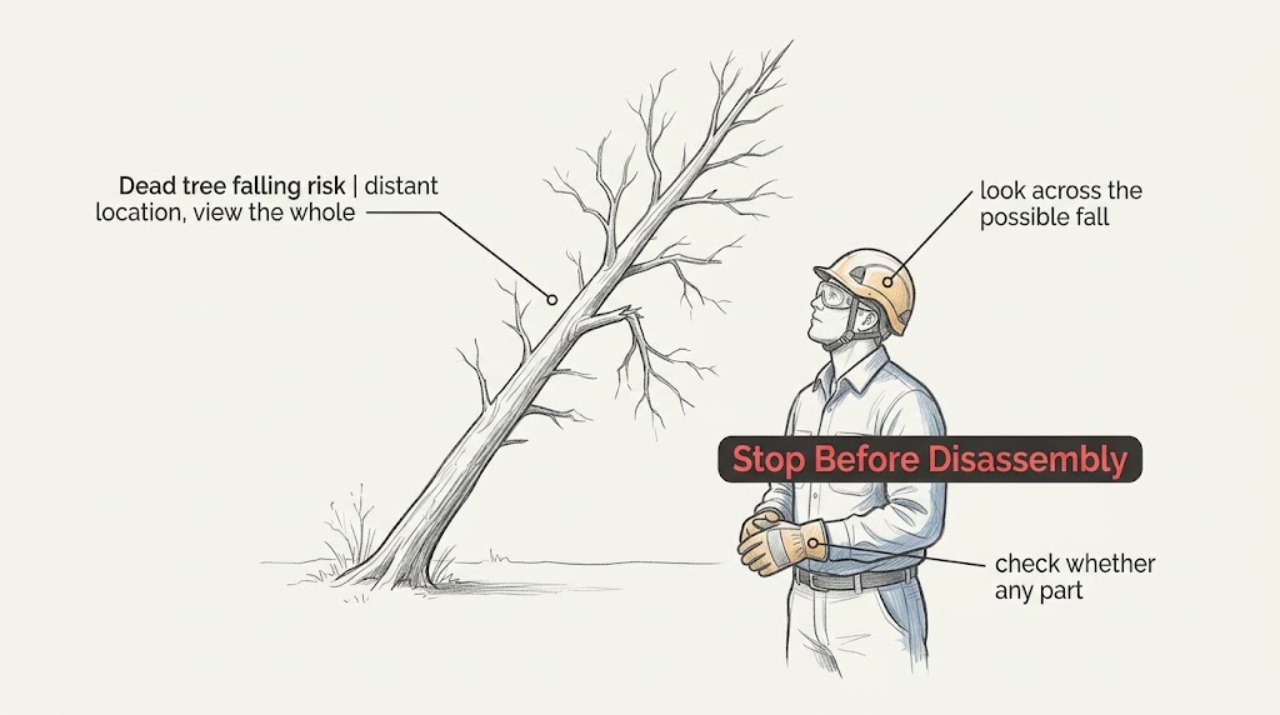
From a safe, distant location, view the whole tree and its base with your eyes or a camera zoom; do not approach, touch, strike, climb, cut, or use a ladder.
Expected result: Note whether the crown is sparse or broken, a large limb or top is hanging, the trunk is leaning more than before, the soil or root plate appears lifted, or fresh cracks and fallen bark are visible.
Next step: Keep the area empty and request urgent qualified tree-removal assessment; if the tree is moving or failing now, leave the area and use the appropriate emergency route.
Stop if: Stop observing and move farther away if wind, cracking, falling material, or movement occurs; never move closer to improve the view.
Why this matters
Why: Any new movement, lifted roots, fresh split, hanging section, or worsening lean is an urgent change rather than a repair opportunity.
-
Check 2
From outside the suspected fall area, look across the possible fall path without entering it and list every target that could be struck.
Expected result: Check for a home, garage, road, driveway, vehicle, play area, walkway, neighboring property, or overhead utility line in or near the path; do not measure the tree, test it, or stand beneath it.
Next step: Keep people, pets, and vehicles out of the area and give the professional the target list and a safe photo location so the work zone can be set correctly.
Stop if: Stop and leave if the tree is touching a line, a limb is suspended, the ground is shifting, or you cannot remain well outside the possible fall area.
Why this matters
Why: A target in the path raises the consequence and requires urgent professional planning; a clear-looking path does not prove the tree is safe.
-
Check 3
From a safe position, check whether any part of the tree is contacting or close to an overhead power line; do not approach the line, tree, or fallen limb.
Expected result: If contact, arcing, a damaged line, or uncertain clearance is visible, treat the area as energized; if no line is visible, still report nearby lines and do not assume clearance.
Next step: Keep everyone away, leave the area if it is unsafe, and contact the utility or emergency service for an active line hazard; tell the qualified tree service about the line before any visit.
Stop if: Stop immediately if you see sparks, smoke, a downed line, or a line moving against the tree; do not touch anything nearby.
Why this matters
Why: A line-related tree hazard needs utility coordination and professional controls, not a homeowner inspection or removal attempt.
-
Check 4
From outside the exclusion area, observe whether conditions are changing while you arrange help; use only a safe existing boundary or place visible barrier tape without approaching the hazard.
Expected result: Watch for wind, creaking, falling bark or limbs, a fresh crack, increasing lean, or people and animals entering the area.
Next step: Move people and pets to a safe location, keep vehicles away, and relay the change to the service or emergency contact without returning to inspect.
Stop if: Stop all observation and shelter away from the tree if the tree moves, parts fall, or severe weather is present.
Why this matters
Why: A changing condition means the exclusion zone must remain empty and the call should be treated as urgent; a quiet period does not make the tree safe.
-
Check 5
Prepare a remote handoff for the qualified tree professional using the address, safe access information, tree location, visible targets, recent weather, and distant photographs.
Expected result: Record whether the tree is standing, lodged, partially fallen, or already on a structure or line, and whether anyone is in danger; do not move debris or attempt to free a lodged section.
Next step: Send only the information that can be collected safely and wait outside the exclusion area for professional instructions.
Stop if: Do not continue collecting details if it requires entering the possible fall area, handling the tree, or working near utilities.
Why this matters
Why: Accurate hazard details help the responder plan access and equipment, while a lodged or line-involved tree needs an urgent safety response.
Use your observations
Decision map
Find the observation that best matches what you see, then follow the next safe action.
-
PATH 01Next step
What you see
The tree or a limb is moving, the root plate is lifting, a fresh split is visible, or material is falling.
Do this next
Leave the area, keep everyone away, and use the appropriate emergency or urgent tree-removal contact; do not return to watch it.
-
PATH 02Next step
What you see
The possible fall path includes a structure, road, occupied area, vehicle, neighboring property, or play area.
Do this next
Maintain the exclusion zone and request urgent qualified tree-removal assessment, providing the target list and safe photos.
-
PATH 03Next step
What you see
The tree or debris contacts or may contact an overhead power line.
Do this next
Stay away and contact the utility or emergency service for the line hazard; do not approach until the utility and tree professionals make the area safe.
-
PATH 04Next step
What you see
The tree is lodged, partly fallen, or has a hanging section even if it is currently still.
Do this next
Treat it as unstable, keep people and pets out, and arrange professional removal without touching, pulling, cutting, or moving it.
-
PATH 05Next step
What you see
No immediate movement or target is visible from a safe distance.
Do this next
Keep the area controlled and schedule a professional assessment; a quiet appearance does not clear a dead tree for approach or removal.
Helpful context
Understand the symptom
Why a dead tree can become urgent
Dead standing trees can lose branches or fail at the trunk or roots, and storm damage can change the risk quickly. A tree that does not threaten a structure may sometimes be retained for habitat, but a dead tree that threatens a home or other structure should be assessed and removed promptly by a professional. Do not try to determine its stability by approaching it or applying force.
Keep the possible fall area empty
Use a safe, distant view to identify what could be struck: buildings, driveways, vehicles, play areas, paths, neighboring property, and overhead lines. Keep everyone and everything out of the possible fall area, and use a visible barrier only if it can be placed from outside that area without approaching the tree. There is no single distance that is safe for every tree; a qualified tree professional must establish the work and drop zones.
What the professional needs to know
When you call, report the tree's location, nearby targets, visible lean or root movement, hanging or broken limbs, recent storm or wind exposure, and any overhead utility lines. Zoomed photographs taken from a safe position can help with triage, but they do not replace an on-site hazard assessment. Tree-care work involves falling branches, falls, struck-by hazards, and electrical hazards, so leave climbing, rigging, cutting, and removal to trained professionals.
Only after diagnosis
Potential parts
- barrier-tape
Consider only a visible temporary barrier if it can be placed from a safe location outside the exclusion area and does not require approaching the tree.
Choose a weather-suitable, highly visible barrier for people and pets; it is only a warning aid and cannot make an unstable tree safe or replace professional controls.
When checks do not resolve it
Need a professional?
Call urgently when the tree is dead and threatens a structure, occupied area, road, vehicle, neighbor, or utility, or whenever movement, root lift, fresh splitting, hanging limbs, or partial failure is visible.
Have this ready
- Provide the address, a safe access point, tree location, nearby targets, overhead-line information, recent storm or wind conditions, and photographs taken from outside the exclusion area.
Common questions
FAQ
Can I push or tap a dead tree to see whether it is stable?
No. Applying force or approaching a dead or leaning tree can trigger failure and gives no reliable safety result. Observe only from a safe distance and arrange a professional assessment.
How far away should people stay?
Do not rely on one universal distance. Keep people, pets, and vehicles outside the possible fall area and have a qualified tree professional determine the exclusion and work zones for this tree and site.
What if the tree has already fallen or is resting on a line?
Do not touch, move, cut, or walk beneath it. Keep everyone away; contact the utility for a line hazard and use an urgent professional or emergency route for immediate danger.
Read the exact guide
Official sources
- Building biodiversity in your forest: Cavity trees, snags, and deadwoodUniversity of Minnesota Extension · The page distinguishes dead standing trees that do not threaten structures from trees that threaten a home or structure and says threatened trees should be promptly removed by a professional.
- Tree Care Work: Falls and Falling Object HazardsOccupational Safety and Health Administration · The bulletin calls for preliminary worksite and tree assessment by a qualified arborist and controlled drop zones before tree-care operations.
- Inspection Guidance for Tree Care and Tree Removal OperationsOccupational Safety and Health Administration · The guidance identifies falls, falling branches, struck-by hazards, and energized lines as serious tree-removal risks and directs worksite hazard assessment by trained professionals.
- Tree Care Industry - Hazards and SolutionsOccupational Safety and Health Administration · The OSHA overview identifies overhead power lines and falling branches among potentially fatal tree-care hazards.
Community feedback
Share a repair observation
Share a plain-text repair observation. Accepted observations are published automatically; this page may take a moment to update.