
On this page
Start here
Quick answer
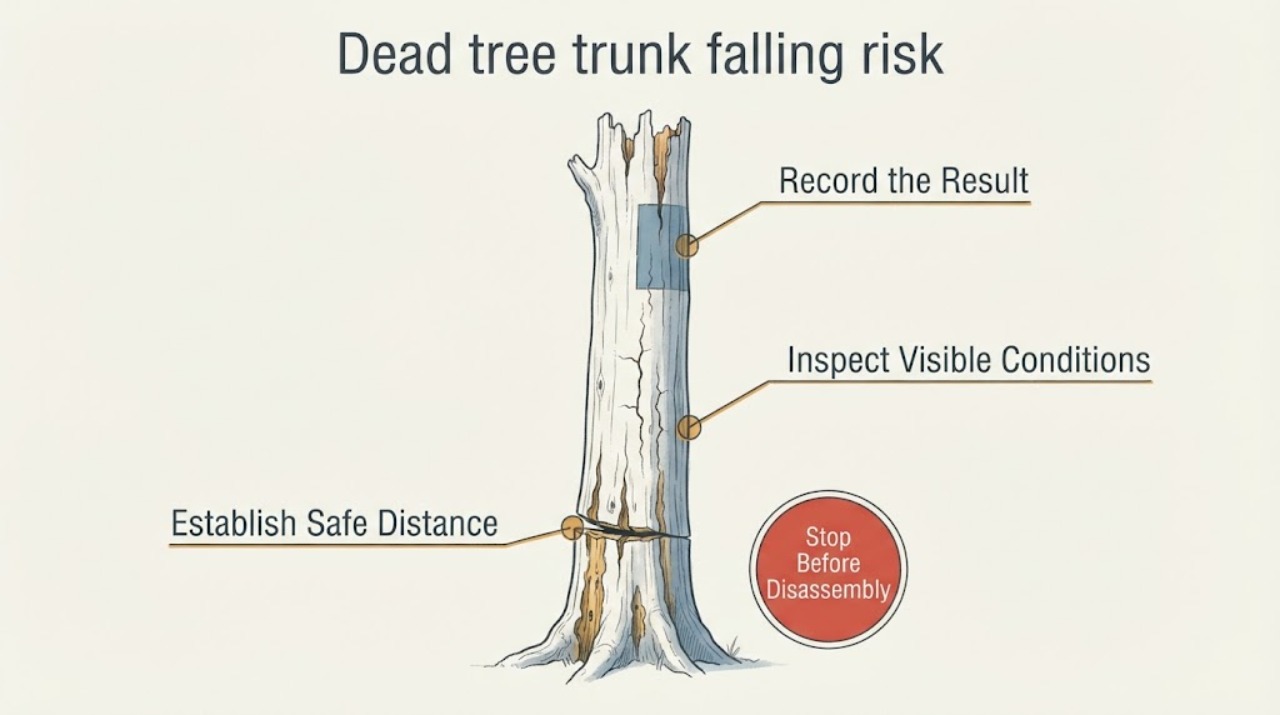
A dead standing tree with a possible falling risk should be treated as an urgent professional-service issue. From well outside the tree's potential fall area, document the trunk's lean, cracks, cavities, missing bark, hanging limbs, recent movement, and the people, vehicles, buildings, and power lines that could be affected. Do not approach the trunk, stand beneath the canopy, climb, use a ladder or chainsaw, pull on wood, or rig a rope. Keep people and vehicles out of the target area and call a qualified tree-removal professional; if the tree or a limb is on a power line or has already fallen across a road or structure, contact the utility or emergency authority as appropriate.
Work through in order
Diagnostic checks
Use only checks that match the exact appliance or system and its official guide.
-
Check 1
From a location well outside the apparent fall area and never beneath the canopy, identify a safe viewing point and keep people, pets, and vehicles behind it.
Expected result: Record whether the tree's potential path reaches a home, road, driveway, play area, neighboring property, or power line and whether anyone is currently inside that area.
Next step: Keep the area clear and call a qualified tree-removal professional with the target information; do not move closer for a better view.
Stop if: Stop immediately if the tree shifts, a limb drops, wind increases, the safe viewing point cannot be maintained, or a person or vehicle enters the target area.
Why this matters
Why: A target in the fall path raises urgency and may require immediate isolation or emergency coordination before any professional approaches.
-
Check 2
From the safe viewing point, use only visual observation to note the trunk's lean, cracks, cavities, missing bark, dead top, basal damage, fungal growth, or visible separation.
Expected result: Record which symptoms are visible, which side of the trunk they occupy, and whether the trunk has changed since the last safe observation; do not approach, touch, tap, or probe it.
Next step: Send wide and zoomed photos taken from the same safe point to the tree professional and continue keeping the area empty.
Stop if: Stop if any part moves, cracks audibly, sheds bark or wood, or the wind or weather makes standing at the viewing point unsafe.
Why this matters
Why: Multiple defects or a new change support urgent professional assessment, but a distant view cannot certify that the trunk is stable or predict the exact failure path.
-
Check 3
From outside the hazard area, look at the crown outline and visible ground context for hanging limbs, broken tops, root lifting, soil cracking, fresh wood, or recent debris without entering the canopy or root zone.
Expected result: Record whether damage is isolated or distributed, whether fresh pieces are present, and whether soil or roots appear newly displaced after wind, rain, or construction.
Next step: Keep the entire possible target area closed and report the changes, weather, and photographs to the tree professional.
Stop if: Stop if a branch is suspended, a root plate is lifting, fresh breakage occurs, or the observation would require entering the canopy or root zone.
Why this matters
Why: Hanging wood, root movement, or fresh debris can indicate changing stability and warrants urgent professional control of the site; absence of a visible symptom does not make a dead trunk safe.
-
Check 4
From a distant, safe position, identify overhead lines, fences, structures, slopes, public paths, and access constraints around the tree without entering the work zone.
Expected result: Record whether any line crosses or touches the tree, whether the fall path includes a road or neighboring property, and whether emergency access is blocked.
Next step: Keep clear and tell the tree professional exactly which lines, targets, and access constraints are present; contact the utility or emergency authority for an immediate line or roadway hazard.
Stop if: Stop and retreat if the tree or limb contacts a line, a line is down, a road is blocked, or any person or vehicle would need to pass through the hazard area.
Why this matters
Why: Power lines and public or shared targets require utility, emergency, or coordinated professional planning; a constrained site is not suitable for an improvised removal.
-
Check 5
From the same safe location, record recent wind, lightning, fire, construction, insect, or disease observations and compare only existing photographs rather than returning to inspect the tree.
Expected result: Note new lean, dropped limbs, bark loss, cracking, exposed roots, or increased target exposure since the earlier photo or event.
Next step: Provide the timeline and photos when scheduling urgent professional service and maintain the exclusion area until the assessment.
Stop if: Do not revisit the tree during wind, storms, darkness, or changing conditions; stop all observation if stability is uncertain.
Why this matters
Why: A recent event or visible change increases urgency, while a lack of change does not remove the hazard posed by a dead trunk.
Use your observations
Decision map
Find the observation that best matches what you see, then follow the next safe action.
-
PATH 01Next step
What you see
The tree or a limb contacts a power line, a line is down, or the tree blocks a public road or emergency route.
Do this next
Stay well away, keep others away, and contact the utility or emergency authority; do not approach, cut, pull, or move the tree.
-
PATH 02Next step
What you see
The trunk shifts, cracks, sheds material, a root plate lifts, or a limb is suspended.
Do this next
Retreat without running beneath the canopy, keep the area empty, and request urgent professional or emergency assistance.
-
PATH 03Next step
What you see
A home, vehicle, road, public path, neighbor, or person is within the possible fall or debris area.
Do this next
Isolate the target area and coordinate urgent professional service; do not use the target area for parking, access, or shelter.
-
PATH 04Next step
What you see
Wind, rain, lightning, snow, darkness, or poor visibility is present.
Do this next
Do not inspect; retreat to a safe place and wait for professional or emergency guidance.
-
PATH 05Next step
What you see
The trunk appears unchanged and no target or line is visible from the safe viewing point.
Do this next
Still treat the dead tree as an urgent professional assessment because apparent stability is not a safety certification.
Helpful context
Understand the symptom
Why a dead trunk is an urgent hazard
A dead tree can fail in the trunk, roots, limbs, or attached wood, and the failure path may not be obvious from one angle. The Forest Service warns that dead or leaning trees can fall without warning, while OSHA identifies falling trees and branches, falls, struck-by objects, and energized lines as serious tree-care hazards. The homeowner role is to observe from a safe distance, isolate the area, and provide useful information to a qualified professional.
Keep out of the fall and debris zone
Do not walk up to the trunk to inspect a cavity, tap it, push it, measure it, or look beneath the canopy. Do not climb, use a ladder, operate a chainsaw, pull with a vehicle, attach a rope, or remove a limb. Do not park or wait under or near the tree. If a power line is involved, keep away and contact the utility or emergency authority rather than attempting any tree work.
What to report
From a safe location, take a wide photograph that shows the tree and nearby targets, then a few zoomed images only if they can be made without moving closer. Report the apparent lean, trunk condition, recent weather or movement, access constraints, and whether the target area includes people, buildings, vehicles, roads, or overhead lines. A tree professional can choose the correct inspection and removal controls.
Only after diagnosis
Potential parts
- barrier-tape
Only consider this category if it can be placed from a safe location without approaching the tree or entering its possible fall area; it is a visual boundary, not a restraint.
Use only a visible boundary that does not invite anyone to approach or create a trip hazard; a professional or emergency authority should define the exclusion zone when risk is uncertain.
Common questions
FAQ
Can I cut down a dead tree if it looks like it will fall in one direction?
No. A dead trunk can fail unpredictably, and the fall and debris path can extend beyond what appears obvious. Keep clear and arrange a qualified hazardous-tree professional.
How far away should I stand?
Do not choose a fixed distance from a generic article. Stay well outside the apparent fall and debris area, never under the canopy, and retreat farther if wind, movement, visibility, or uncertainty changes. A professional should establish the work exclusion zone.
What if the tree touches a power line?
Stay away and keep others away. Do not approach, cut, pull, or move the tree. Contact the utility or emergency authority and tell the tree professional about the line.
Can barrier tape make the area safe?
Barrier tape is only a visual warning and never a restraint or substitute for distance. Use it only if it can be placed without entering the hazard area, and rely on professional or emergency guidance for the actual exclusion zone.
Read the exact guide
Official sources
- Inspection Guidance for Tree Care and Tree Removal OperationsOccupational Safety and Health Administration · Supports treating a dead tree as a professional hazard-control and site-assessment issue rather than a homeowner cutting task.
- Chain Saw SafetyCenters for Disease Control and Prevention · Supports leaving chainsaw and cutting work to trained operators and keeping bystanders clear of tree-removal operations.
- Intermountain Region: Recreating Outdoors - Hazard TreesU.S. Forest Service · Supports distance, avoidance, target-area awareness, and visible signs such as broken tops, missing bark, basal damage, rot, and down limbs.
Community feedback
Share a repair observation
Share a plain-text repair observation. Accepted observations are published automatically; this page may take a moment to update.