
On this page
Start here
Quick answer
A dead or declining standing tree near a house, outbuilding, road, vehicle area, utility, or other target should be treated as a hazard assessment request, not a DIY removal project. From a safe location outside the tree's potential fall and branch-drop area, document the target, tree height and lean, visible dead limbs or decay, root-zone disturbance, and current weather. Keep people and vehicles out of the area and arrange an urgent assessment by a qualified arborist or tree-removal crew. Do not climb, cut, touch, probe, approach the trunk, use a ladder, operate machinery, or work near electrical lines.
Before you begin
Safety first
- Do not climb, cut, drill, touch, probe, pull branches, use a ladder, enter the tree's potential fall area, operate machinery, or perform electrical-line work. Do not attempt DIY removal or temporary stabilization.
Work through in order
Diagnostic checks
Use only checks that match the exact appliance or system and its official guide.
-
Check 1
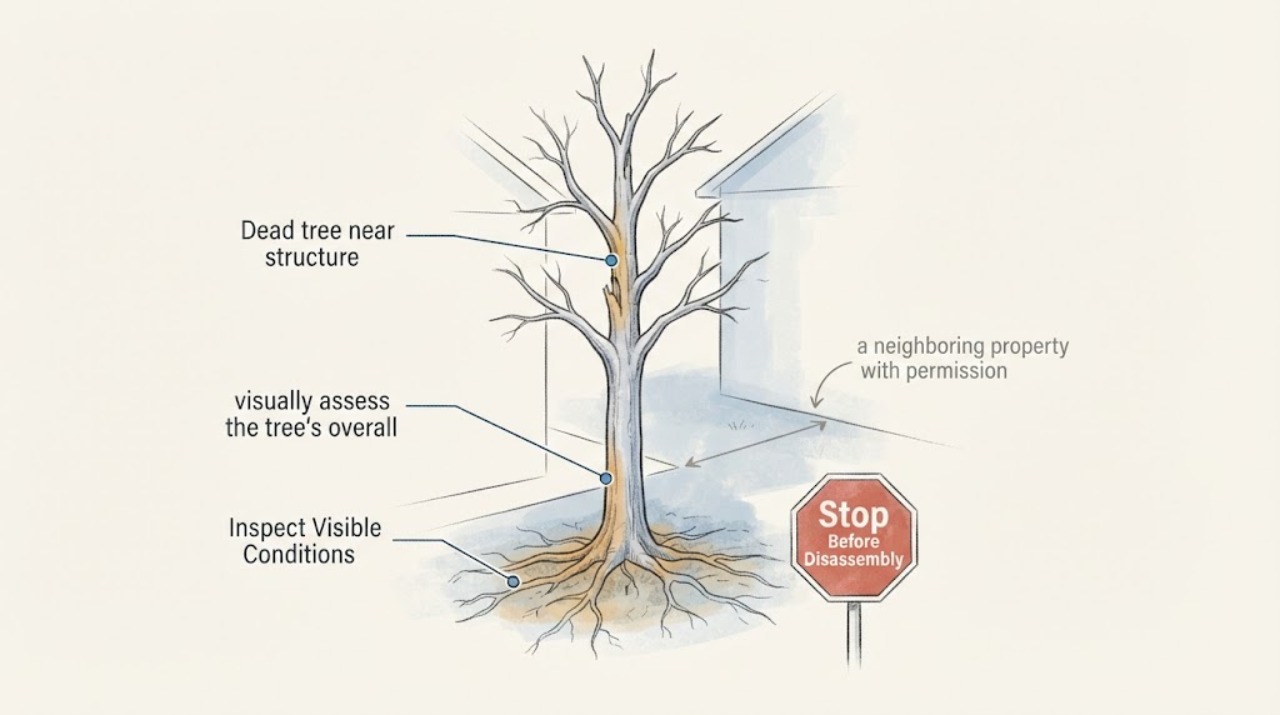
From a safe public area, a neighboring property with permission, or inside a building, identify the tree's nearby targets without approaching the tree: roof, wall, outbuilding, driveway, parked vehicles, walkway, play area, road, fence, utility line, or other place where people or property could be struck.
Expected result: A dead tree with a reachable target has a higher consequence than one with open ground around it. A target may be below the tree, within the canopy, or along a likely fall direction; the exact risk distance cannot be set from a casual estimate.
Next step: Photograph the tree and every nearby target from the safe location, note the address or access point, and keep people and vehicles away from the area beneath and around the tree.
Stop if: Stop observing and move farther away if you hear cracking, see movement, see a branch drop, or notice that your viewing position is within the possible fall or branch-drop area.
Why this matters
Why: Target identity and location tell the arborist where exclusion and traffic controls are needed and whether the request is urgent.
-
Check 2
From a distance, visually assess the tree's overall form: whether the trunk is standing or recently fallen, whether it leans toward a target, and whether the crown has missing leaves or needles, broken tops, hanging branches, uneven weight, or large dead limbs. Do not walk under the crown, climb, use a ladder, touch branches, or try to shake or test the tree.
Expected result: A pronounced or recent lean, broken top, hanging limb, uneven crown, or dead branch over a target increases concern. A tree that looks upright can still have hidden trunk or root failure, so a clear view does not establish safety.
Next step: Record the direction of lean and the largest visible defects in the photos, then wait for professional assessment outside the exclusion zone.
Stop if: Treat any movement, cracking, falling material, or sudden change in lean as an immediate stop: leave the area by the safest route and keep others out.
Why this matters
Why: The visible form helps a qualified arborist prioritize the inspection and decide how to control the work area; it does not support a homeowner removal plan.
-
Check 3
Use only a long-distance view to look for possible decay or structural defects on the trunk and major limbs: cavities, splits, cracks, missing bark, fungal growth, insect damage, broken sections, or an unusually thin or hollow-looking crown. Do not probe, drill, scrape, pull bark, collect samples, or approach for a closer look.
Expected result: Visible cavities, splits, cracks, missing bark, fungus, insect damage, or multiple dead sections are reasons to treat the tree as higher concern, especially when a target is nearby. Lack of a visible defect does not rule out decay or compromised wood.
Next step: Send the images and a description of each visible defect to a qualified arborist or tree-hazard service and keep the exclusion zone in place.
Stop if: Do not enter the tree's base or canopy area to improve the view. If the defect is only visible from inside the potential fall area, leave it undocumented and let the professional assess it.
Why this matters
Why: Defect observations help the professional prepare, but only a qualified assessment can determine the tree's failure potential or removal method.
-
Check 4
From outside the no-entry zone, visually inspect the ground around the tree for exposed or lifted roots, soil cracks, erosion, recent excavation, a leaning root plate, saturated soil, storm debris, or a change in ground level. Do not touch the trunk or roots, walk on the root zone, dig, or move debris.
Expected result: An exposed or lifting root plate, soil cracking, erosion, saturated ground, or recent disturbance can reduce confidence in the tree's anchoring. Downed limbs or debris may also show that failure has already begun.
Next step: Photograph the ground from the safe side, note recent weather or site work, and tell the arborist that the root zone may be compromised.
Stop if: If the root plate is moving, soil is failing, or the trunk is leaning further, increase distance immediately and do not wait inside the area for a routine appointment.
Why this matters
Why: Root-zone and ground conditions can make a seemingly stable tree more urgent, particularly after wind, heavy rain, fire, excavation, or other disturbance.
-
Check 5
Check current conditions from a safe location: strong or gusty wind, rain, saturated soil, reduced visibility, nearby fire damage, or utility lines crossing or touching the tree. Mark the affected line or condition in a photo without approaching it or using any equipment near it.
Expected result: Wind, rain, saturated soil, fire damage, or a utility conflict can increase the immediate hazard and change who must control the site. A utility line that may be energized is an electrical emergency boundary, not a tree-work task.
Next step: Move away, keep the area closed, and contact the utility or emergency service for any line involvement, active failure, blocked road, or immediate threat; otherwise arrange the earliest qualified tree-hazard assessment.
Stop if: Do not enter, cross, touch, or work near a tree or line during dangerous weather or any active movement.
Why this matters
Why: Current conditions determine whether the response is an emergency, a utility coordination issue, or an urgent arborist inspection after the weather settles.
Use your observations
Decision map
Find the observation that best matches what you see, then follow the next safe action.
-
PATH 01Next step
What you see
The tree is moving, cracking, dropping branches, leaning further, has a lifting root plate, or is already failing toward a structure, road, or occupied area.
Do this next
Leave the area immediately by a safe route, keep people and vehicles out, and contact the appropriate emergency or tree-hazard service. Do not wait nearby for a contractor or attempt temporary stabilization.
-
PATH 02Next step
What you see
The tree or a branch is touching, crossing, or close to a utility line, service connection, or electrical equipment.
Do this next
Treat the area as energized and keep everyone away. Contact the utility and an appropriately qualified tree professional; do not approach, climb, cut, move a branch, or use equipment there.
-
PATH 03Next step
What you see
The tree appears dead or severely declining and a roof, wall, vehicle area, walkway, road, or other target is within the canopy or likely fall area, but there is no active movement.
Do this next
Keep a no-entry zone and arrange an urgent on-site assessment by a qualified arborist or tree-removal crew. Provide the target list, photos, lean direction, visible defects, and recent weather or site history.
-
PATH 04Next step
What you see
The tree is distant from people and property, with no visible active movement, but its condition or root stability is uncertain.
Do this next
Do not approach for a closer inspection. Keep routine activity away from the base and schedule a qualified assessment to determine whether monitoring, pruning, or removal is appropriate.
-
PATH 05Next step
What you see
The tree has fallen or large limbs are down and block access, damage a structure, or leave a line or roadway involved.
Do this next
Keep clear of the debris and any line or damaged structure, document from a safe location, and coordinate emergency, utility, property, and qualified tree services before cleanup.
Helpful context
Understand the symptom
Why a dead tree near a structure is urgent
A dead standing tree can lose limbs or fail at the trunk or roots, and the nearby structure or utility becomes a target if a failure occurs. Risk depends on more than whether the crown looks bare: lean, cracks, cavities, decay, root damage, wind exposure, slope, and the size and position of nearby targets all change the assessment. A distance-only report is enough to start professional triage; it is not a substitute for an on-site arborist evaluation.
Use a no-entry zone while waiting
Keep the area beneath and around the tree clear of people, pets, vehicles, and routine work. Set a visible boundary from a safe side only if doing so does not require approaching the tree, and tell everyone not to enter the area. If branches are already down, the tree is moving, a root plate is lifting, or a utility is involved, increase the distance and contact the appropriate emergency, utility, or tree-hazard service.
Only after diagnosis
Potential parts
- tree-risk-binoculars
Only consider binoculars as an optional distance-observation aid when they let the homeowner document visible defects without entering the tree's potential fall or branch-drop area; they cannot diagnose decay or make the tree safe.
Use only from a stable, safe location with both feet on the ground. Keep the tree, utility lines, and exclusion zone in view and defer all close inspection to a qualified arborist. - barrier-tape
Only consider barrier tape when it can be placed from a safe side without approaching the tree and when it supplements, rather than replaces, keeping people and vehicles away from the hazard.
Place boundaries where they are visible and do not require entering the potential fall area. A professional or emergency authority should define the exclusion area when the hazard is active, large, or near utilities.
When checks do not resolve it
Need a professional?
Arrange an urgent qualified arborist or tree-removal assessment for any dead standing tree near a structure, road, utility, vehicle area, or occupied space. Escalate immediately for movement, cracking, falling limbs, root-plate lifting, active storm conditions, blocked access, structural damage, or utility involvement.
Safety scope: Do not climb, cut, drill, touch, probe, pull branches, use a ladder, enter the tree's potential fall area, operate machinery, or perform electrical-line work. Do not attempt DIY removal or temporary stabilization.
Have this ready
- Provide the address and safe access point, target list, photos from a distance, tree lean direction, visible crown and trunk defects, root-zone observations, recent wind or rain, fire or excavation history, and whether any line or structure is involved.
Common questions
FAQ
Is a dead tree next to my house an emergency?
It is at least an urgent hazard-assessment request because the house is a target. Treat it as an immediate emergency if the tree moves, cracks, drops limbs, leans further, has a lifting root plate, blocks a road, damages a structure, or involves a utility line.
Can I walk up to the trunk to check for rot?
No. A dead tree or branch can fail without warning, and the defect may only be visible from inside the danger area. Stay outside the exclusion zone and let a qualified arborist perform the close assessment.
How far away should people stay?
There is no single safe distance for every tree. Height, lean, branch condition, terrain, wind, roots, neighboring trees, and targets all matter. Keep people and vehicles out of the area beneath and around the tree until a qualified professional sets the work exclusion zone.
Can I cut a dead branch or remove the tree myself?
No. Do not climb, use a ladder, cut, pull, drill, or operate machinery around a dead standing tree near a structure. Qualified tree crews must assess and control the hazard.
What if the tree is near a power line?
Keep everyone away and treat the line as energized. Do not touch the tree, branches, line, or equipment near it; contact the utility and a properly qualified tree professional to coordinate the response.
Read the exact guide
Official sources
- After the Fire - Hazard Tree RemovalNatural Resources Conservation Service, U.S. Department of Agriculture · Used for the urgent professional-service boundary and general hazard context; the page focuses on fire-affected trees, so its removal examples are not treated as a universal homeowner procedure.
- National Snag Hazard MapU.S. Forest Service, Rocky Mountain Research Station · Used to support the distinction between broad hazard context and an on-site tree assessment; the national map is not used to rate or clear an individual residential tree.
- Maintain trees and remove hazards to reduce severity or extent of wind and ice damageU.S. Department of Agriculture Climate Hubs · Used to explain why target exposure, tree condition, form, size, wind, and site context matter and why hazard trees near infrastructure need prompt professional management.
Community feedback
Share a repair observation
Share a plain-text repair observation. Accepted observations are published automatically; this page may take a moment to update.