
On this page
Start here
Quick answer
For tree log removal after a cut in an accessible yard, treat accessibility as visibility and reachability, not permission to move the material. From a safe distance, classify size and weight, check slope and rolling potential, note residual tension or partial support, scan utilities and structures, and map equipment access. Only clearly small, loose, dry, stable debris on level ground may fit a limited hand-cleanup boundary. Do not use a chainsaw, lift or roll a log, tow or winch it, or operate machinery without trained professionals and site controls.
Before you begin
Safety first
- Use distant ground-level observation only; do not approach unstable logs, stand downhill, lift, roll, tow, winch, cut, split, brace, or operate heavy equipment.
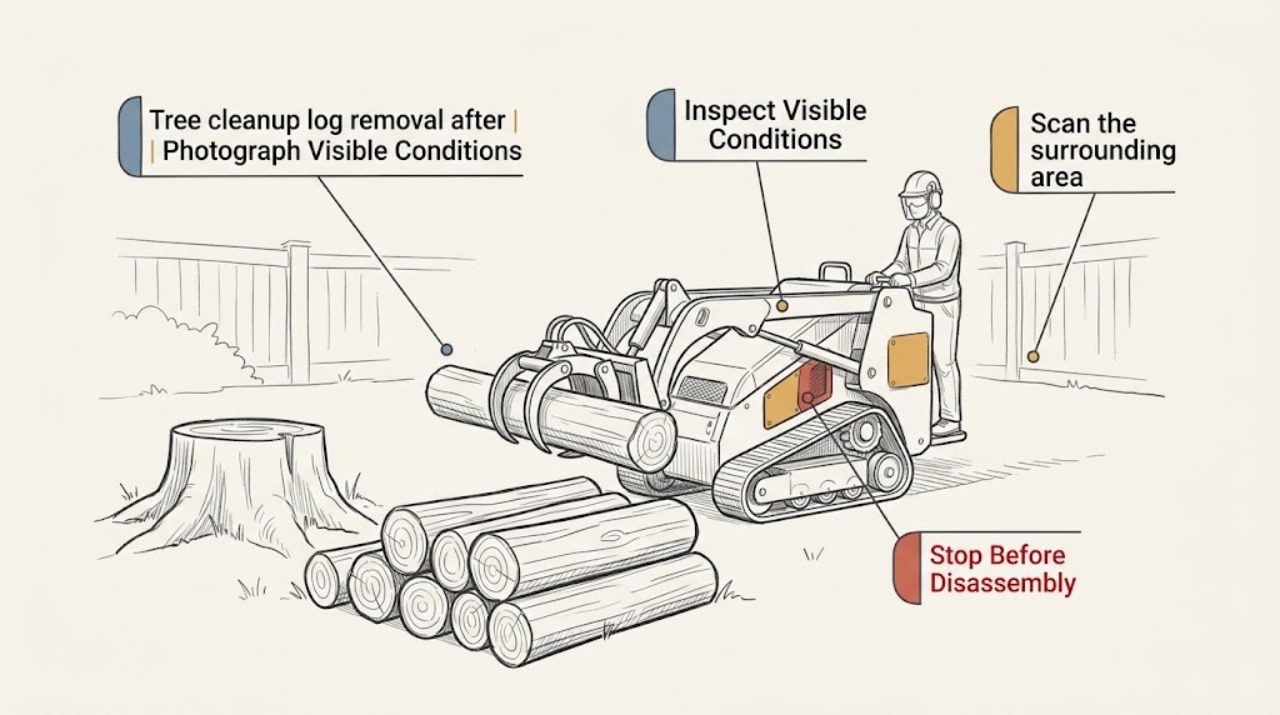
Work through in order
Diagnostic checks
Use only checks that match the exact appliance or system and its official guide.
-
Check 1
From well outside the log and from a stable yard position, estimate its diameter, length, weight, and whether it is whole, split, suspended, or partly supported. Use photographs or a known object for scale; do not approach closely to measure it.
Expected result: Record small and stable, large or heavy, partly suspended, split or unstable, or size cannot be judged safely.
Next step: Record the size class and support condition for a tree-removal professional; leave anything heavy, suspended, or uncertain in place.
Stop if: Stop for rolling potential, springing branches, unstable piles, steep ground, overhead lines, damaged structures, wildlife, or any need to touch or approach the log.
Why this matters
Why: An accessible yard only tells you that the log can be seen or reached, not that it is safe to move. A small, stable piece is a different cleanup task from a heavy trunk or a section with stored energy.
-
Check 2
Assess the yard slope and possible movement path from a distance. Look for downhill grade, mud, ice, retaining edges, driveways, people areas, and whether the log could roll, slide, or pivot if disturbed; do not push or test it.
Expected result: Record level and stable, sloped with a clear downhill path, blocked by a retaining edge, visibly under tension, or uncertain.
Next step: Mark a no-entry area and tell the professional the slope, downhill path, and nearby targets so the removal plan accounts for movement.
Stop if: Do not stand downhill, straddle, roll, lever, chain, tow, or climb over the log or debris.
Why this matters
Why: A log that appears reachable on level ground may roll or slide on a slope. Residual tension, a cut trunk resting on one end, or a partially supported section can release without warning.
-
Check 3
Scan the surrounding area from the ground for utility lines, service drops, fences, vehicles, buildings, sheds, irrigation, buried-service markers, hanging limbs, and root or stump movement. Do not touch a line, limb, or structure to clear a route.
Expected result: Record no nearby exposure, utility or structure nearby, line contact or suspected contact, hanging material, or uncertain.
Next step: Keep people and vehicles clear and contact the utility or qualified tree service as appropriate before any removal planning.
Stop if: Stop and keep well clear for any downed or contacted utility line, unstable structure, suspended limb, fire, or suspected electrical hazard.
Why this matters
Why: A log in an accessible yard becomes a utility or structural job when it contacts a line, rests against a building, blocks a service route, or is connected to a damaged tree. Those hazards cannot be solved by ordinary hauling.
-
Check 4
Observe the proposed equipment route from a safe position: note gate width, overhead clearance, soft or wet soil, slope, steps, narrow passages, and whether a machine would need to cross a public path or work near people. Do not bring in or operate equipment to test the route.
Expected result: Record clear and level route, narrow or obstructed route, soft or sloped ground, overhead or public-route conflict, or route unknown.
Next step: Provide the route constraints to a qualified tree-removal provider and do not assume that a rented machine can be used safely or lawfully.
Stop if: Do not operate a loader, winch, tractor, truck, or other heavy equipment without proper training, authorization, and site controls.
Why this matters
Why: An open yard may still lack safe access for a loader, winch, or truck. Equipment size, ground bearing, slope, and public exposure determine whether mechanized removal is appropriate and who may operate it.
-
Check 5
Separate small, loose, dry, stable twigs or light pieces from log sections and larger branches by visual size and stability only. If a piece is not clearly light enough for one person and free of tension, treat it as log or limb debris and leave it.
Expected result: Record light loose debris only, mixed with log or limb sections, heavy or awkward pieces, contaminated material, or uncertain.
Next step: For clearly light pieces in a clear, level, dry area, follow local waste rules and use gloves only if the piece can be handled without lifting strain; otherwise request cleanup service.
Stop if: Do not lift heavy pieces, place fingers under debris, split logs, use a chainsaw, or handle material with nails, wire, insects, or animal contact.
Why this matters
Why: Only genuinely small and stable debris may fit a limited hand-cleanup boundary. A short-looking log can still be too heavy, sharp, contaminated, or held under tension for safe manual handling.
-
Check 6
Set the removal boundary from the size, movement, terrain, utility, structure, and route observations. Ask for a qualified tree-removal and cleanup scope that states whether hand cleanup, trained mechanical removal, or utility coordination is required.
Expected result: Choose small stable debris, professional log removal, utility or structural coordination, equipment-access constraint, or insufficient safe evidence.
Next step: Keep the log and surrounding area isolated and provide photos, dimensions, slope, hazards, access, and disposal needs to the qualified provider.
Stop if: Do not cut, roll, tow, winch, lift, split, brace, or move the log yourself and do not operate unqualified machinery.
Why this matters
Why: Accessible does not mean safe. Log weight, stored tension, rolling path, slope, equipment route, and nearby exposures decide the method; a yard that permits walking may still require specialized removal.
Use your observations
Decision map
Find the observation that best matches what you see, then follow the next safe action.
-
PATH 01Safety boundary
What you see
Only small, loose, dry, stable pieces are present on level ground, with no utility, structural, wildlife, contamination, or movement hazard.
Do this next
Handle only pieces that are clearly light enough without strain, follow local yard-waste rules, and request service for the remaining log or limb material.
Why this path and its safety boundary
Why it matters: A limited hand-cleanup boundary may be reasonable, but it does not extend to logs, limbs, awkward loads, or anything with stored energy.
Safety stop: Stop for weight, sharp edges, nails, wire, insects, animal contact, unstable footing, or any need to cut or drag.
-
PATH 02Safety boundary
What you see
The log is large, heavy, partly supported, split, under a cut trunk, or its movement path cannot be predicted.
Do this next
Keep people out of the movement zone and request trained tree-removal service with a written removal and disposal plan.
Why this path and its safety boundary
Why it matters: Residual tension, compression, rolling, or pivoting can release suddenly; an accessible yard does not make manual removal safe.
Safety stop: No hand lifting, rolling, levering, towing, winching, splitting, or cutting.
-
PATH 03Safety boundary
What you see
The log lies on a slope, above or below a drop, beside a retaining edge, or on ground that is muddy, icy, soft, or obstructed.
Do this next
Stay uphill and outside the possible path and give the terrain and access constraints to a qualified provider.
Why this path and its safety boundary
Why it matters: The log or removal equipment may slide or roll, and a person can be struck or crushed even without moving the log intentionally.
Safety stop: Do not stand downhill, cross over the log, drive equipment onto the slope, or create a test movement.
-
PATH 04Safety boundary
What you see
A utility line, service drop, building, vehicle, fence, shed, hanging limb, stump, or damaged structure is contacted or within the possible movement path.
Do this next
Keep clear and contact the utility or qualified tree service before any removal or equipment entry.
Why this path and its safety boundary
Why it matters: The cleanup requires utility, structural, or trained tree-work coordination; ordinary yard access is not a safe authorization.
Safety stop: Assume lines are energized and do not touch, cut, pull, brace, or move the log or connected limb.
-
PATH 05Safety boundary
What you see
A machine or truck would be needed, but the route has limited clearance, soft ground, a slope, overhead exposure, a public path, or no trained operator.
Do this next
Ask a qualified provider to choose equipment, exclusion zones, ground protection, and traffic controls for the site.
Why this path and its safety boundary
Why it matters: The yard is not safely accessible for that equipment. Improvised machine operation can cause rollover, crushing, utility contact, or property damage.
Safety stop: Do not rent, drive, tow, winch, or operate heavy machinery without proper training and site controls.
-
PATH 06Safety boundary
What you see
The yard is clear and level, but the log's size, tension, stability, or disposal route remains uncertain.
Do this next
Send photos and measurements made from a safe distance to a qualified tree-removal provider and request an on-site assessment.
Why this path and its safety boundary
Why it matters: Uncertainty is itself a reason to keep the material in place; visibility and reach do not establish a safe removal method.
Safety stop: Do not make a trial cut, move one end, attach a rope, or use a vehicle to test weight.
Helpful context
Understand the symptom
Accessible does not mean safe to move
An accessible yard is a location description, not a safety clearance. Before log removal after a cut, classify the material by size, weight, support, stored tension, rolling path, slope, and nearby people, structures, and utilities. Only clearly small, loose, stable debris belongs in a limited hand-cleanup boundary.
Treat stored movement and equipment as professional hazards
OSHA identifies unstable logs, overhead hazards, spring poles, tension and compression, rolling or sliding, and chainsaw hazards in tree work. A homeowner should not cut, roll, tow, winch, lift, split, or brace a log, and should not operate rented machinery without training and site controls.
Give the provider a site-specific removal picture
Map the slope, possible movement zone, equipment route, utility and structure exposure, and disposal constraints from a safe distance. Request a qualified tree-removal and cleanup scope that explains whether a small debris handoff, trained mechanical removal, or utility coordination is required.
Safety boundary
Stop conditions
- Stop for unstable or heavy logs, residual tension, rolling or sliding potential, steep or soft ground, hanging limbs, utility lines, structures, wildlife, contamination, or any need to approach, touch, cut, lift, or operate equipment.
- Do not use a chainsaw, split logs, roll or tow material, attach a rope or winch, place fingers under debris, brace a log, perform manual heavy lifting, or operate machinery without trained professionals and site controls.
Only after diagnosis
Potential parts
- work-gloves
Consider gloves only for limited handling of genuinely small loose debris after larger logs and hazards have been excluded.
Use only for clearly light, stable, non-sharp debris and confirm local waste rules; gloves do not make logs, limbs, tension, or utility hazards safe. - heavy-duty-tarp
Consider a tarp only to cover or contain light, stable debris after professional assessment; never wrap, drag, or pull a log with it.
Confirm material strength, size, weather, trip hazards, and local disposal guidance; a tarp is not a tie-down, lifting sling, or restraint for a log. - yard-waste-bags
Consider bags only for clearly small, loose, stable pieces that can be handled without strain and without cutting or approaching the log.
Confirm bag rating, local yard-waste rules, and the material's size and weight; bags are not for logs, branches under tension, or sharp contaminated debris.
When checks do not resolve it
Need a professional?
Call qualified tree-removal service for any log, large limb, tension, slope, rolling, utility or structure exposure, equipment need, uncertain weight, or unsafe access. Coordinate with the utility for line contact and use emergency services for immediate threats.
Safety scope: Use distant ground-level observation only; do not approach unstable logs, stand downhill, lift, roll, tow, winch, cut, split, brace, or operate heavy equipment.
Have this ready
- Provide photos from a safe distance, estimated size class, support and tension clues, slope and possible movement path, utility or structure exposures, gate and equipment-route limits, debris types, and disposal needs.
Common questions
FAQ
Does an accessible yard make log removal safe?
No. It only means the yard can be seen or reached. Size, weight, slope, stored tension, rolling path, utilities, structures, and equipment access determine safety.
What should I document before calling for log removal?
Estimate size from a distance, identify slope and possible rolling direction, scan for lines and structures, and note the equipment route without touching or moving the log.
Can I move any small debris by hand?
Only clearly light, loose, dry, stable pieces on level ground with no hazards. Leave logs, heavy branches, awkward pieces, and anything under tension for qualified service.
How can I tell whether a log is under tension?
Do not test it. A log can roll, slide, pivot, or release stored tension when disturbed; ask a trained tree-removal provider to assess the movement path.
When should I stop and call a professional?
Keep clear and contact the utility or qualified tree service for any line contact, hanging limb, building or vehicle exposure, slope hazard, unstable log, or need for machinery.
Read the exact guide
Official sources
- eTool: Logging - Manual Operations - Limbing and BuckingOccupational Safety and Health Administration · Supports the distinction between unstable logs, rolling or sliding, tension and compression, overhead hazards, and the need for stable positions; the article uses it to prohibit homeowner cutting or movement.
- Tree Trimming & Removal SafetyOccupational Safety and Health Administration · Supports the utility, fall, falling-object, chainsaw, weather, and stored-pressure boundaries for tree removal; it does not authorize untrained user work.
- Response/RecoveryOccupational Safety and Health Administration · Supports hazards from downed trees, debris removal, power lines, falling or crushing, chainsaws, and manual lifting; the article applies these warnings to yard cleanup boundaries.
Community feedback
Share a repair observation
Share a plain-text repair observation. Accepted observations are published automatically; this page may take a moment to update.