
On this page
Start here
Quick answer
When a tree is already down and the remaining job is log removal, first confirm that every section is truly on stable ground and free of suspended limbs, root-wad tension, rolling risk, and power-line contact. Photograph and map the trunk, branches, stump, access path, structures, road or sidewalk, and utility lines before moving anything. Decide whether the requested work is removal of logs and brush only or also stump and root-wad work, then use a qualified tree-removal provider for heavy sections, spring poles, slopes, restricted access, or any chainsaw, winch, loading, or chipping operation. Keep people clear, do not improvise a pull with a vehicle or rope, and check local disposal rules before hauling wood; firewood should not be moved without checking applicable pest-movement guidance.
Before you begin
Safety first
- The homeowner scope is visual documentation, keeping people clear, confirming scope and disposal, and checking the finished site from the ground. Do not climb, cut, chip, drag, winch, lift, load, or transport unstable or heavy material without qualified training, equipment, and a site-specific plan.
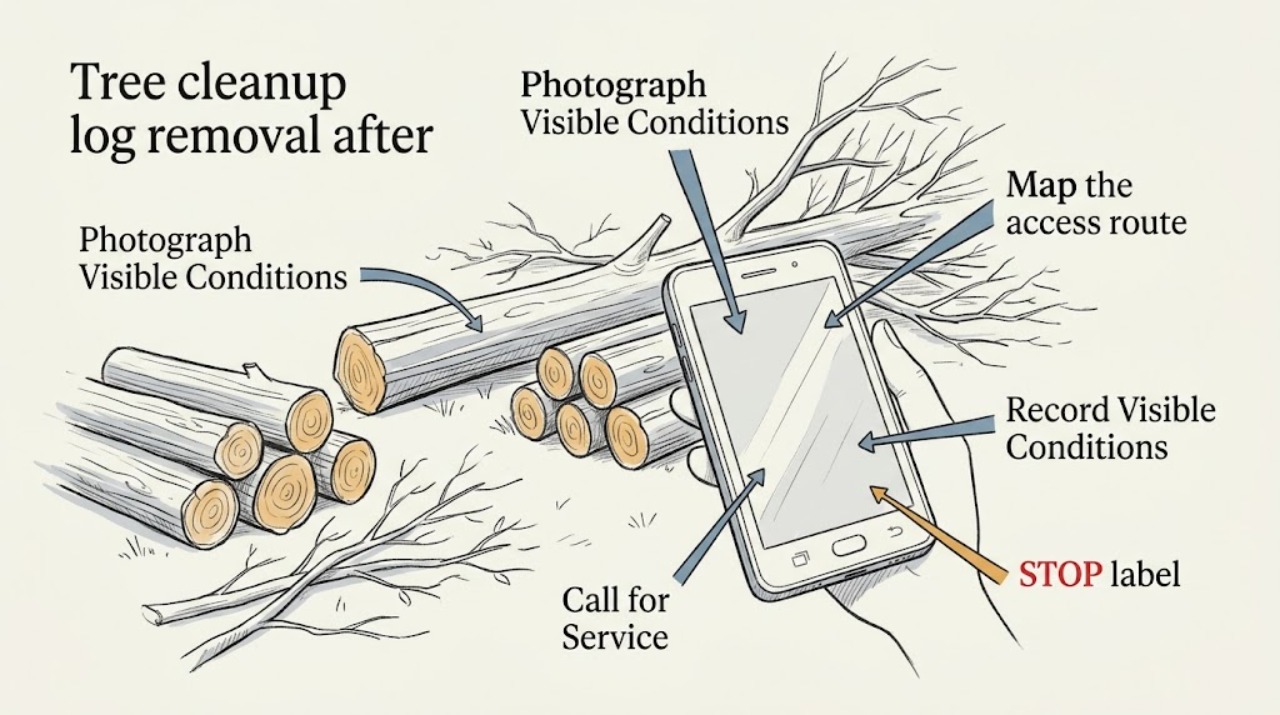
Work through in order
Diagnostic checks
Use only checks that match the exact appliance or system and its official guide.
-
Check 1
From a stable location outside the fall and roll path, photograph the full tree, trunk ends, branches, root wad if exposed, nearby structures, fences, roads, sidewalks, and any overhead or attached utility lines. Do not step onto the tree, climb the root wad, or handle a suspended limb.
Expected result: The trunk and branches lie independently on stable ground, or a section is hung up, supported by another object, under a bent limb, attached to a lifted root wad, or close to a utility line.
Next step: Keep people and pets out of the area, preserve the photographs, and contact a qualified tree professional for any unstable, tensioned, or line-related condition. Do not attempt to free or pull a section.
Stop if: Stop immediately for a lifted root wad, hung or leaning section, bent limb under tension, movement, cracking, unstable footing, or any contact or possible contact with a power line.
Why this matters
Why: Independent pieces on stable ground may support a simple removal assessment; suspended, lodged, tensioned, or line-contact conditions can release or shift without warning and require qualified tree-removal control.
-
Check 2
Map the access route from the wood to its intended destination, including slope, soft or wet ground, gates, overhead clearance, buildings, parked vehicles, pedestrian paths, road edges, and the location of any utility line. Keep the route closed to bystanders while the condition is being assessed.
Expected result: The route is level and clear with adequate room for a provider's equipment, or it has a slope, narrow passage, overhead obstruction, public access, soft ground, or a line hazard.
Next step: Send the map and photographs to a qualified provider and ask how the route, exclusion zone, equipment, and load handling will be controlled. Do not drag logs through a public path or improvise a vehicle pull.
Stop if: Stop if moving the wood would require entering a roadway, blocking a public route, passing under a line, driving on unstable ground, or using a vehicle, winch, cable, or lift without a qualified plan.
Why this matters
Why: A clear route can help a provider plan a controlled removal; restricted or public routes increase the risk of rolling, struck-by events, equipment contact, or property damage and change the required traffic and lifting plan.
-
Check 3
Separate the cleanup scope into trunk or log sections, loose branches, brush, chips, root wad, and remaining stump. Record approximate dimensions from the ground and note whether each piece must be hauled away, chipped, stacked on site, or retained as firewood; do not make new cuts to change the pieces.
Expected result: The requested scope is limited to loose, stable material, or it includes a heavy trunk, attached limbs, root wad, stump, large debris pile, or pieces that cannot be moved without powered equipment.
Next step: Give the itemized scope to a qualified provider and ask them to confirm whether stump treatment, hauling, site grading, and final raking are included. Leave heavy, attached, or tensioned pieces in place until the provider arrives.
Stop if: Stop if the work would require a chainsaw, chipper, stump cutter, loader, winch, lifting strap, or entry into the debris pile without training, guarding, and a site-specific plan.
Why this matters
Why: Loose stable debris and heavy or attached sections are different work categories. Bucking, limbing, chipping, loading, and stump removal each add equipment, stored-energy, and load-control hazards beyond hand cleanup.
-
Check 4
Confirm the intended disposal destination before any load is prepared: municipal green-waste service, licensed hauler, on-site stacking, mulch or chip use, or firewood. Check local rules for roadside placement, burning, transport, protected trees, and right-of-way use rather than assuming that a cut tree can be left or hauled anywhere.
Expected result: The destination and permissions are confirmed, or the wood would cross a property, county, state, park, or other jurisdiction without clear guidance.
Next step: Ask the receiving service or local authority for current instructions and provide the wood's origin and intended use. If firewood must move, follow applicable treatment or local-movement rules and prefer a local destination.
Stop if: Stop loading or transporting if the destination, permission, load restraint, vehicle capacity, or firewood-movement requirement is unknown.
Why this matters
Why: A confirmed local destination reduces the chance of an abandoned load or prohibited disposal; unconfirmed movement can create legal, fire, property, or invasive-pest problems, especially when wood is treated as firewood.
-
Check 5
After a qualified provider completes the removal, inspect from the ground for remaining loose branches, exposed nails or wire, disturbed soil, blocked drainage, damage to structures or pavement, and the separate stump or root area. Compare the final site with the agreed scope and photograph any concern before the crew leaves.
Expected result: The site is clear and stable within the agreed scope, or a branch, log, stump, root wad, damaged surface, blocked route, or other item remains.
Next step: Keep the final photographs and request written clarification or a follow-up visit for anything left within the agreed scope. Keep people away from an unstable remainder until it is resolved.
Stop if: Stop inspection if remaining material is suspended, unstable, near a power line, contaminated, or requires climbing, cutting, digging, or equipment access to assess.
Why this matters
Why: A clear site within scope supports closing the cleanup job; remaining material or damage may mean that stump work, restoration, or a separate repair was excluded and needs documented follow-up.
Use your observations
Decision map
Find the observation that best matches what you see, then follow the next safe action.
-
PATH 01Safety boundary
What you see
Every trunk and branch section is independently grounded, no root wad or spring pole is present, the access route is private and clear, and the requested scope is loose cleanup only.
Do this next
Proceed with a documented local cleanup plan or schedule a provider for removal, confirming disposal, hauling, and final-site scope before material is moved.
Why this path and its safety boundary
Safety stop: Do not turn loose cleanup into unplanned cutting, chipping, winching, or loading work.
-
PATH 02Safety boundary
What you see
A root wad is raised, a limb or trunk is hung up, the wood is pinned against another object, or a bent section may release when moved.
Do this next
Treat the area as an unstable tree-removal site, keep everyone clear, and call a qualified tree professional to stabilize and remove the material with controlled equipment.
Why this path and its safety boundary
Safety stop: Do not pull, roll, cut, climb, or stand on the tree to release tension.
-
PATH 03Safety boundary
What you see
The tree or debris touches a power line, lies beneath a line, blocks a roadway or sidewalk, or the route requires equipment to pass near energized utilities.
Do this next
Keep people away and contact the utility or appropriate local authority and a qualified tree-removal provider before any movement; line status must be confirmed by the responsible utility, not guessed from appearance.
Why this path and its safety boundary
Safety stop: Do not touch the tree, line, tools, vehicle, or equipment in the affected area and do not begin cleanup until the hazard is cleared.
-
PATH 04Safety boundary
What you see
The log is large, the ground is sloped or soft, the route is constrained, or removal would require a chainsaw, chipper, loader, winch, or vehicle pull.
Do this next
Request a site-specific quote from a qualified tree-removal provider that covers sectioning, load control, hauling, equipment clearance, and final cleanup.
Why this path and its safety boundary
Safety stop: Do not improvise a cable, rope, vehicle, jack, or lifting arrangement or stand downhill from a log that could roll or slide.
-
PATH 05Safety boundary
What you see
The requested destination is off-site firewood, a public or shared disposal area, or another jurisdiction and movement or treatment requirements are unclear.
Do this next
Pause transport and ask the receiving authority or current USDA APHIS guidance what movement and treatment rules apply; choose a local destination when possible.
Why this path and its safety boundary
Safety stop: Do not load or transport untreated wood based only on an assumption that a short trip is harmless.
-
PATH 06Safety boundary
What you see
The logs are removed but the stump, root wad, damaged pavement, blocked drainage, or disturbed ground remains outside the agreed cleanup scope.
Do this next
Document the remainder and arrange the separate stump, root, property, drainage, or surface-repair service needed; do not dig or cut into the remainder to make the site look finished.
Why this path and its safety boundary
Safety stop: Keep people away if the remaining stump or root wad is unstable, and stop if follow-up requires excavation near utilities or structural areas.
Helpful context
Understand the symptom
Down does not always mean stable
A trunk resting on the ground may still be supported by a branch, pinned against a structure, or connected to a raised root wad. Bent or twisted limbs can release suddenly when weight or restraint changes, and logs can roll or slide on a slope. Observe from a clear position and treat any suspended, lodged, leaning, or tensioned section as a professional tree-removal task rather than ordinary yard cleanup.
Clarify what log removal includes
The request may mean hauling away trunk sections, removing loose branches and brush, chipping smaller material, leaving usable wood on site, or also grinding or excavating a stump. These are different scopes with different equipment and access needs. Record the exact pieces and the desired end state before scheduling work so a provider can price and plan the correct service without assuming that stump work or site restoration is included.
Plan disposal before the wood is moved
Local waste, roadside, property, and burn restrictions vary, so confirm the destination and any permission needed before loading material. If the wood will be used as firewood away from the property, check current movement rules first: USDA APHIS warns that invasive pests can travel in firewood and recommends buying it where it will be burned or using properly heat-treated wood when movement is necessary.
When checks do not resolve it
Need a professional?
Escalate before movement for a root wad, spring pole, hung limb, rolling risk, power-line proximity, difficult access, public route, or any need for cutting, chipping, loading, winching, or hauling.
Safety scope: The homeowner scope is visual documentation, keeping people clear, confirming scope and disposal, and checking the finished site from the ground. Do not climb, cut, chip, drag, winch, lift, load, or transport unstable or heavy material without qualified training, equipment, and a site-specific plan.
Have this ready
- Provide wide and close photographs, the itemized scope, approximate log dimensions, the map from tree to destination, slope and access details, utility and public-route information, preferred disposal destination, and whether stump or site restoration is required.
Common questions
FAQ
Is a tree that is already down safe to move?
Not automatically. Check from a safe position for a raised root wad, hung or pinned limbs, bent wood under tension, rolling risk, unstable footing, and power-line contact. Leave any such condition in place and call a qualified tree professional.
Does log removal include stump removal?
Usually it is a separate scope unless the provider explicitly includes it. Ask whether the quote covers trunk sections, branches, chips, root wad, stump treatment or grinding, hauling, final raking, and surface restoration.
Can I pull a heavy log with my vehicle?
Do not improvise a vehicle, rope, cable, or winch pull. Heavy logs can roll, slide, swing, or release stored tension, and the route may include people, structures, utilities, or unstable ground. Use a qualified provider with a controlled equipment and load plan.
Can I take the cut wood elsewhere for firewood?
Check the current movement rules for the source and destination first. USDA APHIS warns that invasive pests can travel in firewood and recommends burning wood near where it was obtained or using properly heat-treated wood when movement is necessary.
When should I call a tree-removal professional?
Call before moving anything when a section is suspended or tensioned, the root wad is raised, the log is large or on a slope, access is restricted, utilities or public routes are involved, or the work requires cutting, chipping, loading, winching, or hauling.
Read the exact guide
Official sources
- Inspection Guidance for Tree Care and Tree Removal OperationsOccupational Safety and Health Administration · OSHA inspection guidance supporting professional escalation where tree cleanup involves elevated work, falling objects, powered equipment, or energized utility lines.
- Only Buy Firewood Where You Burn ItUSDA Animal and Plant Health Inspection Service · USDA APHIS consumer guidance for wood intended to be moved and burned away from its source; state, park, and local rules may add requirements.
- Chain Saw SafetyCenters for Disease Control and Prevention · CDC guidance for tree-removal situations after disasters, including fallen or partially fallen trees and branches; it supports a professional boundary for cutting and tension hazards.
- 1910.266 - Logging operations.Occupational Safety and Health Administration · OSHA logging standard used here for hazard recognition and professional work boundaries; residential homeowner work may be governed by other local rules.
Community feedback
Share a repair observation
Share a plain-text repair observation. Accepted observations are published automatically; this page may take a moment to update.