
On this page
Start here
Quick answer
A storm-fallen branch blocking a walkway is first an access and scene-safety problem, not ordinary yard waste. From a distant ground-level position, identify any downed or contacted power line, hung or tensioned limb, leaning tree, lifted root plate, saturated ground, and whether the route is a sole entrance or emergency exit. Only a small, fully detached branch on firm ground and away from all hazards may qualify for limited pickup. Do not use a chainsaw, climb, pull or drag a hung limb, enter an unstable tree area, or work beneath it; a blocked sole route or any storm hazard needs prompt qualified service.
Before you begin
Safety first
- The professional evaluates lines, fall zone, root stability, stored tension, route urgency, and disposal, then clears or removes material with appropriate training and equipment.
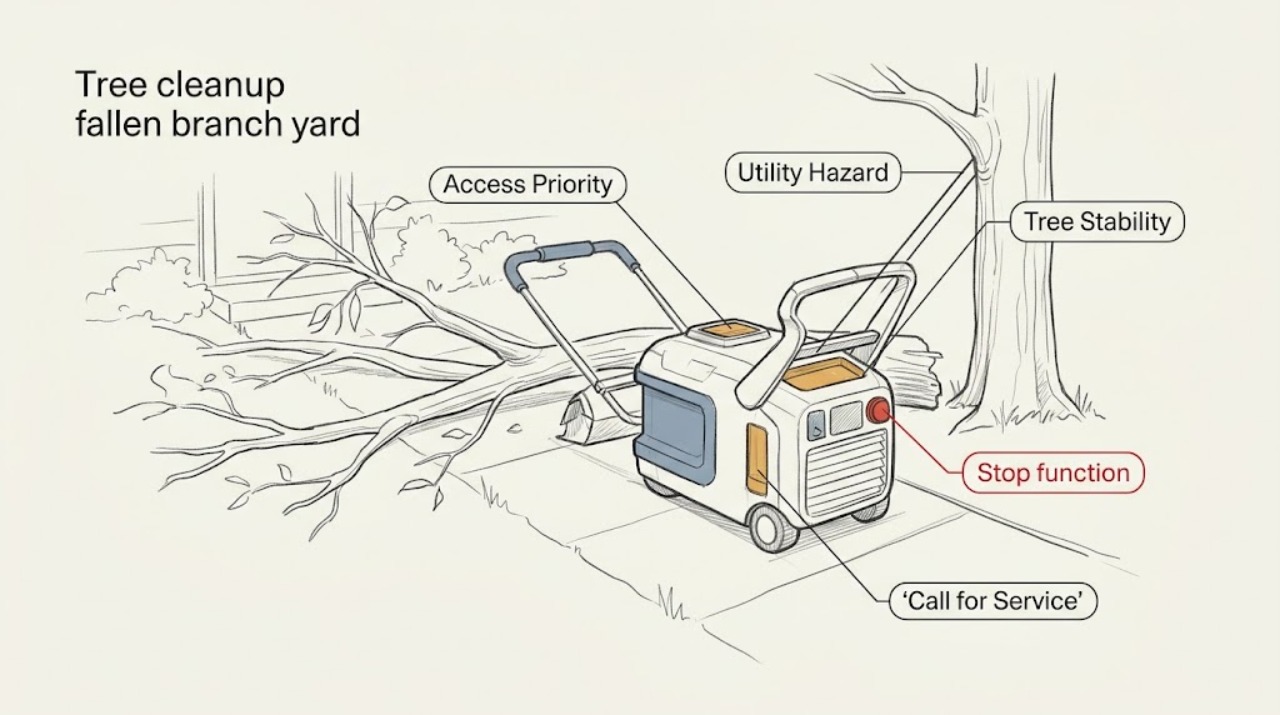
Work through in order
Diagnostic checks
Use only checks that match the exact appliance or system and its official guide.
-
Check 1
From a distant stable position, determine whether the blocked walkway is a sole entrance, emergency exit, route to utilities, or the only safe path around the property.
Expected result: Record alternate routes, whether occupants or emergency responders would have to pass under the tree or through debris, and whether the path is blocked by one loose piece or a larger tree or canopy.
Next step: Keep people and vehicles off the route, use a clearly safe alternate path if available, and request prompt qualified cleanup or emergency access assessment.
Stop if: Do not force a passage, move debris to open the route, or enter a fall zone to inspect an alternate path.
Why this matters
Why: A sole or emergency route raises urgency even when the branch itself looks small. A blocked secondary path can still be unsafe if the surrounding tree, ground, or overhead hazards have not been cleared.
-
Check 2
Check from a distance whether a power or communication line is down, sagging, arcing, or touching the branch, tree, fence, vehicle, or wet ground near the walkway.
Expected result: Answer yes if any line or possible contact is visible; answer no only when no line hazard can be seen from the safe viewpoint.
Next step: Keep everyone away and call the utility or emergency authority; do not approach the walkway, branch, fence, puddle, or tree contact point.
Stop if: Never touch, step over, pull, cut, or move a line or an object in contact with it.
Why this matters
Why: Yes makes the walkway an electrical exclusion zone. The line and anything touching it must be treated as energized until the utility confirms otherwise, regardless of whether neighborhood power appears off.
-
Check 3
View the trunk, major limbs, canopy, and root area from outside the likely fall zone without standing beneath the tree.
Expected result: Note a leaning or split trunk, lifted root plate, fresh soil cracks, hanging or partially attached limbs, broken crown, movement in wind, or a limb resting on another tree or structure.
Next step: Keep the walkway and fall zone closed and request a qualified arborist or tree-removal assessment with distant photos.
Stop if: Do not climb, brace, tie, rope, shake, pull, or cut any tree or limb.
Why this matters
Why: These signs indicate an unstable or loaded tree scene, not a simple walkway-cleanup task. Saturated soil can further reduce root stability, and a hung limb can shift without warning.
-
Check 4
Inspect the ground and the walkway approach from firm, dry terrain without crossing mud, standing water, root voids, or a debris pile.
Expected result: Record saturated or eroded soil, slick footing, hidden holes, standing water, sharp fragments, damaged paving, and whether the blockage could shift if touched or if weather changes.
Next step: Reroute people and mark the blocked area from a safe position; arrange qualified cleanup or local emergency assistance if the route is needed.
Stop if: Do not walk through water or mud, drive over debris, or step onto a damaged walkway to test it.
Why this matters
Why: Unstable footing or ground can turn a small branch into a fall, crush, or access hazard and can make the tree's root support less reliable.
-
Check 5
From outside the branch's drop and roll path, determine whether it is fully detached and resting freely or remains attached, pinned, suspended, or supported.
Expected result: Record loose on firm ground versus attached at one end, hung in the canopy, wedged against a structure, under another limb, bent, or showing movement or tension.
Next step: Leave attached or loaded material in place, keep the walkway closed, and give the state and photos to the tree professional.
Stop if: Do not cut, saw, chop, drag, roll, lever, or pull the branch.
Why this matters
Why: Only a small, fully detached piece on firm ground can be considered ordinary cleanup. An attached, suspended, pinned, or tensioned limb requires trained removal and must not be pulled to reopen the walkway.
-
Check 6
Check whether the walkway blockage is only a small, fully detached branch on firm dry ground, with no line, unstable tree, tension, sharp hazard, or need to climb, pull, or lift awkwardly.
Expected result: Answer yes only when every condition is visibly satisfied and a safe alternate route remains available; answer no if any condition is unknown or the walkway is the sole route.
Next step: If yes, handle only small loose pieces from the clear side and stop at the first resistance or movement. If no, keep the route isolated and call qualified tree or cleanup service promptly.
Stop if: Never use a chainsaw, climb, pull a hung limb, work under the canopy, or reopen a sole route by force.
Why this matters
Why: Yes supports limited ordinary ground-level pickup with suitable gloves and local disposal compliance, but it does not authorize cutting or heavy handling. No requires professional or emergency access service and leaves the branch in place.
Use your observations
Decision map
Find the observation that best matches what you see, then follow the next safe action.
-
PATH 01Next step
What you see
A downed, sagging, arcing, or contacted line is visible near the branch, tree, walkway, fence, vehicle, or wet ground.
Do this next
Keep the entire area clear and contact the utility or emergency authority; do not touch or move any part of the line or debris.
-
PATH 02Next step
What you see
The tree leans or splits, roots or soil are lifted or saturated, the canopy moves, or a large limb is attached, hung, pinned, or supported.
Do this next
Close the walkway and request prompt qualified arborist or tree-removal assessment from outside the fall zone.
-
PATH 03Next step
What you see
The blockage prevents the only entrance, emergency exit, utility route, or safe way around the property.
Do this next
Treat access as urgent, keep occupants and responders out of the hazard area, use another safe arrangement if available, and request prompt professional clearance.
-
PATH 04Next step
What you see
The approach has mud, standing water, erosion, root voids, damaged paving, sharp debris, or other unstable footing.
Do this next
Keep the route closed and arrange qualified cleanup or local emergency access assistance; do not cross or drive over it.
-
PATH 05Next step
What you see
A small branch is fully detached, resting freely on firm dry ground, clear of utilities and unstable trees, and reachable without climbing, pulling, force, or awkward lifting.
Do this next
Limited ground-level pickup may be considered with suitable gloves and local disposal compliance, provided an alternate safe route exists; stop if the piece moves or reveals another hazard.
-
PATH 06Next step
What you see
Distance, weather, darkness, changing wind, or the branch's support prevents a reliable determination of line, tree, ground, tension, or access safety.
Do this next
Treat the walkway as unsafe and request professional storm-damage assessment instead of testing it by touch.
Helpful context
Understand the symptom
Blocked access changes urgency
A branch across a walkway can prevent safe entry, exit, deliveries, or emergency access. After a storm, the same blockage may be connected to a damaged tree, stored limb tension, saturated roots, or a utility line. Establish whether another safe route exists before considering any cleanup; never make the walkway passable by moving a branch you have not cleared as safe.
Observe from the ground
Stay on firm ground outside the likely fall, roll, and electrical zones. Look at the branch, trunk, canopy, root area, lines, structures, and walkway from a distance. Do not climb, stand under hanging material, pull or rope a branch, cross mud or standing water, or use a chainsaw or other cutting tool.
Service priority
A downed or contacted line goes to the utility or emergency authority. A leaning tree, lifted root plate, hung or tensioned limb, saturated ground, damaged structure, or sole blocked route goes to prompt arborist, tree-removal, or emergency access service. Ordinary pickup is limited to clearly small, fully detached pieces on a stable, hazard-free route.
Safety boundary
Stop conditions
- Treat every downed or contacted power line as energized; stay clear and contact the utility or emergency authority.
- Do not use a chainsaw, climb, enter the canopy or fall zone, pull or rope a hung limb, brace a tree, or cut storm-loaded wood.
- Do not cross saturated or unstable ground, standing water, root voids, damaged paving, or a debris pile to reopen the walkway.
- Do not drag, roll, lever, or lift heavy or awkward branches, or drive over the blockage.
- Close a sole entrance or emergency route and request prompt service rather than forcing a passage.
- Stop ordinary pickup when the piece resists, shifts, reveals an attachment or line, or the weather, light, footing, or scene becomes uncertain.
Only after diagnosis
Potential parts
- work-gloves
Consider only after the safe-pickup gate is satisfied and local disposal rules allow ordinary cleanup.
Gloves do not make lines, hung limbs, saturated ground, sharp fragments, or unstable trees safe; use only for small loose pieces on a clear firm route. - yard-waste-bags
Consider only when utilities, tree stability, ground, and sole-route hazards have been ruled out from the ground.
Use only for light loose debris that can be handled comfortably without dragging or lifting heavy wood; never bag attached or tensioned material. - heavy-duty-tarp
Consider only for contained loose debris on firm ground when placement does not enter a hazard zone.
A tarp is not a restraint, rope, lifting device, or cover for a hung limb; do not pull or drag storm-loaded material with it.
When checks do not resolve it
Need a professional?
Contact the utility or emergency authority immediately for downed or contacted lines. Contact a qualified arborist or tree-removal professional promptly for hung limbs, leaning or root-damaged trees, saturated ground, sole-route blockage, structural impact, or any uncertain scene. Use planned ordinary cleanup only for clearly small, detached loose pieces.
Safety scope: The professional evaluates lines, fall zone, root stability, stored tension, route urgency, and disposal, then clears or removes material with appropriate training and equipment.
Have this ready
- Distant photos of the blockage, whole tree, canopy, root area, and walkway approaches
- Whether any line is down, sagging, or in contact with the tree or branch
- Whether the limb is hung, attached, pinned, supported, or under tension
- Ground saturation, erosion, standing water, sharp debris, and route condition
- Whether the walkway is the only entrance, emergency exit, or utility route
- Storm timing and what was not touched, pulled, cut, climbed, or crossed
Common questions
FAQ
What is the first check when a branch blocks a walkway?
From a distance, check for lines, a leaning or root-lifted tree, hung or tensioned limbs, saturated ground, and whether the walkway is the only entrance or emergency route. Do not move the branch to find out.
Can I pull the branch off the walkway?
No if it is attached, hung, pinned, supported, heavy, or of uncertain tension. Pulling can release stored energy or shift the tree. Leave it in place for a qualified tree crew.
What if the walkway is the only way out?
Keep everyone away from the blocked and overhead hazard area and use a safe alternative only if one exists. Notify the appropriate emergency or property authority and request prompt professional clearance.
Does saturated ground matter if the branch is detached?
Yes. Saturated or eroded soil can create slips, hide holes, and reduce root stability around the tree. A clear branch is not enough to clear the scene.
Can I use a chainsaw to reopen the walkway?
No. Chainsaw work, climbing, hung-limb release, and storm-damaged tree removal require trained professionals and a controlled work zone. This article does not provide cutting instructions.
When is small-branch pickup reasonable?
Only when the piece is small and fully detached on firm dry ground, no line or unstable tree is involved, an alternate route exists, and no climbing, pulling, force, or awkward lifting is needed. Stop at any uncertainty.
Read the exact guide
Official sources
- Guidelines for Cleaning Safely After a DisasterCenters for Disease Control and Prevention · Official CDC guidance for avoiding power lines and branches bent or caught under something else during cleanup.
- Line-Clearance Tree Trimming OperationsOccupational Safety and Health Administration · Official OSHA guidance used to keep line-adjacent tree work within trained line-clearance scope.
- Tornado Preparedness and Response - Response/RecoveryOccupational Safety and Health Administration · Official OSHA storm-response guidance used for utility, falling-object, sharp-debris, and unstable cleanup boundaries.
Community feedback
Share a repair observation
Share a plain-text repair observation. Accepted observations are published automatically; this page may take a moment to update.