
On this page
Start here
Quick answer
After a tree is cut, a log is not ordinary yard waste: its weight, rolling potential, slope, hidden limbs, utility proximity, and remaining tree hazards determine whether cleanup is safe. From a safe location, document the log's approximate size and position, the ground slope, property access, overhead or nearby utilities, and any attached or hanging limbs. Do not cut, lift, roll, drag, tow, climb, rig, or work downhill or beneath limbs yourself. Keep people and pets away from an unstable log or active tree hazard and arrange a qualified tree-care or debris-removal service with the observations and photos.
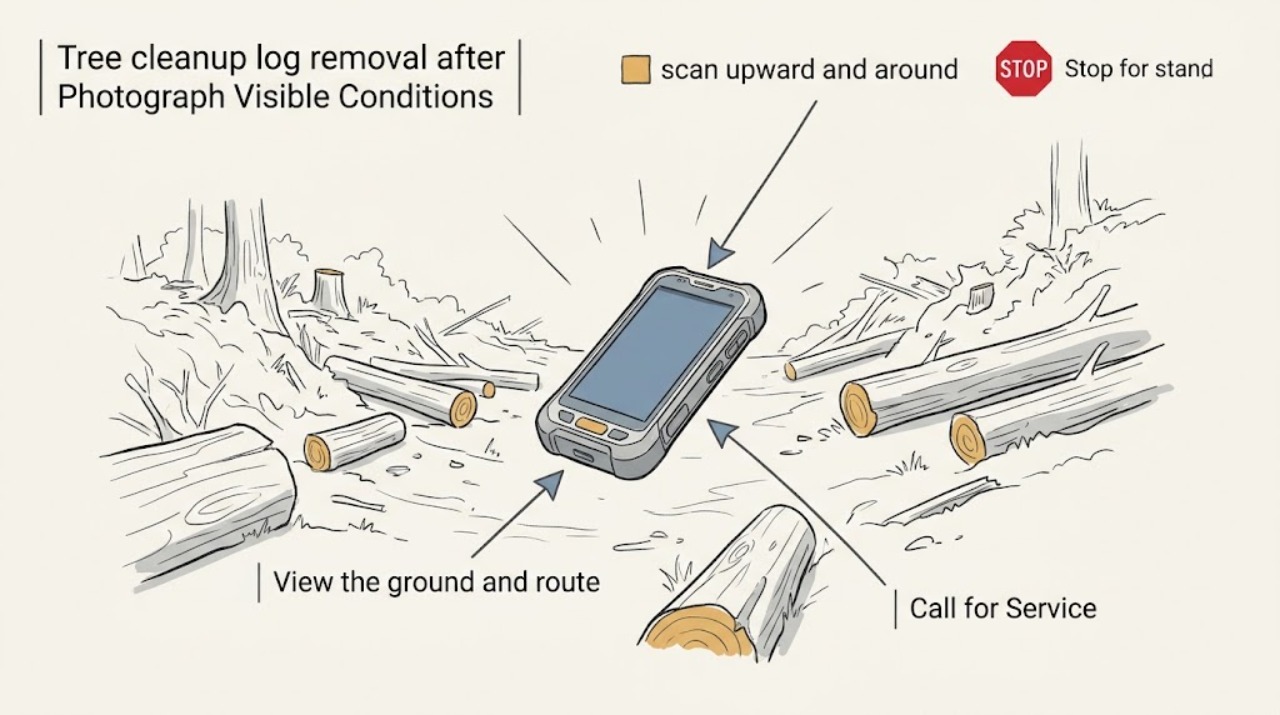
Work through in order
Diagnostic checks
Use only checks that match the exact appliance or system and its official guide.
-
Check 1
From a stable location outside the expected movement area, photograph the log and surrounding worksite without touching the wood. Record whether the log appears short or long, narrow or large, intact or split, and whether branches, root sections, or cut pieces remain attached.
Expected result: The log may be a compact section on level ground, a large trunk, a split or suspended piece, or part of a pile with attached branches and other pieces.
Next step: Send wide and close photographs to a qualified tree-care or debris-removal provider and ask them to include log handling, loading, and final cleanup in the scope.
Stop if: Stop viewing and keep everyone away if the log shifts, is suspended, is under tension, or is close enough that a roll or falling piece could reach the observer.
Why this matters
Why: Size, shape, attachment, and pile condition determine whether ordinary yard-waste handling is inappropriate and whether specialized equipment or a tree-care crew is needed. Visual estimates are for planning a quote, not for deciding that a load is safe to handle.
-
Check 2
View the ground and route from a safe, level position. Note whether the log is on level soil, near a drop, on a slope, against a wall or fence, beside a ditch, or in a place where rain or mud could change its position.
Expected result: The log may be stable-looking on level ground, or it may be angled, downhill, partly supported, near erosion, or positioned where a small shift could reach a structure or route.
Next step: Report the slope, drop, drainage, and nearby obstacles before scheduling removal. Keep the route closed and use a professional plan when the log is downhill, near a drop, or blocking a driveway or public path.
Stop if: Do not approach from below, stand downhill of the log, brace it, or try to make it move.
Why this matters
Why: Slope, drop-offs, wet ground, and obstacles increase rolling, sliding, crushing, and access risks. A visible resting point does not prove that stored weight or tension has been released.
-
Check 3
From outside the work area, scan upward and around the log for standing, leaning, broken, or hanging limbs, a partially cut trunk, damaged roots, and other trees that could fall into the cleanup route.
Expected result: The area may be clear of visible overhead concerns, or it may contain hanging limbs, a leaning tree, a suspended section, broken tops, or remaining cuts and stubs.
Next step: Tell the provider exactly what remains standing or hanging and request a hazard assessment before cleanup. Keep people and pets outside the visible and potential fall area.
Stop if: Do not work under limbs, climb, touch a hanging section, or enter the area during wind, rain, or other conditions that can move the tree.
Why this matters
Why: Residual tree hazards can make log removal a tree-care operation rather than a simple hauling job. A professional must assess the tree and site before any person or machine enters the hazard area.
-
Check 4
From a safe distance, identify overhead lines, service drops, poles, buried-utility markers, fences, buildings, vehicles, public paths, and property boundaries near the log. Note whether access would require crossing a neighbor's land or a public route.
Expected result: The log may be in an open private area, or it may be close to utilities, structures, traffic, neighbors, gates, narrow access, or a public walkway.
Next step: Provide the access and utility information to the provider and obtain any required utility or property coordination through the appropriate professionals. Do not enter utility or public-route exclusion areas to improve the view.
Stop if: Keep away from any limb, log, or equipment near a power line or service drop and contact the utility or qualified tree-care provider rather than approaching.
Why this matters
Why: Utilities, property boundaries, and public access change who must coordinate the work and what equipment can enter. Tree limbs or equipment near energized lines can create an electrocution hazard.
-
Check 5
Document the requested outcome from a safe location: full removal, on-site stacking, chipping of small debris by a provider, or leaving usable wood in an agreed location. Note access limits, surface protection concerns, and where cleanup should end.
Expected result: The site may permit a straightforward professional pickup, or it may require specialized access, a crane or loader assessment, traffic coordination, or separate treatment of the stump, branches, and logs.
Next step: Ask for a written scope that states what will be removed, how the provider will protect property, how access will be controlled, and whether stump or branch work is excluded.
Stop if: Do not agree to or attempt a cleanup method that requires lifting, rolling, dragging, towing, rigging, chainsaws, chippers, climbing, or entry beneath limbs by an untrained homeowner.
Why this matters
Why: A clear scope prevents an unsafe last-minute request to move heavy material by hand or with an improvised vehicle connection. It also tells the provider whether the job includes remaining hazards rather than only visible logs.
Use your observations
Decision map
Find the observation that best matches what you see, then follow the next safe action.
-
PATH 01Safety boundary
What you see
The log is on level private ground, separated from remaining trees and utilities, with clear professional access.
Do this next
Send photographs and dimensions as approximate planning information and request a qualified log-removal and cleanup scope. Keep the area clear until the provider arrives.
Why this path and its safety boundary
Safety stop: Do not treat apparent stability as permission to move the log yourself.
-
PATH 02Safety boundary
What you see
The log is on a slope, near a drop, against a structure, in wet or eroded soil, or positioned where it could roll or slide.
Do this next
Keep people out of the downhill and movement areas and request a professional site assessment with suitable equipment and access planning.
Why this path and its safety boundary
Safety stop: Do not approach from downhill, brace the log, or use a vehicle, rope, chain, or improvised anchor to move it.
-
PATH 03Safety boundary
What you see
Standing trees, hanging limbs, partially cut sections, damaged roots, or storm debris remain near the log.
Do this next
Request tree-hazard assessment and log cleanup from a qualified tree-care provider; state that remaining hazards are part of the site condition.
Why this path and its safety boundary
Safety stop: Do not enter beneath limbs, climb, cut, or work during wind or other conditions that can move the tree.
-
PATH 04Safety boundary
What you see
The log or access route is close to overhead lines, service drops, buried-utility markers, traffic, public paths, or another property.
Do this next
Keep clear and coordinate utilities, public access, and property permission through the utility, owner, or qualified provider before work is scheduled.
Why this path and its safety boundary
Safety stop: Do not approach or move anything near a utility line or cross a boundary without authorization.
-
PATH 05Safety boundary
What you see
The log is split, suspended, under visible tension, part of a pile, or has shifted since the cut.
Do this next
Treat the site as urgent tree-care or load-handling work and request an in-person assessment. Keep everyone outside the potential movement area.
Why this path and its safety boundary
Safety stop: Do not touch, climb, roll, lift, drag, tow, rig, or separate the pieces.
Helpful context
Understand the symptom
Treat the log and the remaining tree as one worksite
A felled trunk can shift even when it looks still, and nearby limbs, stumps, roots, slopes, fences, and utility lines can change the risk. The first decision is whether the area can be viewed safely from outside the hazard zone, not how to move the wood. OSHA identifies struck-by, fall, electrical, equipment, and load-handling hazards in tree-care and log-handling work; those tasks belong with trained and properly equipped providers.
Limit the homeowner check to observation
Do not approach from downhill, stand below a suspended or leaning limb, step onto the log, or enter a place where a roll or fall could reach you. Take photographs from a stable surface only when the view is safe. If the tree was storm-damaged or partially cut, assume remaining limbs and roots can move until a qualified professional confirms the site is clear.
Only after diagnosis
Potential parts
- heavy-duty tarp
Only consider a tarp after a qualified provider confirms it can be placed safely without approaching or disturbing the log and only for protecting an agreed staging area.
Confirm size, weather resistance, anchoring limits, and local disposal requirements; a tarp is not a load-control or lifting device. - work gloves
Only consider gloves for ordinary loose, lightweight debris after the provider or site owner confirms that the area is clear of tree, utility, and load hazards.
Gloves do not make log handling, chainsaw work, rigging, climbing, or work near utilities safe for an untrained person. - yard-waste bags
Only consider bags for small loose debris that is already separated and confirmed safe to collect without approaching the log or remaining tree hazards.
Check local yard-waste rules and weight limits; bags are not for logs, heavy branches, sharp sections, or contaminated debris.
When checks do not resolve it
Need a professional?
Call a qualified tree-care or debris-removal provider when a cut log remains, especially if it is large, split, suspended, downhill, near a structure or utility, part of a pile, or accompanied by standing or hanging tree hazards.
Common questions
FAQ
Can I move a tree log with a rope, vehicle, or hand tools?
Do not improvise log movement. A log can roll, slide, split, or release stored energy, and a rope or vehicle connection can fail. Have a qualified provider assess the load, ground, access, and remaining tree hazards.
What if the log is close to a power line?
Stay away and do not approach the limb, log, or equipment. Tell the utility and qualified tree-care provider where the line and service drop are. Tree work near energized lines requires trained personnel and coordination.
Should cleanup include the stump and remaining limbs?
State the desired outcome before booking. Log pickup, branch cleanup, stump work, and hazard assessment can be different scopes. Ask the provider to identify what is included and what remains.
How can I safely document the log for a quote?
From a stable location outside the potential movement and fall areas, take wide and close photos and note approximate size, number of pieces, slope, access, utilities, structures, property boundaries, and any remaining limbs. Do not step onto or touch the log.
Read the exact guide
Official sources
- Ropes, Cables, Slings, and ChainsOccupational Safety and Health Administration · Industrial log-handling reference used to support keeping homeowners away from improvised load movement and rigging.
- Maintain trees and remove hazards to reduce severity or extent of wind and ice damageUSDA Climate Hubs · General tree-hazard context, particularly where cleanup follows wind or ice damage; site-specific assessment remains necessary.
- Inspection Guidance for Tree Care and Tree Removal OperationsOccupational Safety and Health Administration · Occupational tree-care guidance used to define professional-only hazards and observation boundaries for a homeowner cleanup request.
Community feedback
Share a repair observation
Share a plain-text repair observation. Accepted observations are published automatically; this page may take a moment to update.