
On this page
Start here
Quick answer
Treat a fallen branch in a yard access path as a hazard survey first, not a carrying or cutting job. From stable ground, look for hanging or connected limbs, a bent or tensioned branch, a damaged tree, utility lines, structures, blocked public access, unstable soil, and whether the path can be isolated without approaching the debris. Keep people and pets out, do not touch or move heavy wood, and never use a chainsaw, ladder, rope, vehicle, or climbing method. If a line, structure, large or tensioned branch, or unsafe access is involved, contact the utility, emergency service, or qualified arborist; only clear small loose debris after a professional confirms the area is safe.
Before you begin
Safety first
- This is an observation-only guide. Do not use a chainsaw, climb, use a ladder, touch lines or connected objects, pull or drag heavy wood, use a vehicle or rope, cut, lift, brace, or enter the exclusion area. Tree removal and utility-line clearance require trained professionals and the responsible utility authority.
Work through in order
Diagnostic checks
Use only checks that match the exact appliance or system and its official guide.
-
Check 1
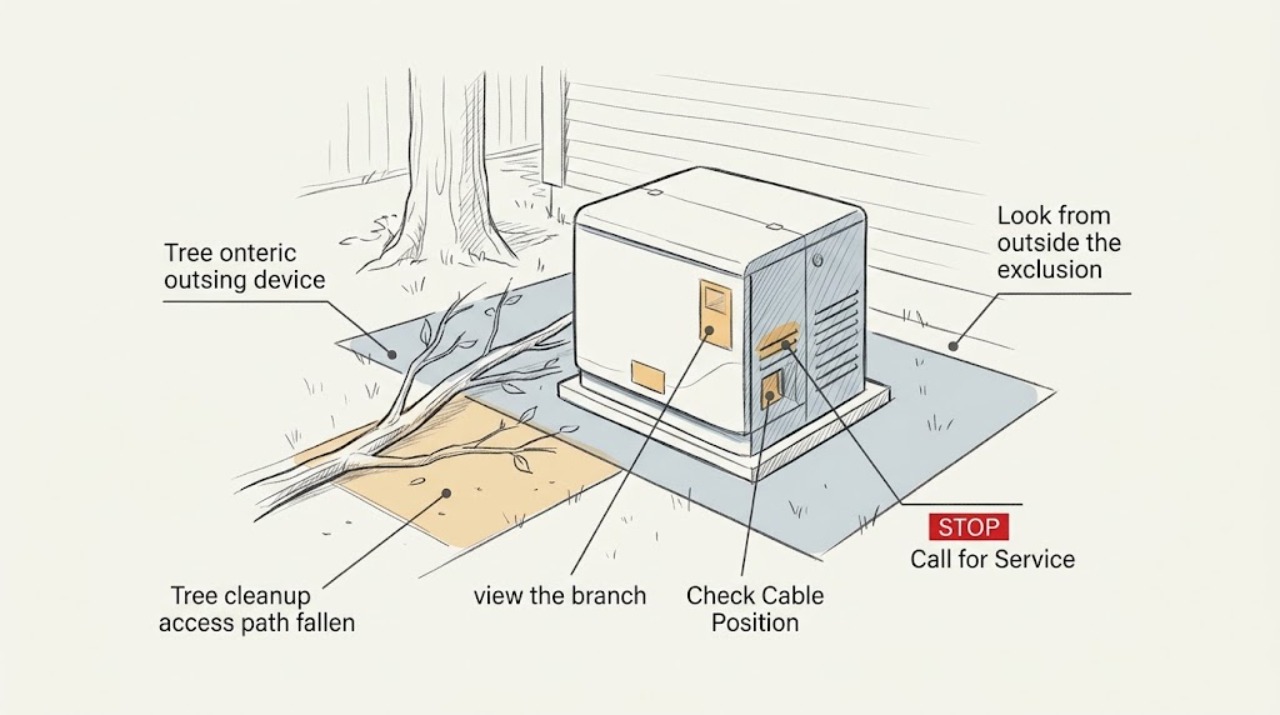
From a stable position at the edge of the access path, view the branch and the entire nearby tree without stepping over, under, or onto the debris.
Expected result: Note whether the branch is fully detached, still attached, resting in another tree, hanging overhead, leaning against a structure, or moving in wind; note whether additional broken limbs or a shifted trunk are visible.
Next step: Keep the path closed and arrange qualified tree assessment. Describe the branch position and any continuing movement rather than trying to make the path passable.
Stop if: Stop and move farther away if the tree shifts, a limb drops, the ground moves, weather worsens, or a closer view would require entering the canopy or debris area.
Why this matters
Why: A connected, suspended, supported, or moving branch is an active fall and tension hazard. A detached appearance does not prove that nearby limbs or trees are stable.
-
Check 2
Trace the visible utility route from a safe distance without touching a wire, branch, fence, puddle, vehicle, or other object near the fallen material.
Expected result: Record whether any wire is down, low, hidden in the tree, attached to a branch, or near the access path; note damaged poles, electrical equipment, smoke, arcing, or an outage if visible.
Next step: Keep everyone and vehicles away and contact the responsible utility or emergency service from a safe location. Tell the tree professional that utility contact is suspected and wait for the responsible authority before any cleanup.
Stop if: Stop immediately for any downed or low line, branch-to-line contact, damaged electrical equipment, smoke, fire, or arcing; never approach to identify a wire.
Why this matters
Why: A line can remain energized even when it is quiet or not sparking, and nearby trees or objects may also be energized. This is a utility hazard, not a cleanup task.
-
Check 3
Look from outside the exclusion area toward the path, driveway, sidewalk, gate, fence, building, vehicle, and other places people or equipment would need to pass.
Expected result: Note whether the branch blocks a public route or emergency access, has struck a structure or vehicle, rests on a fence or gate, threatens a window, or has created a trip, crush, or falling-object hazard.
Next step: Keep people, pets, and vehicles out; notify the appropriate property or emergency authority when access or life safety is affected; request qualified tree removal.
Stop if: Stop if assessment would require crossing the path, entering under a limb, opening a damaged structure, moving a gate, or standing in a roadway.
Why this matters
Why: A blocked public or occupied route can require emergency coordination, while contact with a structure or vehicle may keep the branch under load. The access need does not justify moving it.
-
Check 4
Inspect the visible ground around the path and branch from a dry, stable position without stepping onto disturbed soil, roots, mud, slope, or the branch.
Expected result: Note root heaving, a leaning nearby tree, cracked or split wood, saturated or undermined soil, standing water, hidden-looking debris, and whether the branch appears to bear against another object.
Next step: Share the observations with the arborist and maintain the exclusion area. Do not test stability by pushing, pulling, dragging, lifting, tying, or cutting.
Stop if: Stop if soil collapses, the branch rolls, another tree leans, water is contaminated, or any closer observation requires entering a slope, root ball, debris pile, or restricted area.
Why this matters
Why: Root movement, saturated ground, cracks, splits, and bearing contact can signal additional instability or stored force. A ground view cannot determine how the branch will release when moved.
-
Check 5
Document the access problem from outside the hazard area and review the timeline without handling the fallen branch or other wood.
Expected result: Record storm timing, path location, approximate branch size category, affected property or utility features, photos from a safe position, ongoing weather, and whether any small loose debris is separate from the main branch.
Next step: Give the information to the tree-removal professional, utility, or emergency authority as appropriate. Leave the main branch and any connected wood untouched until cleared for handling.
Stop if: Stop documentation if it requires returning to the path, using a ladder or drone near lines, standing below limbs, driving closer, or working during active severe weather.
Why this matters
Why: A distant record helps the professional plan access and identify urgent hazards without creating a second exposure. Size and stability remain professional assessments, not assumptions from a photograph.
Use your observations
Decision map
Find the observation that best matches what you see, then follow the next safe action.
-
PATH 01Safety boundary
What you see
A wire is down or low, a branch touches a wire, electrical equipment is damaged, or smoke, fire, or arcing is visible or suspected.
Do this next
Keep people and vehicles away, treat the line and nearby objects as energized, and contact the responsible utility or emergency service from a safe location. Wait for the responsible authority before tree cleanup.
Why this path and its safety boundary
Safety stop: Do not approach, touch, move, cut, or drive over the line or anything connected to it.
-
PATH 02Safety boundary
What you see
The branch is attached, suspended, tensioned, resting in another tree, or surrounded by hanging limbs or a leaning tree.
Do this next
Keep the access path closed and request urgent assessment by a qualified arborist or tree-removal professional. Provide the static position and movement observations.
Why this path and its safety boundary
Safety stop: Do not use a chainsaw, rope, vehicle, winch, ladder, or hand force to release or stabilize the wood.
-
PATH 03Safety boundary
What you see
The branch is on a roof, building, vehicle, fence, gate, or public route, or it blocks emergency access.
Do this next
Coordinate the affected property or emergency authority and a qualified tree-removal professional; keep the route isolated rather than moving the branch to create access.
Why this path and its safety boundary
Safety stop: Do not climb onto a structure, enter beneath the branch, open damaged property, or pull the wood away.
-
PATH 04Safety boundary
What you see
The main branch is fully detached on private ground, no utility or structural hazard is visible, and a professional has confirmed the area is safe for limited handling of small loose debris.
Do this next
Follow the professional's site-specific direction for any small, loose, ordinary yard debris only; leave the main branch and any uncertain material for the tree-removal crew.
Why this path and its safety boundary
Safety stop: Stop if a piece is heavy, sharp, embedded, under tension, connected to the tree, difficult to lift, or requires cutting, dragging, climbing, or equipment.
-
PATH 05Safety boundary
What you see
Weather is still severe, the ground or access path is unstable, or the hazard cannot be viewed from a safe position.
Do this next
Wait in a safe location, keep others out, and provide the known scene information when contacting the appropriate tree, utility, or emergency service.
Why this path and its safety boundary
Safety stop: Do not return to inspect, mark, cover, or clear the path during active wind, lightning, flooding, or poor visibility.
Helpful context
Understand the symptom
A branch that blocks a path may still be attached to a standing tree, supported by another limb, or loaded with tension. Broken limbs overhead can move after the storm, and a tree can be in contact with a utility line indirectly through branches, fencing, or other objects. The fact that a branch is on the ground does not establish that it is safe to pull or cut.
Begin at the edge of the yard or another stable ground-level position. Establish an exclusion area without walking beneath the canopy or stepping over the branch, and use camera zoom only from a safe location. Record what a professional needs to know: the path location, branch position, overhead conditions, structures or lines affected, and whether the scene is still changing.
Do not turn an access problem into a cutting operation. A qualified arborist or tree-removal crew can assess tension, remaining tree stability, and a safe removal route. If a utility line or electrical equipment is involved, the utility authority must control that hazard before tree work.
Only after diagnosis
Potential parts
- yard-waste bags
Consider this only after a professional confirms the area is safe and only for small, loose, non-sharp yard debris; bags are not for branches, trunk sections, or debris that must be cut or lifted.
Confirm local yard-waste rules and bag capacity; do not carry a bag through the exclusion area or use it to drag heavy wood. - heavy-duty tarp
Consider this only for temporary ground protection of a clear, safe area after professional direction; it is not a cover, restraint, or lifting aid for a tree or large branch.
Confirm wind conditions and placement method; never throw, tie, tension, or anchor a tarp to a tree, roof, fence, wire, or unstable structure. - work gloves
Consider this only for small loose debris after a professional confirms that limited ground-level handling is safe; gloves do not make sharp, heavy, tensioned, or connected wood safe.
Select protection appropriate to the confirmed task and local guidance; do not use gloves as authorization to cut, pull, climb, or move the main branch.
When checks do not resolve it
Need a professional?
Request urgent qualified tree service for a branch that is attached, suspended, tensioned, on a structure or vehicle, blocking a public or emergency route, near a utility line, surrounded by unstable trees, or too heavy or inaccessible for safe ground-level observation. Contact the utility or emergency service first for any suspected line hazard, smoke, or fire.
Safety scope: This is an observation-only guide. Do not use a chainsaw, climb, use a ladder, touch lines or connected objects, pull or drag heavy wood, use a vehicle or rope, cut, lift, brace, or enter the exclusion area. Tree removal and utility-line clearance require trained professionals and the responsible utility authority.
Common questions
FAQ
Can I move a fallen branch out of the yard path?
Do not move it until a professional confirms that it is detached, not under tension, clear of utilities and structures, and safe to handle. Never pull, drag, lift, or cut heavy, connected, sharp, or uncertain wood.
What if the branch is touching a power line?
Stay away and treat the line, branch, ground, and nearby objects as energized. Do not touch or drive over the area; contact the responsible utility or emergency service and wait for its direction before cleanup.
Is a branch safe if it looks fully detached?
Not necessarily. Nearby limbs, roots, another tree, or hidden tension may still create movement. Observe only from stable ground and have a qualified arborist assess the branch and surrounding tree.
Can I use a tarp or yard bags to clear the path?
Only after a professional confirms the area is safe, and then only for small loose debris from clear ground. A tarp or bag is not a restraint or lifting aid for a branch, trunk, tree, roof, fence, or utility hazard.
Read the exact guide
Official sources
- Working Safely Around Downed Electrical WiresOccupational Safety and Health Administration · OSHA warns that downed or low wires can remain energized, can energize nearby trees and objects, and must not be approached or treated as safe because they are quiet or not sparking.
- Line-Clearance Tree Trimming OperationsOccupational Safety and Health Administration · OSHA distinguishes specialized line-clearance tree work from ordinary homeowner cleanup and describes training, approach-distance, insulated-equipment, and adverse-weather requirements for qualified workers.
- Storm-Related Tree DamageInternational Society of Arboriculture (TreesAreGood.org) · ISA identifies hanging or moving limbs, uprooted trees, tensioned wood, utility contact, height, structures, and cutting equipment as hazards, and recommends staying clear and using a professional arborist.
Community feedback
Share a repair observation
Share a plain-text repair observation. Accepted observations are published automatically; this page may take a moment to update.