
On this page
Start here
Quick answer
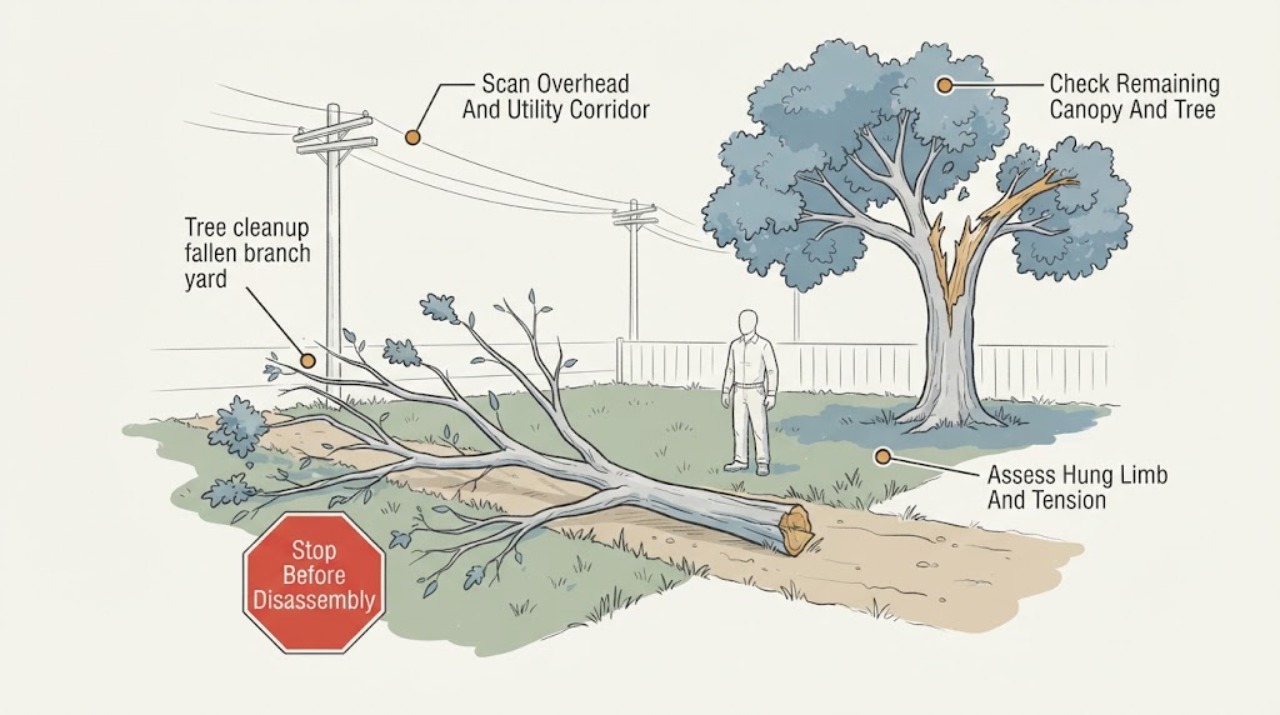
Treat a fallen branch as a tree-hazard assessment before treating it as yard waste. From a safe distance, look for overhead or downed utilities, branches still hanging or supported by the fallen limb, visible tension or movement, damage to roofs or fences, blocked public access, and active or forecast severe weather. A small, fully detached branch in an open yard may only need a routine cleanup quote; anything suspended, touching a utility, near a structure, under tension, or reachable only by climbing or equipment needs qualified tree service. Do not cut, lift, drag, climb, pull with a vehicle, or work beneath hung limbs.
Work through in order
Diagnostic checks
Use only checks that match the exact appliance or system and its official guide.
-
Check 1
From a safe distance, scan above and around the fallen branch for overhead lines, downed lines, poles, service connections, or a limb touching or resting against utility equipment. Do not approach, touch, move, or photograph a line from close range.
Expected result: No utility is nearby, a line or utility is nearby but separate, a branch appears to contact it, or the condition cannot be determined from a safe distance.
Next step: Keep everyone away, report suspected utility contact to the utility or proper local authority, and tell the tree professional exactly what was visible without entering the area.
Stop if: Stop immediately if a line is down, a limb touches a line, equipment is damaged, or any inspection would bring you closer to a possible energized object.
Why this matters
Why: A possible utility contact changes the job from ordinary yard cleanup to utility and qualified tree-service coordination. An uncertain view should be treated as a hazard rather than assumed clear.
-
Check 2
From outside the area where a limb could swing or fall, observe whether the branch is fully on the ground or still suspended by the trunk, canopy, fence, roof, or another branch. Look for bending, twisting, lifted roots, compressed limbs, or movement in wind; do not test the branch with a hand, rope, pole, vehicle, or tool.
Expected result: The branch is fully detached and settled, partly supported, visibly tensioned or moving, or its support is hidden.
Next step: Photograph the branch and its support points from a distant safe location and request a tree-service assessment; keep people and pets outside the potential fall path.
Stop if: Stop if the limb moves, cracks, rolls, is suspended above the ground, or can only be assessed from beneath it or by climbing.
Why this matters
Why: A settled, detached branch in an open area is a simpler service request. Support, movement, lifted roots, or hidden tension means the branch can shift or release suddenly and needs qualified tree work.
-
Check 3
From the yard edge or a protected interior view, inspect the remaining tree and canopy for additional hanging branches, a split trunk, a newly leaning tree, broken leaders, or roots lifted from the soil. Do not walk beneath the canopy or climb, shake, brace, or probe the tree.
Expected result: The remaining tree appears unchanged, has visible broken or hanging limbs, leans differently, shows a trunk split, or cannot be viewed safely.
Next step: Keep the canopy exclusion area clear and report the full tree view, not only the fallen branch, when arranging professional service.
Stop if: Stop if the tree is moving, the trunk or roots appear unstable, branches hang overhead, or safe viewing would require entering the canopy area.
Why this matters
Why: Additional damage can make the fallen branch only one part of a larger hazard. A new lean, trunk split, or hanging canopy increases urgency and means the site should be assessed as a tree hazard, not just a debris pile.
-
Check 4
From a clear, stable position, note whether the branch touches a roof, wall, fence, vehicle, shed, pool, play area, sidewalk, driveway, road, or gate. Record blocked access and visible damage without entering a blocked route or moving the branch.
Expected result: The branch is isolated in an open yard, touches property, blocks private access, blocks public access, or has caused visible damage.
Next step: Send wide and close photos from a safe position, identify the access or property impact, and ask the service provider whether utility, structure, or local-authority coordination is needed.
Stop if: Stop if the branch is on a roof, across a road or sidewalk, against a structure, near people or vehicles, or if access would require stepping over or under it.
Why this matters
Why: An isolated open-yard branch may be quoted as routine cleanup after a safety assessment. Contact with a structure or vehicle, blocked public access, or visible damage requires coordinated professional response and may need urgent protection of people and property.
-
Check 5
Record whether wind, lightning, ice, or another storm is active or forecast, and distinguish loose twigs already on the ground from the main branch and remaining canopy. Do not begin cleanup while severe weather continues and do not use a saw, chipper, ladder, rope, vehicle, or lifting equipment.
Expected result: Weather is calm and the branch is fully detached in an open area, weather remains hazardous, or the branch and canopy scope is uncertain.
Next step: Provide the weather timing, branch condition, access, utility, and property notes to a tree professional and keep the yard exclusion area in place until the hazard is cleared.
Stop if: Stop and shelter or leave the area when wind, lightning, ice, falling debris, blocked exits, or other storm hazards are present.
Why this matters
Why: Calm weather and a settled branch support a planned cleanup assessment, not automatic self-removal. Active or worsening weather and an uncertain canopy require waiting at a safe location and arranging qualified service.
Use your observations
Decision map
Find the observation that best matches what you see, then follow the next safe action.
-
PATH 01Next step
What you see
A branch or tree may touch a power line, downed line, pole, or utility equipment.
Do this next
Keep away and notify the utility or proper local authority. Request tree service only after the utility hazard has been addressed; do not touch the line or branch.
-
PATH 02Next step
What you see
The branch is suspended, bent, twisted, moving, supported by another tree or structure, or has lifted roots nearby.
Do this next
Treat it as a qualified tree-removal job. Keep people and pets outside the potential fall path and do not cut, pull, lift, drag, or work beneath it.
-
PATH 03Next step
What you see
The limb touches a building, vehicle, fence, roof, road, sidewalk, or blocked gate.
Do this next
Request prompt professional coordination and provide wide photos, visible damage, and access details. Do not enter the blocked route or move the limb.
-
PATH 04Next step
What you see
The remaining tree has hanging branches, a split trunk, new lean, root lifting, or other storm damage.
Do this next
Request a whole-tree hazard assessment rather than a branch-only cleanup. Keep clear of the canopy and avoid any climbing or tool work.
-
PATH 05Next step
What you see
The branch is fully detached and settled in an open yard, with no utility, structure, access, or weather hazard visible.
Do this next
Request a routine cleanup quote and confirm the provider's safe handling scope. Do not assume that a detached branch is safe to move without professional direction.
-
PATH 06Next step
What you see
High wind, lightning, ice, falling debris, or another severe-weather condition is active or expected.
Do this next
Stay in a safe location and wait for qualified emergency guidance or service. Do not inspect beneath the tree or begin cleanup during the hazard.
Helpful context
Understand the symptom
Why a branch that looks down can still be dangerous
A broken limb can remain supported by another branch, a fence, a roof, or a utility line. Wind can move the canopy and release stored tension without warning. The first useful information is therefore the branch's relationship to the remaining tree, utilities, structures, and the ground—not its apparent size alone.
Keep the inspection outside the hazard zone
Use a distant yard or window view and take photos only from a stable, clear position. OSHA identifies falling limbs, energized lines, slips, falls, and sharp debris as storm-response hazards. If any line or object may be energized, keep away and notify the utility or proper local authority rather than investigating it.
A cleanup quote needs more than a branch count
Tell the service provider whether the limb is fully detached, where it landed, what it touches, whether access is blocked, and whether other canopy remains damaged. This helps separate loose-yard-debris pickup from suspended-limb removal, utility coordination, structure protection, or a larger tree assessment.
Only after diagnosis
Potential parts
- yard-waste bags
Consider this category only for small, fully detached debris after a qualified professional confirms the area is safe and the material is within local disposal rules.
Do not use bags for heavy limbs, tensioned wood, sharp debris, or material near utilities or structures; confirm local disposal requirements. - heavy-duty tarp
Consider this category only for containing light, already-safe debris after the hazard has been cleared; it is not a tool for pulling or dragging a branch.
Choose a size and material appropriate for light debris only and keep it away from lines, sharp wood, active weather, and unstable branches. - work gloves
Consider this category only for small, detached debris in a confirmed safe area, not for handling the fallen limb or entering a tree-hazard zone.
Gloves do not protect against falling limbs, energized lines, saws, crushing, or tension; professional assessment remains necessary for the main branch.
When checks do not resolve it
Need a professional?
Call a qualified tree-service professional promptly for a suspended or tensioned branch, a branch near utilities or structures, additional canopy or trunk damage, a blocked road or sidewalk, visible property damage, lifted roots, a new lean, or any condition that cannot be viewed safely. Contact the utility or proper local authority first for possible line contact.
Have this ready
- Provide wide and close photos taken from a safe distance, the branch's location and whether it is fully detached, visible support or tension, remaining-canopy damage, utility and structure proximity, blocked access, storm timing, and whether people or vehicles must be kept away.
Common questions
FAQ
Can I cut up a fallen branch if it is already on the ground?
Do not assume that a branch on the ground is safe. First confirm from a distance that it is fully detached, not under tension, away from utilities and structures, and not part of a damaged canopy. For the main branch, request qualified tree service rather than beginning cutting.
What if a fallen branch is touching a power line?
Stay away and do not touch the line, branch, fence, or other object that may be energized. Notify the utility or proper local authority and wait for qualified coordination before any tree cleanup.
How can I tell whether a branch is under tension?
Do not test it. From a safe distance, note whether it is suspended, bent, twisted, supported by another limb or structure, moving in wind, or associated with lifted roots. Any of those observations should be given to a tree professional.
What photos help with a fallen-branch cleanup request?
Take wide and close photos from a safe location showing the branch, remaining canopy, utility corridor, nearby structures, access routes, visible damage, and the storm or weather context. Keep people and pets outside the potential fall path.
Read the exact guide
Official sources
- Inspection Guidance for Tree Care and Tree Removal OperationsOccupational Safety and Health Administration · Supports the article's hazard categories and professional-service boundary; it is not a homeowner cutting or cleanup procedure.
- Tornado Preparedness and Response: Response/RecoveryOccupational Safety and Health Administration · Supports safe-distance observation and escalation for storm debris; it does not authorize untrained tree or utility work.
Community feedback
Share a repair observation
Share a plain-text repair observation. Accepted observations are published automatically; this page may take a moment to update.