
On this page
Start here
Quick answer
Wood chips left after stump grinding should usually be removed from the planting zone before replanting. Mixed chips, sawdust, and root fragments can reduce usable soil volume, change moisture behavior, temporarily tie up nitrogen, and leave voids that settle. First mark the work area and inspect its depth, grade, drainage, and remaining wood; rake or shovel loose chips away without mixing them into soil. Replace the lost volume with suitable topsoil, address compaction and drainage, and replant only when the area is stable and debris-free. Replanting a new tree in the exact old stump location needs extra caution because remaining roots and settling can limit rooting depth and stability; ask an arborist or landscape professional when the site, utilities, grade, or plant choice is uncertain.
Before you begin
Safety first
- This article supports site observation, temporary isolation, and ordinary hand cleanup of loose identifiable material on stable ground. Equipment operation, excavation, utility-adjacent work, root or stump removal, grading, drainage correction, herbicide use, and tree-site design belong to qualified professionals.
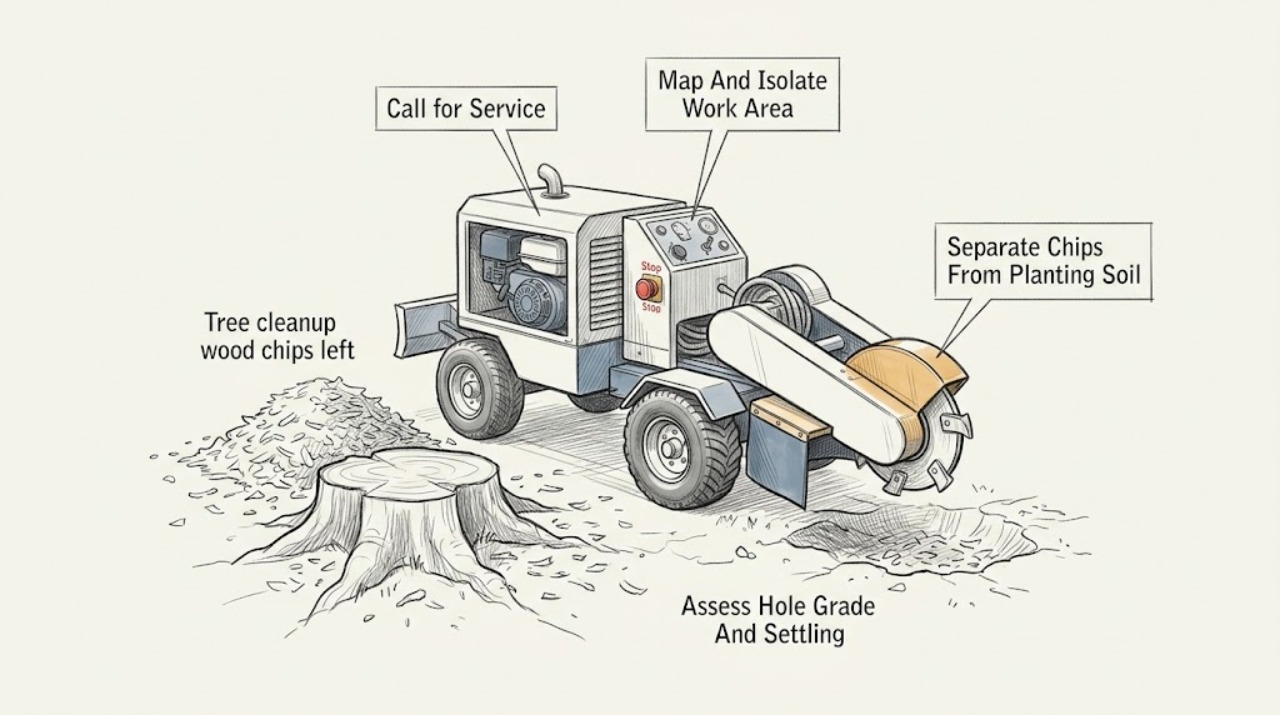
Work through in order
Diagnostic checks
Use only checks that match the exact appliance or system and its official guide.
-
Check 1
Mark the former stump area and the walking, mowing, drainage, utility, and planting boundaries before moving material; keep people and pets away from any open hole, loose pile, sharp fragments, or unstable edge.
Expected result: The work area is a shallow level patch, a deep or soft hole, a pile spread into turf or hardscape, an eroding slope, or a location close to utilities, foundations, retaining structures, or an accessible route.
Next step: Photograph the area from several sides and record its relationship to paths, structures, drainage, utilities, and retained trees. Keep a hazardous or uncertain area isolated and request professional site guidance before proceeding.
Stop if: Do not enter an unstable hole, operate a grinder or excavator, dig near an unverified utility, or pull large roots with a vehicle or improvised rigging.
Why this matters
Why: A level, isolated patch can support ordinary cleanup planning. A deep, soft, eroding, route-critical, or structure/utility-adjacent site needs a site-specific restoration or arboricultural assessment before digging, grading, or planting.
-
Check 2
Rake or shovel loose grindings into a separate pile or container from stable ground, removing visible chips, sawdust, and large root fragments from the soil surface and planting zone without deliberately mixing the material deeper into the soil.
Expected result: Most material is loose and separable, fine sawdust is mixed through the soil, large woody pieces or roots remain below grade, or the material contains unknown debris or signs of contamination.
Next step: Continue only with ordinary hand cleanup when the area is stable and material is clean. Stop and ask the stump contractor, arborist, or landscape professional to remove deeply mixed, bulky, contaminated, or inaccessible material.
Stop if: Do not burn the chips, mix them into backfill, use chemical stump treatments on a future planting site, or dig aggressively around retained tree roots or utilities.
Why this matters
Why: Loose, clean chips can be removed or separately reused. Fine or bulky material mixed through the soil can affect moisture, nutrient availability, rooting depth, and future settling; unknown or contaminated material is not a normal planting amendment.
-
Check 3
After loose debris is removed, inspect the remaining hole and surrounding grade from the surface; note low spots, soft pockets, exposed roots, voids, standing water, runoff paths, or a surface that is not level with the surrounding landscape.
Expected result: The site is stable and close to grade, or it has substantial missing volume, visible voids, ongoing settling, standing water, compaction, or erosion.
Next step: Replace lost volume with quality topsoil and shape the area according to the planting or turf plan; allow for settling as recommended by the extension guidance. Request professional grading or drainage help for persistent water, erosion, a retaining issue, or an unstable fill.
Stop if: Do not conceal a void with a thin surface layer, pile soil against a foundation or trunk, or plant into a surface that rocks, sinks, drains toward a structure, or cannot be made stable without excavation.
Why this matters
Why: A stable grade supports soil replacement and planting preparation. Missing volume and decaying roots can lead to further settlement, while compaction or standing water can restrict oxygen, drainage, and root growth.
-
Check 4
Observe the prepared soil after ordinary watering or rainfall and compare it with adjacent undisturbed soil; note whether water infiltrates, ponds, runs off, or leaves the soil unusually dry, hard, or loose.
Expected result: Water infiltrates similarly to adjacent soil, ponds or runs toward a structure, the soil is hard and compacted, or the surface dries rapidly around buried woody material.
Next step: Address only shallow, accessible compaction using the landscape plan and avoid turning soil unnecessarily. Request a qualified landscape or arboricultural assessment when drainage, compaction, buried roots, or grade cannot be corrected without affecting utilities or retained trees.
Stop if: Do not add fertilizer to hide poor drainage, install drainage toward a neighbor or foundation without a plan, or mechanically excavate near utilities, retained tree roots, irrigation, or buried services.
Why this matters
Why: Similar infiltration supports normal planting preparation. Ponding, runoff, compaction, rapid drying, and buried wood indicate that soil structure or site grade may still prevent healthy establishment.
-
Check 5
Decide whether the goal is turf, a shrub or perennial bed, or a replacement tree, and compare the cleared site with an alternate planting position; record remaining stump/root material, available soil volume, sun, drainage, utilities, and clearance from structures.
Expected result: Turf or shallow planting is planned, a new tree would occupy the exact old stump location, the site is still occupied by large roots, or an alternate location provides cleaner, deeper, more stable soil.
Next step: Use the prepared area only when it meets the chosen plant's site needs. Prefer an alternate location for a replacement tree when practical, or have an arborist assess the old stump site and species/site constraints before planting there.
Stop if: Do not plant a new tree directly into a deep chip-and-root pocket, over a visibly decaying stump, or where mature roots, utilities, grade, or structures leave inadequate rooting space.
Why this matters
Why: Turf and smaller plants can use a prepared debris-free surface, but a replacement tree needs adequate rooting depth and structural stability. Remaining stump/root material and future settling make the exact former stump location a higher-uncertainty choice.
-
Check 6
Once the area is debris-free, graded, and suitable for the chosen planting, install seed, sod, shrubs, or a tree according to the plant and site guidance; keep clean chips separate from the root zone and monitor moisture, yellowing, sprouts, settlement, and erosion.
Expected result: The new planting establishes evenly, dries or yellows, sinks as buried material decays, produces sprouts from remaining roots, or erodes after rain.
Next step: Maintain moisture according to the seed, sod, or plant guidance and document changes. Correct minor surface settlement with suitable soil only when the cause is understood; request arboricultural or landscape service for recurring sprouts, sinking, drainage, erosion, or plant decline.
Stop if: Do not pile chips against trunks or stems, apply herbicide outside its label, fertilize repeatedly without a soil or plant diagnosis, or continue using a route that has become uneven or unsafe.
Why this matters
Why: Even establishment supports a successful restoration. Yellowing, poor growth, rapid drying, recurring settlement, sprouts, or erosion indicate unresolved nutrient, moisture, root, grade, or soil-volume issues rather than permission to add more chips or fertilizer blindly.
Use your observations
Decision map
Find the observation that best matches what you see, then follow the next safe action.
-
PATH 01Next step
What you see
Loose chips and root fragments are removed, the soil is close to grade, drainage is acceptable, and the plan is turf or shallow groundcover rather than a new tree.
Do this next
Add suitable topsoil to replace lost volume, prepare a debris-free surface, then seed or sod according to the local planting window and care guidance. Keep any reused chips as separate surface material rather than mixing them into the seedbed.
Why this path and its safety boundary
Why it matters: The site is closer to a normal restoration project; buried debris, settling, and nutrient/moisture effects still need monitoring.
-
PATH 02Next step
What you see
Fine sawdust, bulky chips, or root fragments remain mixed below grade, and the surface has voids, sinking, or repeated low spots.
Do this next
Pause replanting and request stump-site restoration to remove or manage the buried wood and replace the lost soil volume. Keep the area isolated if settlement affects walking or mowing.
Why this path and its safety boundary
Why it matters: Decomposition and the altered soil structure can continue to reduce rooting conditions and create uneven ground; a thin layer of soil will not resolve the underlying volume loss.
-
PATH 03Next step
What you see
A replacement tree is planned in the exact former stump location, and substantial stump/root material, limited soil depth, settling, or utility/structure constraints remain.
Do this next
Prefer an alternate location when practical or have a qualified arborist assess the old site, remaining roots, drainage, species fit, and required soil volume before planting.
Why this path and its safety boundary
Why it matters: The former stump site may not provide adequate rooting depth or stability for a new tree, and the best planting position may be elsewhere.
-
PATH 04Next step
What you see
The chips are clean and identifiable, the planting soil is kept separate, and there is a suitable non-root-zone use such as a path or surface mulch.
Do this next
Move chips to the planned surface use, keep them away from trunks and stems, and remove or compost them when preparing the actual planting bed. Do not mix them into soil.
Why this path and its safety boundary
Why it matters: The material may be reusable outside the planting zone, but its use as surface material does not make it suitable backfill or a substitute for topsoil.
-
PATH 05Next step
What you see
The area is beside a foundation, retaining wall, drainage route, accessible path, irrigation or utility line, retained tree, or slope, and cleanup would require digging, grading, or heavy equipment.
Do this next
Keep the area controlled and request qualified tree, landscape, utility, or drainage assessment before excavation, grading, or replanting. Do not guess at buried services or pull material mechanically.
Why this path and its safety boundary
Why it matters: The restoration scope affects site safety or infrastructure beyond ordinary chip cleanup; an apparently small planting patch can create erosion, access, root, or utility damage.
-
PATH 06Next step
What you see
The prepared area is planted, but yellowing, poor growth, rapid drying, sprouts, erosion, or new settlement appears while nearby undisturbed planting performs normally.
Do this next
Document the pattern and request a qualified soil, arboricultural, or landscape assessment before changing amendments, herbicides, drainage, or the plant location.
Why this path and its safety boundary
Why it matters: The stump site may still have nitrogen availability, moisture, soil-volume, root-remnant, drainage, or grade problems; adding more chips or fertilizer without diagnosis can worsen the mismatch.
Helpful context
Understand the symptom
Chips in a planting bed are different from surface mulch
Fresh stump grindings are a mixture of wood, sawdust, and sometimes root fragments. Iowa State notes that buried debris can change soil moisture and nutrient availability, while Purdue explains that the carbon-rich material can temporarily reduce nitrogen available to new grass or trees and that decaying material can leave settling voids. Remove or separate the grindings from the soil in the planting zone rather than treating a deep pile as finished soil.
Prepare the site before choosing what to plant
After loose debris is removed, inspect the remaining hole and soil for grade, compaction, drainage, and buried wood. Add suitable topsoil to replace the volume lost to grinding and allow for future settling. A level lawn, a shrub bed, and a replacement tree do not have the same rooting or stability needs, so the planting choice should follow the prepared site rather than hide an unstable fill.
Reuse chips only where they do not interfere with establishment
Clean arborist chips may be useful as a separate path or surface mulch, but they should not be mixed into the soil intended for seed, sod, or roots. If chips are used around an existing or new plant, keep them away from the trunk or stem and avoid creating a wet, deep layer against the plant. Chips containing unknown material, diseased wood, trash, or chemical contamination should be handled through an appropriate disposal or professional route.
Safety boundary
Stop conditions
- Keep people and pets away from deep holes, loose edges, unstable fill, active erosion, or an access route that has become uneven.
- Do not mix grindings into planting soil, use chips as backfill, burn them, or bury unknown or contaminated material.
- Do not dig, pull roots, operate a stump grinder or excavator, or mechanically grade near unverified utilities, foundations, retaining structures, irrigation, or retained tree roots.
- Do not plant a replacement tree directly over substantial remaining stump/root material or in a site with unresolved settling, poor drainage, or inadequate rooting space.
- Do not pile chips against trunks or stems, apply herbicide or fertilizer by guesswork, or continue when replanting failure, erosion, sprouts, or settlement is recurring.
Only after diagnosis
Potential parts
- quality topsoil
Consider this material only after loose and unsuitable grindings are removed and the remaining hole or settling volume has been assessed for the intended turf or planting.
Confirm soil texture, drainage, contaminants, and volume with the planting plan or qualified professional; do not use topsoil to conceal voids or unstable fill. - grass seed or sod
Consider this category only when the site is level, debris-free, adequately prepared, and the restoration goal is turf or groundcover rather than a replacement tree.
Match the seed or sod to local conditions, season, soil, and site use; follow the extension or supplier establishment guidance rather than burying chips under it. - erosion-control cover
Consider this category only when exposed soil, slope, runoff, or a temporary restoration delay creates an erosion risk and a qualified site plan supports it.
Confirm the cover is suitable for the slope, seed, drainage, and local requirements; do not use it to stabilize a deep hole or unstable fill without addressing the cause. - replacement tree or shrub
Consider a replacement plant only after the site has adequate soil volume, drainage, stability, clearance, and a qualified assessment where the old stump/root zone remains.
Confirm species, mature size, root-zone space, utilities, structures, and planting instructions with an arborist or landscape professional; do not assume the old stump location is suitable.
When checks do not resolve it
Need a professional?
Request qualified tree or landscape service when chips and roots are deeply mixed, the site continues to settle, drainage or erosion is present, a replacement tree is planned in the old stump location, large roots or utilities limit cleanup, the grade affects access or structures, or new planting repeatedly yellows, dries, sprouts, or declines. Ordinary hand cleanup is reasonable only on a stable site with identifiable clean material and no utility, root, structure, or drainage conflict.
Safety scope: This article supports site observation, temporary isolation, and ordinary hand cleanup of loose identifiable material on stable ground. Equipment operation, excavation, utility-adjacent work, root or stump removal, grading, drainage correction, herbicide use, and tree-site design belong to qualified professionals.
Common questions
FAQ
Should I leave stump-grinding chips in the hole and plant over them?
Usually not for a planting zone. Extension guidance says chips, sawdust, and root fragments can alter moisture and nutrient availability and can create settling voids. Remove loose material, replace lost volume with suitable soil, and plant only after the site is stable and debris-free.
Can I use the leftover wood chips as mulch?
Clean, identifiable chips may be reused as a separate path or surface mulch, but do not mix them into soil intended for roots or seed. Keep chips away from trunks and stems, and do not use unknown or contaminated material.
Can I plant a new tree in the exact spot where the stump was ground?
Not automatically. Remaining roots and stump material can limit soil volume and stability, and decomposition can cause settling. Prefer an alternate location when practical or have an arborist assess the old site, drainage, utilities, roots, and the proposed tree before planting.
How do I know the stump area is ready for grass or plants?
The area should be isolated safely, loose chips and bulky roots removed from the planting zone, lost volume replaced with suitable soil, grade and drainage addressed, and the surface stable rather than sinking or ponding. Monitor for yellowing, drying, sprouts, erosion, and settlement after planting.
Should I add fertilizer to compensate for stump chips?
Do not add fertilizer by guesswork. Wood debris can temporarily reduce nitrogen availability, but poor growth can also result from moisture, compaction, drainage, shallow soil, or settling. Prepare the soil first and request a plant or soil assessment if yellowing or decline persists.
Read the exact guide
Official sources
- How to Plant Grass After Tree Stump RemovalIowa State University Extension and Outreach · University extension guidance for restoring turf after stump removal; planting plans and local conditions control.
- Planting and Transplanting Trees and Shrubs in the Home LandscapeConnecticut Agricultural Experiment Station · State agricultural experiment station guidance used for evaluating a replacement tree or shrub site after stump cleanup.
- Woodchips for Site PreparationUniversity of Connecticut College of Agriculture, Health and Natural Resources · University guidance for intentional woodchip site preparation and reuse; stump-site restoration still requires debris removal and soil replacement where planting is planned.
- Forestry ServicesCity of Milwaukee Department of Public Works · Municipal restoration example used to illustrate chip removal, soil replacement, grading, and site assessment; private site requirements may differ.
- How to Remove Tree StumpsIowa State University Extension and Outreach · University extension overview of residential stump removal and restoration; qualified site assessment controls where utilities, roots, structures, or slopes are involved.
- Question: Can I Plant Grass Over Newly Removed StumpPurdue University Extension · University extension answer for grass and new planting over a recently removed stump; local soil and plant conditions control.
Community feedback
Share a repair observation
Share a plain-text repair observation. Accepted observations are published automatically; this page may take a moment to update.