
On this page
Start here
Quick answer
Wood chips and sawdust left in a stump-grinding hole are not the same as stable topsoil. Buried wood debris and remaining roots can create voids as they decompose, tie up nutrients, dry the soil unevenly, and leave a low spot. For a lawn or planting bed, first photograph the area and identify its boundaries, then remove loose chips and woody debris as far as practical, replace the lost volume with quality soil, and leave a modestly raised final grade for expected settlement. Firm and level the soil without compacting it into a hard layer, and delay seed or sod until the surface is debris-free and reasonably settled. Keep people and equipment away from an open or unstable hole, and have a qualified arborist or site professional handle buried utilities, large roots, contaminated or diseased material, drainage problems, retaining structures, or a deep void.
Work through in order
Diagnostic checks
Use only checks that match the exact appliance or system and its official guide.
-
Check 1
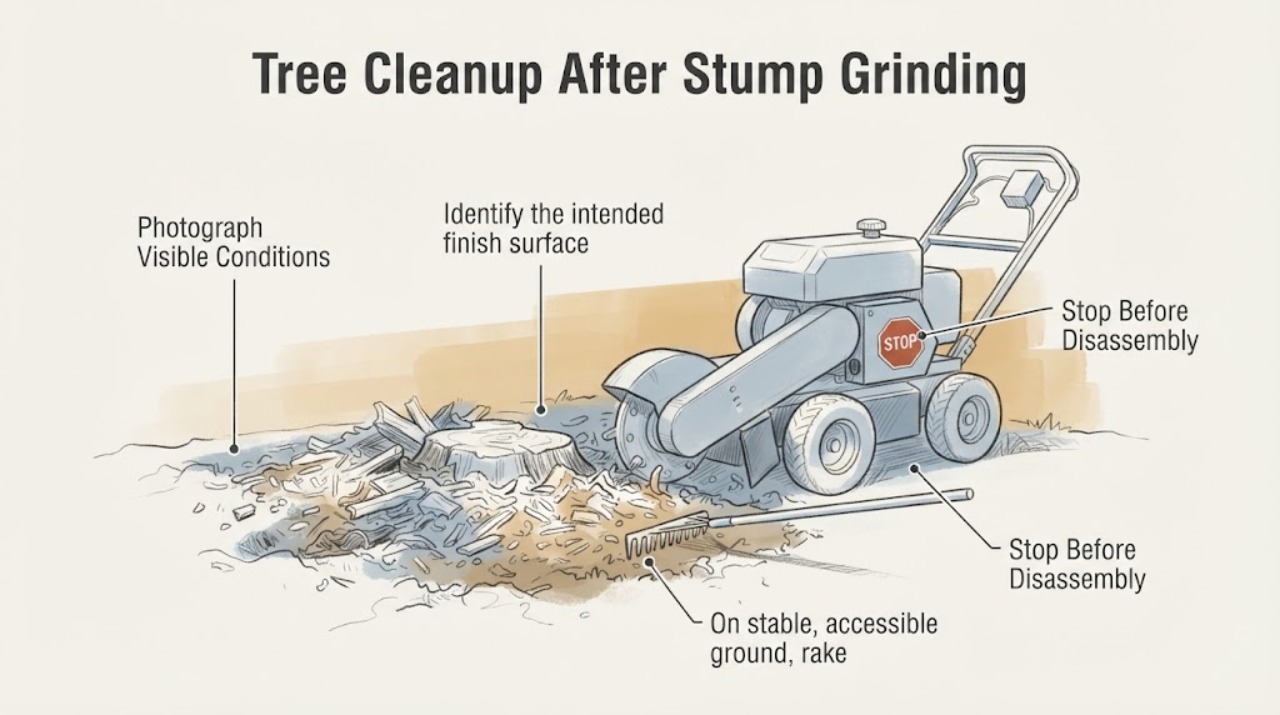
Photograph the work area from several angles and mark the visible edge of the grindings, hole, low spot and any nearby path, lawn, planting bed, drain, foundation or retaining edge. From the surface only, note whether the area is dry and stable, soft, hollow-sounding, waterlogged or open enough to catch a foot or mower wheel.
Expected result: The material is a shallow loose pile on stable ground, or there is an open cavity, soft edge, standing water, exposed root, undermined surface or a grade that directs water toward a structure.
Next step: Keep people and equipment away from an unstable area and arrange an arborist, utility-locate service or qualified site professional as appropriate. If the surface is stable, continue by identifying the intended final use before moving material.
Stop if: Stop before probing or digging if the hole is deep, the ground is collapsing, water is entering, a structure is undermined, or buried utilities are not accounted for.
Why this matters
Why: A loose pile is primarily a cleanup and finish-grade issue. A cavity, unstable edge, water problem or undermined feature is a site-safety or drainage issue that cannot be resolved by simply adding chips or soil on top.
-
Check 2
Identify the intended finish surface and sort the visible material without entering an open hole: lawn or sod, planting bed, a surface mulch layer, walkway or paving, or a location where a new tree will be planted. Keep a representative photo of the chips, sawdust, root pieces and any non-wood debris before disposal.
Expected result: The area is intended for turf or a new plant, or it is intended to remain as surface mulch or become a load-bearing surface.
Next step: For turf or planting, plan to remove as much buried wood debris as practical before adding soil. For mulch, keep chips on the surface rather than mixing a thick layer into soil. For paving or structural work, ask the installer or site professional to specify the fill and compaction method.
Stop if: Stop if material includes trash, treated wood, fuel or chemical contamination, an unknown diseased tree issue, or anything that should not be spread in a garden or compost stream.
Why this matters
Why: Turf and new planting need a debris-free rooting medium and stable grade. A surface mulch use may tolerate suitable clean chips, but it does not fill a void. Walkways and paving need a more carefully specified base than ordinary lawn topsoil.
-
Check 3
On stable, accessible ground, rake or shovel loose chips and sawdust away from the finish area and inspect the exposed surface for remaining stump wood, large roots, buried debris and a soft or hollow zone. Do not use a grinder, vehicle, winch, chain or deep excavation to chase roots, and do not cut near an unlocated utility.
Expected result: Most debris is loose and removable, or substantial wood, roots, a cavity or an obstruction remains below the intended grade.
Next step: Remove loose debris only with hand tools and safe footing. If significant wood, roots or a cavity remain, stop and have the arborist or site professional decide whether further grinding, excavation or a different finish is appropriate.
Stop if: Stop for buried cable or pipe uncertainty, a collapsing edge, large root tension, unstable footing, a deep hole, or any need for powered cutting, pulling or heavy equipment.
Why this matters
Why: Loose material can be separated for appropriate disposal or reuse. Substantial remaining wood and roots can continue decomposing and create settlement; an obstruction or cavity may need deeper professional removal or a designed alternative.
-
Check 4
Add quality soil in manageable lifts to replace the volume removed, then rake the area to blend with the surrounding grade. Leave a slight raised grade where future decomposition is expected, and observe after watering or normal rainfall whether the surface settles, ponds or sheds water toward a building; do not make a hard compacted mound or bury a plant trunk.
Expected result: The backfill remains stable and drains across the area, or it drops, cracks, stays wet, exposes wood, or directs water toward a foundation, path or other feature.
Next step: For ordinary lawn restoration, add compatible soil to correct minor settlement and re-rake. For repeated sinking, standing water, a slope failure or a grade affecting a structure, stop surface repairs and obtain professional site assessment.
Stop if: Stop if the area is undermining a foundation, retaining edge, walkway or utility, if water is entering a structure, or if more fill would conceal a void rather than support it.
Why this matters
Why: A small amount of settlement is expected where underground stump and roots continue to decay, which is why a modest mound can be useful. Persistent ponding, rapid subsidence or redirected water indicates unresolved fill, drainage or grade problems.
-
Check 5
Wait to seed, sod or plant until the surface is level enough for the intended use, free of loose wood debris and reasonably settled. During establishment, observe whether turf germinates evenly, yellows, dries faster than surrounding lawn, or sinks into low spots; do not plant a replacement tree directly in a debris-filled former stump location without site preparation.
Expected result: The finished area supports even growth and stable footing, or turf yellows, dries unevenly, develops low spots or a new plant struggles while the old stump material continues to decay.
Next step: Record the affected area and correct the soil or grade based on the observed cause. If a new tree must occupy the same spot, have the planting site prepared with the remaining debris and roots addressed; moving the planting location may be more reliable.
Stop if: Stop planting or mowing if footing is unstable, a void reopens, exposed roots create a hazard, or the area is too soft for equipment without rutting.
Why this matters
Why: Healthy, even establishment supports a finished restoration. Yellowing, drought stress and low spots are consistent with remaining wood, nitrogen tie-up, moisture differences or ongoing settlement, and they are not fixed by adding a thin layer of chips.
Use your observations
Decision map
Find the observation that best matches what you see, then follow the next safe action.
-
PATH 01Next step
What you see
There is only a stable, loose pile of clean chips on the surface and the area is not intended for turf, a new tree or a load-bearing surface.
Do this next
Keep suitable chips as a surface mulch only where that use fits the landscape, or arrange appropriate removal. Do not count a mulch pile as structural fill or use it to conceal a cavity.
-
PATH 02Next step
What you see
The goal is lawn or sod, and chips, sawdust and root fragments are mixed into the top layer or the area already shows low spots.
Do this next
Remove as much woody debris as practical, replace the lost volume with quality topsoil, allow for expected settlement, and seed or sod only after the surface is debris-free and reasonably stable. Monitor for renewed settling and yellowing.
-
PATH 03Next step
What you see
A deep or collapsing hole, large root, buried utility uncertainty, standing water, or undermined foundation, path or retaining edge is present.
Do this next
Keep people and equipment out, mark the area and obtain the appropriate arborist, utility-locate or site professional. Do not probe blindly, pull roots with a chain or bury the hazard under more chips.
-
PATH 04Next step
What you see
The area is intended for a new tree in the old stump location, or the surface repeatedly settles after debris removal and soil replacement.
Do this next
Have the planting site assessed and prepared with remaining wood debris and roots addressed; if possible, choose a nearby new location. Repeated settlement requires finding the remaining void or decaying material, not repeated surface topping alone.
Helpful context
Understand the symptom
A pile of grindings is normal after stump work, but its next use depends on the finish surface. A thick layer can be a temporary surface cover in some landscape settings; it is poor fill under a lawn or new planting because chips and sawdust mixed with soil can interfere with moisture and nutrient availability. Remaining roots and buried wood also decay and leave voids, so a surface that looks level immediately after grinding can sink later.
Treat this as site restoration rather than simply spreading the pile thinner. Establish whether the desired result is lawn, a planting bed, mulch, a path or a paved area; the acceptable finish and backfill are different. Keep the work area marked until chips, exposed roots and any soft edges have been assessed, especially where children, pets, mowers or foot traffic pass.
Do not burn the stump debris or improvise a chain, rope or machine pull to remove roots. Burning can be difficult to control and may be restricted locally, while a slipping or breaking chain can cause serious injury. If the ground has a large void, slopes toward a structure, drains toward a foundation, or may contain utilities, stop and obtain site-specific help before digging.
Safety boundary
Stop conditions
- Stop immediately for an open or collapsing cavity, unstable footing, exposed utility, water undermining the area, damage to a foundation or retaining feature, or a deep void concealed by loose chips.
- Stop before using powered cutting, pulling or digging equipment if utilities are not located or if a root is under tension.
- Stop planting or mowing when the surface is soft, sinking, debris-filled or unsafe, and do not conceal the condition with additional mulch or a thin soil layer.
When checks do not resolve it
Need a professional?
Arrange arborist or qualified site help for a deep or unstable hole, large root removal, recurring settlement, drainage toward a structure, or a grade affecting a walkway, retaining edge or pavement., Use a utility-locate service before digging when buried electric, gas, water, communications or irrigation lines are possible or their location is unknown., Ask the tree contractor to clarify whether chip removal, hole filling and final grading were included in the agreed work. Keep the area marked until the surface is safe for people, pets and equipment., Do not burn the grindings, improvise a chain or rope pull, operate a grinder without appropriate training and protection, or spread unknown contaminated or diseased debris in a planting area.
Common questions
FAQ
Can I leave stump-grinding chips where they are?
Clean chips can sometimes remain as a surface mulch where that is the intended landscape finish, but a thick chip pile is not stable fill. For lawn, planting or a load-bearing surface, remove loose and mixed-in debris and replace the lost volume with suitable soil or a specified base.
Why is the ground uneven after stump grinding?
Grinding removes wood volume, and remaining roots and buried chips can decay and create voids. The area can therefore settle after it first looks level. Remove debris, add quality soil and leave a modest allowance for expected settlement, then correct minor low spots as they appear.
Should I mix the wood chips into the soil?
Not as a shortcut under new lawn or planting. Extension guidance notes that woody debris can reduce nutrient availability, change moisture behavior and create settling voids. Keep suitable chips as an intentional surface mulch or remove them before preparing a clean rooting medium.
How should I fill a stump-grinding hole?
First remove as much loose wood debris as practical, then use quality soil appropriate to the intended finish and rake it to blend with the surrounding grade. A slight mound can allow for future settlement. A deep void, structural edge, drainage issue or planned pavement needs site-specific professional fill and grading advice.
Can I plant a new tree in the old stump location?
It is usually easier to choose a nearby new location. The old site can contain roots and wood debris, have limited rooting space and continue to settle. If the tree must go there, have the debris and roots addressed and the soil prepared before planting rather than placing the root system in a chip-filled void.
Read the exact guide
Official sources
- STUMP REMOVALMontgomery County Department of Transportation, Division of Highway Services · County public-works stump-removal procedure for chip removal, topsoil backfill, grass restoration and allowing for settlement
- Question: Can I Plant Grass Over Newly Removed StumpPurdue Extension · Purdue Extension guidance on woody debris, nutrient availability, settlement and soil replacement after stump grinding
- How to Remove Tree StumpsIowa State University Extension and Outreach · University extension guidance on stump grinding, remaining wood shavings, filling, disposal, hazards of pulling and burning
- How to Plant Grass After Tree Stump RemovalIowa State University Extension and Outreach · University extension guidance on removing stump-grinding debris, settlement, topsoil, compaction and timing turf restoration
Community feedback
Share a repair observation
Share a plain-text repair observation. Accepted observations are published automatically; this page may take a moment to update.