
On this page
Start here
Quick answer
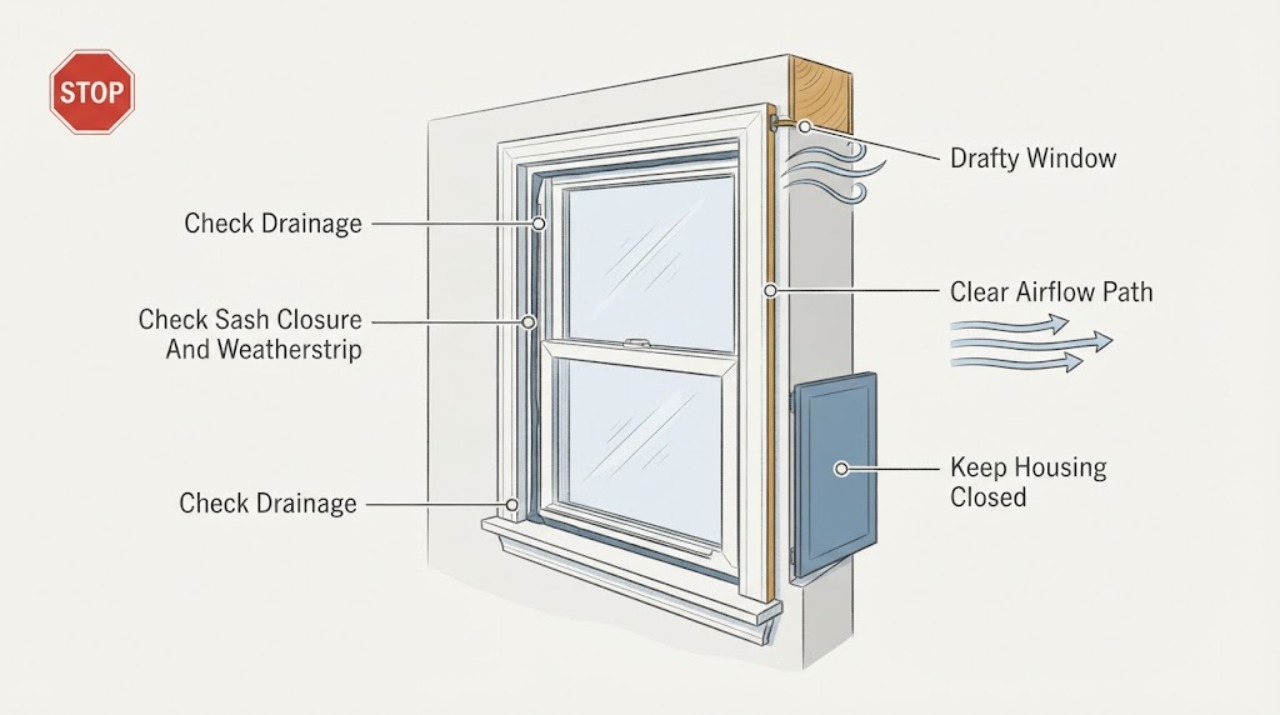
For a drafty window, first locate the air movement without using a flame: compare the sash, meeting rail, frame, trim, and nearby wall on a windy or temperature-difference day. If the draft follows a moving sash or latch, inspect the weatherstripping and whether the window closes squarely. If it follows stationary trim or a visible crack, compatible caulk may be appropriate; do not seal weep or drainage paths. Condensation on the glass is a separate moisture clue, not proof of an air leak. Persistent drafts, loose or rotten frames, water entry, a window that cannot operate safely, inaccessible gaps behind trim, or pre-1978 paint concerns call for a qualified window or home-energy professional.
Before you begin
Safety first
- This article supports paper-based external observation, normal operation checks, and a compatible accessible weatherstrip or stationary caulk repair performed according to instructions. Trim removal, lead-paint work, rough-opening sealing, glazing, structural repair, and drainage or flashing changes require qualified professionals.
Work through in order
Diagnostic checks
Use only checks that match the exact appliance or system and its official guide.
-
Check 1
On a windy or temperature-difference day, move a narrow strip of tissue or light paper slowly around the closed sash, meeting rail, latch side, frame, trim, sill, and nearby wall; do not use a candle, lighter, smoke, or any open flame.
Expected result: Record whether the paper moves at a sash joint, around the frame or trim, at the sill, through a nearby wall crack, or nowhere obvious.
Next step: Mark the exact locations with removable tape or a note and use that map for the next check or a professional assessment; do not open trim merely to chase a hidden leak.
Stop if: Do not use an open flame, insert tools into a gap, disturb insulation, or remove trim, siding, or painted material during this check.
Why this matters
Why: Movement at a moving joint points toward weatherstripping, compression, or latch alignment. Movement at stationary trim or the wall points toward caulk, an installation gap, or a larger air-sealing issue; no movement suggests the sensation may be cold glass, convection, or another opening.
-
Check 2
Operate the window normally and inspect the visible weatherstripping, sash meeting surfaces, hinges or tracks, latch, and lock from the room side; close and latch it without forcing a painted-shut, swollen, or distorted sash.
Expected result: Record a complete seal with a working latch, a torn or missing weatherstrip, a latch that does not pull the sash tight, a gap that changes when the sash moves, or a window that binds or will not close.
Next step: Replace only a visibly accessible weatherstrip with a product and installation method approved for the window, or arrange qualified window service for misalignment, failed hardware, binding, or a frame that will not hold a seal.
Stop if: Do not plane, drill, pry, force, or permanently seal a window shut; do not remove balances, hinges, or concealed hardware without model-specific instructions.
Why this matters
Why: A draft that changes with sash position is consistent with a moving-part seal or alignment problem. A window that will not close can have a hardware, frame, or structural issue that a strip of sealant will not safely correct.
-
Check 3
Inspect the stationary interior and exterior perimeter for cracked or missing caulk, loose trim, a visible gap between the frame and wall, water staining, soft wood, or blocked drainage openings; keep the window's weep or drainage path open.
Expected result: Classify the perimeter as intact, a small accessible stationary crack, a larger frame-to-wall gap, a water-damaged area, or an unclear condition behind trim.
Next step: Use compatible caulk only for a clearly identified accessible stationary joint and follow its instructions; arrange qualified window or building-envelope service for frame gaps, water damage, loose trim, or an inaccessible rough opening.
Stop if: Do not caulk over weep holes, drainage channels, moving joints, active water damage, or unknown wall cavities; do not remove trim if it may release old paint dust.
Why this matters
Why: A small stationary crack can be an air-sealing location. A large gap, water damage, or loose frame may indicate installation, flashing, or structural work rather than a simple surface draft.
-
Check 4
Compare the suspected draft with visible moisture: look for water on the interior glass, between panes, on the sill, or as a stain on the wall, and note whether the air movement remains when the sash and trim path are sealed by normal closure.
Expected result: Record air movement without moisture, interior-surface condensation, moisture between panes, water intrusion at the frame, or no repeatable draft.
Next step: Improve room airflow and manage indoor humidity according to the home and equipment guidance when condensation is the only clue; arrange qualified window or envelope assessment for moisture between panes, staining, or water entry.
Stop if: Do not paint over mold or water damage, block ventilation, seal drainage openings, or dismantle glazing to investigate moisture.
Why this matters
Why: Interior-surface condensation can result from a cold glass surface and indoor humidity rather than an air gap. Moisture between panes can indicate failed glazing, while water at the frame may involve flashing or drainage; neither is reliably fixed by adding random caulk.
-
Check 5
After locating a simple accessible leak, compare the repair to the moving or stationary surface: use window-appropriate weatherstripping at a moving joint or window-appropriate caulk at a stationary crack, following the product and window instructions.
Expected result: After the material has been installed as directed, record a closed window that still operates and has less air movement, a draft that remains, a new operating problem, or water or condensation that appears.
Next step: Undo or stop only a plainly misapplied removable seal if it prevents normal operation; otherwise keep the window in a safe usable state and arrange qualified service for a persistent, inaccessible, damaged, or installation-related leak.
Stop if: Do not seal a window shut, fill a large gap with an unapproved expanding product, cover drainage paths, disturb lead paint, or continue if the window cannot open for required egress or ventilation.
Why this matters
Why: Less draft without impaired operation supports a localized seal as the cause. A persistent draft, binding sash, new moisture, or damage means the selected material or the assumed leak path is wrong and the window needs further assessment.
Use your observations
Decision map
Find the observation that best matches what you see, then follow the next safe action.
-
PATH 01Safety boundary
What you see
Air movement follows the sash or meeting rail and changes when the window is closed or latched.
Do this next
Inspect and replace accessible window-appropriate weatherstripping as directed; use qualified service for binding, distortion, failed hardware, or a sash that will not latch.
Why this path and its safety boundary
Why it matters: Weatherstripping, compression, latch alignment, or sash condition is more likely than a wall cavity leak.
Safety stop: Do not force, drill, plane, or permanently seal the moving sash.
-
PATH 02Safety boundary
What you see
Air movement follows a visible crack at stationary trim or the frame perimeter.
Do this next
Use compatible caulk only at a small accessible stationary joint; obtain qualified envelope or window service for larger gaps, loose trim, or water damage.
Why this path and its safety boundary
Why it matters: A stationary-joint air-sealing issue is possible, but a large gap or water stain can indicate installation or flashing work.
Safety stop: Do not caulk moving joints, weep paths, active leaks, or unknown cavities.
-
PATH 03Safety boundary
What you see
Air movement is strongest behind trim, at the wall beside the window, or at a gap too large or deep for a surface seal.
Do this next
Arrange qualified window or home-energy assessment; do not remove trim, inject foam, or disturb insulation without the appropriate instructions and safety controls.
Why this path and its safety boundary
Why it matters: The leak may be at the frame-to-wall rough opening or a broader envelope penetration rather than at the sash.
Safety stop: Do not fill a hidden cavity blindly, block drainage, or disturb old paint or insulation.
-
PATH 04Safety boundary
What you see
There is moisture on the interior glass but no repeatable air movement at the sash, frame, or trim.
Do this next
Improve air circulation over the glass and manage indoor humidity; arrange service for moisture between panes, staining, or recurring water entry.
Why this path and its safety boundary
Why it matters: Cold glass and indoor humidity may be the main issue rather than a draft through the window.
Safety stop: Do not seal ventilation openings or paint over damp or mold-affected materials.
-
PATH 05Safety boundary
What you see
The frame is rotten or loose, water enters, the window cannot operate safely, the trim is complicated, or old paint may be disturbed.
Do this next
Keep the opening weather-protected without blocking required operation and arrange a qualified window, building-envelope, or lead-safe professional assessment.
Why this path and its safety boundary
Why it matters: The work may involve building-envelope performance, lead-safe practices, structural repair, or required emergency egress rather than a simple seal.
Safety stop: Do not remove old painted trim, seal the only usable egress window shut, or continue a repair that releases dust or worsens water entry.
Helpful context
Understand the symptom
A draft can come from the sash, frame, or the wall around the window
Air can leak through a gap between moving window parts, around stationary trim, or between the frame and the rough opening. ENERGY STAR lists drafts around windows as an air-leak symptom and notes that even a well-performing window can be drafty when installation is poor. Locate the path before choosing weatherstripping, caulk, a temporary interior film, repair, or replacement.
Match the repair to what moves and what stays still
Weatherstripping is for components that open and close, while caulk is generally used at cracks or openings between stationary components. A bead placed across a sash joint can stop the window from operating, and sealing a drainage or weep path can trap water. Use the product and installation instructions for the window, and do not force a painted-shut or distorted sash.
Do not confuse condensation with an air draft
Moisture on interior glass can occur when a cold surface meets humid indoor air, even without a direct air leak. ENERGY STAR recommends considering frame-to-opening insulation, airflow over the glass, and indoor humidity. If a draft is accompanied by water stains, rot, or a gap behind trim, the concern extends beyond a surface seal and should be assessed professionally.
Safety boundary
Stop conditions
- Do not use a candle, lighter, smoke, or open flame to find a draft; use a paper observation instead.
- Do not seal moving joints, window weep holes, drainage channels, active water damage, or a required egress window shut.
- Stop and arrange qualified service for rotten or loose frames, water entry, large or hidden gaps, failed glazing, binding hardware, or a draft that remains after an accessible seal.
- If the home was built before 1978 or old paint may be disturbed, do not remove trim or create dust without lead-safe guidance and the appropriate professional assessment.
- Do not disturb insulation, inject unapproved foam, dismantle glazing, or modify a window beyond the manufacturer instructions.
Only after diagnosis
Potential parts
- window weatherstripping
Consider this only when the draft follows a moving sash or meeting rail and the existing seal is visibly missing or damaged.
Confirm the window type, dimensions, seal profile, and manufacturer guidance before selecting a replacement. - window and door caulk
Consider this only for a small, clearly located crack at a stationary frame or trim joint after confirming it is not a drainage path or active water-damage site.
Choose a sealant compatible with the window frame and adjacent building materials and follow the product instructions; do not use it to immobilize the sash.
When checks do not resolve it
Need a professional?
Arrange qualified window or home-energy service for a persistent draft, a gap behind trim or at the rough opening, water entry, rot, loose or distorted frames, failed glazing, binding hardware, complicated trim, or a window that must remain operable for egress. Seek lead-safe professional guidance before disturbing paint in a pre-1978 home. A simple, clearly located moving-joint or stationary-joint leak may be addressed with compatible weatherstripping or caulk according to the window and product instructions.
Safety scope: This article supports paper-based external observation, normal operation checks, and a compatible accessible weatherstrip or stationary caulk repair performed according to instructions. Trim removal, lead-paint work, rough-opening sealing, glazing, structural repair, and drainage or flashing changes require qualified professionals.
Common questions
FAQ
How can I find where a window is drafty?
With the window closed, move a small strip of paper around the sash, meeting rail, frame, trim, sill, and nearby wall on a windy or temperature-difference day. Do not use a flame or smoke. Mark the location where the paper moves so the repair matches the actual leak path.
Should I use weatherstripping or caulk on a drafty window?
Use window-appropriate weatherstripping when the leak follows a moving sash or other opening part. Use compatible caulk only at a small stationary frame or trim crack. Do not caulk moving joints, weep holes, drainage paths, or a window that must remain operable.
Is window condensation the same as a draft?
Not necessarily. Interior condensation can form when humid indoor air meets cold glass, even without a direct air leak. Moisture between panes, water stains, or water entering at the frame needs window or building-envelope assessment rather than random caulk.
Can I seal behind the window trim myself?
Only a clearly accessible, simple joint should be considered for a user-level seal, and the product must be appropriate for the window and surrounding materials. Large or hidden gaps, complicated trim, water damage, insulation, or old paint call for qualified assessment before trim is removed.
When should a professional fix a drafty window?
Arrange service for a persistent draft, loose or rotten frame, water entry, failed glazing, binding or unsafe operation, a gap behind trim, complicated trim, or a window that must remain openable for egress. In a pre-1978 home, obtain lead-safe guidance before disturbing old paint.
Read the exact guide
Official sources
- Identify the Problems You Want to FixENERGY STAR · ENERGY STAR problem-identification guidance used to distinguish window air leaks from wider home-sealing issues; professional inspection is appropriate when safety conditions apply.
- Seal and Insulate with ENERGY STARENERGY STAR · ENERGY STAR home-sealing guidance used for accessible draft-repair categories; product instructions and the window construction control the repair.
- Residential Windows, Doors, & SkylightsENERGY STAR · ENERGY STAR guidance used for general residential window draft and condensation triage; window-specific instructions and local safety requirements control.
Community feedback
Share a repair observation
Share a plain-text repair observation. Accepted observations are published automatically; this page may take a moment to update.