
On this page
Start here
Quick answer
A draft at a closed window can come through failed sash weatherstripping, a gap around the stationary frame, a cracked or poorly sealed pane, or the rough opening behind the trim. First identify whether air moves at the sash, glass edge, frame, or wall and whether the symptom changes with wind or rain. Use a paper check and visual inspection from a safe, accessible position; do not pry trim, remove glazing, or seal over a drainage path. Replace weatherstripping or seal a stationary gap only after the window type and soundness of the substrate are confirmed. Cracked glass, fog between panes, soft or stained trim, water entry, or a draft that persists after accessible checks needs qualified window or building-envelope service.
Before you begin
Safety first
- The professional determines whether the cause is sash weatherstripping, hardware or alignment, stationary frame sealing, glazing, rough-opening insulation, or exterior water management, then selects compatible materials and completes access-dependent work safely.
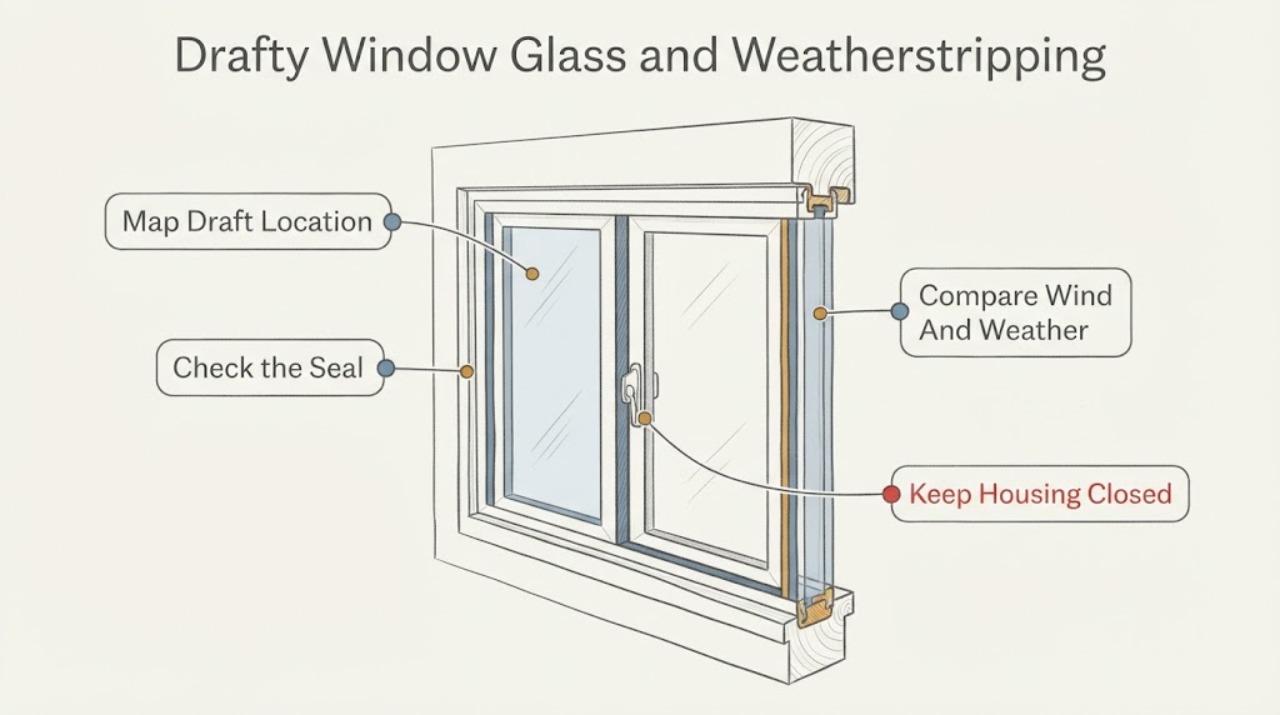
Work through in order
Diagnostic checks
Use only checks that match the exact appliance or system and its official guide.
-
Check 1
With the window closed and locked if the hardware permits, inspect the room-side glass, glass-to-sash edge, meeting rail, movable sash, stationary frame, trim, sill, and adjacent wall from a standing position.
Expected result: Record where cool air or a visible gap is found, whether the glass is cracked or fogged between panes, whether trim is peeling or stained, and whether water appears after rain.
Next step: Photograph the exact point and use the matching branch. Do not remove trim, glazing beads, putty, or sealant to expose a hidden cause.
Stop if: Stop if the glass is cracked or loose, the frame or trim is unstable or soft, water is active, or the inspection would require climbing, prying, cutting, or handling old flaking paint.
Why this matters
Why: A sash-edge draft points toward weatherstripping or alignment; a stationary trim gap points toward frame or rough-opening sealing; damaged glass or trapped haze needs glazing assessment; rain-timed moisture is not just a comfort draft.
-
Check 2
For an intact, accessible, closed operable window, place one sheet of ordinary paper across the sash seal and close the window on it without forcing the latch or crushing the glass.
Expected result: If the paper pulls out easily at one section while the window is closed, note that section and compare it with a point where the seal feels tighter. Do not use the test on a window that will not close safely or has damaged glass.
Next step: Give the location and window type to a qualified window professional or use only the exact manufacturer guidance for a confirmed weatherstrip profile; do not order a generic strip from the symptom alone.
Stop if: Stop if closing the sash requires force, the latch or frame is damaged, the glass moves, or the test would put hands near a sharp or unstable edge.
Why this matters
Why: An easy pull suggests the movable seal may not be compressing consistently, but it does not identify the profile, adjustment, or replacement material. A firm result does not rule out a frame gap or rough-opening leak elsewhere.
-
Check 3
Compare the same draft location on a calm day and a windy day, and note whether the symptom changes after rain; observe only from inside and keep the window closed.
Expected result: Record wind direction if known, whether air moves inward or outward, whether only one window is affected, and whether the sill, wall, or trim becomes damp after rain.
Next step: Keep dated observations and photos. Choose weatherstripping only for a confirmed moving-seal issue; route rain-related moisture, staining, or soft materials to building-envelope service.
Stop if: Stop if checking the exterior would require a ladder or roof access, if the wall is actively wet, or if the window cannot be closed and secured.
Why this matters
Why: A wind-dependent draft supports an air-leak path, while rain-related dampness raises a water-entry or flashing concern. A draft limited to one sash or corner narrows the inspection without proving which seal has failed.
-
Check 4
Visually inspect the accessible stationary frame-to-trim joint and the movable sash weatherstrip for cracked sealant, missing sections, daylight, debris, compression damage, or a seal that has pulled away; do not scrape or remove material.
Expected result: Separate a small, dry, exposed stationary gap from a joint with staining, soft wood, dampness, or a blocked visible drainage path. Note whether the seal is on a moving sash or fixed frame.
Next step: Provide photos and the window type to a qualified professional. If the substrate is confirmed sound and the repair is accessible, follow the exact product or manufacturer instructions; do not fill a drainage route or bridge a moving joint with stationary caulk.
Stop if: Stop before removing trim, disturbing old paint, injecting foam behind the frame, or working where a sealant change could conceal water or prevent the sash from operating.
Why this matters
Why: DOE guidance treats caulk as a stationary-gap material and weatherstripping as a moving-component seal. A wet or damaged substrate needs the water path and framing assessed before any new seal is applied.
-
Check 5
Inspect the visible glass and glazing perimeter without touching a cracked pane or removing a bead, gasket, or putty; compare the room-side and between-pane appearance in normal light.
Expected result: Look for a crack, chipped edge, loose-looking pane, failed perimeter seal, or haze and droplets trapped between panes. Note whether the air sensation is actually at the glass edge or only at the sash or frame.
Next step: Keep people away from damaged glass and arrange qualified glazing or window service. Do not tape over a loose pane as a permanent repair, drill the unit, or remove glazing components to test the seal.
Stop if: Stop immediately for cracked or moving glass, sharp edges, falling fragments, an unstable sash, or any need to dismantle the window.
Why this matters
Why: Cracked or loose glass is a safety and glazing repair issue. Haze trapped between panes suggests an insulated-unit seal problem. A clear pane with a sash-edge draft keeps weatherstripping or frame sealing in the diagnostic path.
Use your observations
Decision map
Find the observation that best matches what you see, then follow the next safe action.
-
PATH 01Next step
What you see
The draft is localized to the closed movable sash or meeting rail, the paper test is loose at that section, and the glass and frame are intact and dry.
Do this next
Request a window assessment or follow the exact manufacturer instructions for the known window type. Replace weatherstripping only after fit and movement are confirmed.
Why this path and its safety boundary
Why it matters: A weatherstrip, compression, latch, or sash-alignment issue is plausible, but the correct profile and adjustment remain model- and window-specific.
-
PATH 02Next step
What you see
Air moves at a fixed frame-to-trim joint or rough-opening edge, while the sash seal closes evenly and the substrate is dry and sound.
Do this next
Confirm that the repair will not block drainage or bind the frame, then arrange appropriate air-sealing work. Do not remove complicated trim or fill a concealed cavity from the symptom alone.
Why this path and its safety boundary
Why it matters: A stationary air-sealing gap may be contributing; caulk and, for a larger accessible gap, a window-rated backer or low-expansion material may be considered by a qualified person.
-
PATH 03Next step
What you see
The glass is cracked, loose, or foggy between panes, or the draft seems to originate at a damaged glazing edge.
Do this next
Stop handling the window and request qualified glazing or window service. Supply the pane dimensions and frame information only if they can be recorded safely; do not remove the pane.
Why this path and its safety boundary
Why it matters: This is a glazing safety or sealed-unit problem rather than an ordinary weatherstrip replacement.
-
PATH 04Next step
What you see
The draft is accompanied by rain-related water, damp or stained trim, peeling paint, soft framing, or moisture behind the wall or sill.
Do this next
Protect the area from further wetting when safe and arrange building-envelope or window service. Do not seal over wet material or open the wall as a casual test.
Why this path and its safety boundary
Why it matters: A water-management, flashing, installation, or concealed-moisture fault may be present and surface caulk could hide it.
-
PATH 05Next step
What you see
The draft location cannot be established, the window is inaccessible or unsafe, the trim is complicated or old paint is disturbed, or the symptom persists after accessible checks.
Do this next
Arrange a qualified window or home-energy assessment and provide photos, window type, weather conditions, and the results of the paper and visual checks.
Why this path and its safety boundary
Why it matters: The remaining cause may be behind trim, in the rough opening, or in the wider building envelope and needs tools or access beyond this check.
Helpful context
Understand the symptom
Do not assume every cold spot is a failed weatherstrip. Air that moves at the meeting rail or sash points toward a movable seal; a gap at stationary trim points toward frame or rough-opening air sealing; a crack in the glass is a glazing repair; and water after rain points to a water-management or flashing problem. A foggy appearance trapped between panes is not fixed by wiping the room-side surface.
The checks below are limited to an accessible, closed window. Record the room, wind and rain conditions, exact draft location, window type, and photos. ENERGY STAR describes trim sealing as a moderate-to-difficult project and recommends professional help for complicated trim, older paint that may contain lead, or work that cannot be completed without altering the assembly.
A new seal is conditional, not automatically better. Blocking weep paths, compressing a sash out of alignment, or sealing a wet wall can trap water and make the original problem harder to find. If the source is behind trim or inside the wall, request an assessment rather than filling the visible gap blindly.
Safety boundary
Stop conditions
- Stop for cracked, loose, or unstable glass, sharp edges, falling fragments, an unsecured sash, active water, or soft or collapsing trim.
- Do not climb, access the roof or exterior, remove glazing or trim, pry the frame, disturb old flaking paint, or open the wall as a casual diagnostic test.
- Do not use a generic sealant or weatherstrip to block a visible drainage path, bind a moving sash, or cover damp, stained, moldy, or rotten material.
- If a smoke or pressure test would interact with combustion appliances or create an indoor-air safety concern, skip it and use a qualified home-energy professional.
Only after diagnosis
Potential parts
- window sash weatherstripping
Consider only when the draft is localized to a movable sash and a qualified assessment confirms the seal profile and replacement path.
Confirm window type, make, model, sash profile, compression, and installation method before selecting a strip; a generic seal can prevent closure or interfere with drainage. - stationary frame sealant or backer material
Consider only for a confirmed, dry, sound stationary gap after the water path and drainage design have been assessed.
Match the joint movement, frame and trim materials, exposure, existing sealant, and manufacturer instructions; do not seal a wet or concealed cavity from appearance alone. - insulated glazing unit or glazing seal
Consider only when haze or moisture between panes, a cracked pane, or a failed glazing edge is confirmed and the frame can support the repair.
A professional must confirm dimensions, glass specification, spacer, safety requirements, gasket or seal, and frame system before selection.
When checks do not resolve it
Need a professional?
Request prompt service for cracked or loose glass, active water, unstable framing, or significant wall damage. Arrange a planned assessment for persistent drafts, failed weatherstripping, fog between panes, peeling paint, or suspected rough-opening leakage.
Safety scope: The professional determines whether the cause is sash weatherstripping, hardware or alignment, stationary frame sealing, glazing, rough-opening insulation, or exterior water management, then selects compatible materials and completes access-dependent work safely.
Common questions
FAQ
How can I tell whether a draft is from weatherstripping or the window frame?
Map the air at a closed sash, meeting rail, and fixed frame-to-trim joint. A paper test that pulls out easily at the sash suggests a movable-seal issue; air at stationary trim points toward frame or rough-opening sealing. Neither test identifies the correct replacement part by itself.
Can I caulk around a drafty window?
Only after confirming the gap is stationary, dry, sound, and not part of a drainage path. Weatherstripping is for moving components; caulk is for suitable stationary cracks. Do not seal over staining, wet material, or a gap that requires removing complicated trim.
Does fog between panes mean the weatherstrip failed?
Not necessarily. Haze or droplets trapped between panes point to the sealed glazing unit, while a draft at the sash edge points toward weatherstripping or alignment. Keep damaged or loose glass untouched and arrange qualified glazing service.
When is a drafty window an urgent repair?
Request prompt help for cracked or loose glass, active rain entry, unstable framing, soft or stained trim, or water reaching the wall. A persistent but dry draft still merits a planned window or building-envelope assessment when accessible checks do not locate the cause.
Read the exact guide
Official sources
- Windows and Doors are Installed: Fully Flashed Window and Door OpeningsU.S. Department of Energy Building Science Education · Supports routing rain-related water, sill staining, or hidden moisture to a building-envelope assessment rather than treating it as a weatherstrip-only problem.
- Energy-Efficient Home Improvement Credit Insulation and Air-Sealing EssentialsU.S. Department of Energy · Supports the component-specific distinction between caulk for stationary cracks and weatherstripping for moving window components, with rough-opening work conditional on access and substrate.
- What to Look For: DIY Checks and InspectionsENERGY STAR · Supports visual inspection and the paper test for a closed window; smoke testing is presented only with combustion and ventilation precautions.
- Sealing Behind Window & Door Trim ProjectENERGY STAR · Supports checking draft signs and the paper test for a closed sash, distinguishing trim sealing from movable weatherstripping, and escalating complicated or unsafe trim work.
- Residential Windows, Doors, & SkylightsENERGY STAR · Supports checking air leakage around windows, recognizing that poor installation can cause drafts, and using trained professionals for installation-dependent work.
Community feedback
Share a repair observation
Share a plain-text repair observation. Accepted observations are published automatically; this page may take a moment to update.