
On this page
Start here
Quick answer
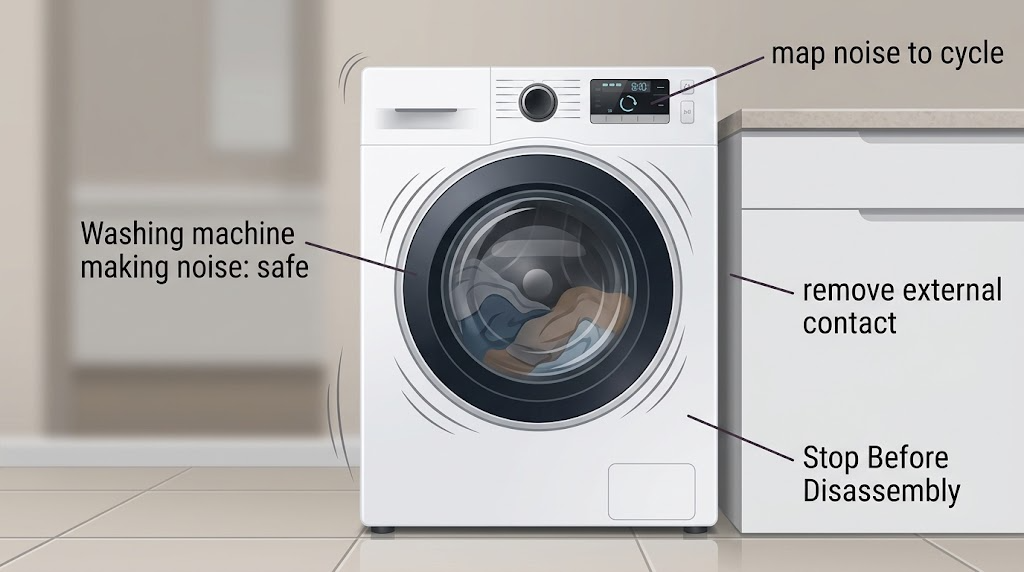
First note whether the noise occurs during filling, agitation, draining, or spin, then stop the cycle and check the outside of the washer, hose contact, load balance, and whether the cabinet is level and firm. Redistribute an uneven load and secure a hose or object that is striking the cabinet; do not keep running the washer if it bangs violently, scrapes, grinds, smells hot, leaks, or repeatedly stops. Unplug the washer before reaching into the basket or removing an obstruction, and do not open panels or work on the motor, belt, bearings, wiring, or suspension without model-specific service instructions and appropriate training.
Work through in order
Diagnostic checks
Use only checks that match the exact appliance or system and its official guide.
-
Check 1
Stop the current cycle and write down when the noise occurs: while water enters, during agitation, while draining, or during spin. Note whether it is a knock, rattle, squeal, scrape, hum, or grinding sound, and whether the noise changes with the load.
Expected result: The sound is limited to a particular phase, occurs only with a load, or continues even when the basket is empty.
Next step: Use the matching branch below and avoid repeating a full cycle merely to recreate a loud or damaging noise.
Stop if: Stop immediately for grinding, metal-on-metal scraping, violent banging, smoke, burning odor, a hot cabinet, a leak, or uncontrolled walking.
Why this matters
Why: A phase-specific noise can point to hose/object contact, load imbalance, or a drain-related condition; noise with an empty basket is less consistent with clothing distribution and merits service if it persists.
-
Check 2
With the washer stopped, inspect the outside and rear without removing panels. Move loose objects away from the cabinet and check that inlet and drain hoses are not positioned where vibration can make them hit the washer.
Expected result: A hose, rack, broom, hanger, wall, or other object is touching or striking the cabinet, or the exterior is clear.
Next step: Secure or move the contact point, then make one short, supervised test. If the noise remains, stop and continue with the level/load decision.
Stop if: Stop if the cabinet is dented near moving parts, the hose is leaking, a cord is damaged, or the check would require removing a panel.
Why this matters
Why: A contact point can transmit or create a rattle that is not an internal washer failure. If the exterior is clear, focus on load balance and leveling instead of adding lubricant or opening the machine.
-
Check 3
For a top-load washer, pause safely, wait for the basket to stop, and redistribute clothes loosely and evenly around the agitator or wash plate. Do not overload the basket, wash one heavy item alone, or reach into a moving washer.
Expected result: Heavy items are gathered on one side, a bulky item is holding water, the basket is overloaded, or the load is already evenly distributed.
Next step: Run only a supervised rinse or spin test if the washer is stable and there are no leaks or damaged parts. Stop if the noise returns or the cabinet moves.
Stop if: Stop for violent movement, a basket that remains off-center, a damaged agitator, water leaking from below, or any need to reach into a moving basket.
Why this matters
Why: An off-balance load can make the tub contact the cabinet and create thumping or vibration, particularly during spin. An even load that still bangs points toward leveling or a mechanical fault.
-
Check 4
With the washer empty and stopped, gently test whether it rocks diagonally from corner to corner. Check that all four feet are in firm contact with the floor; adjust feet only according to the model's installation instructions and do not tip the appliance without help.
Expected result: The cabinet rocks, one foot is not contacting the floor, or the washer is firm and level.
Next step: Correct a simple level condition using the model instructions, then make one supervised test. If it remains noisy, stop using the machine and arrange service.
Stop if: Stop for a cracked floor, a damaged foot, a leaning cabinet, a stacked or inaccessible installation, or any need to move the washer alone.
Why this matters
Why: An unlevel cabinet lets the load become unbalanced and can amplify spin vibration. A firm, level washer with persistent noise makes an internal or load-independent fault more likely.
-
Check 5
If the noise persists after the external, load, and level checks, turn the washer off and unplug it before checking for a loose object at the accessible basket opening. Do not remove the lid, front, rear panel, belt guard, motor, pump, suspension, or tub components.
Expected result: A foreign object is visibly accessible and removable without tools, or the empty washer still makes a scrape, grinding sound, or abnormal vibration.
Next step: Remove only an accessible object with power disconnected. For persistent empty-drum noise, leave the washer unplugged and have a qualified appliance technician diagnose it.
Stop if: Stop for sharp objects, standing water, a stuck lid, a loose drum, burnt wiring, a damaged cord, or any need to disassemble the cabinet.
Why this matters
Why: A safely removable object can explain a rattle; persistent empty-drum noise points toward bearings, drive, pump, suspension, motor, or another model-specific component that cannot be identified safely from sound alone.
Use your observations
Decision map
Find the observation that best matches what you see, then follow the next safe action.
-
PATH 01Next step
What you see
The noise is a rattle or knock and a hose or nearby object is touching the cabinet.
Do this next
Move the object away and secure the hose according to the installation instructions.
-
PATH 02Next step
What you see
The noise appears during spin and clothing is gathered on one side or a bulky/single item is being washed.
Do this next
Stop the cycle and distribute the load loosely and evenly; avoid overloading.
-
PATH 03Next step
What you see
The washer rocks or one or more feet are not firmly on the floor.
Do this next
Level it only as described in the model's installation instructions and with adequate help to prevent tipping.
-
PATH 04Safety boundary
What you see
The noise continues with an empty basket or sounds like grinding, scraping, or a failing bearing/drive.
Do this next
Unplug the washer and stop operating it.
Why this path and its safety boundary
Safety stop: True
-
PATH 05Safety boundary
What you see
The motor stops, the washer is overloaded, or the appliance becomes hot and then stops during operation.
Do this next
Stop the cycle, unplug the washer, and let it remain out of service rather than repeatedly restarting it.
Why this path and its safety boundary
Safety stop: True
-
PATH 06Safety boundary
What you see
Noise is accompanied by a leak, burning smell, smoke, sparks, damaged cord, or water near electrical parts.
Do this next
Stop using the washer, disconnect power only if it can be done without contacting water or damaged wiring, and keep clear.
Why this path and its safety boundary
Safety stop: True
Helpful context
Understand the symptom
The cycle phase is the most useful clue
A washer can make different sounds during fill, agitation, drain, and high-speed spin. A hose or object touching the cabinet tends to make noise when the washer vibrates; an uneven load or an unlevel cabinet is most noticeable in spin. A scrape, grinding sound, or noise that continues with an empty drum is less likely to be a simple load problem and should not be chased by repeatedly running cycles.
Start with checks that do not expose the mechanism
Move nearby brooms, racks, containers, and other objects away from the washer. Check that the inlet and drain hoses are not free to strike the rear cabinet. For top-load models, place clothing loosely and evenly around the agitator or wash plate rather than washing one bulky or single heavy item by itself. Do not add a part or lubricant based only on a noise description; Admiral models and configurations vary.
Know when a noise is a service symptom
If the washer rocks, walks, leaks, emits a burning smell, makes a metallic scrape or grinding sound, or the motor stops repeatedly, stop using it. An overload protector may stop a motor after overload or low-voltage conditions in some Admiral models, but repeated stops are a reason to contact a service technician rather than repeatedly restarting the appliance.
When checks do not resolve it
Need a professional?
Noise persists with an even load, a level cabinet, and no external contact., The washer grinds, scrapes, walks violently, leaks, or makes noise with an empty basket., The motor stops repeatedly, overheats, or a breaker trips., Diagnosis would require opening panels or working on the drive, pump, motor, wiring, suspension, or tub.
Common questions
FAQ
Why is my Admiral washer noisy only during spin?
Start by checking for an uneven or bulky load and confirm that the washer is level with all feet firmly on the floor. Hoses or objects touching the cabinet can also amplify vibration. If it still bangs, walks, or vibrates with an even load, stop and arrange service.
Can a hose make a washing machine sound like it is broken?
Yes. Inlet or drain hoses can strike the rear cabinet as the washer vibrates, and nearby racks or household items can rattle against the cabinet. Move external objects and secure hose contact before considering internal repairs.
Should I keep running the washer if it makes a grinding noise?
No. Stop the cycle and unplug the washer once it is safe to do so. Grinding or scraping that persists with an empty basket can indicate a drive, pump, bearing, suspension, or motor problem that needs professional diagnosis.
Why does my washer stop after making noise?
An overload, low-voltage condition, or motor protection can stop some Admiral models, but repeated motor stops are not a reset procedure. Remove an excessive load only after the machine is stopped and safe; if stopping repeats, call a service technician.
Can I open the washer to find the noisy part?
Do not remove cabinet, lid, belt, motor, pump, or tub panels just to identify a sound. Unplugging the appliance does not make every stored or mechanical hazard safe, and model-specific disassembly is best left to a qualified technician.
Read the exact guide
Official sources
- Knocking or Thumping - NoiseAmana · Manufacturer guidance on washer noise timing, hoses, external objects, load balance, and leveling
- Admiral Washing Machine Use and Care Guide (AAV1200AGW/AAV1200ARW)Admiral · Admiral top-load washer operating safety, overload protection, noise checks, and service boundary for the documented models
Community feedback
Share a repair observation
Share a plain-text repair observation. Accepted observations are published automatically; this page may take a moment to update.