
On this page
Start here
Quick answer
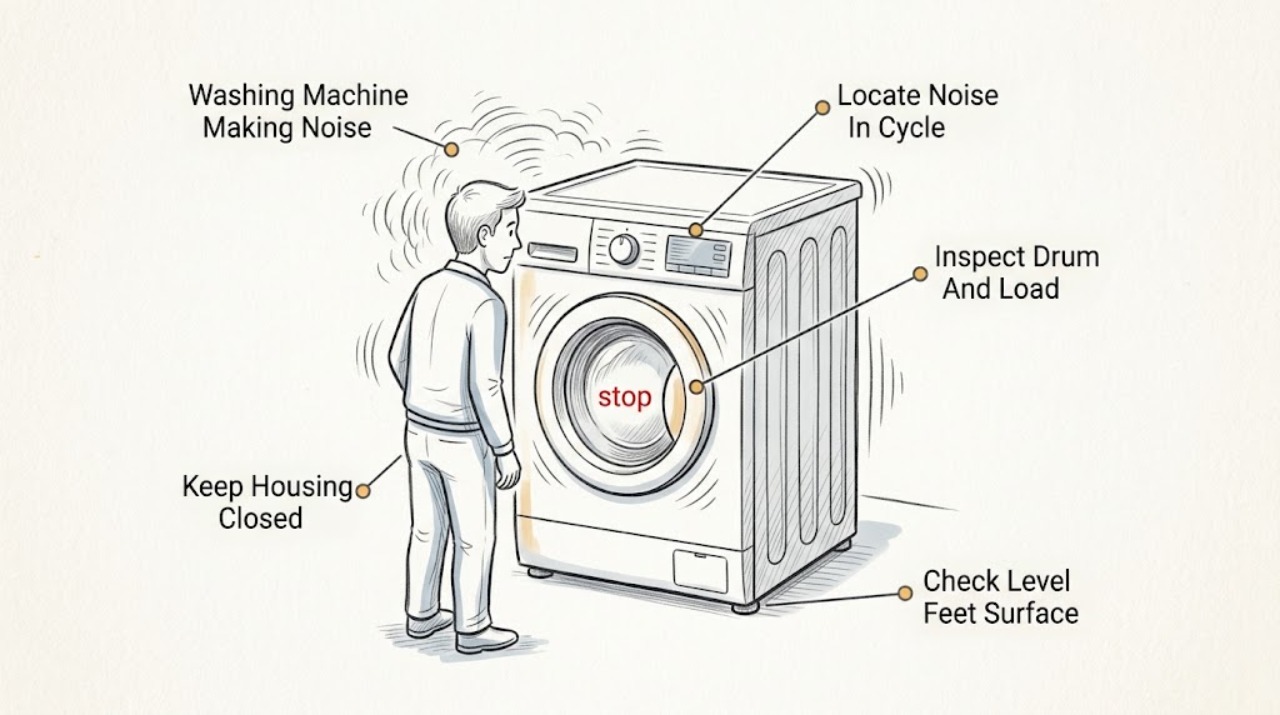
A Bosch washing machine can make normal water, pump, or brief motor noises, but banging, rattling, grinding, or movement needs a source check. First note when the sound occurs, then stop the cycle and inspect the drum for loose objects, redistribute an uneven load, and check from the outside that the washer is level, its feet are secured, and transit bolts were removed after installation. Bosch also identifies foreign objects, unbalanced laundry, alignment, loose feet, and unremoved transit bolts as common noise causes. If the noise is grinding, persists with an empty drum and a balanced load, the washer moves, the breaker trips, there is a burning smell or leak, or access to internal moving parts is needed, stop using it and arrange qualified Bosch service.
Before you begin
Safety first
- This article covers cycle-stage observation, visible drum and load checks, dry external installation observations, and only model-approved user maintenance. Do not open panels, access moving mechanisms, test live circuits, move a heavy appliance, or work near water and electricity.
Work through in order
Diagnostic checks
Use only checks that match the exact appliance or system and its official guide.
-
Check 1
Stop the programme using the normal control and note whether the sound occurs during water fill, tumble, drain, or high-speed spin. From outside the cabinet, note whether it is a gentle rush or whir, a repetitive rattle, a single knock, scraping, or grinding.
Expected result: The noise matches water entering, pumping out, or a brief motor/dosing sound, or it is an unusual impact, metallic rattle, scrape, or grind tied to drum movement.
Next step: If the sound is clearly normal and the washer is stable, continue only with ordinary use. If it is unusual or unclear, switch the appliance off and continue with the drum and load check.
Stop if: Stop immediately for smoke, burning odor, sparks, a damaged cord, a leak near electrical parts, or a sound accompanied by violent movement.
Why this matters
Why: Bosch manuals describe some rushing, hissing, slurping, and brief whirring as normal operating sounds. A movement-related impact or grinding sound needs the external checks below and should not be reproduced repeatedly just to listen.
-
Check 2
When the drum has stopped, open the door and remove loose coins, buttons, underwire, or other visible objects from the drum and door seal. Check whether one heavy item is clumped on one side or the load is packed tightly; redistribute it and use a small mixed test load rather than overloading.
Expected result: A foreign object is present, a single heavy item is concentrated on one side, the load is overfilled, or the empty drum and small balanced load are also noisy.
Next step: Remove only an object that is plainly accessible, redistribute the laundry, and run the appropriate short test once. If the sound remains empty, stop testing and arrange qualified diagnosis.
Stop if: Do not put hands through a moving drum, dismantle the door seal, force an object out of a gap, or continue a cycle if the drum is scraping or striking the cabinet.
Why this matters
Why: Bosch identifies foreign objects and uneven laundry as common causes of rattling, knocking, banging, or excessive spin noise. Noise that remains with an empty or balanced drum is less likely to be load distribution and needs installation or service checks.
-
Check 3
With the appliance off, look at the washer from the front and sides and check whether it rocks, has shifted, or sits on a soft or visibly uneven surface. If the manual permits user adjustment, verify the feet are firmly seated and their lock nuts are secured; do not lift the washer to make the check.
Expected result: The cabinet rocks, a foot is loose, the washer has moved during spin, the floor flexes, or the appliance appears level and stable.
Next step: Correct only an accessible foot or lock-nut issue according to the exact Bosch manual, then use a balanced load test. If leveling requires moving a heavy appliance or removing panels, stop and call a servicer.
Stop if: Do not wedge unsafe objects under the washer, defeat anti-vibration hardware, lift the appliance alone, or operate it while it walks across the floor.
Why this matters
Why: Bosch states that incorrect alignment, unsecured feet, or an unsuitable installation surface can cause vibration, movement, rattling, and loud spin noise. A stable level cabinet makes a load or internal fault more likely than a simple installation issue.
-
Check 4
If the noise began after delivery, installation, or a move, check the installation record and the rear of the appliance only from a safe, dry position. Confirm that the model's transit bolts were removed as instructed and that hoses, drain hardware, and the cabinet are not visibly striking a wall, stand, or adjacent object.
Expected result: The washer is newly installed or moved and transit-bolt removal is unconfirmed, an external hose or cabinet is contacting something, or installation was previously correct.
Next step: Follow the exact model manual or Bosch installation guidance for transit-bolt verification; correct only an obvious external clearance issue without shifting the machine. Use a qualified installer or servicer if the rear cannot be reached safely.
Stop if: Do not run repeated spin cycles with transit bolts installed, remove rear hardware by guesswork, pull on water or electrical lines, or move a stacked or built-in unit without appropriate help.
Why this matters
Why: Bosch says transit bolts protect a new washer during transport and must be removed before use; its manual links unremoved bolts and installation faults with loud spin noise and movement. Contact with a wall or hose can add a rattle but does not explain grinding from inside the drum.
-
Check 5
After the safe checks, note whether the noise is limited to draining, remains during drum rotation with no laundry, or continues across programmes. If the manual gives a user-accessible pump-filter procedure, isolate power and drain hot water carefully before inspecting it; otherwise leave the pump and internal mechanism closed.
Expected result: A rattle occurs only while draining, the drum is quiet when empty, grinding occurs whenever it rotates, or the sound persists despite a clear drain path and correct installation.
Next step: For a model-approved accessible filter check, follow the manual exactly and stop if water is hot or the area is unsafe. For empty-drum grinding, repeated impact, or any internal diagnosis, stop using the washer and arrange qualified Bosch service.
Stop if: Do not remove panels, reach for the pump impeller while connected, test live circuits, open the tub, or keep operating a washer that leaks, overheats, or moves violently.
Why this matters
Why: Bosch manuals associate banging or rattling in the drain pump with foreign bodies and distinguish that from loud spin noise. Persistent grinding or rotation noise with an empty drum can indicate a bearing, shock absorber, motor, pump, or other internal fault that sound alone cannot diagnose.
Use your observations
Decision map
Find the observation that best matches what you see, then follow the next safe action.
-
PATH 01Safety boundary
What you see
The sound is a brief whir, water rush, hissing, or rhythmic pump suction that occurs at the expected stage and the washer remains stable.
Do this next
Continue normal use while observing for a new change in volume, timing, movement, or an error message.
Why this path and its safety boundary
Why it matters: Bosch manuals identify several water, pump, and dosing sounds as normal operating noise rather than a failed component.
Safety stop: Arrange service if the sound changes to grinding, scraping, repeated impact, or is accompanied by movement, odor, smoke, or leakage.
-
PATH 02Safety boundary
What you see
The noise appears with one heavy or tightly packed load, or a loose object is visible in the drum, door seal, or pump-access area.
Do this next
Remove only the accessible object, redistribute the load, and run one suitable balanced test.
Why this path and its safety boundary
Why it matters: The load distribution or object can create a localized rattle or imbalance without proving an internal failure.
Safety stop: Call for service if the noise remains with an empty drum or if an object is trapped behind a panel or seal.
-
PATH 03Safety boundary
What you see
The washer rocks, walks, has loose feet, contacts a wall, or was recently installed or moved with transit-bolt removal unconfirmed.
Do this next
Use the exact Bosch installation instructions to verify transit-bolt removal and secure the feet or external clearance only when safely accessible.
Why this path and its safety boundary
Why it matters: Alignment, surface, loose-foot, or transit hardware can produce loud vibration and spin noise.
Safety stop: Use a qualified installer or servicer if the appliance is stacked, built in, too heavy to move safely, or the issue remains after correct installation.
-
PATH 04Safety boundary
What you see
The rattle occurs only during drain and the drum and cabinet are otherwise quiet.
Do this next
Follow the exact manual's safe pump-filter or drain-path procedure if the model makes that maintenance user-accessible; otherwise arrange service.
Why this path and its safety boundary
Why it matters: Bosch associates banging or rattling in the drain pump with a foreign body, while a suction sound can be a normal pump operation.
Safety stop: Stop for hot water, a leak, electrical moisture, a jammed filter, or any need to remove a panel or reach live parts.
-
PATH 05Safety boundary
What you see
Grinding, scraping, or repeated knocking remains with an empty drum and a stable, correctly installed washer.
Do this next
Stop using the washer, record the cycle stage and sound, and arrange qualified Bosch diagnosis using the exact model number.
Why this path and its safety boundary
Why it matters: An internal bearing, shock absorber, motor, pump, drive, or other mechanical fault is possible, but the sound does not identify the failed part.
Safety stop: Do not open the cabinet, spin exposed mechanisms, test live voltage, or order a part solely from the noise description.
-
PATH 06Safety boundary
What you see
There is smoke, sparking, a burning smell, a hot or damaged cord, active water near electrical parts, or violent movement.
Do this next
Stop the cycle and use a dry, safe, accessible shutoff only if it can be reached without contacting the hazard; arrange qualified appliance or electrical service.
Why this path and its safety boundary
Why it matters: Fire, shock, flood, and injury prevention take priority over further noise diagnosis.
Safety stop: Do not touch wet electrical parts, pull a damaged cord, restart the machine to reproduce the sound, or step into water near the appliance.
Helpful context
Understand the symptom
Identify the noise before opening anything
A rushing or hissing sound can be water entering the detergent drawer, and a rhythmic suction or slurping sound can be the drain pump moving water. A short whir after switch-on can be a dosing-system test on models that have that feature. Those sounds are not automatically faults. Banging, metallic rattling, scraping, or grinding is different: note whether it happens while filling, tumbling, draining, or spinning, and stop the programme before inspecting the appliance.
Use only low-risk external checks
The safest useful checks are the load, visible drum, door area, hose position, level, feet, and installation history. Unplug the washer only when the plug and floor are dry and safely accessible. Do not reach into a moving drum, remove panels, hold a fan or pulley, or test live wiring. A washer that has just been installed or moved deserves a transit-bolt and leveling check before component theories are considered.
When the noise is a service symptom
If the sound remains with an empty drum and the washer is correctly installed, a worn bearing, shock absorber, pump obstruction, motor, or other internal fault becomes more plausible, but sound alone cannot identify a replacement part. Bosch lists drum bearings, shock absorbers, motors, and related parts in its model-based parts support; use the exact model and a qualified diagnosis rather than ordering by appearance.
Safety boundary
Stop conditions
- Stop immediately for smoke, sparks, a burning smell, a hot or damaged cord, a leak near wiring, or violent cabinet movement.
- Do not reach into a moving drum, remove panels, test live circuits, or hold a moving pump, pulley, fan, belt, or suspension part.
- Do not operate a newly installed washer with transit bolts still installed or unconfirmed when the manual requires their removal.
- Do not lift, move, or unstack a heavy washer alone; do not wedge unsafe materials under the cabinet or bypass installation hardware.
- Arrange qualified Bosch service when grinding persists with an empty drum, the washer walks after correct leveling, a hidden object or pump fault is suspected, or internal parts are needed.
Only after diagnosis
Potential parts
- Bosch-compatible drain pump or filter assembly
Consider this category only if the rattle is isolated to draining and qualified diagnosis confirms a blocked or failed pump after the model-approved drain-path check.
Confirm the exact Bosch model, pump design, filter arrangement, and manufacturer fit information before ordering; water and electrical safety apply. - Bosch-compatible shock absorber or suspension component
Consider this category only if qualified diagnosis links persistent spin banging or cabinet movement to worn suspension after load balance and leveling are correct.
Confirm the exact Bosch model and approved repair procedure; suspension access requires cabinet or tub work on many models. - Bosch-compatible drum bearing or drum support
Consider this category only if qualified diagnosis confirms rotation-related grinding or play from the drum assembly rather than a loose object or pump noise.
Confirm the exact Bosch model and assembly compatibility; bearing and drum work is professional repair, not a sound-only parts decision. - Bosch-compatible motor or drive component
Consider this category only when testing identifies a motor or drive fault after installation, load, pump, and drum checks are cleared.
Confirm the exact Bosch model, motor and drive configuration, electrical diagnosis, and manufacturer fit information before replacement.
When checks do not resolve it
Need a professional?
Arrange qualified Bosch appliance service when a balanced-load, visible-object, level, foot, clearance, and model-specific transit-bolt check does not stop the unusual noise, or whenever the sound is grinding, scraping, repeated impact, or associated with movement, a leak, an error, or an electrical symptom. Stop immediately for smoke, sparks, burning odor, a hot cord, or water near electrical parts and use qualified electrical service for a circuit or wiring concern.
Safety scope: This article covers cycle-stage observation, visible drum and load checks, dry external installation observations, and only model-approved user maintenance. Do not open panels, access moving mechanisms, test live circuits, move a heavy appliance, or work near water and electricity.
Common questions
FAQ
Is a rushing or slurping sound from a Bosch washer always a fault?
No. Bosch manuals describe water entering the detergent drawer and a drain pump moving water as normal operating sounds in the appropriate cycle stage. Escalate if the sound becomes a grinding, scraping, or impact noise or the washer moves.
Why does a Bosch washer bang only during spin?
Start with load balance, level, secured feet, floor stability, and transit-bolt removal after a move or installation. Bosch identifies each of these as relevant to vibration or loud spin noise; persistent noise with a balanced load needs service diagnosis.
Should I keep running a Bosch washer that is grinding?
No. Stop the cycle and arrange Bosch support or qualified service. Bosch provides a dedicated grinding-noise escalation page, and repeated operation can worsen a mechanical or safety problem.
Read the exact guide
Official sources
- User manual and installation instructions WGA244A0MEBosch Home Appliances · A Bosch washer manual used for general noise categories and safety boundaries; the user's exact model manual controls final instructions.
- Bosch Washing Machine Troubleshooting & Repair GuideBosch Home Appliances · Applies to Bosch washing-machine noise checks in the United States; the exact model manual controls model-specific procedures.
- Washing Machine Spare PartsBosch Home Appliances · Applies only after diagnosis and exact Bosch model identification; it does not establish that any particular part has failed.
- Washing Machine Transit BoltsBosch Home Appliances · Applies when a Bosch washer is new, installed, or moved; the exact owner's manual controls bolt location and removal steps.
- Washing machine drum making grinding noisesBosch Home Appliances · Applies when the drum or washer makes a grinding sound; Bosch directs the user to support for diagnosis.
Community feedback
Share a repair observation
Share a plain-text repair observation. Accepted observations are published automatically; this page may take a moment to update.