
On this page
Start here
Quick answer
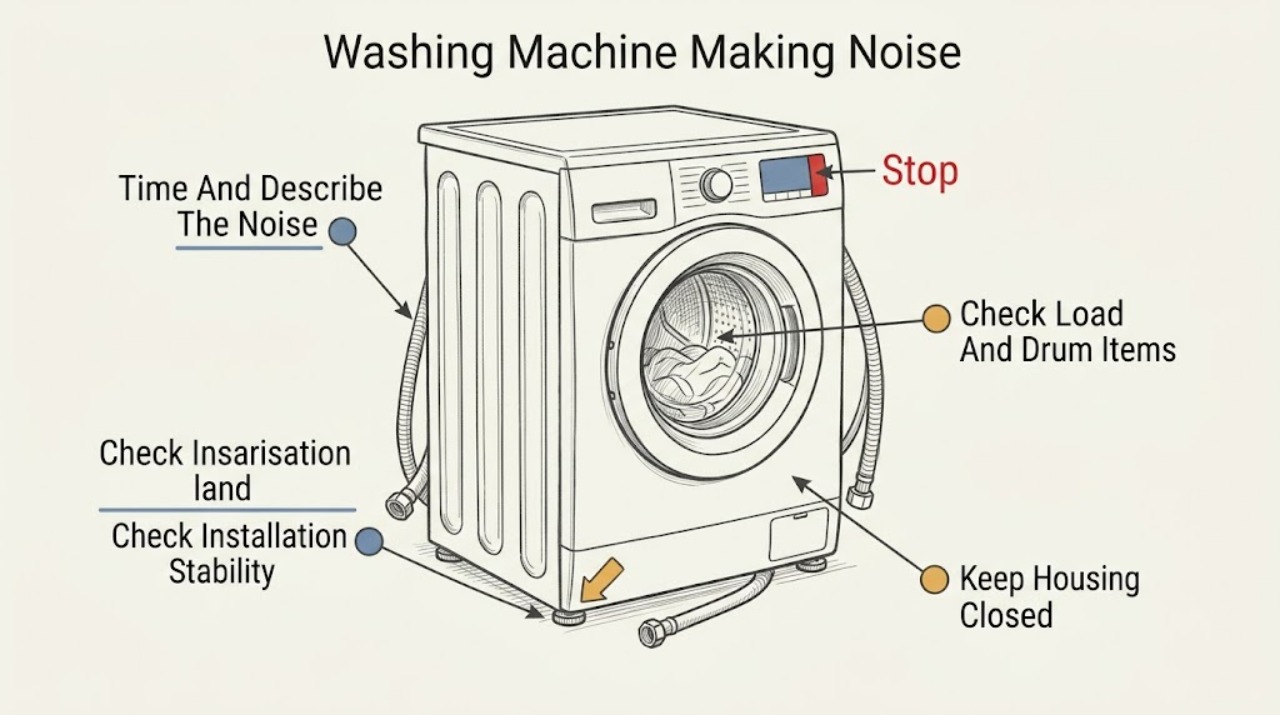
First record when the AEG washing machine makes the noise and whether it is a normal hum, a rattle from laundry, or a new knock, scrape, or grinding sound. AEG says humming or pumping during a cycle can be normal, while excessive spin noise or movement can come from transit bolts, an unlevel machine, an unbalanced load, loose hoses, or objects in the drum or drain filter. With the machine stopped, check only safe, visible items: the floor and feet, remaining transit hardware if it was recently installed, load balance, hose contact, and the drum/filter for loose objects as the model manual permits. Do not open the cabinet or reach into moving parts. If the sound is sudden, persistent, accompanied by burning smell, smoke, a leak, an error, poor draining, a drum that will not turn freely, or violent movement, stop using the machine and arrange qualified appliance service.
Before you begin
Safety first
- No live electrical work, cabinet disassembly, motor or pump dismantling, forced filter access, drum probing, or solo movement of the appliance.
Work through in order
Diagnostic checks
Use only checks that match the exact appliance or system and its official guide.
-
Check 1
Stop the programme if the sound is new, harsh, or accompanied by movement. From a safe position, note the exact stage (filling, washing, draining, spinning, or drying if this is a washer-dryer), and make a short recording only if no one needs to approach a moving or unstable appliance.
Expected result: Classify the sound as a steady hum/pump, buzz that follows the motor, water slosh, click, clothing rattle, intermittent knock, scrape/grind, or violent shake; record whether an error, leak, smell, or poor draining is also present.
Next step: Continue only with the matching safe external check when there is no stop symptom. Keep the appliance off and request qualified service for grinding, scraping, burning smell, smoke, leak, error, violent movement, or uncertainty about the source.
Stop if: Do not place hands near the drum, belt, fan, filter, or moving hoses, and do not run another cycle just to reproduce a dangerous sound.
Why this matters
Why: A steady hum or pump sound can be normal operation. A noise isolated to spin points toward load, levelling, hose contact, transit hardware, or a drum/filter object; a new harsh sound or a sound with a safety symptom requires service rather than repeated testing.
-
Check 2
With the machine off, inspect from the front whether it sits on a hard, stable, level floor and whether it rocks when gently assessed from a safe, non-pinching position. If the appliance was recently installed, check the exact manual or installation leaflet for the transit-bolt procedure rather than reaching behind or moving the machine alone.
Expected result: Record whether all visible feet appear firmly supported, the cabinet rocks, the machine touches a wall or cupboard, or recent installation leaves transit hardware status unknown.
Next step: If the manual describes a safe adjustment and the machine can remain in place, follow that procedure without improvised shims; otherwise document the installation and arrange service or installer assistance. Recheck only at a low-risk stage if the manual allows.
Stop if: Do not tip, pull, lift, crawl behind, or place hands under the machine alone; stop if it can fall, the floor is damaged, or hardware cannot be identified without moving the appliance.
Why this matters
Why: An unlevel or unstable installation can amplify spin vibration and noise. Transit hardware left in place after installation can also cause excessive movement, but its presence and removal method are model-specific.
-
Check 3
After the drum has stopped, remove laundry only in the normal way and inspect pockets, zips, hooks, belts, and small items. Look through the drum for a loose strap or object and check whether the load is a single bulky item, tangled, or visibly overloaded; do not reach between drum sections or force the drum.
Expected result: Record whether the sound disappears with the load removed, whether one item or a small object could strike the door, and whether the drum has a visible obstruction or damage.
Next step: For an intact machine with a clearly correctable load, redistribute or reduce the load according to the manual. If noise persists with an empty drum or an object is trapped, keep the appliance off and arrange service.
Stop if: Do not insert tools, fingers, or improvised hooks into drum holes, and do not dismantle the door, drum, or cabinet to retrieve an object.
Why this matters
Why: AEG notes that clothing hardware and a single or overloaded item can create rattling or an unbalanced spin. A visible object that cannot be safely removed, a damaged drum, or a sound that remains empty points beyond laundry balance.
-
Check 4
From the front or an already accessible side, inspect visible inlet and drain hoses for slack, kinks, trapped sections, or contact with the cabinet, wall, or cupboard. Do not pull the appliance forward; only adjust a loose visible hose if the manual permits it and no water or electrical hazard is present.
Expected result: Classify the hoses as clear and secure, touching a rigid surface, kinked or pinched, visibly damaged, leaking, or inaccessible.
Next step: If a safe, visible hose contact is the only finding, restore the routing described in the manual without force and keep watch for leaks. For damage, a leak, or persistent noise, leave the machine off and request qualified service.
Stop if: Do not loosen plumbing connections, use tools on hose fittings, move the machine alone, or touch wet areas near the plug or socket.
Why this matters
Why: AEG says loose hoses can vibrate against the housing and produce a knocking noise. A damaged or leaking hose is a water and electrical risk, not a noise-adjustment task; an inaccessible hose requires professional or installer help.
-
Check 5
If the exact AEG manual identifies a visible user-accessible drain filter, inspect its cover and surrounding area with the machine stopped and disconnected only from a dry safe location. Follow the model manual for any filter cleaning; do not force a jammed cover or reach into the pump.
Expected result: Record whether loose coins, buttons, lint, or another small object is visibly lodged, whether the cover is secure and undamaged, and whether draining is also slow or noisy.
Next step: Use only the documented filter procedure for the exact model and refit the cover securely; if no manual procedure exists, keep the machine off and provide the observation to a technician.
Stop if: Do not open a filter while water may be hot, do not probe with a tool, and do not continue if the floor/electrics are wet or the cover will not move normally.
Why this matters
Why: AEG says small objects can become trapped in a visible drain filter and can contribute to noise. A jammed cover, damaged filter, water release, or persistent pump noise needs model-specific service rather than force.
-
Check 6
Only if a clearly safe cause was corrected (such as load distribution or visible hose contact), the machine is stable, and there is no leak, smell, error, or electrical hazard, use the lowest-risk model-approved programme check while remaining nearby. Stop at once if the original noise returns.
Expected result: Observe whether the sound is gone, remains only as a normal hum or pump sound, returns at spin, or is now accompanied by movement, poor draining, a leak, or another fault.
Next step: If the noise recurs, stop using the machine, preserve the recording and observations, and arrange qualified appliance service with the model details.
Stop if: Do not recheck after an unresolved mechanical noise, with violent movement, a damaged hose, wet electrics, burning smell, smoke, or any need to open the appliance.
Why this matters
Why: A quieter cycle after a load or installation correction supports that external cause, but it does not prove internal components are healthy. A repeat or escalating noise, especially with a symptom, requires diagnosis rather than more cycles.
Use your observations
Decision map
Find the observation that best matches what you see, then follow the next safe action.
-
PATH 01Safety boundary
What you see
The sound is a steady hum or pumping sound during filling or draining, with normal operation and no leak, error, smell, or excessive movement.
Do this next
Monitor the stage and continue normal use if it remains stable and unchanged; arrange service if it becomes new, harsh, persistent, or is joined by another fault.
Why this path and its safety boundary
Why it matters: AEG describes these sounds as potentially normal parts of a cycle.
Safety stop: Stop for grinding, scraping, burning smell, smoke, leak, error, or violent movement.
-
PATH 02Safety boundary
What you see
Noise and shaking occur mainly during spinning, especially with a single bulky item, overloaded load, rocking cabinet, or unclear level.
Do this next
Redistribute the load and check stable levelling only as the manual permits, then stop if the issue persists.
Why this path and its safety boundary
Why it matters: Load balance and installation stability are plausible external causes.
Safety stop: Do not tip or move the heavy appliance alone, and do not keep running high-speed cycles to test it.
-
PATH 03Safety boundary
What you see
The sound is a rattle or knock and a visible garment item, drum object, or hose is contacting a hard surface.
Do this next
Remove or redistribute only the accessible laundry and restore visible hose routing if the manual allows; request service if the object is trapped or noise remains.
Why this path and its safety boundary
Why it matters: A loose item or hose can transmit impact or vibration, but trapped or damaged parts cannot be safely inferred from sound alone.
Safety stop: Do not probe drum holes, dismantle the door, or use tools to release an object or hose.
-
PATH 04Safety boundary
What you see
Noise occurs during draining and the machine drains slowly or a visible filter has loose objects.
Do this next
Follow the exact model's safe filter procedure only if the access is user-serviceable and the area is dry; otherwise arrange service.
Why this path and its safety boundary
Why it matters: A filter obstruction is plausible and AEG directs filter checks through the user manual.
Safety stop: Stop for hot water, a jammed or damaged cover, a leak, or any need to reach into the pump.
-
PATH 05Safety boundary
What you see
The noise started suddenly, persists with an empty drum, escalates, or occurs with poor draining, an error, a leak, burning smell, smoke, or violent movement.
Do this next
Stop using the machine, isolate it only from a dry safe location if necessary, and request qualified appliance service; provide the model and recording.
Why this path and its safety boundary
Why it matters: An internal, electrical, plumbing, or mechanical fault is possible and external checks are no longer sufficient.
Safety stop: Do not open the cabinet, dismantle the pump or motor, or operate repeated test cycles.
Helpful context
Understand the symptom
Classify the sound before changing anything
A steady hum or pump sound during filling or draining may be ordinary operation, and AEG also lists water inflow, motor, pump, heating, fans in washer-dryers, door locking, and clothing hardware among normal sounds. A sharp new scrape, repeated knock, metallic rattle, or sound paired with movement needs a different path. The cycle stage, speed, load, and whether the machine is level are more useful clues than loudness alone.
Spin noise is often a stability or load problem
AEG recommends checking transit bolts, a level stable floor, hose fit, load distribution, the visible drain filter, and loose straps or objects in the drum when a machine shakes or makes noise during spinning. A single bulky item can unbalance the drum just as an overloaded load can. Make only model-directed external checks; do not compensate for a mechanical fault by repeatedly running high-speed cycles.
The safety boundary is reached before internal diagnosis
The user manual is the authority for any filter access, transit-hardware procedure, or adjustment on the exact model. AEG directs continuing problems to a professional technician. Stop before opening the cabinet, dismantling the pump or motor, working near live wiring, or forcing a drum or filter; these observations cannot establish which internal part has failed.
Safety boundary
Stop conditions
- Stop immediately for burning smell, smoke, sparks, a leak, a damaged power cable, an error with abnormal noise, violent movement, or any water near electrical equipment.
- Stop before opening the cabinet, working on wiring, dismantling the motor or pump, forcing a filter, probing the drum, or moving the heavy machine alone.
- Stop repeated testing when the sound is sudden, escalating, present with an empty drum, or not explained by a clearly safe load or installation correction.
- Keep the appliance out of service and request qualified repair when the source is internal, inaccessible, or uncertain.
When checks do not resolve it
Need a professional?
Use qualified service for internal or persistent noise, unexplained noise after safe external checks, or any electrical, water, drum, pump, or motor symptom.
Safety scope: No live electrical work, cabinet disassembly, motor or pump dismantling, forced filter access, drum probing, or solo movement of the appliance.
Have this ready
- Exact AEG model, cycle and spin stage, sound recording, whether the drum was empty or loaded, installation age, visible hose/filter findings, and any error or secondary symptom.
Common questions
FAQ
Is a humming sound from an AEG washing machine normal?
It can be. AEG says humming or pumping during a cycle may be normal. Treat it as a fault when it is new, harsh, persistent, or accompanied by movement, a leak, an error, smell, or poor operation.
Why does the machine knock during spin?
Check the load balance, stable levelling, transit-bolt status after installation, and visible hose contact as the exact model instructions permit. A single bulky item can unbalance a load; persistent noise needs service.
Can clothes or coins cause washing-machine noise?
Yes. AEG notes that zips, buckles, straps, coins, buttons, and other small objects can rattle or become trapped in the drum or visible drain filter. Inspect only from safe access and do not probe the machine.
Should I run an empty cycle to test the noise?
Only after a clearly safe external cause was corrected and there is no leak, electrical hazard, burning smell, error, violent movement, or unresolved mechanical sound. Stop immediately if the noise returns.
When should I call a technician for an AEG washing-machine noise?
Call when the sound is sudden, persistent, escalating, present with an empty drum, or joined by a leak, poor draining, error, smell, smoke, sparks, or violent movement. Do not open the cabinet or dismantle internal parts.
Read the exact guide
Official sources
- Washing machine emits buzzing sound during washingAEG · AEG motor buzz during washing
- User ManualAEG · Model-specific installation, hose, filter, safety, and service boundaries; confirm the user's model before applying details
- Washing machine emits noises and shakes while spinningAEG · AEG spin-cycle noise, vibration, load, hose, filter, and drum-object checks
- Washing machine emits humming / pumping noiseAEG · AEG normal humming and pumping sounds during a cycle
- How to stop your washing machine vibrating and reduce noise / unbalanced load / reduce vibration during rinseAEG · AEG vibration reduction through transit-bolt, levelling, clearance, and load checks
Community feedback
Share a repair observation
Share a plain-text repair observation. Accepted observations are published automatically; this page may take a moment to update.