
On this page
Start here
Quick answer
First identify whether the noise occurs while filling, washing, draining, or spinning, then run only the safe checks that match that stage. On a Bauknecht washer, clothing hardware, a foreign object, an unbalanced or poorly leveled load, transport hardware after installation, a belt, motor sound, or a bearing can produce different clues; a loud empty-drum turn or excessive drum play needs professional diagnosis.
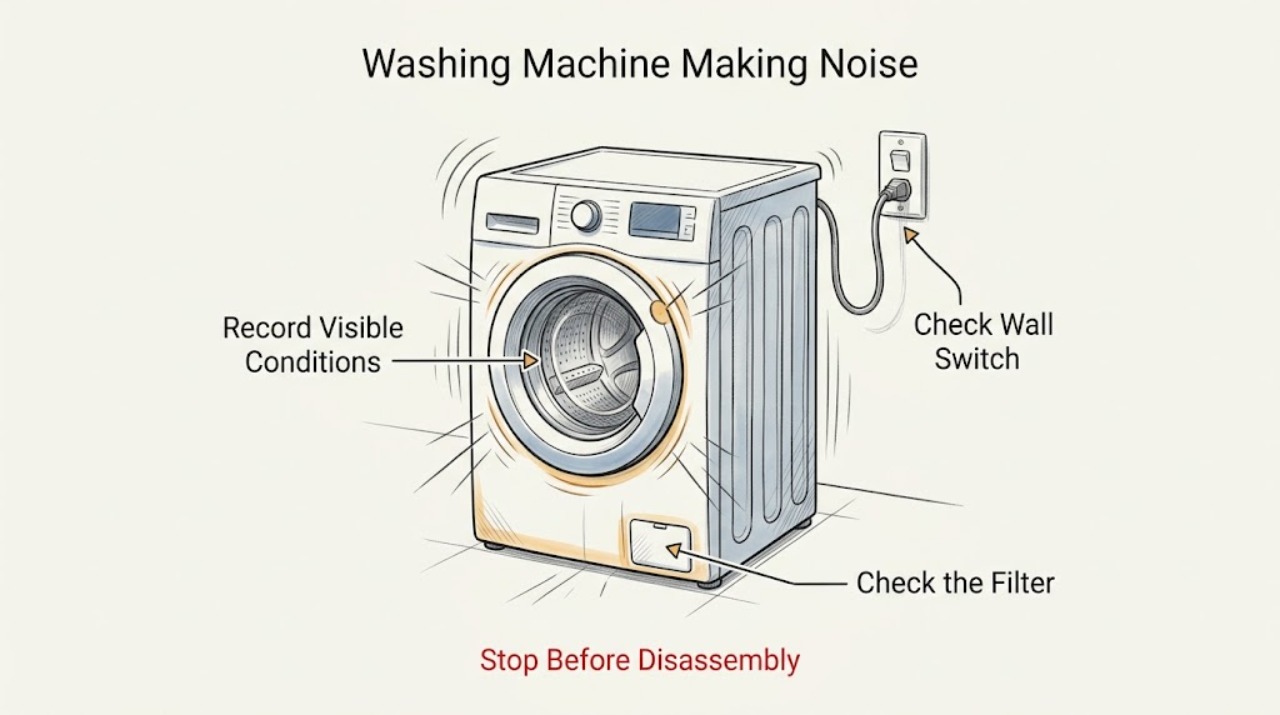
Work through in order
Diagnostic checks
Use only checks that match the exact appliance or system and its official guide.
-
Check 1
With the washer stopped, record the sound and the point in the cycle where it appears: fill, tumble, drain, or spin. Also note whether the drum is empty or loaded, whether the cabinet moves, and whether the sound began after installation or recently.
Expected result: A sound limited to high-speed spin, a sound that tracks drum rotation, a pump-area sound during draining, or noise present from the first cycle are different patterns.
Next step: Use the matching checks below and stop the test if there is a burning smell, smoke, water escaping, electrical shock, or uncontrolled movement.
Why this matters
Why: The timing separates load and installation causes from a drum, belt, pump, motor, or bearing clue; it prevents repeating unrelated checks.
-
Check 2
Switch the washer off and empty the drum. Check garments for coins, clips, keys, open zippers, buttons, and other loose hardware, then slowly turn the empty drum by hand.
Expected result: If the noise disappears when garment hardware is secured or removed, the load was the trigger. If the empty drum still clicks, scrapes, or grinds, the noise follows the machine rather than the laundry.
Next step: Remove only loose items you can see and reach without dismantling anything. If the empty-drum noise remains, stop using the washer and arrange professional inspection rather than opening the cabinet.
Why this matters
Why: Bauknecht notes that small objects can leave pockets and move around the drum; an object that has passed between the drum and tub can remain noisy even when the drum is empty.
-
Check 3
For noise during draining, turn the washer off and inspect only the accessible pump or drain-filter area described in the Bauknecht model manual; place a suitable container and towels first if the manual requires water release.
Expected result: A small foreign object in the accessible filter or pump path may be visible; a clear accessible area with continuing noise points beyond this user check.
Next step: Remove only an obvious loose object using the manual's procedure, refit the filter securely, and run one supervised short test. Stop immediately for a leak or persistent mechanical noise and call for service.
Why this matters
Why: Bauknecht identifies both the drum and the pump as possible foreign-object locations, so a drain-stage rattle is not diagnosed by inspecting the drum alone.
-
Check 4
If the washer bangs or walks mainly during spin, pause it, redistribute the load, and avoid testing with one heavy item or a tightly bundled bulky item. Check that the machine has clearance from the wall, counter, and neighboring appliances.
Expected result: Noise that changes after the load is balanced or after contact with nearby surfaces is removed is load or clearance related; repeated banging with a balanced load is not resolved.
Next step: Run one supervised spin with a balanced load. If the washer still moves or bangs, continue to the leveling check and do not keep running high-speed cycles to see whether it improves.
Why this matters
Why: A small or unevenly distributed load can send wet weight to one side, while a cramped installation can make the cabinet strike its surroundings.
-
Check 5
With the washer empty and powered off, check whether all four feet are firmly on the floor and use a level if available. Adjust the feet only as described in the model manual, then lock them as directed.
Expected result: Rocking, a visible tilt, or one foot that is not firmly planted indicates an installation issue; a stable, level machine that still bangs points to another cause.
Next step: After leveling, run one supervised spin. If the noise remains despite a balanced load, clearance, and firm feet, stop treating it as a setup problem and arrange diagnosis.
Why this matters
Why: Bauknecht's movement guidance specifically calls for all four feet to stand firmly and for the machine to be correctly aligned.
-
Check 6
If the washer has been loud since its first cycle or was recently moved, verify from the installation instructions that the transport locking screws were removed; check for loose plastic transport material without dismantling the machine.
Expected result: Transport hardware still installed, or plastic material that has entered the machine, explains immediate severe noise after setup; no installation finding means the original symptom needs another branch.
Next step: Do not run further cycles until the installer or a qualified technician confirms the transport hardware is correctly handled. Do not remove structural parts based on a generic picture; use the exact model instructions.
Why this matters
Why: Bauknecht's installation FAQ identifies transport screws and displaced plastic parts as a first-cycle noise cause.
-
Check 7
If the sound is a steady high-pitched hum, check the model documentation to determine whether the washer uses a collector motor with carbon brushes, without opening the cabinet.
Expected result: A high hum on a model identified as using that motor type can be expected motor noise; a new hum accompanied by poor operation, a hot or burning smell, or arcing is not a normal-use check.
Next step: If the hum is not clearly covered by the model documentation or has a safety symptom, stop using the washer and request professional diagnosis.
Why this matters
Why: Bauknecht states that the sound is normal when the washer has a collector motor with carbon brushes, but that identification is model dependent.
-
Check 8
If the sound is a squeak while the empty drum turns, stop the washer and do not remove panels to inspect the drive system.
Expected result: A repeatable squeak that follows drum rotation, after clothing and accessible foreign objects are excluded, is consistent with the belt clue described by Bauknecht.
Next step: Record the sound and model details for a technician; have the belt and related drive components confirmed before any part is selected.
Why this matters
Why: A worn, porous, or loose drive belt can squeak, but the sound alone does not prove belt failure or identify a replacement.
-
Check 9
If the washer produces a deep rumble or metallic knock while the drum turns, reach into the empty drum only when it is disconnected and gently check for unusual vertical play.
Expected result: Marked up-and-down drum movement together with the rumble or knock is a serious bearing clue; a firm drum means the bearing is not confirmed by this check.
Next step: Stop using the washer and arrange professional assessment if there is excessive play. Do not infer a bearing replacement from sound alone when there is no play.
Why this matters
Why: Bauknecht presents excessive empty-drum play, after other causes are excluded, as a reason to suspect bearing damage.
Use your observations
Decision map
Find the observation that best matches what you see, then follow the next safe action.
-
PATH 01Next step
What you see
The noise is a light click or knock only when buttons, zippers, or similar garment hardware are present.
Do this next
If it continues with plain laundry or an empty drum, follow the foreign-object branch.
Why this path and its safety boundary
Why it matters: Secure the hardware and retest with a suitable load; this pattern can be normal contact noise.
-
PATH 02Next step
What you see
The empty drum remains noisy when turned by hand.
Do this next
Stop and arrange service; do not open the cabinet.
Why this path and its safety boundary
Why it matters: A foreign object between the drum and tub or another internal mechanical fault is possible.
-
PATH 03Next step
What you see
The sound occurs during draining and an accessible pump or filter check finds a loose object.
Do this next
Remove it only by the model manual's procedure, then run one supervised test; persistent noise needs service.
Why this path and its safety boundary
Why it matters: The object may be causing the drain-stage rattle.
-
PATH 04Next step
What you see
The washer bangs or walks only with a small, single, or unevenly distributed load.
Do this next
Redistribute the load and run one supervised spin; do not continue if movement persists.
Why this path and its safety boundary
Why it matters: Load imbalance is more likely than an immediate internal failure.
-
PATH 05Next step
What you see
The cabinet contacts a wall, counter, or neighboring appliance during spin.
Do this next
Restore clearance and retest once; persistent noise requires diagnosis.
Why this path and its safety boundary
Why it matters: Installation clearance is contributing to the noise.
-
PATH 06Next step
What you see
The washer rocks or one foot is not firmly planted.
Do this next
Adjust and secure all feet according to the model manual, then run one supervised spin.
Why this path and its safety boundary
Why it matters: Leveling is incorrect.
-
PATH 07Next step
What you see
Severe noise has been present since the first cycle or immediately after moving the washer.
Do this next
Stop cycles until installation is verified by the instructions or a qualified technician.
Why this path and its safety boundary
Why it matters: Transport locking hardware or displaced transport material must be checked.
-
PATH 08Next step
What you see
The sound is a high hum and the model documentation confirms a collector motor with carbon brushes.
Do this next
Monitor for change or safety symptoms; service it if the sound is new, worsening, or accompanied by poor operation or burning smell.
Why this path and its safety boundary
Why it matters: The motor sound may be normal for that design.
-
PATH 09Next step
What you see
A deep rumble or metallic knock is accompanied by excessive vertical drum play.
Do this next
Stop using the washer and arrange inspection; do not select a bearing by sound alone.
Why this path and its safety boundary
Why it matters: Bearing damage is a professional-diagnosis condition.
-
PATH 10Next step
What you see
There is smoke, a burning smell, an electric shock, a water leak, or uncontrolled movement.
Do this next
Stop the cycle, isolate power and water only if it can be done safely, keep clear, and request qualified help.
Why this path and its safety boundary
Why it matters: This is an immediate safety stop, not a routine noise diagnosis.
Helpful context
Understand the symptom
What the sound is telling you
A click or light knock that follows buttons, zippers, or other garment hardware can be normal. A new rattle or scrape with an otherwise plain load is more useful diagnostically. Note whether the sound follows the drum, happens only at high speed, comes from the drain area, or makes the cabinet move; those distinctions decide the next check.
Keep the inspection external
Disconnect power before handling the drum or accessible filter area, keep hands out while the machine is running, and use the model's manual for any drain-filter access. Do not remove panels, reach between the drum and tub, or test a suspected electrical fault yourself. A check that points inside the cabinet is a service boundary, not a repair instruction.
Only after diagnosis
Potential parts
Only when a technician confirms a repeatable drum-rotation squeak and verifies that the model uses a belt drive.
Only when a professional confirms deep rumble or metallic knocking together with excessive drum play.
Only when the noise is localized to draining and an authorized inspection confirms internal pump-path damage or an inaccessible obstruction.
Only when repeated spin banging remains after load balance, clearance, and leveling are confirmed and a technician identifies the failed component.
When checks do not resolve it
Need a professional?
Arrange qualified appliance service when the empty drum remains noisy, the drum has excessive play, a squeak persists after accessible checks, transport hardware cannot be verified, the washer still bangs after load and leveling checks, or any safety symptom appears. Provide the model identifier, cycle stage, sound description, whether the drum was empty, and a short recording if safe.
Common questions
FAQ
Is a clicking sound always a fault?
No. Bauknecht says buttons, zippers, or similar garment hardware can knock against the drum. Secure them and compare with plain laundry; noise that remains with an empty drum needs service.
Why does the washer make a loud noise only during spin?
An uneven load, a small bulky load, contact with nearby surfaces, or an unlevel machine can cause spin noise. Redistribute the load, restore clearance, and verify all four feet before one supervised retest.
What if the noise started with the very first wash?
Check the installation instructions for transport locking screws and displaced plastic transport material. Do not continue cycles until the installation is correctly verified.
Can a high-pitched hum be normal?
Bauknecht says a high hum is normal when the specific washer uses a collector motor with carbon brushes. Confirm the motor type in the model documentation and stop for burning smell, poor operation, or other safety symptoms.
Read the exact guide
Official sources
- Wie unterbinde ich sehr laute Waschgänge?Bauknecht · Foreign objects in the drum or pump and noise from a laundry ball.
- Was ist zu tun wenn die Waschmaschine ein hohes, summendes Geräusch von sich gibt?Bauknecht · Distinguishing a high hum from a collector motor with carbon brushes.
- Seit dem 1. Waschgang ist die Maschine sehr laut. Wie kann das behoben werden?Bauknecht · Noise present from the first wash and transport screws or plastic parts.
- Warum vibriert und bewegt sich die Waschmaschine beim Waschen?Bauknecht · Checking firm contact and alignment of all four feet when the washer vibrates or moves.
- Waschmaschine macht Geräusche beim Drehen: Woran liegt’s?Bauknecht · Sound patterns, garment hardware, foreign objects, belt clues, imbalance, clearance, leveling, and bearing clues.
Community feedback
Share a repair observation
Share a plain-text repair observation. Accepted observations are published automatically; this page may take a moment to update.