
On this page
Start here
Quick answer
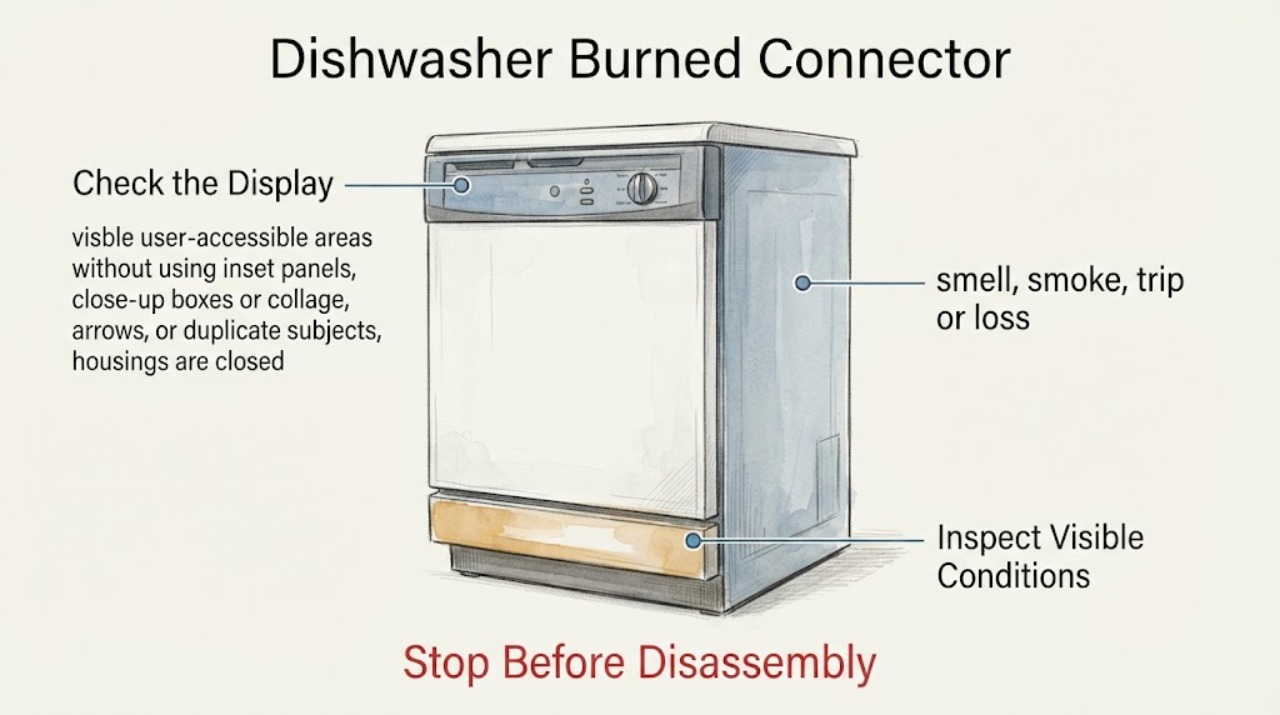
A burned connector is an electrical-damage warning, not a connector-replacement DIY. Stop the AEG dishwasher, isolate its power only if this can be done without touching damaged or wet electrical parts, and do not plug it back in, use an extension cable, bypass a fuse/RCD, or open the cabinet to remake the wiring. AEG says not to use the dishwasher until an electrical problem is completely fixed and directs service for electrical concerns or burning smells. Record the model/PNC, serial number, symptoms and any visible external damage for an authorised technician; the connector, harness, terminal and the cause of overheating require model-specific inspection.
Work through in order
Diagnostic checks
Use only checks that match the exact appliance or system and its official guide.
-
Check 1
Stop the dishwasher immediately and prevent a restart: cancel the programme if the controls respond without touching the damaged area, then isolate power at the plug or dedicated isolator only when it is dry and safely reachable.
Expected result: Note whether there was smoke, a burning smell, heat, arcing, a tripped RCD/breaker or a blown fuse, and whether water is near the appliance or connection.
Next step: Leave the appliance unplugged or isolated and do not restore power to test it. If the plug, outlet or surrounding area is wet, hot, visibly charred or inaccessible, keep clear and arrange qualified electrical/appliance help.
Why this matters
Why: These observations are consistent with an electrical safety event, but they do not prove whether the connector, harness, terminal, outlet or another component is at fault.
-
Check 2
Do a documentation-only check from outside the appliance: capture the rating-plate model/PNC and serial number and record when the burning, smell, smoke, trip or loss of function occurred.
Expected result: Record whether the symptom appeared at start-up, during heating/washing, at shutdown, or after a leak or movement; photograph only visible external damage with power isolated.
Next step: Send the identity and symptom history with the service request. Do not remove panels, pull on wires, loosen terminals or attempt to match a replacement connector by appearance.
Why this matters
Why: The timing and exact identity help AEG or an authorised technician select the correct wiring diagram and safety procedure, while a photo cannot establish an internal connector’s compatibility or cause.
-
Check 3
Check the external power path without testing it: look at the plug, socket/isolator, visible cord and nearby moisture only if they can be seen without moving the appliance or touching damaged parts.
Expected result: A scorched plug/socket, melted insulation, a wet connection, repeated breaker/RCD operation or a fuse that blows again indicates that the supply path also needs professional attention.
Next step: Keep the circuit isolated and arrange the appropriate qualified electrician/appliance service. Never use an extension cable, bypass the protective device, or repeatedly reset it.
Why this matters
Why: The AEG support page treats a trip or blown fuse as possible ground leakage or short circuit and warns that an extension cable can create a short-circuit or fire hazard; it does not support moving the appliance to another circuit as a repair for burned wiring.
-
Check 4
Prepare the safe service handoff: keep the appliance unused and provide the model/PNC, serial number, purchase/delivery information, the symptom timeline and any visible external evidence.
Expected result: If the burned connector is behind a panel, the fault returns, the dishwasher leaks, or there are electrical concerns or burning smells, no further user diagnosis is appropriate.
Next step: Book AEG or authorised service and describe the connector damage. Leave internal wiring, connector replacement, insulation checks and cause-finding to the technician; do not resume use until the fault is confirmed fixed.
Why this matters
Why: AEG says its technicians can assess dishwasher electrical and related faults, and specifically says to book service for electrical concerns, burning smells, leaks, repeated errors or recurring faults.
Use your observations
Decision map
Find the observation that best matches what you see, then follow the next safe action.
-
PATH 01Next step
What you see
If there is smoke, an active burning smell, visible arcing, heat or a wet electrical connection
Do this next
Move away, isolate power only if safely reachable without touching the hazard, and contact qualified emergency/electrical or appliance service. Do not re-energise it.
Why this path and its safety boundary
Why it matters: The appliance or its supply path may still present fire or shock risk; a visual symptom cannot identify the failed part safely.
-
PATH 02Next step
What you see
If the plug, socket or isolator is scorched or the RCD/breaker trips again
Do this next
Keep that circuit off and arrange a qualified electrician plus authorised appliance service as appropriate. Do not use an extension cable or another outlet as a workaround.
Why this path and its safety boundary
Why it matters: The issue may include the household supply connection as well as the dishwasher, and AEG treats repeated trips or a blown fuse as a possible short circuit or ground leakage.
-
PATH 03Next step
What you see
If the damage is behind the dishwasher panel or the exact model/PNC is unavailable
Do this next
Do not open the cabinet or improvise a connector repair. Obtain the rating-plate identity if it can be read externally and book authorised service.
Why this path and its safety boundary
Why it matters: The connector type, wiring route, ratings and repair procedure cannot be safely established from the symptom or a photograph.
-
PATH 04Next step
What you see
If there is no current smell or smoke but a connector is visibly burned or the appliance has lost function
Do this next
Keep the dishwasher isolated and arrange inspection before any further cycle.
Why this path and its safety boundary
Why it matters: The absence of an active smell does not prove the electrical damage is safe; the connector may have overheated previously and the root cause remains unknown.
Helpful context
Understand the symptom
A burned connector can reflect heat damage, a poor connection, moisture-related leakage or another electrical fault; the visible mark does not identify which component caused it. AEG’s dishwasher guidance says an electrical fault or RCD/fuse event should be treated as leakage to ground or a short circuit, warns against extension cables, and says not to use the product until it is completely fixed. With no model number, this guide stops at safe isolation, documentation and service handoff instead of giving wiring or connector instructions.
When checks do not resolve it
Need a professional?
Arrange AEG or authorised appliance service before using the dishwasher again whenever a connector, plug, cord or outlet is burned, there has been smoke or a burning smell, an RCD/breaker trips, a fuse blows, or the fault recurs. If the household outlet or wiring is visibly damaged or wet, use a qualified electrician as well. Do not open the cabinet, remake wiring, replace a connector by appearance, bypass protective devices, use an extension cable or re-run the dishwasher to reproduce the fault.
Common questions
FAQ
Can I cut out the burned AEG dishwasher connector and join the wires?
No. The connector, wire gauge, terminals, insulation, load and cause of overheating are model- and fault-specific. AEG says to keep the appliance unused until the electrical problem is completely fixed; leave internal wiring to authorised service.
Should I plug the dishwasher into another outlet to see whether it works?
No. Do not use an extension cable or repeatedly reset a protective device. If the plug, outlet or circuit is damaged or trips, keep it isolated and arrange qualified electrical/appliance service.
What information should I give the technician?
Provide the model/PNC and serial number, purchase or delivery date, when the burn or smell occurred, whether smoke or water was present, any RCD/breaker or fuse event, and photos of visible external damage taken without touching the hazard.
Read the exact guide
Official sources
- Dishwasher repair serviceAEG Support · Official AEG dishwasher repair page. It directs users to provide model/PNC and says to book service for electrical concerns, burning smells, leaks, repeated errors or recurring faults; it does not support user wiring work.
- Dishwasher short-circuits, burns out fuses or trips RCD circuit breakersAEG Support · Official AEG dishwasher support article. It supports safety isolation and service boundaries for short-circuit, fuse, RCD and electrical fault symptoms; it does not identify a connector part or authorise wiring repair.
Community feedback
Share a repair observation
Share a plain-text repair observation. Accepted observations are published automatically; this page may take a moment to update.