
On this page
Start here
Quick answer
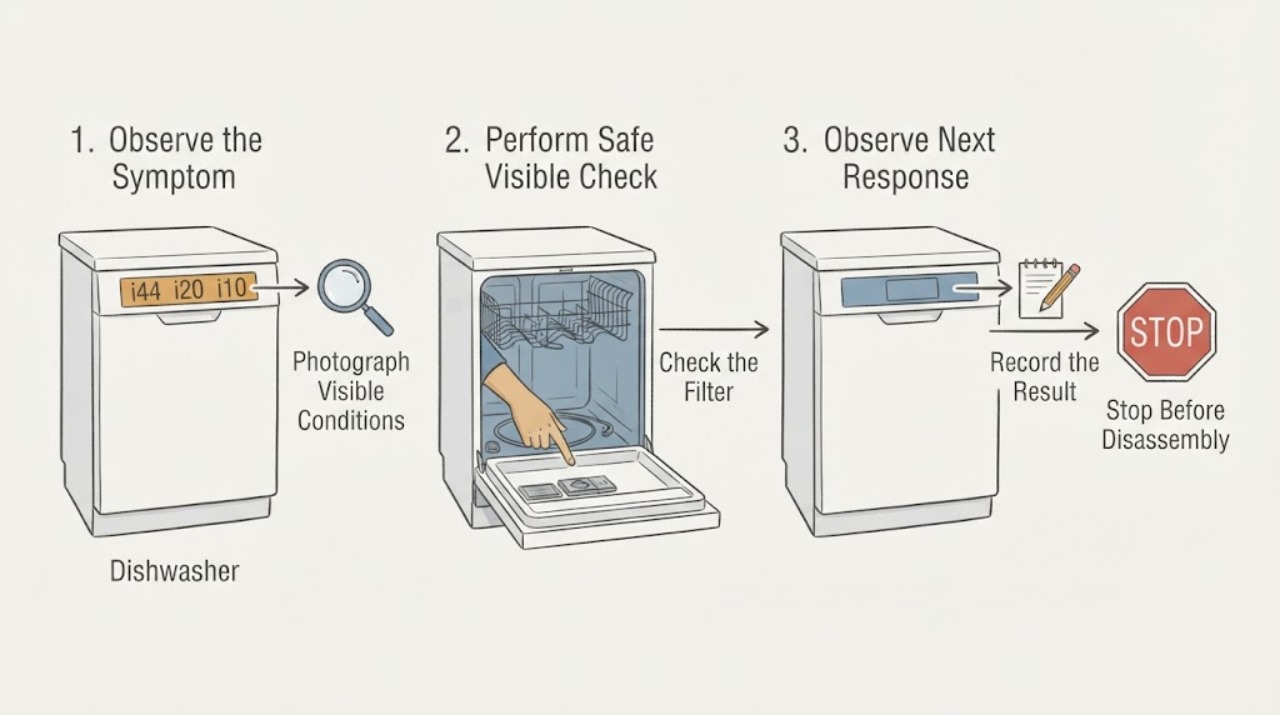
For the AEG FSE63806P, record the complete display and order before resetting: i44 is in AEG's i40-family pressure-sensor/water-level group, i20 is a drainage indication, and i10 is a water-inlet indication. The codes narrow the next safe check but do not prove three failed parts. If i44 is present, disconnect power only as the model instructions allow, clean the accessible filters and sump of foam or debris, and retry once. If i20 follows or standing water remains, check only the sink connection, filters/sump, accessible drain-hose routing, and any recently installed sink-trap blanking plug. If i10 follows, check the fully open tap, household water flow, visible inlet-hose kink, and inlet filter only after closing the tap. If the mixed sequence returns, the cycle cannot complete, water leaks, or the accessible paths are clear, stop repeated resets and arrange authorised AEG service with the rating-plate model, PNC, serial number, exact sequence, programme stage, and water observations. Do not replace a pressure sensor, pump, inlet valve, or control board from the codes alone.
Work through in order
Diagnostic checks
Use only checks that match the exact appliance or system and its official guide.
-
Check 1
Before switching the dishwasher off, photograph the display and rating plate, record the exact order of i44, i20 and i10, count any beeps or flashes, and note the programme stage and whether the tub is filling, washing, draining, heating, or holding water. Confirm that the rating plate reads FSE63806P and record the PNC and serial number.
Expected result: One code is stable, the codes appear in a repeatable order, the order varies, the display is partial, or the model/PNC does not match FSE63806P.
Next step: Use the exact FSE63806P documentation for any button, reset, filter, or hose procedure. If several codes recur or the identity is uncertain, preserve the evidence and arrange service rather than clearing the display repeatedly.
Why this matters
Why: AEG maps the three codes to different monitored functions, so the sequence selects the next observation. A partial display, wrong model identity, or changing order prevents safe component attribution. A similar sequence reported by one FSE63806P owner is useful only as a chronology check, not a repair prescription.
-
Check 2
For i44, disconnect mains power only as directed by the exact model instructions, then inspect and clean the user-accessible filters and sump for foam, suds, or debris. Do not open the cabinet or probe a pressure sensor, hose, pump, or control. Restore power and run one suitable programme only if the appliance is dry and safe.
Expected result: The filters or sump contain foam/debris and the next cycle completes, or they are clear and i44 returns or the cycle still stops.
Next step: If i44 returns after the permitted check, stop repeated resets and arrange authorised service with the PNC and evidence. Do not buy or install a pressure switch from a similar-looking listing.
Why this matters
Why: AEG's i44 guidance treats the code as an i40-family pressure-sensor/water-level indication and lists filter/sump cleaning plus a reset as accessible checks. A successful cycle after clearing a temporary condition does not prove the sensor, wiring, pump, or control is healthy; recurrence needs professional diagnosis.
-
Check 3
If i20 appears or water remains, with the dishwasher inactive and water controlled, check the accessible sink spigot/connection, interior filters and sump, visible drain-hose routing, and—only if the dishwasher was recently installed or moved—the sink-trap blanking plug. Do not reach into uncontrolled standing water or dismantle the drain pump.
Expected result: A sink connection, filter/sump, hose kink or twist, or unremoved blanking plug is visible, or the accessible drain path is clear while i20 returns.
Next step: Correct only a clearly accessible restriction according to the FSE63806P instructions and run one suitable cycle if there is no leak or electrical concern. If water remains or i20 returns, keep the appliance off and arrange authorised service.
Why this matters
Why: AEG defines i20 as a drainage problem and lists these restrictions or installation conditions before service. A clear accessible path with a returning code does not establish a failed drain pump, especially when i44 preceded it.
-
Check 4
If i10 appears, check that the appliance tap is fully open and that another household water use is not reducing flow; inspect the visible inlet hose for a kink, twist, or damage. Close the tap before any manual-directed inspection of the inlet-hose filter, and do not loosen a wet fitting.
Expected result: The tap is closed or weak, household flow is absent, the hose is kinked or damaged, the inlet filter has scale/debris, or the inlet path appears clear while i10 returns.
Next step: Correct a clearly accessible tap or hose-routing issue only as the exact manual allows, then test once. For a damaged hose, no household flow, or recurring i10 after a clear path, shut off water as needed and arrange authorised service.
Why this matters
Why: AEG identifies i10 as a water-inlet problem and lists supply, hose, and inlet-filter restrictions as checks. A damaged hose needs an engineer; a clear path with a returning i10 does not prove an inlet valve or control fault and may follow an unresolved earlier water-state problem.
-
Check 5
After the three individual observations, compare the sequence and programme behaviour: note whether i44 occurs immediately, whether i20 appears with standing water, and whether i10 appears before any fill. Do not interpret the sequence as three independent parts without a technician's model-specific test.
Expected result: The cycle completes after one accessible correction, the same order i44→i20→i10 returns, codes occur in a different order, or several codes return immediately after power-up.
Next step: Stop repeated cycles and provide the exact code order, timing, PNC, photos, water level, filter/sump result, hose observations, and any recent installation or repair history to an authorised AEG technician.
Why this matters
Why: A single corrected restriction may explain one event. A repeatable mixed sequence or immediate recurrence means the monitored water-level, drain, and inlet conditions remain unresolved; the codes narrow service diagnosis but do not identify a sensor, pump, valve, or board by themselves.
Use your observations
Decision map
Find the observation that best matches what you see, then follow the next safe action.
-
PATH 01Next step
What you see
i44 appears first, the programme stops or cannot measure its water state, and foam or debris is visible in the accessible filters or sump.
Do this next
Clean only the accessible filters/sump, reset once as the exact manual directs, and stop for service if i44 returns or the cycle cannot complete.
Why this path and its safety boundary
Why it matters: This matches AEG's supported i44 first checks more closely than a proven pressure-sensor replacement; the debris or suds may be a temporary operating condition, but it does not prove the sensor is good.
-
PATH 02Next step
What you see
i20 follows i44 and standing water remains, or the dishwasher cannot reach its drain stage, while the sink connection, filters/sump, hose routing, and blanking-plug check are unresolved.
Do this next
Keep the appliance off, control the water, correct only a clearly accessible drainage or installation restriction, and arrange service if water remains or i20 returns.
Why this path and its safety boundary
Why it matters: The immediate safe decision is the drainage path, not a pump diagnosis. The preceding i44 may reflect a water-level event, but it does not prove why i20 followed.
-
PATH 03Next step
What you see
i10 appears after i20, the dishwasher has not filled or household water flow is weak, and the tap, visible inlet hose, and manual-directed inlet filter check have not been completed.
Do this next
Check the fully open tap, household flow, visible hose condition, and inlet filter only with the tap closed for that step. Stop and arrange service for a damaged hose, absent supply, or recurring i10.
Why this path and its safety boundary
Why it matters: A water-inlet restriction is the next supported branch; the order still does not establish a failed inlet valve, particularly if the earlier drain or water-level state was abnormal.
-
PATH 04Next step
What you see
The full i44→i20→i10 pattern or several codes returns after the accessible checks, the cycle stops immediately, or the display order changes between attempts.
Do this next
Stop repeated resets and book authorised service with the FSE63806P model, PNC, serial number, complete chronology, photos, programme stage, water level, and accessible-check results.
Why this path and its safety boundary
Why it matters: This is no longer a single clear inlet or drain restriction. AEG's code families narrow the systems to report, while the exact cause and any component remain unresolved.
-
PATH 05Next step
What you see
There is a visible leak, uncontrolled standing water, a damaged inlet hose, burning smell, exposed wiring, an electrical trip, or the next check requires cabinet access.
Do this next
Close the water tap, stop the appliance, disconnect power only if it can be done without touching wet electrical areas, and arrange authorised service.
Why this path and its safety boundary
Why it matters: Water and electrical safety take priority over interpreting the sequence; internal sensor, pump, heater, valve, and control work is outside a safe user check.
Helpful context
Understand the symptom
The order i44, i20, i10 is more useful than any one code in isolation. AEG's opened error-code overview groups i10 with water inlet, i20 with drainage, and i40/i43/i44 with pressure-sensor or water-level monitoring. The same overview warns that codes assist diagnosis but do not by themselves identify a failed component. Record the sequence before clearing it, because a later i20 or i10 can be the consequence of the programme's water state rather than proof of a second failed part.
The AEG FSE63806P manual is retrieved through AEG's model-code/PNC documentation route; the model manual and AEG support material take precedence over general code guidance. A public Reddit report does mention an FSE63806P by PNC and a similar i44, i20, i10 sequence, but that is an anecdotal chronology, not proof that its attempted pressure-switch replacement or later sensor-port theory applies to every unit.
When checks do not resolve it
Need a professional?
Arrange authorised AEG service when the i44, i20, or i10 sequence returns after the model-directed accessible checks, when multiple codes recur, the cycle cannot complete, standing water remains, a hose is damaged, or any internal sensor, pump, inlet valve, wiring, heater, or control access would be required. Stop immediately for a leak, uncontrolled water, burning smell, exposed wiring, electrical tripping, or cabinet access. Do not treat the code sequence as permission to replace parts or bypass a safety device.
Have this ready
- The complete FSE63806P rating-label model, PNC and serial number; photos of the display; exact code order and timing; programme stage; whether the appliance was filling, washing or draining; water level; filter/sump result; hose and tap observations; and any recent installation, move, filter, repair, or detergent history.
Common questions
FAQ
Do i44, i20 and i10 mean three parts have failed?
No. AEG groups i44 with pressure-sensor/water-level monitoring, i20 with drainage, and i10 with water inlet. Accessible restrictions or a changing water state can produce a sequence; recurring codes need model-specific service diagnosis rather than three guessed replacements.
What should I check first when i44 is followed by i20?
Preserve the order, then follow the i44 accessible filter/sump check. If i20 appears with standing water, move to the sink connection, filters/sump, visible drain hose and recently installed sink-trap connection. Do not dismantle the drain pump or assume i44 proves a pressure sensor is bad.
Can I replace the pressure switch or inlet valve myself?
Not from these codes alone. The AEG pages support accessible supply, filter, sump and reset checks, but they do not establish a compatible replacement component for every PNC. Repeated or mixed codes belong with an authorised technician.
Read the exact guide
Official sources
- Dishwasher displays error code i40, i43 or i44AEG Support · The opened AEG article applies to integrated and freestanding dishwashers and directs a roughly five-minute power reset, accessible filter/sump cleaning for foam or debris, and service if the issue continues; it describes the i40 family as a potential pressure-sensor/water-level fault.
- Download User Manuals - Support | AEGAEG · The opened AEG manual page says to search by model code or PNC, identifies the rating plate as the source of model code and product number, and is used to keep FSE63806P instructions ahead of generic dishwasher advice.
- AEG dishwasher: i44, i20 and i10 errorsr/appliancerepair · The opened post records i44 followed by occasional i10, then i20, i10 and i44 again, and identifies PNC 911536416 05 as AEG FSE63806P. Follow-up comments are anecdotal and are not used as a DIY procedure.
- Dishwasher displays error code i10, i11, AL5, C1, beeps once, or the warning light flashes onceAEG Support · The opened AEG article identifies i10/i11 as water-inlet problems and lists the tap, household flow, inlet-hose condition, and inlet-filter check, with the tap closed before removing the filter and service for a damaged hose or unresolved condition.
- Dishwasher displays an error code, how to fix it?AEG Support · The opened AEG overview explicitly links i10 to water inlet, i20 to draining, and i40/i43/i44 to pressure-sensor problems, and says error codes do not always indicate component failure.
- Fix Dishwasher Not Draining | Error I20 Guide | AEGAEG Support · The opened AEG article identifies i20 as a water-drainage problem and lists the sink spigot, interior filters/sump, drain-hose routing, and sink-trap blanking plug before service.
Community feedback
Share a repair observation
Share a plain-text repair observation. Accepted observations are published automatically; this page may take a moment to update.