
On this page
Start here
Quick answer
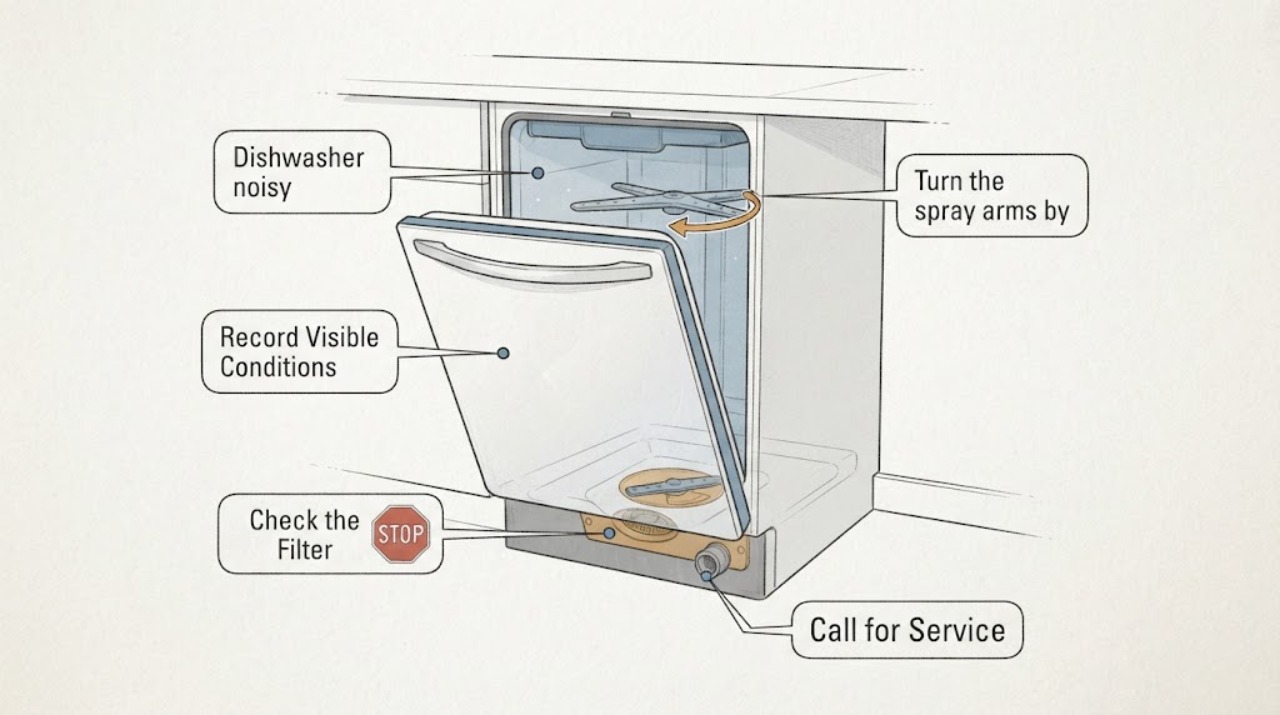
A noisy AEG dishwasher is not automatically faulty. A hum while filling or draining, water spraying during washing, and some programme-dependent pump or motor sounds can be normal. First identify when the sound occurs, then check loading, spray-arm clearance, accessible filters or sump debris, and whether the appliance is level. Persistent grinding, metal scraping, continuous knocking, excessive new vibration, an error, or a change in washing, filling, draining or drying performance needs service rather than a guessed pump or motor part.
Work through in order
Diagnostic checks
Use only checks that match the exact appliance or system and its official guide.
-
Check 1
With the dishwasher stopped, identify whether the sound occurs during filling, washing/spray, draining, drying, or only when the detergent dispenser operates. Record whether it is a hum, swish, click, rattle, grind, scrape or knock.
Expected result: The sound matches a fill hum, spray sound, drain-pump hum, or dispenser click, or it is a new mechanical sound that does not match one of those stages.
Next step: If the sound is grinding, scraping, persistent knocking, or is accompanied by poor performance or an error, stop repeated testing and arrange qualified service. Otherwise continue with loading and spray-arm checks.
Why this matters
Why: AEG describes the first group as common operating sounds; a new, persistent mechanical sound needs the external checks below and may require service.
-
Check 2
Turn the spray arms by hand with the dishwasher stopped and check that no large plate, baking tray, long utensil or other item protrudes into their path. Reload items so they are secure and cannot touch each other.
Expected result: A spray arm catches or contacts an item, or the arms move freely with no load contact.
Next step: Move the obstructing item and run the next normal load only if the appliance has no safety sign. If the sound remains with clear spray-arm paths, continue to the filter and installation checks.
Why this matters
Why: A repeated click or knock caused by an item in the spray-arm path is a loading/contact issue, while free movement makes that explanation less likely.
-
Check 3
After the appliance has stopped and is safe to access, inspect the visible filters and sump area for glass, broken crockery, fruit stones, labels, food debris or plastic fragments. Wear protective gloves; do not reach into a running machine or dismantle the pump.
Expected result: A foreign object or heavy debris is visible, or the filter and accessible sump area are clear.
Next step: Remove only loose, accessible debris and refit the filter correctly. If the noise persists or the object is not safely reachable, leave internal inspection to a qualified technician.
Why this matters
Why: AEG says objects trapped in the filter or pump area can cause grinding, rattling or clicking. A clear accessible area does not rule out an internal pump, motor or bearing problem.
-
Check 4
Check from outside that the dishwasher is level, all feet are adjusted securely, and the cabinet is not vibrating against surrounding cupboards or the floor. Do not remove an integrated front panel or appliance cover for this check.
Expected result: The appliance is stable and clear of surrounding contact, or it rocks/vibrates against the installation.
Next step: Correct only an obvious external leveling or contact issue according to the appliance installation instructions. If excessive vibration remains, arrange service.
Why this matters
Why: AEG identifies an unlevel or insecure installation as a possible source of vibration; correcting it cannot prove an internal component failure.
-
Check 5
After the safe checks, note whether cleaning, drying, filling or draining performance is normal and whether an error message appears. Avoid repeated cycles solely to reproduce a loud or scraping sound.
Expected result: Performance is normal and the sound is a familiar stage-specific hum/click, or performance is affected and the abnormal noise persists.
Next step: For persistent abnormal noise or any affected function/error, stop use as appropriate and contact qualified appliance service with the exact sound stage and observations.
Why this matters
Why: AEG treats noise with poor performance or an error, and persistent grinding, scraping or mechanical knocking, as a possible genuine fault requiring inspection.
Use your observations
Decision map
Find the observation that best matches what you see, then follow the next safe action.
-
PATH 01Next step
What you see
The dishwasher hums at fill or drain, or makes swishing/spraying sounds during washing, with normal performance and no unusual vibration.
Do this next
Keep the load secure and monitor the sound; seek service if it becomes suddenly louder, changes to grinding/scraping, or affects performance.
Why this path and its safety boundary
Why it matters: This matches AEG-described water inlet, spray-arm and drain-pump operation rather than a confirmed fault.
-
PATH 02Next step
What you see
A repeated click or knock stops after a plate, tray, utensil or other item is moved away from the spray arm.
Do this next
Reload with spray-arm clearance and observe the next normal cycle; do not order a pump or motor part from this result.
Why this path and its safety boundary
Why it matters: The load was contacting the spray arm or moving during washing, which AEG identifies as a common noise source.
-
PATH 03Next step
What you see
A click or tick occurs during a cycle but is not accompanied by poor performance, and it matches detergent-dispenser operation.
Do this next
Continue normal use while following the exact model manual for detergent and rinse-aid settings; arrange service if the sound changes or other symptoms appear.
Why this path and its safety boundary
Why it matters: AEG describes the dispenser releasing rinse aid as normal clicking/ticking behavior.
-
PATH 04Next step
What you see
Grinding, metal scraping, continuous mechanical knocking or excessive new vibration remains after loading, spray-arm, filter and leveling checks.
Do this next
Stop repeated testing and arrange qualified AEG appliance service. Do not open the pump, motor or control area or choose a replacement part from the noise alone.
Why this path and its safety boundary
Why it matters: AEG treats this pattern as abnormal and says a technical inspection may be needed; possible internal causes cannot be distinguished safely by sound alone.
Helpful context
Understand the symptom
The cycle stage is the first diagnostic clue
Listen for where the noise falls in the programme. AEG describes humming as normal when the inlet valve opens at fill and when the drain pump removes water. Swishing or spraying is usually the spray arms circulating water, and the sound can vary with the load and programme. A separate AEG article describes clicking or ticking from the detergent dispenser releasing rinse aid as normal during a cycle. These patterns should not be treated as evidence of a failed motor or pump by themselves.
Use safe external checks before assuming an internal fault
A repeated click or knock can occur when a spray arm hits a large plate, tray, long utensil or another item protruding from a basket. AEG advises rotating the spray arms by hand to confirm they move freely. Small glass, crockery, food or packaging fragments in the filter or pump area can also cause grinding, rattling or clicking; inspect only with the appliance stopped and use protective gloves. Do not reach into an energized appliance or open panels to identify a pump, bearing or impeller.
When the noise deserves service
AEG treats a sound as more concerning when it is suddenly new or much louder, continues as grinding, scraping or mechanical knocking, produces excessive vibration, appears with an error, or comes with poor washing, drying, filling or draining. The support guidance lists several possible internal causes but says technical inspection may be required; the sound alone does not identify which part has failed.
When checks do not resolve it
Need a professional?
Arrange qualified appliance service when grinding, metal scraping, persistent mechanical knocking or excessive new vibration remains after the safe external checks, or when the noise is accompanied by an error or poor washing, drying, filling or draining. Tell the technician when in the programme the sound occurs, its character, whether it changes with an empty or reloaded basket, and whether any object or installation issue was found.
Common questions
FAQ
Is humming from an AEG dishwasher normal?
Often yes. AEG describes humming during water fill and near the end of a cycle while the drain pump removes water as normal operating sounds. A hum that becomes much louder, changes to grinding, or coincides with poor performance needs service.
Why does the dishwasher click or knock repeatedly?
Check whether a plate, tray, long utensil or another item is touching the spray arm. AEG recommends turning the spray arms by hand with the appliance stopped and correcting the load. A separate AEG guide says detergent-dispenser clicking/ticking while releasing rinse aid can be normal.
Should I replace the pump when my AEG dishwasher is noisy?
No. AEG lists pump, motor, impeller and spray-arm issues among possible causes but says technical inspection may be needed. The noise pattern and external checks do not establish which part is faulty or compatible.
When is an AEG dishwasher noise a genuine fault?
AEG flags a noise that is suddenly new or much louder, continues as grinding, scraping or mechanical knocking, causes excessive vibration, appears with an error, or is accompanied by poor washing, drying, filling or draining. Arrange service when those patterns remain.
Read the exact guide
Official sources
- Dishwasher emits clicking/ticking noise during cycleAEG · Opened AEG official support article. It applies to integrated and freestanding dishwashers and defines detergent-dispenser clicking during rinse-aid release as normal; it does not identify other persistent mechanical noises.
- Dishwasher Making Noises – Normal Sounds and Signs of a ProblemAEG · Opened AEG official support article. It explicitly applies to dishwashers and supports cycle-stage sound identification, loading, spray-arm, accessible filter/sump, level and service checks. No model number was supplied, so no model-specific part or repair procedure is claimed.
Community feedback
Share a repair observation
Share a plain-text repair observation. Accepted observations are published automatically; this page may take a moment to update.