
On this page
Start here
Quick answer
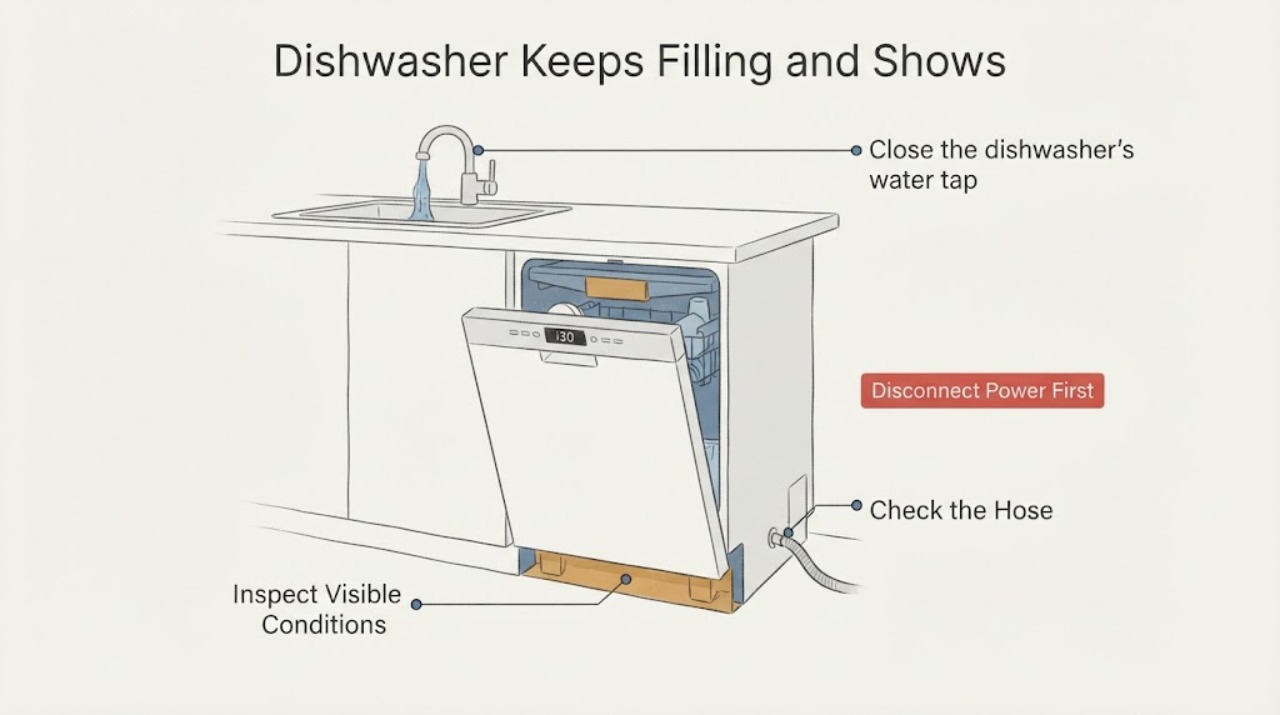
Treat an AEG F55522VI0 dishwasher that will not stop filling and shows i30 as a water and flooding hazard, not as proof that one valve or pump has failed. Close the dishwasher's water tap immediately and isolate electrical power only from a dry, safe position; do not keep running it, repeatedly reset it, tip it, open the cabinet, or test an internal part. AEG describes i30 as possible water collecting in the base and anti-flood protection, while its separate continuous-fill guidance says to shut off the water, stop using the dishwasher, unplug it, and arrange authorised service. From outside the appliance, record whether the water was still entering after a programme was stopped, whether the pump ran continuously, and where any water or foam appeared. Give the technician the exact F55522VI0 PNC, because AEG lists four PNC variants for this model and the PNC selects the correct documentation.
Work through in order
Diagnostic checks
Use only checks that match the exact appliance or system and its official guide.
-
Check 1
Close the dishwasher's water tap immediately. From a dry, safe position, isolate mains power at the accessible plug or household isolation point; do not reach through water or pull out the built-in dishwasher.
Expected result: Water stops entering after the tap is closed, or water continues because the tap cannot be safely reached or the source is not under control; there may also be standing water, a pump hum, a trip, smoke, or a burning smell.
Next step: Keep the tap closed and the appliance disconnected. If water is uncontrolled, the floor is wet near electrical equipment, or there is smoke, burning smell, or an electrical trip, keep clear and use qualified emergency, electrical, or appliance help.
Why this matters
Why: AEG treats i30 as a possible water-in-base and anti-flood condition, and separately warns that a dishwasher filling while turned off can cause flooding and should not be used. The immediate priority is stopping water and electrical exposure, not identifying a part.
-
Check 2
Without restarting the machine, record the complete display as i30 or another exact sequence, any three-beep or three-flash pattern, whether the drain pump was humming continuously, and whether the filling was observed during a programme or after the controls were stopped.
Expected result: The display is i30, the code is partial or uncertain, the pump is continuously running, or water was still entering after the programme was stopped or the appliance appeared off.
Next step: Send the exact sequence and timing to authorised AEG service. Do not clear the code by tipping the unit, cycling power repeatedly, opening the cabinet, or running another programme.
Why this matters
Why: AEG associates i30 with leak detection and anti-flood protection, while filling in the off state is a separate service condition. These observations narrow the handoff, but none proves an inlet valve, float, pressure sensor, pump, or electronic-control failure.
-
Check 3
From outside the appliance and only after the water tap is closed, inspect the dry-visible floor, lower door edge, sink area, and accessible hose ends for water, foam, wet trails, kinks, or a visibly loose connection; do not pull out the dishwasher or loosen a hidden fitting.
Expected result: Water or foam is at the door or floor, a visible hose or seal is wet or damaged, the sink area shows a backflow clue, or the exterior looks dry despite the i30 event.
Next step: Keep the tap closed. Photograph only what is safely visible and give it to the technician; do not pull out an integrated appliance, reach into standing water, or attempt a hidden hose or seal repair.
Why this matters
Why: AEG lists levelling, built-in door-panel installation, visible pipe problems, spray-arm deflection, foam, and a dirty or damaged door gasket as possible leak contributors. A dry exterior does not rule out water in the base or an internal leak.
-
Check 4
With power isolated and the tap closed, look through the open door only if there is no standing water or other hazard, and note visible foam, a large item that could deflect a spray jet, an obstructed spray arm, or contamination at the filter and sump; do not dismantle the filter area or run a test cycle.
Expected result: Foam is present, a large item blocked or deflected a spray arm, the accessible filter or sump is visibly dirty, or none of these is present.
Next step: Leave the appliance off with the water tap closed. If the exact manual permits a simple accessible cleaning, follow only that manual; otherwise provide the observation to service. Do not add chemicals, bypass anti-flood protection, or run the machine to see whether i30 clears.
Why this matters
Why: AEG says excessive foam and spray-arm obstruction can trigger or contribute to i30 by directing water toward a seal area. These are possible contributors, not evidence that the continuous-fill symptom is resolved or that an internal leak is absent.
-
Check 5
Photograph the AEG rating plate and record the full model, PNC, serial number, market, programme, and when the filling began; compare the PNC with AEG's listed F55522VI0 variants rather than relying on the model string alone.
Expected result: The rating plate identifies one of the listed PNC versions, a different PNC, or cannot be read safely without moving the appliance.
Next step: Give the plate photo and complete event history to an authorised service centre. If the plate cannot be safely accessed, do not move the dishwasher just to obtain it; report that limitation.
Why this matters
Why: AEG lists four PNC versions under F55522VI0, and the PNC is the model-specific identifier used to obtain the correct documentation and parts view. A model-family match alone does not establish compatibility or a repair diagnosis.
Use your observations
Decision map
Find the observation that best matches what you see, then follow the next safe action.
-
PATH 01Next step
What you see
Water was still entering after the programme was stopped or while the dishwasher appeared to be off.
Do this next
Keep the water tap closed, keep the dishwasher unplugged, do not use it, and arrange authorised service. Do not restore water or power to test the inlet path.
Why this path and its safety boundary
Why it matters: This matches AEG's separate continuous-fill warning and is a flooding risk; it does not establish which internal water-control component is at fault.
-
PATH 02Next step
What you see
i30 is accompanied by a continuously running pump, three beeps or flashes, visible water, or a wet base is suspected.
Do this next
Close the tap and leave the appliance off. Do not tip it or open the cabinet; arrange service if i30 returns or any leak remains.
Why this path and its safety boundary
Why it matters: AEG describes this as the leak/anti-flood branch, potentially caused by water collecting in the base. A temporary disappearance after drying would not prove the leak source is repaired.
-
PATH 03Next step
What you see
Foam, a blocked or deflected spray arm, a damaged gasket, or a visible installation issue is found, but filling does not continue with the appliance off.
Do this next
Keep the tap closed and correct only a simple, manual-permitted visible condition. If i30 returns, water remains, or filling recurs, stop and use authorised service.
Why this path and its safety boundary
Why it matters: AEG identifies these as possible contributors to leakage or i30, but a visible contributor does not prove that the anti-flood base is dry or that the internal condition is fixed.
-
PATH 04Next step
What you see
The exterior is dry, no foam or obstruction is visible, and the i30 code returns or the dishwasher cannot complete a programme.
Do this next
Keep the tap closed and power isolated, provide the exact PNC and event timeline, and book authorised repair. Do not guess or order a valve, pump, float, sensor, or control module.
Why this path and its safety boundary
Why it matters: The absence of a visible cause does not clear an internal leak or anti-flood response. AEG recommends an authorised technician when i30 persists.
Helpful context
Understand the symptom
Why continuous filling changes the i30 decision
i30 is a leak or anti-flood indication, not a component verdict. AEG's i30 guidance covers water in the base, a continuously running pump, three beeps or flashes, and visible leaking. The separate AEG guidance for water entering even while the dishwasher is turned off adds a higher-priority branch: shut off the water, stop using the appliance, unplug it, and arrange service. Do not infer that the inlet valve, pressure system, pump, or control is the failed part from the code or the filling symptom alone.
The PNC matters for this older model
AEG's official F55522VI0 model page identifies four PNC versions: 91153606000, 91153606001, 91153606002, and 91153606003. That confirms the model family but not which variant is installed in a particular home. Photograph the rating plate from a safe, dry position and provide the full PNC, serial information, exact display, programme stage, and water behaviour to service. Do not use a parts listing or a neighbouring AEG manual to select a valve, float, pump, or control module.
When checks do not resolve it
Need a professional?
Arrange authorised AEG service immediately when water continues entering after the programme is stopped or while the dishwasher is off. Also book service for recurring i30, visible water, a continuous pump, damaged hose or gasket, an electrical trip, uncontrolled foam, or any programme that cannot complete.
Have this ready
- Provide model F55522VI0, the complete PNC and serial number, market, exact display, beeps or flashes, programme and stage, whether filling continued after stopping, pump behavior, water or foam location, visible hose/gasket/load observations, and whether the event recurred.
Common questions
FAQ
What should I do if the AEG dishwasher keeps filling and shows i30?
Close the water tap immediately and isolate power from a dry, safe position. AEG treats i30 as possible water in the base and separately says a dishwasher filling while turned off should be unplugged, left unused, and referred to authorised service. Do not restore water or power to reproduce the event.
Does i30 prove that the inlet valve is bad?
No. AEG describes i30 as a possible leak or anti-flood condition. Continuous filling can be a separate water-control symptom, but the code and symptom do not identify a valve, float, pressure system, pump, or control as the failed part. Keep the appliance off and let service diagnose it using the complete PNC and event history.
Why do I need the PNC for F55522VI0?
AEG's official F55522VI0 page lists four PNC versions. The PNC distinguishes the exact product variant and helps service select the correct documentation and parts information; do not order a water-control part from the model string alone.
Read the exact guide
Official sources
- Dishwasher displays error code i30AEG · Opened official AEG UK guidance for integrated and freestanding dishwashers; exact F55522VI0 PNC documentation and local-market instructions take precedence.
- Water is being filled into the dishwasher even when it is turned offAEG · Opened official AEG UK guidance for integrated and freestanding dishwashers; it is used for the continuous-fill safety boundary and not for a component diagnosis.
- Model F55522VI0 - Spares & Accessories - AEGAEG · Opened official AEG UK model page; it confirms the model family and lists four PNC versions, but a service diagnosis still requires the rating-plate PNC and does not follow from the model string alone.
- Dishwasher Leaking – Causes and SolutionsAEG · Opened official AEG UK dishwasher leak guidance; it supports safe visible observations but does not authorize cabinet disassembly or part selection.
Community feedback
Share a repair observation
Share a plain-text repair observation. Accepted observations are published automatically; this page may take a moment to update.