
On this page
Start here
Quick answer
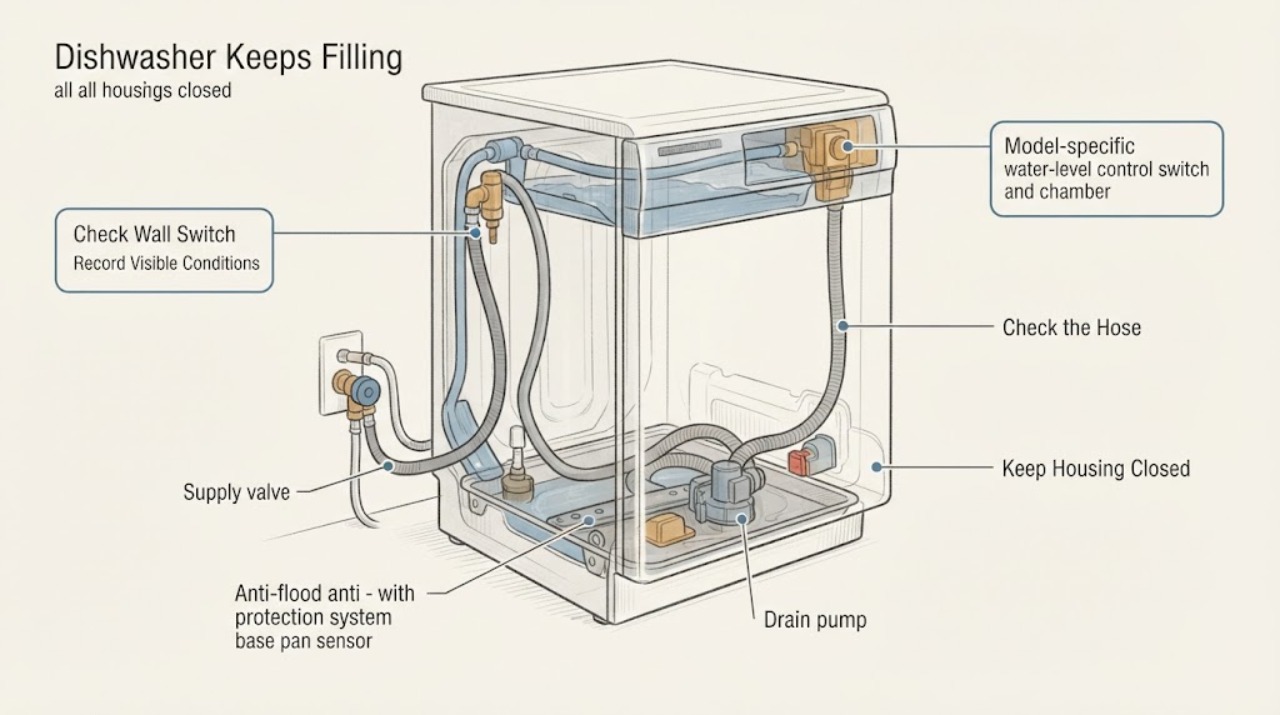
Treat continuous filling as an active flooding risk. Close the dishwasher water tap immediately and do not keep running programmes to test it. If the power connection is dry and safely accessible, switch the dishwasher off and unplug it; do not reach behind a wet appliance. AEG's exact support article for water entering while the dishwasher is off says to turn off the water supply, stop using the product, unplug it, and request an Authorized Service Center. From a safe position, record whether water continues with power removed, note any code such as i30 or iF0/iF1, and look only for visible hose damage, a wet floor, or an external leak. Do not open the base, test the inlet valve or level sensor, or reconnect the water and repeatedly try cycles.
Before you begin
Safety first
- This no-model article is limited to closing the water tap, safely disconnecting accessible power, observing the timing and visible location of water, recording the exact code and appliance identity, and arranging service. Do not continue testing, open the base, remove the inlet valve or pressure system, bypass anti-flood protection, reconnect a damaged hose, or perform live electrical tests.
Work through in order
Diagnostic checks
Use only checks that match the exact appliance or system and its official guide.
-
Check 1
Close the dishwasher's water tap immediately. If the floor or power connection is wet, do not reach behind the appliance; if the plug or switch is dry and safely accessible, switch the dishwasher off and unplug it.
Expected result: Water stops when the tap is closed, or water continues because the tap cannot be reached or the appliance connection is unsafe to access.
Next step: Keep the water supply closed and request authorized service. Do not restart the dishwasher or restore water for a test cycle.
Why this matters
Why: Closing the tap limits flooding. An inaccessible or wet connection is a safety boundary, not a reason to move or open the dishwasher.
-
Check 2
From outside the appliance, note whether filling occurred only during a selected programme, continued after the controls were stopped, or occurred while the dishwasher was switched off. Record the tub level and any visible water on the floor without opening panels.
Expected result: Water enters while the dishwasher is off, fills only during a programme, or a leak is visible at the door, hose, or floor.
Next step: Treat any filling while off or any active leak as a stop-use condition. Keep the tap closed and give service the exact timing and visible location.
Why this matters
Why: AEG has a separate support path for water entering while switched off; programme-only overfill, a door leak, and base water can require different model-specific diagnosis.
-
Check 3
Only from a dry, accessible position, look for a kinked, crushed, split, or visibly disconnected inlet or drain hose, wet connection, damaged seal, or water escaping at the door. Do not pull out an integrated dishwasher or remove a hose under pressure.
Expected result: A visible hose or seal problem is present, or all accessible connections appear dry and intact.
Next step: Leave the water closed and arrange service for any damage or persistent filling. Do not attempt an internal repair or reconnect a pressurized hose.
Why this matters
Why: AEG identifies hose kinks, disconnections, split seals, and door-seal problems as possible leak contributors. A clear external view does not rule out an internal base leak or water-level fault.
-
Check 4
Record the complete display code or warning-light pattern, plus the model number, PNC, serial number, and whether the dishwasher is integrated or freestanding. Use the matching AEG manual or troubleshooting article rather than a code from another appliance family.
Expected result: The display shows i30, iF0/iFo/iF1, i10/i11, another code, or no code; the model and identification data are available or missing.
Next step: Provide the recorded information to AEG service while the tap remains closed. Do not use a generic reset to clear a continuous-fill condition.
Why this matters
Why: AEG associates different code families with leak/anti-flood, water-level, and water-inlet conditions. Without the exact code and model, no internal component can be identified safely.
-
Check 5
Keep the dishwasher out of use and request an authorized AEG service visit if water enters while off, the code returns, water is visible in or under the appliance, or the issue would require access to the base, inlet valve, pump, pressure sensor, or wiring.
Expected result: Continuous filling persists after isolation, a leak or anti-flood condition is suspected, or safe external checks cannot explain the behavior.
Next step: Leave the water tap closed and power disconnected when safe, protect the floor, and give the technician the model, PNC, code, timing, and visible-water observations.
Why this matters
Why: AEG's official continuous-fill guidance directs the owner to service; an internal leak or water-level fault cannot be confirmed from the symptom alone.
Use your observations
Decision map
Find the observation that best matches what you see, then follow the next safe action.
-
PATH 01Next step
What you see
Water continues entering while the dishwasher is switched off or after the programme has been stopped.
Do this next
Keep the tap closed and dishwasher unplugged when safe. Do not restore water or run another programme to test it.
Why this path and its safety boundary
Why it matters: AEG treats this as a flooding risk and directs the owner to close the water supply, stop using the product, unplug it, and request service.
-
PATH 02Next step
What you see
Water enters only during a programme and there is a wet floor, door leak, damaged hose, or i30/anti-flood indication.
Do this next
Close the tap, disconnect power only from a dry accessible connection, and arrange authorized service. Do not remove the base or keep testing cycles.
Why this path and its safety boundary
Why it matters: The condition is consistent with a leak or base-water protection path, but the visible symptom does not identify the internal source.
-
PATH 03Next step
What you see
The inlet or drain hose is visibly kinked, damaged, disconnected, or the door seal is visibly compromised.
Do this next
Keep water off and have the damaged connection or appliance assessed. Do not reconnect a damaged hose or pull out an integrated unit without the installation instructions and safe access.
Why this path and its safety boundary
Why it matters: AEG identifies external hose and seal conditions as possible contributors to leaks and abnormal water behavior.
-
PATH 04Next step
What you see
No external cause is visible, filling persists, or the display shows an unverified code such as iF0/iFo/iF1.
Do this next
Keep the water closed and power isolated when safe, record the model/PNC/code, and request authorized AEG service. Do not diagnose or replace a valve, sensor, pump, or control board from the code alone.
Why this path and its safety boundary
Why it matters: The remaining possibilities include protected water-level or internal leak conditions that cannot be distinguished safely without the model and service assessment.
Helpful context
Understand the symptom
Continuous filling is different from a normal inlet-valve sound at the start of a cycle. The first decision is whether water continues after the programme is stopped or the dishwasher is switched off. If it does, isolate the water supply before doing anything else. AEG treats water entering while the dishwasher is off as a service condition because it can flood even when the controls are not running.
Once the tap is closed and power is safely isolated, record the exact model, PNC, displayed code, and whether there is water on the floor or in the tub. Check only visible hoses and seals from a safe position. Do not pull out an integrated appliance, remove the base, or guess that a valve, pressure sensor, float, or control board has failed.
A leak, i30, persistent filling with power removed, or any recurrence after a brief safe observation requires authorized service. Keep the water tap closed and the dishwasher unplugged until the source is inspected; do not restore water merely to see whether the symptom repeats.
When checks do not resolve it
Need a professional?
Contact an authorized AEG service center immediately when the dishwasher fills while switched off, water is visible or reaches the floor, i30 or another code returns, or safe diagnosis would require moving the appliance, opening its base, or testing internal components.
Safety scope: This no-model article is limited to closing the water tap, safely disconnecting accessible power, observing the timing and visible location of water, recording the exact code and appliance identity, and arranging service. Do not continue testing, open the base, remove the inlet valve or pressure system, bypass anti-flood protection, reconnect a damaged hose, or perform live electrical tests.
Common questions
FAQ
What should I do if my AEG dishwasher fills while it is turned off?
Close the dishwasher water tap, stop using the appliance, and unplug it only when the connection is dry and safely accessible. AEG directs owners to an authorized service center and warns against using the product until it is fixed.
Should I keep restarting the dishwasher to see whether it stops filling?
No. Repeated tests can increase flooding risk. Keep the water supply closed and request service, especially if water enters while the controls are off or an i30 condition is present.
Could a kinked hose cause abnormal water behavior?
AEG identifies kinked, twisted, damaged, or disconnected hoses as possible contributors to water and drainage problems. Inspect only visible accessible sections with the water off; a damaged hose needs professional assessment.
Does i30 prove that the inlet valve failed?
No. AEG describes i30 as water-leak or anti-flood protection and lists several possible external and internal causes. Keep water off and use authorized service rather than choosing an inlet valve, pump, sensor, or control board from the code alone.
Read the exact guide
Official sources
- Dishwasher displays error code i30AEG UK · Opened AEG guidance for i30, including water in the base, water-supply isolation, external loading/filter/seal checks, and authorized service for recurrent conditions.
- Dishwasher displays error code i10, i11, AL5, C1, beeps once, or the warning light flashes onceAEG UK · Opened AEG guidance that covers accessible inlet-hose damage/kinks, water isolation, filter and drain-installation checks, and service escalation. It is used for external checks only, not to assign i10/i11 to continuous filling.
- Dishwasher Leaking – Causes and SolutionsAEG UK · Opened AEG leak guidance for integrated and freestanding dishwashers. It covers visible hose/seal/door and spray-arm observations and recommends an authorized technician for internal leaks.
- What to check before contacting AEG consumer serviceAEG UK · Opened AEG general support guidance. It requires recording the complete error, model/PNC/serial, detailed behavior and timing, and says model-specific documentation takes precedence over general guidance.
- Water is being filled into the dishwasher even when it is turned offAEG UK · Opened the exact AEG support article. It directs owners to close the water supply, stop using the product, unplug it when safe, and request an authorized service visit.
Community feedback
Share a repair observation
Share a plain-text repair observation. Accepted observations are published automatically; this page may take a moment to update.