
On this page
Start here
Quick answer
If an AEG dryer is genuinely overheating, stop the cycle, disconnect it when safe, let it cool, and do not keep using it until the cause is resolved. Once it is cool and there is no smoke, burning smell, damaged cord, or water near electrics, check the model-approved load and programme, clean the lint filters and any condenser or heat exchanger the manual identifies, and verify that ventilation is not blocked. A recurring overheat, warning code, abnormal noise, or persistent heating fault needs authorised service; do not open the cabinet or test the heater yourself.
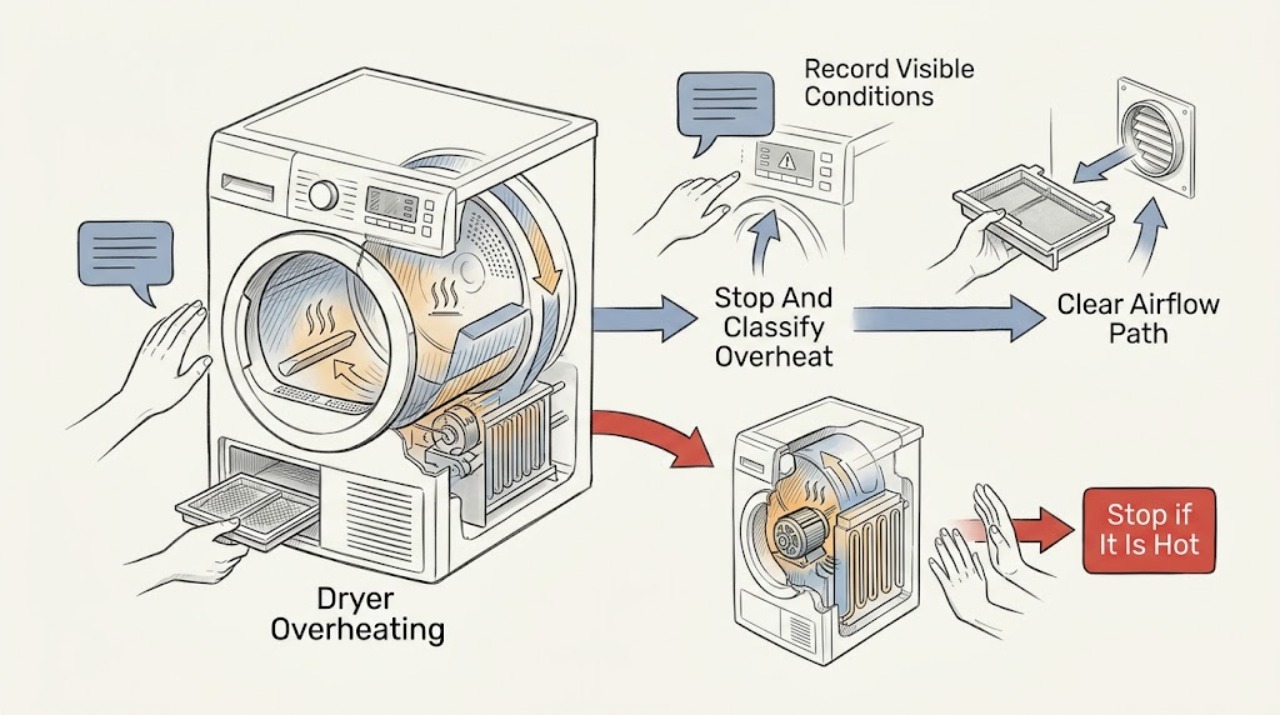
Work through in order
Diagnostic checks
Use only checks that match the exact appliance or system and its official guide.
-
Check 1
Stop the drying programme. If there is smoke, a burning or melted-plastic smell, visible scorching, a damaged cord, a water leak near electrical parts, or a cabinet that is too hot to approach safely, disconnect the appliance only if you can do so without touching a hazard and leave it unused.
Expected result: The dryer is merely warm and completed normally, or it has an unsafe odor, smoke, scorching, repeated protection shutdown, or abnormal heat.
Next step: For a normal warm cycle, continue only after it has cooled and no safety symptom is present. For any unsafe symptom, arrange authorised service or emergency help as appropriate and do not restart the dryer.
Stop if: Stop immediately for smoke, flames, a burning odor, exposed or melted wiring, a damaged plug, water near electrics, or an appliance that remains dangerously hot.
Why this matters
Why: Normal warm operation is not the same as a safety event. Smoke, burning odor, scorching, or repeated overheat behavior indicates a fault or fire risk that cannot be resolved by another drying cycle.
-
Check 2
Once the dryer is cool and safe to approach, record any display code, warning symbol, flashing light, beep pattern, and whether the cycle ended, stopped early, or kept running. Photograph the display if useful, but do not remove panels to read internal lights.
Expected result: A code or warning is present, the cycle stops repeatedly, or there is no code and the appliance completes but feels hotter than usual.
Next step: Use the exact model manual to interpret the code. If it repeats, if the cycle stops on protection, or if overheating remains unexplained, keep the dryer disconnected and request authorised service.
Stop if: Do not repeatedly clear a warning, reset the appliance, or run another cycle when the code is accompanied by heat, odor, smoke, or a repeated electrical trip.
Why this matters
Why: AEG directs users to the matching manual for codes and notes that a failure to heat, a cycle that will not end, or persistent symptoms can indicate an internal fault. The observation narrows the service diagnosis but does not identify a replaceable part.
-
Check 3
After the appliance is unplugged and fully cool, follow the exact manual to inspect the lint or fluff filters, and—only when applicable to the dryer type—the condenser or heat exchanger and door seal. Clean accessible parts as instructed; do not scrape, bend, bypass, or remove a fixed heat exchanger or internal guard.
Expected result: A filter, condenser, heat exchanger, or seal is visibly blocked or dirty, or all model-approved maintenance areas are clean.
Next step: Refit every part securely and allow it to dry if the manual requires washing. If the dryer remains abnormally hot after maintenance, do not compensate with a longer cycle; arrange service.
Stop if: Stop if a filter frame, condenser, seal, housing, or wiring is cracked, melted, wet, or impossible to refit, or if access requires removing the cabinet.
Why this matters
Why: AEG states that dirty filters, condensers, or heat exchangers can restrict airflow or affect heating and drying. A clean accessible path does not rule out a blocked internal duct, fan, thermostat, or heater fault.
-
Check 4
Using the model manual and garment care labels, check that the programme matches the fabric and that the load is not above the stated drying limit. Remove bulky or unsuitable items, redistribute the remainder, and do not add wet items during the cycle.
Expected result: The drum was overloaded, the items were unsuitable for the selected programme, or the load and programme were already within the manual limits.
Next step: After the dryer is cool and maintenance is complete, use a smaller, suitable load only if there were no safety symptoms. If overheat behavior returns, stop and arrange service rather than repeating the test.
Stop if: Stop if garments are scorched, the drum or door is dangerously hot, the load contains a material the manual excludes, or the dryer overheats again.
Why this matters
Why: AEG says overloading can reduce heat circulation and extend drying, while unsuitable items or programmes can make a cycle appear abnormal. A correctly loaded dryer that still overheats points away from a simple load correction.
-
Check 5
Identify the dryer type in the manual. Check that a condenser or heat-pump dryer is not enclosed without the required air space, and that the room has suitable ventilation. For a vented dryer only, visually check that the hose is connected to the correct outside vent, is not crushed or blocked, and can discharge air freely; do not alter the wall vent or drill the hose.
Expected result: The dryer is enclosed, the room is unusually hot or poorly ventilated, or a vented hose or outside vent is kinked or obstructed; alternatively, the installation appears suitable.
Next step: Remove only movable obstructions and restore the model-required air space. If the installation cannot meet the manual requirements or the dryer still overheats, keep it disconnected and call service.
Stop if: Stop if moving the appliance requires lifting, the hose or wall outlet is damaged, water is present near electrics, or ventilation changes would require construction or cabinet modification.
Why this matters
Why: AEG links poor ventilation and restricted venting with heat, condensation, and poor drying. The correct installation depends on whether the model is vented, condenser, or heat pump, so a vent-hose check does not apply to every dryer.
Use your observations
Decision map
Find the observation that best matches what you see, then follow the next safe action.
-
PATH 01Next step
What you see
Smoke, flames, burning odor, scorching, melted wiring, water near electrics, or dangerously high heat is present.
Do this next
Stop, disconnect only if safe, leave the appliance unused, and obtain appropriate emergency or authorised professional help. Do not restart it to see whether the symptom clears.
-
PATH 02Next step
What you see
A warning symbol, display code, flashing light, repeated beep, or protection shutdown appears.
Do this next
Record it and use the exact model manual. If it returns after the manual's safe steps, request authorised service and leave the dryer disconnected.
-
PATH 03Next step
What you see
A model-approved filter, condenser, heat exchanger, seal, or vent path is dirty or blocked.
Do this next
Clean only the accessible part as the manual directs, refit it securely, and do not run the dryer if a part is damaged or cannot be refitted.
-
PATH 04Next step
What you see
The load exceeds the model's drying limit, contains unsuitable items, or uses an unsuitable cycle.
Do this next
Cool the appliance, reduce or correct the load, and use the programme specified by the manual and care labels. Stop if overheating returns.
-
PATH 05Next step
What you see
The dryer lacks required air space, the room is poorly ventilated, or a vented hose or outside vent is restricted.
Do this next
Restore only movable ventilation clearance or a safe hose position permitted by the manual; arrange professional help for installation changes or a persistent overheat.
-
PATH 06Next step
What you see
The dryer still overheats after the model-approved load, programme, maintenance, and installation checks.
Do this next
Keep it disconnected and request authorised service. Do not diagnose or replace a heater, thermostat, fan, sensor, motor, or control component yourself.
Helpful context
Understand the symptom
Warm air and a warm load can be normal during drying, especially on a heat-pump model. Overheating is different: the appliance becomes abnormally hot, stops on a protection response, gives a warning, smells of burning, or keeps heating without completing its cycle. AEG notes that heat-pump dryers use lower temperatures and may take longer, so do not judge normal operation by comparing it with a different dryer type.
The safe sequence is to remove heat and risk first, then inspect only accessible maintenance areas once the dryer is cool and disconnected. The exact filter, condenser, heat-exchanger, vent, and programme instructions depend on the model. No user check below authorizes opening the cabinet or working on the heater, motor, wiring, sensors, or control board.
When checks do not resolve it
Need a professional?
Request authorised appliance service for persistent overheating or any internal heating, airflow, electrical, or control fault. Provide the exact model, dryer type, programme and load, displayed code, filter or condenser condition, installation arrangement, and what happened immediately before the overheat. Do not order a heater, thermostat, fan, sensor, or control part from the symptom alone.
Common questions
FAQ
Is it normal for an AEG heat-pump dryer to feel warm?
Heat-pump dryers use lower drying temperatures and can take longer than conventional dryers, so warmth alone does not prove overheating. Abnormal heat, a burning smell, scorching, a warning, repeated shutdown, or a cycle that will not end is not a normal comparison point; stop using the dryer and follow the safety branch.
Can a dirty filter or condenser make an AEG dryer overheat?
It can restrict airflow and affect heating or drying performance. Once the dryer is unplugged and cool, clean only the filters, condenser, heat exchanger, and seal that the exact model manual identifies. If the dryer remains abnormally hot afterward, do not run longer cycles; request service.
Should I keep running the dryer to see if the overheating stops?
No. AEG advises not using the product until an unresolved heating or drying problem is fixed and says to unplug it until you are certain it is safe. Record the symptoms and any code, then arrange authorised service, especially for odor, smoke, scorching, repeated shutdown, or abnormal heat.
Read the exact guide
Official sources
- Tumble dryer's drying cycle does not end / Does not sense when clothes are dryAEG · AEG dryer load, filter, heating observation, internal-fault escalation, and safe-use warning
- Moisture, condensation, water in tumble dryerAEG · AEG dryer type distinctions, room conditions, filter, condenser, load, and vented-airflow guidance
- Tumble dryer does not heat upAEG Ireland · AEG dryer warning-code, heating, ambient-condition, filter, condenser, vented-hose, and service guidance
- Tumble dryer displays error message E60 and does not heat upAEG · AEG dryer ventilation, filter airflow, heat-source service boundary, and model-specific E60 guidance
- The dryer's cycle is taking too longAEG · AEG dryer heating, filter and condenser checks, heat-pump behavior, overload, and authorised-service boundary
Community feedback
Share a repair observation
Share a plain-text repair observation. Accepted observations are published automatically; this page may take a moment to update.