
On this page
Start here
Quick answer
An RCBO that trips while the BE501310AM is heating is a safety event, not a reason to keep raising the temperature or repeatedly reset the circuit. AEG says a tripping oven can involve the supply, installation, overload, cable, water or an internal component and recommends trained-technician work. Note whether the trip occurs during preheat or a particular function, whether it happens only near 230 °C, and whether opening the door merely precedes the trip or is when the RCBO actually operates. Leave the oven isolated after a repeat trip and have the installation and oven assessed by a qualified electrician or AEG technician.
Before you begin
Safety first
- Do not repeatedly reset the RCBO, fit a larger fuse, open the oven or connection box, probe live conductors, bypass protection, or replace a heater/thermostat based only on the temperature at which the trip occurs. Use a qualified electrician for supply/RCBO questions and an AEG-trained appliance technician for oven diagnosis.
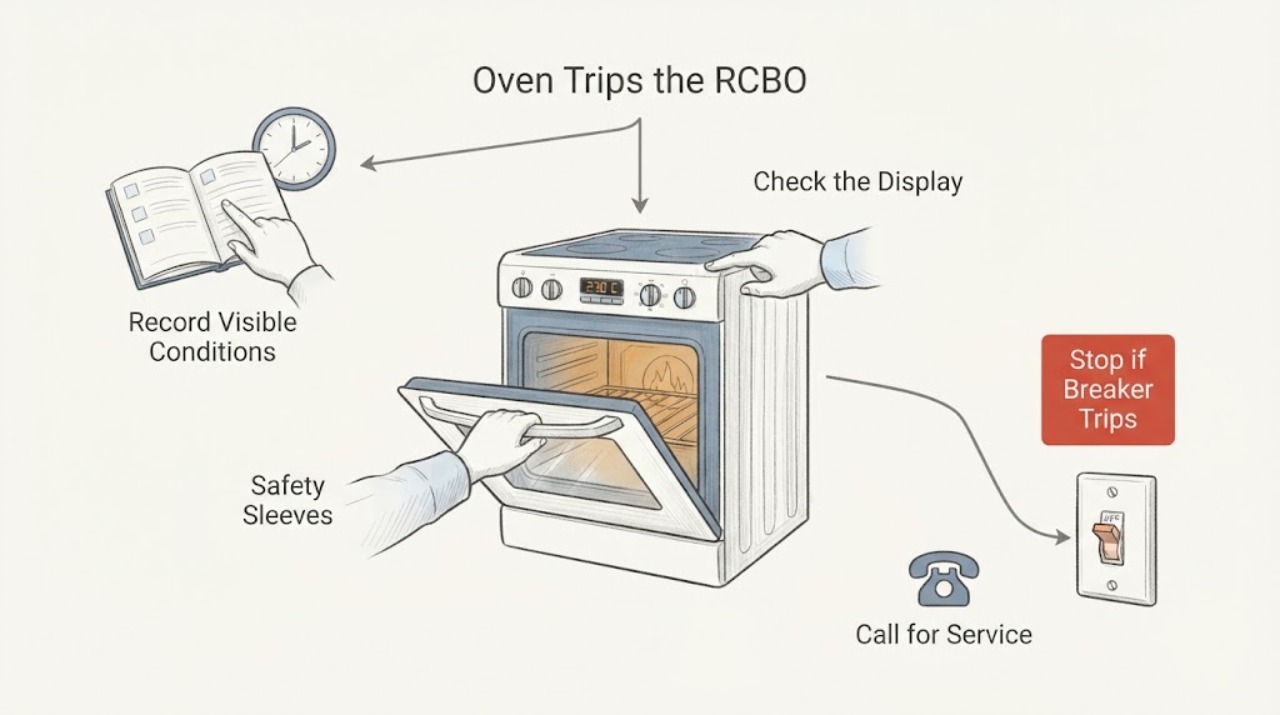
Work through in order
Diagnostic checks
Use only checks that match the exact appliance or system and its official guide.
-
Check 1
After a trip, stop the oven and write down the selected function, displayed temperature, whether it was preheating or already cycling, whether the door was opened immediately before the event, and whether the RCBO tripped once or repeatedly.
Expected result: The trip occurs only at a higher setting such as 230 °C, only on one function, during preheat, after opening the door, or across several functions.
Next step: Do not repeat the test to confirm the pattern. Leave the oven off after a repeat trip and provide the complete sequence to qualified service.
Why this matters
Why: The sequence helps a technician compare a heating-mode pattern with a supply or installation problem, but none of these observations identifies a specific element, thermostat, fan or control part.
-
Check 2
From a safe position, check the display and clock after the circuit is restored by a qualified person or after the event has been safely isolated. Note whether the display is blank, flashing or normal; do not open the built-in oven or its connection area.
Expected result: The display is blank/dark, the clock is flashing after a power interruption, or the display is normal but the oven trips when a heating function is selected.
Next step: Give power-source or installation symptoms to a qualified electrician. If the display is normal but a heating function trips the RCBO, stop using the oven and arrange trained appliance service.
Why this matters
Why: AEG says a blank display with a tripped fuse/RCD can point to the power source or installation, while a flashing clock can follow a power cut; a normal display does not clear a heating fault.
-
Check 3
Compare the symptom across functions only from the user's existing safe observations; do not deliberately run every mode. Record whether one heating type is affected or several heating types cause the trip.
Expected result: Only one heating mode appears affected, or several modes and temperatures cause the RCBO to trip.
Next step: For either pattern, avoid internal testing. Provide the affected function(s), setting and model/PNC to an AEG technician; use an electrician when the supply or protective device is implicated.
Why this matters
Why: AEG's troubleshooting distinguishes one non-working heating type from several non-working types, but repeated breaker operation still indicates an electrical or component fault that needs service.
-
Check 4
Check only the installation history and visible surroundings: whether the oven was recently installed or moved, whether other kitchen appliances were added to the circuit, and whether there is visible moisture or external cable/isolator damage. Do not remove trim or probe the supply.
Expected result: The problem began after installation or electrical work, other appliances share the circuit, or there is visible moisture or supply damage; otherwise no external cause is visible.
Next step: Have the installer or a qualified electrician check the circuit and connection. Keep the oven out of use and request trained appliance service when the oven itself is suspected.
Why this matters
Why: AEG lists installation error, overload, water and cable damage as possible causes; no visible issue does not rule out an internal oven fault.
-
Check 5
Do not use door opening, a different breaker, a larger fuse or a replacement element as an experiment. If the RCBO trips again or there is heat damage, odor, smoke, moisture or an abnormal sound, isolate the appliance from a safe position.
Expected result: The protective device trips again, or there is any visible or sensory sign of electrical or heat damage.
Next step: Do not re-energize the oven for another test. Arrange qualified electrician/appliance service and report the model, PNC, function, temperature and event sequence.
Why this matters
Why: AEG describes the trip as a safety feature that prevents damage or hazards and says electrical appliances can present a risk of harm.
Use your observations
Decision map
Find the observation that best matches what you see, then follow the next safe action.
-
PATH 01Next step
What you see
The RCBO trips once during a recent installation or after another high-load appliance was added to the kitchen circuit.
Do this next
Keep the oven off and have the installer or a qualified electrician assess the circuit and connection; do not change the protective device yourself.
Why this path and its safety boundary
Why it matters: AEG identifies installation error and an overloaded circuit as possible causes, so the supply arrangement needs checking before blaming an oven component.
-
PATH 02Next step
What you see
The display is blank after the trip, the clock lost its setting, or the oven has no power before a heating function is selected.
Do this next
Do not open the oven. Have the power source and installation checked safely, then use AEG service if the oven remains without normal operation.
Why this path and its safety boundary
Why it matters: AEG says a blank display with a tripped fuse/RCD may indicate the power source or installation, and a flashing clock can follow a power cut.
-
PATH 03Next step
What you see
The display is normal but the RCBO trips when a heating function is selected, especially after the oven reaches a higher temperature or across more than one function.
Do this next
Stop further tests, isolate the oven safely after the trip and arrange trained appliance service with the event details.
Why this path and its safety boundary
Why it matters: This is consistent with an electrical or component fault, but timing does not identify a particular heater, thermostat, fan or control.
-
PATH 04Next step
What you see
The RCBO trips only when the door is opened while the oven is hot, but it does not trip during the same function with the door closed.
Do this next
Do not keep reproducing the event at 230 °C. Record the function and sequence, keep the oven out of use if the trip recurs, and have the oven and supply assessed by qualified service.
Why this path and its safety boundary
Why it matters: The door timing is a reported correlation, not proof that the door or hinge caused the electrical fault; opening the door changes heat and operating conditions.
Helpful context
Understand the symptom
Treat the RCBO trip as the symptom, not a diagnosis
BE501310AM is a hardwired electric multifunction oven with a 3.5 kW connected load and a 15 A maximum current rating. Those specifications confirm the appliance identity and electrical context, but they do not identify whether the fault is in the oven, its connection, the protective device or a shared circuit. AEG lists damaged cables, water, faulty installation, an overloaded circuit and aged components among possible causes, so a temperature threshold alone does not prove a failed element or thermostat.
Opening the door is not a safe fault-isolation test
Record what happens when the door is opened, but do not repeatedly run the oven and open the door at 230 °C to reproduce a trip. Opening the door changes the cooking condition and releases heat; it does not distinguish a supply fault from an internal component fault. If the RCBO trips after the door is opened, report the exact sequence and the selected function to the technician rather than treating the door as the confirmed cause.
Use AEG's supported external distinction before service
AEG separates a single heating function that fails from several functions failing. It also says a blank display with a tripped fuse or RCD can indicate a power-source or installation problem, while an oven that continues to trip requires trained service. The useful user evidence is the display state, clock/settings, selected function, temperature at the event, recent installation or electrical work, and whether other appliances lose power—not a component diagnosis made from the timing of the trip.
When checks do not resolve it
Need a professional?
Call a qualified electrician or AEG service when the RCBO trips again, the oven has a blank display or power loss, the event began after installation, other appliances share the circuit, or there is moisture, odor, smoke, heat damage or an abnormal sound.
Safety scope: Do not repeatedly reset the RCBO, fit a larger fuse, open the oven or connection box, probe live conductors, bypass protection, or replace a heater/thermostat based only on the temperature at which the trip occurs. Use a qualified electrician for supply/RCBO questions and an AEG-trained appliance technician for oven diagnosis.
Have this ready
- Provide model BE501310AM, the PNC from the rating plate if visible, selected function, set temperature, preheat/cycling state, door-open timing, display/clock state, trip count, recent installation work and any other appliance or visible damage information.
Common questions
FAQ
Does tripping at 230 °C prove that the heating element is bad?
No. AEG lists supply, installation, overload, cable, water and several oven components as possible causes. The temperature and function are useful service evidence, but they do not identify a particular part.
Should I keep opening the door to reproduce the RCBO trip?
No. Opening the door changes the oven's operating and heat conditions and is not a safe electrical test. Record whether the trip followed a door opening, then stop repeated testing and arrange qualified service if it recurs.
What can I check without removing the oven?
Record the function, temperature, display/clock state, installation history, other appliances on the circuit and visible external moisture or cable damage. AEG directs supply issues and persistent oven faults to trained technicians; do not open the connection area or make live measurements.
Can I replace the breaker with a larger one so the oven keeps running?
No. Do not change the protective device or repeatedly reset it. The BE501310AM has a specified hardwired electrical connection, and the circuit must be assessed by a qualified electrician when the RCBO trips.
Read the exact guide
Official sources
- Oven Trips Fuses or Circuit Breaker – Causes & How to FixAEG · Opened AEG's official support article. It covers built-in ovens and lists supply, installation, overload, cable, water and component faults; it directs power-supply work and persistent diagnosis to trained technicians.
- Oven does not heat upAEG · Opened AEG's official support article. It distinguishes one versus several heating types, blank display/RCD state, clock after power loss, duration/end settings and service escalation.
- 60cm OptiSight MaxiKlasse Multifunction Oven - BE501310AMAEG Australia · Opened the exact AEG product page. It identifies BE501310AM as a 60 cm multifunction electric oven and lists the 3.5 kW connected load, 15 A maximum current rating and hardwired connection.
- Support For 60cm OptiSight Multi-Function Oven BE501310AMAEG Australia · Opened the exact AEG support page. It identifies the model, directs owners to the model manual and provides AEG repair/service routing; it does not define an internal fault or permit DIY electrical repair.
Community feedback
Share a repair observation
Share a plain-text repair observation. Accepted observations are published automatically; this page may take a moment to update.