
On this page
Start here
Quick answer
On the AEG L99695HWD, E20 is a drain or pumping fault even when the machine appears to drain during washing. A code that appears only during drying deserves a separate check of the drying air filters and the drying phase, as well as the shared drain hose, drain filter, and pump path. First record when E20 appears, unplug the appliance before accessible checks, confirm the hose position and filter are clear, clean the drying filters as the model manual allows, and use only the documented reset. If E20 returns with clear accessible paths, stop using the washer dryer and arrange an authorised repair rather than dismantling the machine or replacing a sensor/pump by guesswork.
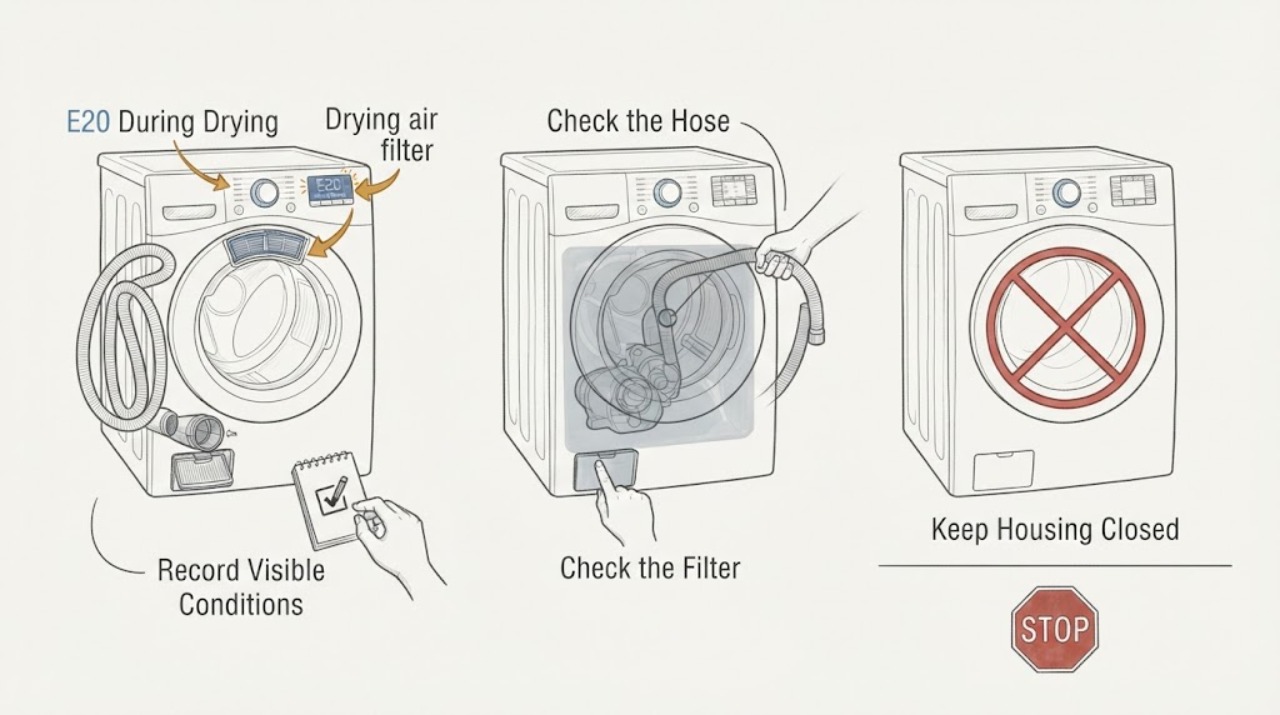
Work through in order
Diagnostic checks
Use only checks that match the exact appliance or system and its official guide.
-
Check 1
With the washer dryer stopped, write down the complete E20 message, beeps/flashes, programme name, whether the wash phase completed, whether water remains in the drum, and whether E20 appears at the start, during, or near the end of drying. Record unusual pump noise and the model/PNC from the rating plate.
Expected result: E20 appears only in drying; it appears in washing and drying; water remains; the drum is empty; or the code clears after an interruption.
Next step: Continue with the hose, filter, and drying-filter checks that match the observed pattern. If water is visible on the floor or electrical area, stop and isolate the water supply/power only from a safe position.
Stop if: Do not run repeated cycles to reproduce the fault, reach into a moving drum, or open panels.
Why this matters
Why: AEG uses E20 for pumping/draining problems. A drying-only pattern makes the drying air/filter path an additional lead, while a code in every phase points more strongly to the shared drain system; neither pattern identifies an internal part.
-
Check 2
Stop the appliance, disconnect the mains plug, and wait until the water is cool before checking the visible drain hose and accessible drain filter. Confirm the hose is not kinked, is inserted no more than 10 cm into the drain, and the drain height is 60–100 cm above the machine base or the model manual's specified height.
Expected result: The hose is kinked or too deep/low; the household drain backs up; the filter contains lint or an object; the filter seal is loose; or the accessible path is clear and drains normally.
Next step: Correct only the visible installation issue, refit the filter firmly, and check for leaks. If the accessible path is clear, continue to the drying air-filter check rather than dismantling the machine.
Stop if: Do not remove a hot filter, force the pump blade, use tools inside the hose, or restore power with a leak or wet connection.
Why this matters
Why: AEG lists hose position, drain height, kinks, blockages, and pump/filter conditions as E20 causes. A clear filter and a successful wash drain reduce but do not eliminate a concealed restriction or drying-stage problem.
-
Check 3
With power disconnected, clean the L99695HWD drying air filters exactly as the model manual allows, removing fine fluff from the filter surfaces and checking that the filter drawer is fully inserted. Do not remove cabinet panels to inspect concealed ducts.
Expected result: The drying filters were visibly loaded with fluff; the filters look clean but E20 occurs only during drying; the filter drawer was not fully seated; or E20 also occurs in wash programmes.
Next step: After the filters are dry and correctly seated, make one model-authorized test only if there is no leak or electrical hazard. If the code returns, report the drying-only pattern and do not attempt internal cleaning.
Stop if: Do not wash or reinstall filters contrary to the exact manual, run the machine with filters removed, or dismantle the drying duct.
Why this matters
Why: The manual identifies the drying filters as the fluff-collection path and directs cleaning after drying. A matching owner report links intermittent drying-only E20 to fine lint and restricted internal airflow, but that report is not proof of the cause on every machine.
-
Check 4
Check detergent use and foam history. If the machine produced unusually heavy suds, follow AEG's external instruction to stop, clean the accessible drain path, and run the documented hot cleaning wash without adding detergent; use the exact model manual for any cycle selection.
Expected result: There was heavy foam or excess detergent; there was no unusual foam; or E20 returns after the accessible cleaning and a normal cycle.
Next step: Reduce detergent to the product and load instructions and monitor one cycle. If E20 returns, stop use and arrange authorised service.
Stop if: Do not add chemicals to force a blockage through, bypass level sensing, or continue running with water on the floor.
Why this matters
Why: AEG says excessive detergent or foam can block the level system and contribute to E20. No foam and a clear drain path leave a pump, concealed duct, level-sensing, or drying-stage fault unresolved.
-
Check 5
Only after the appliance is dry, safely connected, and the accessible checks are complete, apply the AEG reset once. The support guidance allows switching power off for about 1–2 hours when a blocked pump protection device may need to cool; then run the shortest appropriate test and observe the code.
Expected result: E20 does not return; E20 returns only during drying; E20 returns in both wash and dry; or the pump makes an unusual noise or fails to move water.
Next step: Keep the washer dryer out of use and contact an authorised AEG service centre with the model L99695HWD, PNC/serial, cycle, timing, code, filter results, and reset result.
Stop if: Do not repeat long resets, replace a pump or sensor by code alone, or open the appliance.
Why this matters
Why: A cleared code can represent a temporary protection state, but it does not prove the pump, air path, or level sensing is healthy. A returning code is a service condition even if a prior wash drained normally.
Use your observations
Decision map
Find the observation that best matches what you see, then follow the next safe action.
-
PATH 01Next step
What you see
E20 appears only during drying, washing drains normally, the drain filter is clear, and the drying air filters were dirty, not fully seated, or have a fine-fluff history.
Do this next
Clean and seat the accessible drying filters as the manual permits and run one controlled test. If E20 returns, stop and request model-specific service for the concealed drying/drain path.
Why this path and its safety boundary
Why it matters: The drying air/filter path is a credible additional lead; the exact Reddit report describes a similar pattern, but it is anecdotal and does not establish a universal AEG fault.
-
PATH 02Next step
What you see
E20 appears during washing and drying, water remains, the hose or filter is restricted, or the pump makes an unusual noise.
Do this next
Correct the accessible hose/filter/drain issue once with cool water and a secure seal. If drainage is still abnormal or E20 returns, arrange authorised service.
Why this path and its safety boundary
Why it matters: The shared drain hose, pump, filter, household drain, or an internal blockage is more likely than a drying-only airflow explanation.
-
PATH 03Next step
What you see
The accessible hose and filter are clear, the household drain works, there is no unusual foam, and E20 returns after the documented reset.
Do this next
Stop using the appliance and provide AEG service with the exact cycle and timing, especially whether the fault is drying-only. Do not dismantle the cabinet.
Why this path and its safety boundary
Why it matters: A concealed pump, level-sensing, internal drain, or drying-stage fault remains possible; the symptom does not identify a safe replacement part.
-
PATH 04Next step
What you see
Water leaks, the filter cannot be resealed, the appliance trips power, or the drum/pump area produces abnormal noise or heat.
Do this next
Disconnect power only from a dry, safe position, close the water tap if appropriate, keep the appliance out of use, and arrange qualified service.
Why this path and its safety boundary
Why it matters: This is a stop-use safety or mechanical condition in addition to E20.
Helpful context
Understand the symptom
Why E20 can appear during drying even when washing drains
AEG defines E20, E21, and C2 as a water-draining or pumping issue. The washing and drying phases share parts of the drainage system, but the drying phase also uses the machine's air and lint-management path. A normal wash drain therefore does not prove that every drying-stage condition is normal. The first useful distinction is whether E20 occurs only during drying, during both types of cycle, or immediately after a prior interruption.
Drying filters are a separate check
The L99695HWD manual says its air filters collect fluff and advises cleaning them after drying; it also lists properly cleaned air filters when a drying cycle is too long. In the exact model-matched Reddit report, the owner described the drain filter as clear and E20 as intermittent during drying; a commenter attributed a similar symptom to fine lint and a restricted air path. Treat that report as a troubleshooting lead only. Do not dismantle the cabinet to copy it.
Check the shared drain path without opening the cabinet
AEG specifies that the drain hose should not be inserted more than 10 cm into the drain, and the drain should be 60–100 cm above the machine base or as shown in the model manual. A kink, blocked household drain, loose filter, pump obstruction, or excessive foam can trigger E20 even if water sometimes leaves the machine. These checks must be done with the appliance stopped and the water cool.
A returning code needs a service boundary
AEG permits a controlled reset after the accessible checks; its support article says power may need to be off for about 1–2 hours if a pump protection device has cooled. A reset that clears E20 once does not identify the cause. If the code returns, especially only in drying or with a clear accessible drain, provide the model, PNC, cycle, timing, filter results, and any abnormal noise to an authorised service centre.
When checks do not resolve it
Need a professional?
Arrange an authorised AEG repair when E20 returns after the hose, accessible drain filter, drying air-filter, foam, and documented reset checks; when it occurs in both washing and drying; when a pump makes unusual noise or does not move water; or when the concealed drying duct, pump, level sensing, wiring, or internal drain would need access. Give the technician the exact model L99695HWD, PNC/serial, programme, point in the cycle, whether washing drains normally, filter results, foam history, and reset result. Use the exact L99695HWD manual selected by the PNC.
Common questions
FAQ
Why does my AEG L99695HWD show E20 only during drying?
AEG defines E20 as a pumping/drain problem, but drying uses an additional lint and air path. Check the hose and drain filter, then clean and seat the drying air filters as the model manual allows. A model-matched owner report describes a similar drying-only pattern linked anecdotally to fine lint; if E20 returns, arrange service.
Does a clear drain filter rule out an E20 fault?
No. A clear filter and a successful wash drain reduce the chance of a simple accessible blockage, but hose position, pump protection, foam, concealed paths, level sensing, and drying-stage airflow can still require diagnosis.
Should I clean the drying filters when E20 appears?
Yes, with power disconnected and only according to the L99695HWD manual. AEG says its drying air filters collect fluff and should be cleaned after drying. Do not remove cabinet panels or try to clean concealed ducts yourself.
How do I reset AEG E20 on this washer dryer?
After the appliance is safe, cool, dry, and the accessible checks are complete, AEG support describes switching power off for about 1–2 hours before trying a cycle again. Use that reset once; a returning E20 needs authorised service.
Read the exact guide
Official sources
- AEG L99695HWD washer dryer giving a drain error fault, but drain filter checks out fine, and it drains fine?Reddit r/appliancerepair · Opened the exact Reddit post for the assigned L99695HWD symptom; used only as an anecdotal lead about drying-only E20/check-filter behavior and fine-lint observations, not as an AEG diagnosis or general repair instruction.
- AEG L99695HWD User Manual Search ResultsAEG / Electrolux User Manuals · Opened the Electrolux Group manual site and confirmed model-denomination records for L99695HWD; use the appliance rating plate and PNC to select the correct language and revision.
- AEG User Manuals: How to Find & Download InstructionsAEG · Opened AEG official support article; used to direct the owner to the exact model/PNC manual rather than generalising across washer-dryer variants.
- Washer dryer displays error message E20 or C2, emits 2 beeps or 2 flashesAEG · Opened AEG official support article; used for E20 meaning, hose insertion and height, pump/filter and drain checks, foam, reset interval, and service escalation.
- How to clean and maintain your AEG washer dryer and extend its lifeAEG · Opened AEG official washer-dryer maintenance article; used for fluff-filter cleaning, drain-filter safety, and the instruction to use the exact model manual for variations.
Community feedback
Share a repair observation
Share a plain-text repair observation. Accepted observations are published automatically; this page may take a moment to update.