
On this page
Start here
Quick answer
Start by deciding whether the problem is dirt left on the fabric, detergent residue, odor, or a dryer-only issue. Use a program suited to the soil and fabric, do not overload the drum, and measure detergent according to the product and AEG manual. If detergent remains in the drawer, clean the drawer and its recess and run an empty rinse. Clean the door seal, drum, and the model-specific lint or drain filters, then run a maintenance cycle when appropriate. A recurring error, weak water flow, no heating on a program that should heat, leaking, excessive foam, or a need to open the cabinet is a stop point for qualified service.
Work through in order
Diagnostic checks
Use only checks that match the exact appliance or system and its official guide.
-
Check 1
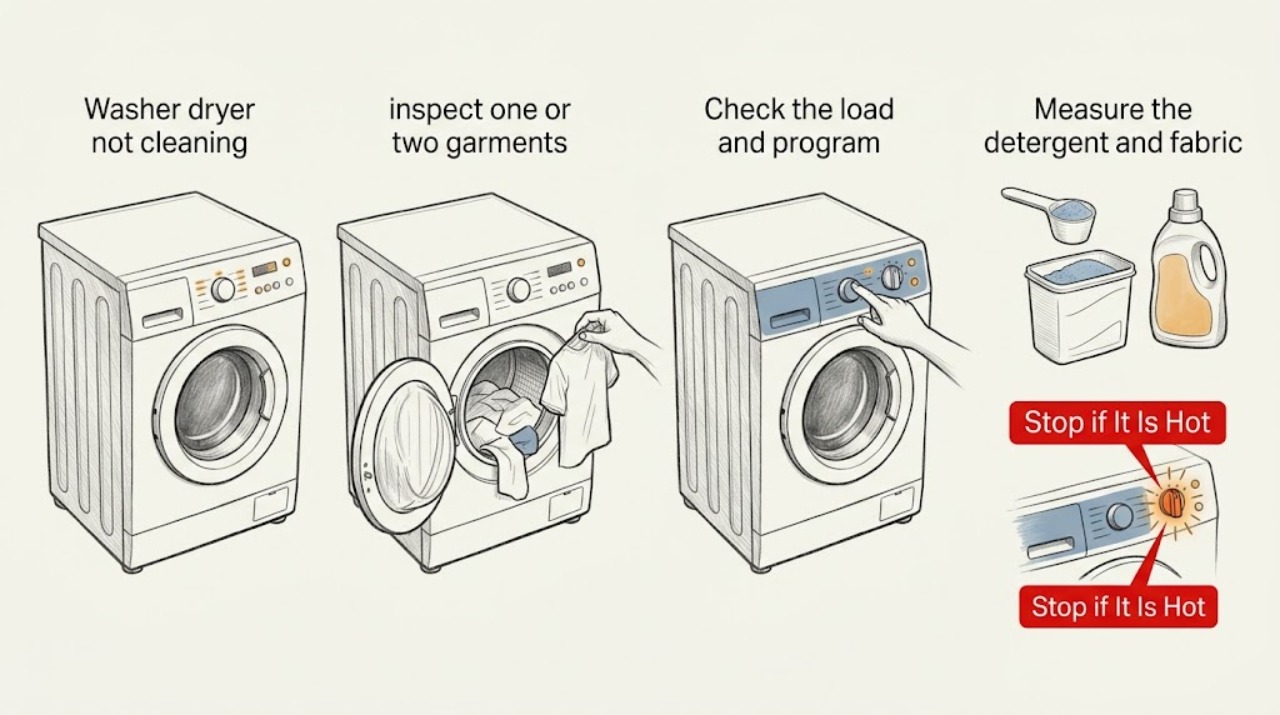
After the cycle, inspect one or two garments and classify the result as remaining soil, gray or greasy marks, undissolved detergent, excessive foam, sour odor, or clean-but-damp fabric; note whether the problem happened on wash-only, dry-only, or combined operation.
Expected result: The issue is residue or odor, visible dirt remains, the fabric is clean but damp, or the problem is limited to one fabric type or one program.
Next step: Choose the matching branch below and keep the garment, detergent type, program, load size, and any display message for comparison. Do not increase detergent before identifying residue versus insufficient soil removal.
Why this matters
Why: Residue and odor point toward dosing, rinsing, drawer, seal, drum, or low-temperature buildup. Clean-but-damp fabric is primarily a drying result and should not be “fixed” by adding more wash detergent. A one-program or fabric-specific pattern may be a selection or care-label mismatch.
-
Check 2
Check the load and program before the next wash: separate heavily soiled items from lightly soiled items, follow each garment's care label, choose a cycle and temperature suited to the soil, and leave enough room for the load to move rather than filling the drum to maximum capacity.
Expected result: A quick or delicate cycle was used for heavily soiled items, the drum was overloaded, mixed soil levels were washed together, or the program and load match the manual and care labels.
Next step: For a wrong program or overloaded/mixed load, correct only that choice and run one representative load. If the same cleaning failure occurs with a correctly loaded, suitable cycle, continue to detergent and water-delivery checks.
Why this matters
Why: AEG notes that a quick cycle may not clean very dirty or stained items, and overloading can prevent movement and proper rinsing. Mixing soil levels can transfer dirt back onto cleaner items; a matched cycle makes detergent or machine faults easier to evaluate.
-
Check 3
Measure the detergent and fabric conditioner for the actual load and local water hardness according to their packaging and the exact AEG manual; do not overdose, do not put a pre-wash dose in the wrong compartment, and do not use a pod in a drawer that is not designed for it.
Expected result: The dose was excessive or too small, foam or greasy residue is present, the product is unsuitable for the fabric or program, or dosing is correct but clothing remains dirty.
Next step: Correct the measured dose and use the manual's compartment or dosing method for one test. If residue or poor cleaning persists with correct dosing, inspect whether the drawer is delivering water and detergent rather than adding more product.
Why this matters
Why: Too little detergent can reduce cleaning performance, while too much can leave concentrated residue, create foam, and reduce mechanical washing. Hard water can reduce detergent effectiveness, so a larger dose is not automatically the answer.
-
Check 4
With no cycle running, remove and clean the detergent drawer only as the model instructions permit: rinse the removable sections with warm water, brush residue from the drawer recess and its water-entry area, refit every section, and run an empty rinse.
Expected result: Detergent or conditioner remains in the drawer, the recess is blocked or moldy, water leaks from the drawer front, or the drawer is clean and delivers product normally.
Next step: If the drawer was blocked, run one correctly dosed wash and compare the result. If the drawer is cracked, still leaks, does not receive water, or the problem returns, stop trying to force it and request service; use the exact model manual for removal.
Why this matters
Why: AEG explains that buildup in the drawer and recess can block detergent flow and, in severe cases, cause leakage. A clean drawer followed by an empty rinse removes a delivery restriction from the likely causes but does not test internal valves or controls.
-
Check 5
With the appliance empty and cool, inspect and wipe the inner door seal, accessible drum surfaces, and any model-specific primary fluff filter; inspect the drain pump filter only using the exact manual and only when the machine is off, unplugged, and the water is cool.
Expected result: Lint, hair, coins, detergent film, greasy buildup, mold, or a blocked filter is present; or the seal, drum, and applicable filters are clean and correctly refitted.
Next step: Remove only accessible residue or objects with the model-approved method, refit the filter correctly, and run the specified empty rinse or test. If a filter cannot be removed, water remains, a leak starts, or a pump hums abnormally, stop and arrange service.
Why this matters
Why: Residue and foreign objects can return soil to fabrics, create odor, restrict drainage, or reduce drying performance. A filter that is not tightened or refitted correctly can create a leak or prevent a normal cycle, so cleaning must include reassembly.
-
Check 6
If the result is gray or greasy marks, odor, or repeated residue, run the model-approved empty maintenance or cleaning cycle and then wipe the seal and drawer; keep ventilation by leaving the door and drawer slightly open between uses when the manual allows.
Expected result: The maintenance cycle removes residue and the next load is clean, or marks, odor, foam, or dirt remain after the machine is clean and correctly dosed.
Next step: Use the machine only within its manual limits if the result improves. If residue or odor returns quickly, or the washer-dryer displays an error, leaks, fails to drain, or behaves abnormally, stop and request professional diagnosis.
Why this matters
Why: AEG associates repeated low-temperature washing, detergent buildup, grease, mold, and biofilm with marks and poor results. A maintenance cycle can address buildup, but persistence after cleaning shifts the suspicion toward water, heat, mechanics, or a control fault.
-
Check 7
For a wash program that should heat, verify the selected temperature and observe the cycle only as described by the AEG guidance; do not touch the door as a heat test if it could burn you, and do not open panels or test the heater.
Expected result: A cold-wash option or low-temperature program was selected, the appliance heats as expected for the chosen program, or the expected heating does not occur and an error may or may not appear.
Next step: Correct only an unintended cold or low-temperature selection and make one test. If the selected program should heat but does not, or an error appears, stop using the appliance and arrange qualified service rather than repeating hot cycles.
Why this matters
Why: Some programs intentionally wash cold or at a lower temperature, and the final rinse can be cold. If a suitable program does not heat, AEG identifies a possible heater fault and may show a corresponding error; that is not a detergent problem.
-
Check 8
Run one correctly loaded, correctly dosed wash-only test after the relevant correction and record water intake, drum movement, foam, rinse behavior, drainage, and the final fabric result; do not keep repeating tests when the same fault returns.
Expected result: The test cleans normally, leaves residue or dirt again, leaves standing water, shows an error, leaks, or stops with unusual noise or no drum movement.
Next step: Continue normal care only when the test is stable and no safety symptom exists. For recurrence, unplug when safe, keep the recorded sequence, and request professional service; do not open the cabinet or replace a component based on symptoms alone.
Why this matters
Why: A stable result after a simple correction supports a program, dose, or maintenance cause. Recurring poor cleaning with correct setup, weak water or drainage behavior, a leak, error, or abnormal mechanics indicates a fault that requires diagnosis.
Use your observations
Decision map
Find the observation that best matches what you see, then follow the next safe action.
-
PATH 01Next step
What you see
The drum was overloaded, soil levels were mixed, or a quick/delicate program was used for heavily soiled items.
Do this next
Sort the load, leave movement space, and run one program suited to the fabric and soil; escalate if the result remains poor with correct loading.
-
PATH 02Next step
What you see
Clothing is greasy, foamy, coated with powder, or otherwise shows a dosing problem.
Do this next
Measure the detergent and conditioner to the actual load, water hardness, product instructions, and model manual; use an extra rinse when appropriate and do not keep adding product by guesswork.
-
PATH 03Next step
What you see
Detergent or conditioner remains in the drawer, the drawer recess is blocked, or water leaks from the drawer front.
Do this next
Clean the drawer and recess with the model-approved method and run an empty rinse; service a cracked, leaking, or non-delivering drawer.
-
PATH 04Next step
What you see
Gray marks, sour odor, or residue persist after repeated low-temperature use or visible buildup on the seal, drawer, or drum.
Do this next
Run the exact model's empty maintenance cycle, clean accessible seals and drawer, and improve ventilation; arrange service if the marks or odor return quickly.
-
PATH 05Next step
What you see
The issue is clean-but-damp laundry after the drying stage rather than soil left after washing.
Do this next
Use the model's drying troubleshooting path and clean applicable lint filters; do not alter wash detergent to solve a drying-only result.
-
PATH 06Next step
What you see
A suitable wash program does not heat as expected, displays a heater-related error, or the appliance has a recurring error, leak, standing water, or abnormal mechanics.
Do this next
Stop using the washer-dryer, unplug when safe, and arrange qualified appliance service; do not open the cabinet or test heater, motor, pump, valve, sensor, or controls.
-
PATH 07Next step
What you see
One correctly loaded, correctly dosed wash-only test is clean and no error, leak, foam, or abnormal behavior returns.
Do this next
Resume normal use within the exact manual's limits, keep the door and drawer ventilated when allowed, and maintain the seal, drawer, drum, and applicable filters.
Helpful context
Understand the symptom
Define what not cleaning means
A shirt that still has soil, a garment covered with powder, a sour odor, gray greasy marks, and clothing that is clean but damp are different failure patterns. A washer-dryer can wash and dry in separate stages, so evaluate the wash result before the drying stage and keep a sample of the affected fabric or residue. The pattern determines whether to change the program, detergent, cleaning routine, or service path.
Cleaning the machine is not the same as repairing it
Regular maintenance can remove detergent, grease, limescale, lint, and odor sources, but it cannot prove that a heater, water valve, pump, sensor, or control is healthy. Use only the checks described for the exact model. Stop if the appliance leaks, displays an error, overheats, makes an abnormal noise, or needs panels or electrical parts removed.
When checks do not resolve it
Need a professional?
Use professional service when correct loading, dosing, drawer delivery, cleaning, and one documented test do not restore cleaning, or whenever an error, leak, heating fault, drainage issue, or internal component is suspected.
Common questions
FAQ
Why is my Aeg washer dryer leaving clothes dirty?
Start with load size, soil sorting, and the program: a quick cycle or overloaded drum may not clean heavily soiled items. Then check detergent dosing, drawer delivery, the seal and drum, and the model-specific filters. If a correctly set wash still fails, arrange service.
Can too much detergent make an Aeg washer dryer clean less effectively?
Yes. AEG says excess detergent can remain on fibers, create foam, and contribute to residue; too little can also reduce cleaning performance. Measure the dose for the load, water hardness, product, and model rather than adding more by guesswork.
What should I do if detergent stays in the drawer?
Remove and rinse the drawer sections with warm water, brush residue from the drawer recess, refit it correctly, and run an empty rinse as AEG describes. A cracked drawer, front leak, or continuing failure to deliver detergent needs service or model-specific replacement guidance.
How do I remove gray marks and odor from laundry?
Empty the drum and run the exact model's maintenance or cleaning cycle, then clean the seal and detergent drawer and leave the door and drawer open to dry when allowed. Reduce overdosing and avoid overloading; persistent marks or odor after this routine need diagnosis.
Why are clothes clean but still damp after an Aeg washer-dryer cycle?
That is a drying-result issue rather than proof that the wash is not cleaning. Check the drying program, load and applicable lint filters using the exact model manual. If drying remains abnormal or an error appears, use the professional-service boundary.
How can I tell if the washer dryer is not heating the wash water?
First verify that the selected program is not intentionally cold or low temperature. AEG notes that the final rinse is normally cold; if a suitable program does not heat or an error appears, stop repeating hot cycles and request service rather than opening the machine.
Read the exact guide
Official sources
- Laundry is hard after washing in washing machineAEG · AEG washing machines and washer dryers; exact programs vary by model
- How to clean and maintain your AEG washer dryerAEG · AEG washer dryers; filter presence and procedures are model-dependent
- Washing machine does not heat up and does not display an error messageAEG · AEG washing-machine wash stage; exact washer-dryer programs and heater behavior vary by model
- Washing tipsAEG · AEG washing machines; the principles are relevant to the wash stage of washer dryers
- Washer dryer does not take detergents / water remains in the softener compartmentAEG · AEG front-loading washing machines and washer dryers; drawer construction varies by model
- Grey Marks on Clothes After Washing? Causes and FixesAEG · AEG washing machines and washer dryers
Community feedback
Share a repair observation
Share a plain-text repair observation. Accepted observations are published automatically; this page may take a moment to update.