
On this page
Start here
Quick answer
Start by defining what is wrong: visible stains remain, dirt or residue transfers onto clean laundry, odors remain, or the wash cycle does not complete normally. LG identifies an oversized load, a cycle that is too gentle or short for the soil, detergent left in a clogged dispenser, undissolved detergent in cold water, and residue inside the tub as common causes of poor cleaning. Reduce the load so items can move, select a cycle and soil option suitable for the fabric, clean the dispenser, use only the detergent type and amount specified for the model, and run the model's Tub Clean cycle when residue or odor suggests buildup. A front-load washer may use less water and show only a partial water level by design. Stop for smoke, a burning smell, water near electricity, or a damaged cord. If the same load remains dirty after these separate checks, or the drum does not tumble, fill, heat, rinse, or drain correctly, arrange qualified appliance service.
Before you begin
Safety first
- A user may adjust load and cycle, clean an accessible dispenser, use model-supported detergent and maintenance cycles, and observe operation from a safe position. Internal water, drive, heater, sensor, control, and live electrical diagnosis require qualified service.
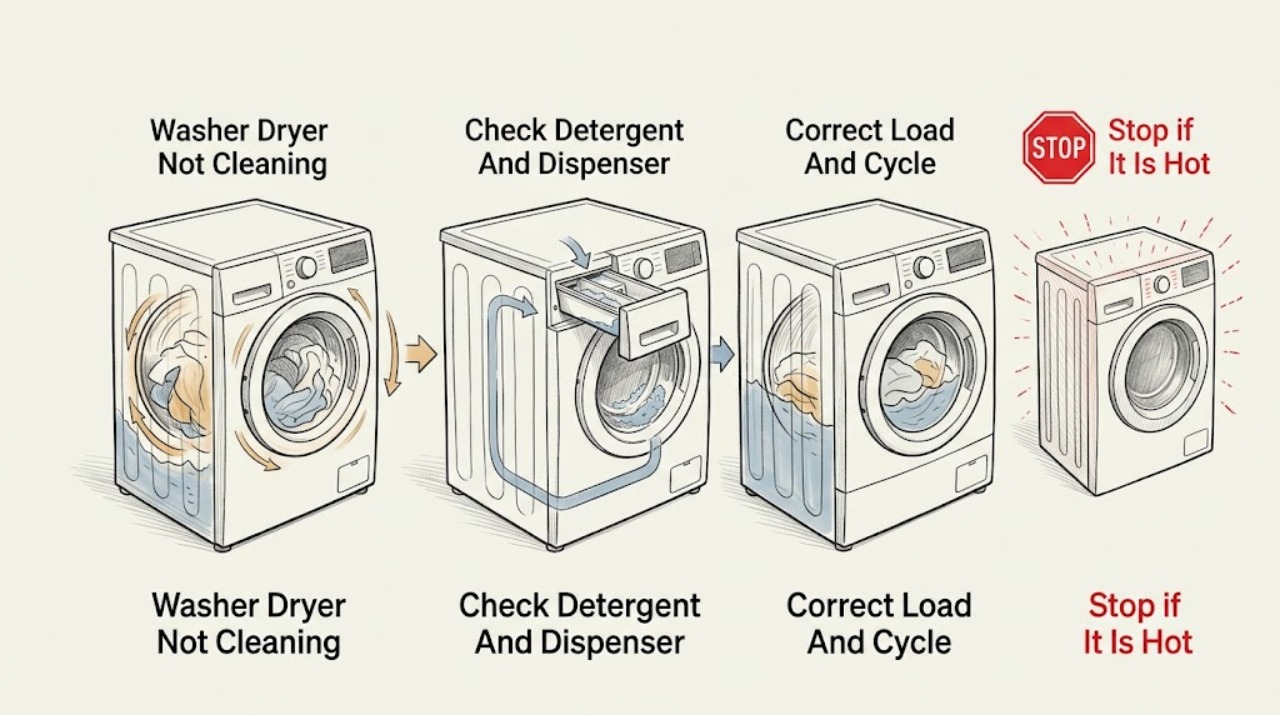
Work through in order
Diagnostic checks
Use only checks that match the exact appliance or system and its official guide.
-
Check 1
Before another cycle, photograph the laundry and record whether the problem is remaining stain, detergent residue, odor, poor rinsing, no drum movement, or an incomplete cycle; stop immediately for smoke, burning smell, sparks, water near electricity, a hot plug, damaged cord, or repeated protection trips.
Expected result: Note the selected cycle, load type, detergent, temperature option, water level appearance, error message, and whether filling, tumbling, rinsing, and draining occurred.
Next step: For a safe machine, continue to the load and cycle check. For a hazard or major operating failure, keep the washer dryer off and arrange qualified appliance or electrical help.
Stop if: Do not continue operating after smoke, burning odor, sparking, a hot plug, damaged wiring, water near electricity, or repeated protection trips.
Why this matters
Why: A soil or residue result points toward load, cycle, detergent, or tub condition. No movement, no fill, no drain, an error, or an electrical or water hazard points toward a service or safety boundary.
-
Check 2
Remove enough laundry to allow tumbling and choose the model's cycle for the fabric and soil; use a stronger or longer model-supported option for heavy soil and do not judge cleaning by how high the water appears in a front-load drum.
Expected result: During the next safe wash, check whether bulky items can move through the water, whether the drum tumbles rather than staying packed, and whether the selected cycle matches the care label and soil level.
Next step: Compare the result with the smaller, suitable load. If stains are old or set in, use only a fabric-safe pretreatment or model-supported soak or prewash; if the load still remains dirty, continue to detergent and tub checks.
Stop if: Do not exceed the appliance's capacity, use a hotter setting than the fabric or model permits, or add chemicals that are not approved for the garment and washer.
Why this matters
Why: LG says an overfilled front-load drum reduces tumbling, while a short or gentle cycle may be less thorough. A partial water level can be normal in a front-load design.
-
Check 3
Inspect the dispenser for hardened detergent, residue, an incorrect insert, or an obstruction; clean the accessible tray and housing with lukewarm water and a soft brush as the model manual permits, then use the specified high-efficiency detergent and amount without exceeding the fill mark.
Expected result: Record whether detergent remains in the compartment after a cycle, whether clumps or buildup block the water path, whether the insert is seated correctly, and whether residue on clothes decreases after the correction.
Next step: Reassemble the dispenser securely and run one suitable test load. If detergent still does not enter, water flow is weak, the drawer overflows, or clothes remain dirty, arrange service rather than opening the inlet or dispenser housing.
Stop if: Do not pry the dispenser housing, reach into a filling washer, mix cleaning chemicals, or use a detergent compartment that is cracked or leaking.
Why this matters
Why: LG says a clogged or incorrectly assembled dispenser can prevent detergent from entering the tub, while the wrong amount or type can leave residue and reduce cleaning performance.
-
Check 4
For heavy soil or cold-weather poor results, use only the model's permitted soak, prewash, soil-level, or warm-water option and follow the fabric care label; do not assume visible suds are needed for cleaning.
Expected result: Note whether the detergent dissolves, whether the cycle supplies and drains water normally, whether the clothing was fully wetted, and whether the same fabric improves with the supported soil or temperature option.
Next step: Keep the option that improves the result and remains suitable for the fabric. If water entry is weak, the cycle never wets the load, or results do not improve, arrange service for water-flow or control diagnosis.
Stop if: Do not use an unsafe temperature, overload the drum to force more water, or add extra detergent to create suds.
Why this matters
Why: LG explains that cold incoming water can leave detergent insufficiently dissolved, that bulky laundry may not be fully wetted, and that visible suds are not a measure of proper cleaning in a high-efficiency washer.
-
Check 5
If the laundry has odor, marks, or residue that suggests buildup, run the installed model's Tub Clean cycle with an empty drum and only the cleaner and amount permitted by the appliance and cleaner instructions.
Expected result: After the cycle, check whether residue or odor is reduced, whether the dispenser and door area remain clean, and whether the same marks transfer to a subsequent correctly loaded test wash.
Next step: Repeat only at the model's documented maintenance interval and leave the washer open after use when permitted. If residue, odor, or poor cleaning continues, prepare a service handoff.
Stop if: Do not combine cleaners, use an occupied drum for Tub Clean, or continue if the cycle leaks, produces smoke, or triggers an error.
Why this matters
Why: LG says detergent and soil residue inside the tub can transfer to laundry and reduce wash performance, and recommends regular Tub Clean maintenance.
-
Check 6
Run one correctly loaded, model-supported test wash only if the appliance is safe, and observe filling, tumbling, rinsing, draining, and any error or abnormal noise without opening the cabinet.
Expected result: Record the exact cycle and options, whether the drum moves, whether water enters and exits, whether detergent dispenses, whether the result improves, and whether an error, leak, odor, or unusual heat returns.
Next step: Arrange qualified LG appliance service and provide the model and serial information, cycle details, photographs, detergent information, test result, and any error message or safety symptom.
Stop if: Do not test live wiring, remove panels, bypass a door or control, run a cycle with standing water or a leak, or repeatedly operate a machine with smoke, burning odor, or abnormal heat.
Why this matters
Why: Improvement after load, cycle, detergent, or tub maintenance supports an operating-condition cause. Persistent poor cleaning with a failed movement, fill, drain, heat, or control symptom supports qualified diagnosis.
Use your observations
Decision map
Find the observation that best matches what you see, then follow the next safe action.
-
PATH 01Safety boundary
What you see
There is smoke, burning smell, sparking, a hot plug, damaged cord, water near electricity, repeated protection trips, an active leak, or abnormal heat.
Do this next
Keep the washer dryer off, isolate only from a safe position, and arrange qualified appliance or electrical help.
Why this path and its safety boundary
Safety stop: Do not run another cycle, open panels, or touch wet electrical areas.
-
PATH 02Safety boundary
What you see
The load is packed tightly, bulky items are not moving, or a short or gentle cycle was used for heavy soil.
Do this next
Reduce the load and select the model-supported cycle and soil option for the fabric and condition.
Why this path and its safety boundary
Safety stop: Persistent poor cleaning after a suitable load and cycle requires service rather than more detergent.
-
PATH 03Safety boundary
What you see
Detergent remains in the drawer, the drawer is blocked, or residue transfers to clothing.
Do this next
Clean and correctly reassemble the accessible dispenser, then use the model-specified high-efficiency detergent and amount.
Why this path and its safety boundary
Safety stop: A drawer that still will not dispense, overflows, or leaks needs service.
-
PATH 04Safety boundary
What you see
The load is correctly sized but heavy soil remains, detergent is clumped, or cold water appears to limit dissolution.
Do this next
Use only the model-supported soak, prewash, soil, or temperature option and follow the fabric care label.
Why this path and its safety boundary
Safety stop: Weak filling, an error, or no improvement after a suitable test load needs service.
-
PATH 05Safety boundary
What you see
Marks, odor, or residue suggest buildup inside the drum.
Do this next
Run the empty Tub Clean cycle with the approved cleaner and follow the documented maintenance interval.
Why this path and its safety boundary
Safety stop: If residue or odor returns, or the cycle leaks or errors, arrange qualified service.
-
PATH 06Safety boundary
What you see
The washer dryer does not fill, tumble, rinse, drain, or complete the selected cycle correctly after the safe external checks.
Do this next
Stop repeating cycles and provide the operating notes and any error message to qualified service.
Why this path and its safety boundary
Safety stop: Do not test live components or replace a motor, valve, heater, or control by guesswork.
Helpful context
Understand the symptom
Identify the kind of poor result
A washer dryer that leaves a set-in stain, deposits detergent, leaves an odor, or fails to move the load needs a different next check. Photograph the result and note the load type, cycle, detergent, water setting, and whether the drum filled, tumbled, rinsed, and drained. A low-looking water level in a front-load drum is not automatically a fault: LG says these machines use a partial level to tumble laundry through water.
Correct load movement before changing parts
Overloading reduces tumbling and leaves bulky items insufficiently moved through the wash water. A short or gentle cycle can also be unsuitable for heavy soil, while an old stain may need pretreatment or a longer, model-supported option. Remove enough laundry for it to move freely, choose the cycle recommended for the fabric and soil, and compare the next result rather than changing several settings at once.
Treat detergent and tub residue separately
A clogged dispenser can leave detergent out of the wash, while too much detergent or poorly dissolved detergent can leave residue on clothing. Use the detergent type and amount required by the installed model, clean the dispenser and its housing with the model-approved method, and run Tub Clean when buildup or odor is present. Leave the washer open after washing when the manual allows it so the tub can dry.
Know when cleaning performance is a machine fault
If a smaller, correctly selected load still comes out dirty and the detergent and tub checks are complete, observe whether the machine fills, tumbles, heats as the selected cycle requires, rinses, and drains. A drum that never moves, weak water entry, unusual noise, an error message, standing water, or a recurring leak is not a reason to open panels. Preserve the cycle and result details for qualified service.
Only after diagnosis
Potential parts
- detergent dispenser assembly
Consider only when the dispenser remains blocked or fails to deliver detergent after accessible cleaning and correct assembly.
Confirm the exact model and dispenser configuration before any replacement decision. - inlet valve or inlet filter
Consider only when filling is weak or inconsistent after the faucet, hose, and accessible flow checks are complete.
Internal inlet diagnosis and part selection require exact model confirmation and qualified service. - drive or drum-motion component
Consider only when a correctly loaded cycle repeatedly fails to tumble or spin and no safe load or cycle correction helps.
Drive parts are model-specific; do not infer a failed component from poor cleaning alone. - heater or temperature-sensing component
Consider only when a model-supported temperature cycle has a confirmed heating or temperature-control fault.
Do not test live heating parts or choose a component from cleaning results without qualified diagnosis. - control or cycle-sensing component
Consider only when the selected cycle repeatedly fails to fill, tumble, rinse, drain, or complete after safe external checks.
Control compatibility depends on the exact model and revision and requires qualified diagnosis.
When checks do not resolve it
Need a professional?
Arrange qualified appliance service for smoke, burning odor, water near electricity, active leaks, an error, no drum movement, weak filling, incomplete draining, abnormal heat, or poor cleaning that continues after a correctly loaded cycle, suitable cycle, detergent-dispenser check, and model-approved Tub Clean.
Safety scope: A user may adjust load and cycle, clean an accessible dispenser, use model-supported detergent and maintenance cycles, and observe operation from a safe position. Internal water, drive, heater, sensor, control, and live electrical diagnosis require qualified service.
Have this ready
- Provide the exact LG model and serial information, the cleaning symptom, fabric and load details, cycle and option settings, detergent type and amount, photographs of residue or stains, whether the drum filled and tumbled, and any error, leak, odor, or unusual-noise notes.
Common questions
FAQ
Why is my LG washer dryer not cleaning clothes well?
Start with load size, cycle suitability, detergent dispensing, and tub residue. A packed load, unsuitable cycle, blocked dispenser, incorrect detergent amount, or buildup can reduce cleaning. If a correctly loaded test wash still performs poorly, arrange service.
Is a low water level in an LG front-load washer a fault?
Not necessarily. LG explains that front-load washers use a partial water level while tumbling laundry through water. Judge the result by whether the load wets, tumbles, rinses, and drains normally rather than by water height alone.
Can too much detergent make LG washer cleaning worse?
Yes. Excess detergent can leave residue and buildup, while a clogged dispenser can keep detergent from entering the tub. Use the model-specified high-efficiency detergent and amount and keep it below the dispenser's fill mark.
Which LG washer cycle should I use for heavy soil?
Use the cycle, soil, soak, or prewash option that the installed model recommends for the fabric and soil. A short or gentle cycle may be less thorough for heavily soiled laundry, and old stains may need fabric-safe pretreatment.
How does Tub Clean help when an LG washer dryer leaves marks or odor?
LG says residue inside the tub can transfer to clothing and reduce performance. Run the empty Tub Clean cycle with the approved cleaner and instructions, then arrange service if odor, marks, or poor cleaning returns.
Read the exact guide
Official sources
- [LG Front Load Washer] Laundry Not Clean (Poor Wash Performance)LG Electronics USA Support · The page describes tumbling, load size, detergent dissolution, cycle choice, prewash, and Tub Clean; use the installed model instructions for options.
- LG Washer - Not Cleaning ProperlyLG Electronics USA Support · The page covers load size, cycle choice, dispenser cleaning, Tub Clean, and service escalation; settings and menus vary by model.
- LG Washer - Clothing Not Clean ProperlyLG Electronics USA Support · The guidance covers load wetting, cycle choice, set-in soil, cold water, detergent amount, and Tub Clean; actual controls vary by model and region.
- LG Washer – Troubleshooting Detergent Left in the DispenserLG Electronics USA Support · Use the detergent type, fill-line, cleaning, and reassembly guidance with the exact model because dispenser inserts differ.
- Not Enough Suds in Washing MachineLG Electronics USA Support · The guidance applies to LG high-efficiency washer operation; detergent and cycle instructions for the installed model take precedence.
Community feedback
Share a repair observation
Share a plain-text repair observation. Accepted observations are published automatically; this page may take a moment to update.