
On this page
Start here
Quick answer
When a Maytag washer-dryer is not cleaning, first decide whether the problem is unchanged soil, detergent residue, poor rinsing, or a cycle that does not complete. Maytag's guidance points first to the cycle and temperature, load size and sorting, high-efficiency detergent and dosage, and routine washer cleaning. Use a cycle that matches the fabric and soil, leave room for items to move, and correct detergent or dispenser buildup before suspecting a component. If a correctly loaded and dosed test cycle still leaves the whole load dirty, or the washer leaks, cannot fill or drain, shows a fault, or makes abnormal noise, stop repeated testing and arrange qualified service.
Work through in order
Diagnostic checks
Use only checks that match the exact appliance or system and its official guide.
-
Check 1
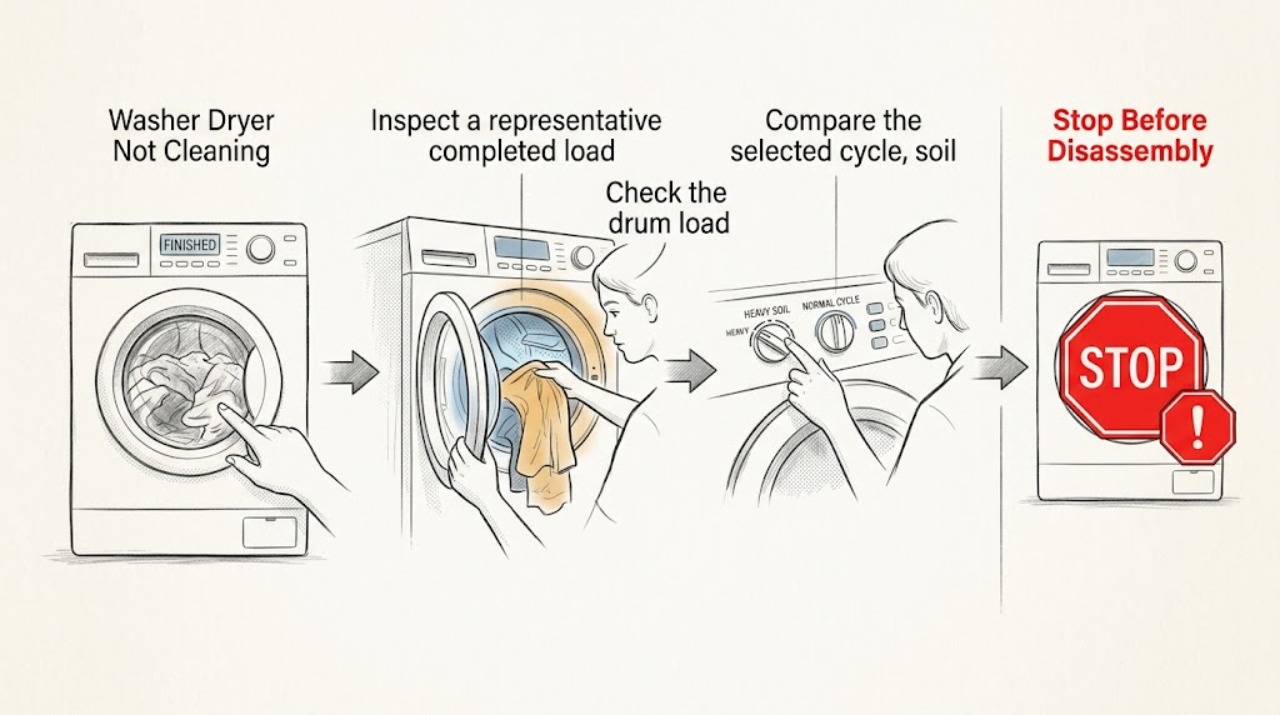
Inspect a representative completed load and classify the result as unchanged soil, dye transfer, white or greasy residue, poor rinsing, or clothes that remain unusually wet. Note whether the issue affects every item or only one garment.
Expected result: The same problem affects most of the load, or only one item has a stubborn mark.
Next step: Use the whole-load symptom to choose the checks below. Treat an isolated stain according to the garment-care instructions rather than replacing washer parts.
Why this matters
Why: A whole-load pattern points to cycle, load, detergent, water, cleaning, or drain conditions. One isolated stain may be set into the fabric and does not by itself establish a washer fault.
-
Check 2
Compare the selected cycle, soil level, temperature, and options with the garment-care labels and load. Use the model's cycle intended for the fabric and soil; avoid judging cleaning from a short cycle used for a large or heavily soiled load.
Expected result: The cycle is too short or gentle for the load, the temperature does not suit the fabric or soil, or the settings are a reasonable match.
Next step: Run one compatible test load using the model's appropriate settings. Follow garment-care limits and do not select a hotter temperature that the fabric cannot tolerate.
Why this matters
Why: Maytag states that cycle selection, water temperature, and soil settings affect cleaning. A mismatch can leave soil behind without a failed washer component; correct settings with poor results shift the diagnosis to load, detergent, water, or machine condition.
-
Check 3
Check the drum load and sorting. Place sorted items loosely so they can move freely, avoid tightly packing the washer-dryer, and separate loads that need different fabric or soil settings.
Expected result: The drum was tightly packed, items were tangled or poorly sorted, or the load had room to move and a suitable fabric mix.
Next step: Reduce and rebalance the load, then repeat the matched-cycle test once. If the smaller load is still uniformly dirty, continue to the detergent and dispenser checks.
Why this matters
Why: A packed load can prevent detergent from circulating and keep the washer from rinsing thoroughly. A suitable load with the same whole-load failure makes detergent, water, dispenser, or internal wash action more likely.
-
Check 4
Verify the detergent type, placement, and amount. Use high-efficiency detergent where required, measure for the load and soil level, and check the model instructions for the correct detergent-pac location. Do not add extra detergent to compensate for poor cleaning.
Expected result: Non-HE detergent, excess detergent, the wrong compartment, a detergent pac in an unsupported location, or caked residue is present, or detergent use matches the instructions.
Next step: Correct the detergent setup and run a suitable test load. If residue or suds remain, clean the dispenser and use the model's Clean Washer procedure before judging the next load.
Why this matters
Why: Maytag links excess or unsuitable detergent to oversudsing, poor rinsing, residue, and poor cleaning performance. A correct detergent setup shifts suspicion to water entry, cycle action, dispenser flow, or draining.
-
Check 5
Inspect the dispenser for buildup and confirm it is seated correctly. Follow the model instructions to remove the drawer if permitted, rinse or wash away residue with mild soap and water, dry it, and return it to its slot; do not put a dispenser drawer in a dishwasher.
Expected result: The dispenser is clogged, contains dried detergent or additive buildup, is not seated correctly, or is clean and operating normally.
Next step: Clean and reseat the drawer using the exact model guide, then run one controlled load. If detergent still remains in the drawer or cleaning does not improve, arrange service rather than opening the dispenser plumbing.
Why this matters
Why: A clogged dispenser can block water flow through the dispenser and prevent the intended detergent dose from reaching the load. A clean, correctly seated dispenser makes water supply, cycle selection, load, and internal wash action more relevant.
-
Check 6
Check the wash and rinse water behavior without opening the cabinet. Confirm the washer-dryer fills as expected, does not display a water-related fault, and does not leave excessive suds. If the model supports a Clean Washer cycle, run it empty according to its owner instructions when residue or a low-water-level concern is present.
Expected result: Water entry is incomplete, a fault or excessive suds appears, the washer has visible buildup, or the wash and rinse stages proceed normally.
Next step: Correct only a visible, model-documented user condition and complete the model-supported cleaning cycle. Stop and arrange service for a persistent fill fault, repeated suds, or a water-level problem.
Why this matters
Why: Maytag guidance associates poor cleaning or rinsing with excess suds, buildup, load conditions, and water-level or supply concerns. Normal filling and rinsing move the diagnosis toward cycle match, load, or an internal wash-action fault.
-
Check 7
Observe the end of the washer stage before relying on the dryer. Check whether water drains fully, the cycle completes, and clothing is merely damp rather than saturated. If a drain or spin warning appears, inspect only the visible drain path for an obvious installation problem and follow the model guide.
Expected result: Clothes remain saturated, water remains in the tub, the cycle stops before completion, a fault appears, or draining and spinning are normal.
Next step: Stop using the washer-dryer if it cannot drain, repeatedly stops, or shows a persistent fault. Arrange qualified service for pump, motor, control, or internal drain diagnosis.
Why this matters
Why: A failed rinse, drain, or spin stage can leave soil or detergent on clothing and can make the dryer result look poor. Normal draining and spinning make a wash-performance or cycle-selection problem more likely.
-
Check 8
Run one correctly sized, correctly sorted, correctly dosed test load and compare it with the original symptom. Record the cycle, options, detergent, water behavior, suds, dispenser condition, final rinse, and whether the whole load is still dirty.
Expected result: Cleaning improves after a user-safe correction, or the same whole-load failure remains despite the controlled test.
Next step: If the failure repeats, stop repeated ineffective cycles and arrange qualified Maytag appliance service with the recorded observations and any displayed message.
Why this matters
Why: Improvement supports a cycle, load, detergent, dispenser, buildup, or water-use cause. A repeatable whole-load failure after those checks indicates an internal wash, fill, heat, sensing, motor, or control issue.
Use your observations
Decision map
Find the observation that best matches what you see, then follow the next safe action.
-
PATH 01Safety boundary
What you see
Only one garment has an unchanged mark while the rest of the load is clean.
Do this next
Treat it as a fabric or set-in-stain issue first and follow the garment-care instructions; do not diagnose a washer fault from one item.
Why this path and its safety boundary
Safety stop: Use the whole-load pattern to check cycle, load, detergent, water, and draining.
-
PATH 02Safety boundary
What you see
The cycle or temperature does not match the fabric and soil level.
Do this next
Run a compatible, correctly sized load with the model's suitable cycle and soil setting, respecting the garment-care label.
Why this path and its safety boundary
Safety stop: Check load arrangement and detergent use.
-
PATH 03Safety boundary
What you see
The washer-dryer is overloaded, poorly sorted, or leaves detergent residue or heavy suds.
Do this next
Reduce and sort the load, correct HE detergent type and dosage, and clean the dispenser or run the model's Clean Washer cycle when supported.
Why this path and its safety boundary
Safety stop: Continue with water entry, drain, and cycle-completion checks.
-
PATH 04Safety boundary
What you see
Water entry, rinsing, draining, or spinning is incomplete, or a fault appears.
Do this next
Stop repeated cycles and arrange qualified service for the unresolved water, drain, pump, motor, or control condition.
Why this path and its safety boundary
Safety stop: Run one controlled test load and compare the whole-load cleaning result.
-
PATH 05Safety boundary
What you see
The whole load is still dirty after the matched cycle, loose load, correct detergent, clean dispenser, and normal water and drain checks.
Do this next
Stop repeated ineffective cycles and schedule qualified service for internal wash action, fill, heating, sensing, motor, or control diagnosis.
Why this path and its safety boundary
Safety stop: Continue normal use with the corrected load and settings.
Helpful context
Understand the symptom
Identify the cleaning symptom
Unchanged stains across a full load, white or greasy residue, colors transferred between garments, and clothes that remain very wet point to different checks. A single set-in stain is not enough to diagnose the washer. If the washer portion leaves clothes heavily wet, evaluate the drain and spin result before assuming the dryer section is the cause.
Match the cycle to the load
Maytag advises using the garment-care label when choosing temperature and cycle settings. A heavily soiled load needs enough wash time and appropriate soil options, while a short cycle is intended for a smaller, lightly soiled load. Extra cleaning options are model dependent, so use the exact owner's guide for this washer-dryer.
Detergent residue can look like dirty clothing
Too much or unsuitable detergent can cause oversudsing, poor rinsing, and detergent to settle back on fabric. Maytag recommends high-efficiency detergent for the applicable washer and says to follow the detergent maker's amount for soil and load size. A clogged dispenser or accumulated residue can keep detergent from reaching the wash water correctly.
Keep the service boundary clear
Cleaning the dispenser, running the model's Clean Washer cycle, reducing a load, and changing a cycle are user checks. Cabinet access, live electrical testing, pump or motor diagnosis, water-valve work, and repair of a leak belong to a qualified technician.
Safety boundary
Stop conditions
- Stop if water leaks into the cabinet, reaches an electrical connection, or cannot be contained safely.
- Do not open electrical panels, test live wiring, or access the heater, pump, motor, drive, or control as an ordinary user check.
- Stop repeated cycles if a breaker trips, a burning smell appears, abnormal noise continues, or a fault repeatedly returns.
- Stop using the washer-dryer if it cannot fill, drain, or complete the cycle after the model-supported user checks.
- Arrange qualified service when one controlled test load remains uniformly dirty despite correct cycle, load, detergent, dispenser, water, and drain conditions.
When checks do not resolve it
Need a professional?
Call a qualified appliance technician when the whole load remains dirty after one controlled test cycle, when the washer-dryer leaks, cannot fill or drain, repeatedly oversuds, leaves clothing saturated, shows a persistent fault, or needs internal heating, motor, pump, wiring, sensing, or control diagnosis.
Common questions
FAQ
Why are my Maytag washer-dryer clothes still dirty?
Check the cycle and temperature, load size and sorting, HE detergent type and dosage, dispenser buildup, water entry, suds, and the final rinse and drain. If a correctly loaded and dosed test load is still uniformly dirty, arrange service.
Can too much detergent make a Maytag washer clean poorly?
Yes. Maytag says excess or unsuitable detergent can create oversudsing, poor rinsing, and residue that makes clothing appear unclean. Measure the detergent for the load and use the model-supported HE setup.
Should I run a Clean Washer cycle when clothes are not coming clean?
If the model provides a Clean Washer cycle and the washer has buildup or a low-water-level concern, follow the owner's guide and run it empty. Do not put clothing in that cycle, and arrange service if poor cleaning continues afterward.
Read the exact guide
Official sources
- Clothing has White ResidueMaytag · Official Maytag washer guidance; exact detergent and temperature behavior varies by washer-dryer model.
- Not Dispensing Detergent - Front Load Washer - Product HelpMaytag · Official Maytag front-load washer guidance; use the exact owner's manual for a washer-dryer dispenser removal procedure.
- Detergent Remains in Dispenser - Product HelpMaytag · Official Maytag top-load washer guidance; dispenser design and removal method vary by model.
- Not Cleaning Clothing - Front Load WasherMaytag · Official Maytag front-load washer guidance; cycle controls and features vary on washer-dryer and model combinations.
- WASHER/DRYERMaytag · Official Maytag washer-dryer owner manual; the exact controls, cycle names, and appliance layout vary by model.
- Preventing Detergent from Re-depositing on ClothingMaytag · Official Maytag washer guidance; concentration settings and extra-rinse options vary by model.
- Not Rinsing Well - Top Load Washer - Product HelpMaytag · Official Maytag top-load washer guidance; apply the cycle and cleaning details only when supported by the exact washer-dryer model.
Community feedback
Share a repair observation
Share a plain-text repair observation. Accepted observations are published automatically; this page may take a moment to update.