
On this page
Start here
Quick answer
Start with the checks that affect every AEG washer-dryer drying cycle: turn on the water tap, clean any air filters required by your model, clear the drain filter according to the user manual, use a drying load smaller than the wash load, and select a program and dryness level that match the fabric. A very small load may finish early on an automatic sensor program, while a heat-pump model may take longer by design. If drying still produces damp laundry after those checks, the cycle stops with an error, the appliance does not heat at all, or the machine will not switch on after drying, stop repeated testing and arrange authorized service.
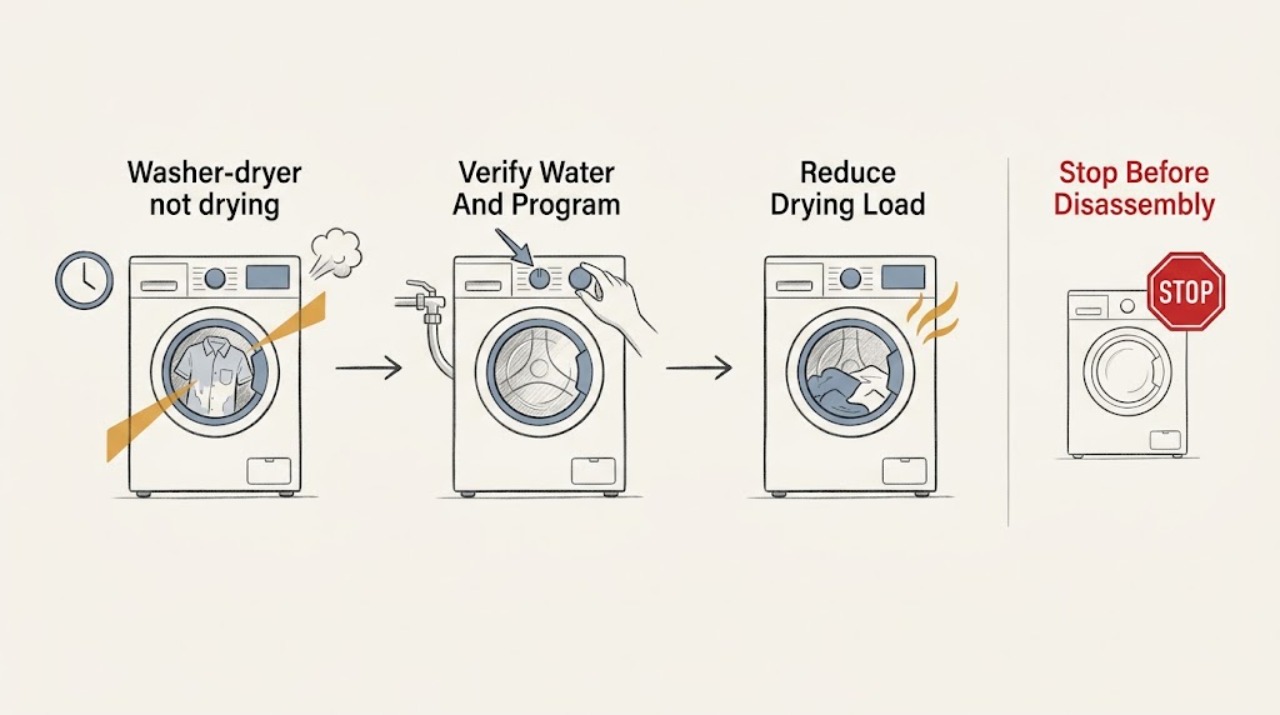
Work through in order
Diagnostic checks
Use only checks that match the exact appliance or system and its official guide.
-
Check 1
Confirm the water tap is fully on, select a drying program intended for the load's fabric, and choose the desired dryness level or a documented timed-dry option. Use the model manual when the control panel offers both automatic and timed settings.
Expected result: The tap is off, the selected program does not match the fabric/load, the dryness level is lower than intended, or the settings are correct.
Next step: Correct the tap or program setting and run one appropriate test with a reduced load. If the result remains damp or the cycle stops, continue with filter and load checks.
Stop if: Stop for a leak, damaged hose, water near electrical components, an error code that persists, or any need to open the appliance cabinet.
Why this matters
Why: An AEG washer-dryer can need water during drying, and automatic programs use fabric/load settings to determine the result. A wrong setting can look like a heating failure even when the appliance is operating.
-
Check 2
Compare the amount of laundry with the drying capacity in the model manual, not the washing capacity. Remove enough items to leave a model-approved drying load, and separate fabrics whose care labels do not permit tumble drying.
Expected result: The drum was filled to the wash limit, contains bulky or incompatible fabrics, or is already within the documented drying capacity.
Next step: Run the correct drying program with a reduced, compatible load. If a small load ends early, use the documented timed-drying option where available rather than adding more laundry indiscriminately.
Stop if: Stop if clothing is unusually hot, scorched, damaged, or the drum does not turn normally; do not continue testing a suspected mechanical or heating fault.
Why this matters
Why: A washer-dryer has a smaller maximum drying load than washing load. Overloading or using an unsuitable fabric can leave clothes damp even when the cycle completes normally.
-
Check 3
With the appliance stopped, inspect and clean the drain filter according to the user manual. If the washer-dryer is a heat-pump model, inspect the primary and secondary air filters and clean them at the interval specified by AEG. Do not remove sealed covers or wash electrical parts.
Expected result: The drain filter is clogged, a required heat-pump air filter is clogged, or all applicable filters are clean.
Next step: Reinstall each filter exactly as instructed and run one reduced-load drying test. If drying remains poor, stop and arrange service rather than opening the cabinet.
Stop if: Stop for standing water that cannot be drained safely, a damaged filter seal, a filter that cannot be removed as the manual describes, or any electrical/heating compartment access.
Why this matters
Why: A blocked drain filter can interfere with drying, while clogged heat-pump air filters restrict the air path and can lengthen or spoil the drying cycle. Clean filters do not rule out a heater, sensor, fan, or control fault.
-
Check 4
Note whether the cycle is Sensor/Automatic or Timed. For a very small load or laundry that is already partly dry, use a timed option only when the model manual provides it; for a normal washed load, select the correct fabric and dryness level for the automatic program.
Expected result: The automatic cycle ends after a few minutes with a tiny or partly dry load, the timed option is unavailable for the selected fabric, or the correct program still leaves a normal load damp.
Next step: Use the model-approved program once more with a suitable load. If it ends early, never heats, or leaves the load damp again, record the program and result for service.
Stop if: Stop for overheating, burning odor, smoke, abnormal drum noise, repeated error messages, or a cycle that stops with water remaining in the appliance.
Why this matters
Why: Sensor programs adjust duration based on the detected load and dryness, while timed drying is intended for cases where automatic sensing is unsuitable or unavailable. A correct program that cannot dry a normal load indicates a deeper issue.
-
Check 5
If the washer-dryer will not switch on after a drying cycle, do not repeatedly cycle the controls or remove panels. If it does switch on but drying fails after the safe checks, record any displayed code and leave the appliance accessible for an authorized technician.
Expected result: The appliance is completely unresponsive after drying, or it powers on but still cannot produce a satisfactory result.
Next step: Stop using the drying function and arrange authorized service. Provide the model number, program, load type, filter condition, cycle behavior, and any code.
Stop if: Stop immediately for smoke, burning smell, overheating, a damaged cord, water near electrical parts, repeated tripping, or any need to access live or sealed components.
Why this matters
Why: AEG identifies failure to switch on after a drying cycle as a technical appliance problem. Persistent poor drying after water, load, program, and filter checks may involve heating, airflow, sensors, drain, or controls beyond user maintenance.
Use your observations
Decision map
Find the observation that best matches what you see, then follow the next safe action.
-
PATH 01Next step
What you see
The water tap was off or the inlet supply was interrupted during the attempted drying cycle.
Do this next
Restore the tap only if the hose and connection are intact, then select the documented drying program.
-
PATH 02Next step
What you see
The load exceeds the drying capacity or contains bulky/incompatible fabrics.
Do this next
Reduce the load and follow the care-label and program-table requirements.
-
PATH 03Next step
What you see
The drain filter or a required heat-pump air filter is clogged.
Do this next
Clean the accessible filter using the appliance manual and reinstall it correctly.
-
PATH 04Next step
What you see
An automatic drying program ends early with a very small or partly dry load.
Do this next
Use a model-approved timed-drying program if the manual allows it, or select the correct automatic program for the fabric/load.
-
PATH 05Safety boundary
What you see
Water, filters, load size, fabric, and program settings are correct but laundry remains damp.
Do this next
Stop repeated drying tests and treat the result as a technical fault.
Why this path and its safety boundary
Safety stop: True
-
PATH 06Safety boundary
What you see
The washer-dryer will not switch on after a drying cycle.
Do this next
Do not open the appliance or repeatedly reset it.
Why this path and its safety boundary
Safety stop: True
Helpful context
Understand the symptom
Separate a poor result from a technical stop
“Not drying” can mean clothes are damp at the end, the program stops after a few minutes, or the appliance will not start a drying cycle at all. AEG's washer-dryer guidance treats load size, fabric/program selection, water supply, and filter condition as first checks. A machine that will not switch on after a drying cycle is treated as a technical problem and should be examined by an authorized service center.
Drying capacity is not washing capacity
The maximum load for drying is always smaller than the maximum wash load. A full wash load can therefore leave too little room for warm air and movement during drying. Use the capacity and program table in the appliance's own manual; do not infer a safe drying load from the drum being physically full.
Filters and water still matter during drying
AEG specifies that washer-dryers need water during the drying cycle, and that a clogged drain filter or, on heat-pump models, clogged air filters can prevent a good result. Clean only the filters and access points identified in the user manual. Do not open sealed heating or electrical compartments to search for a blockage.
When checks do not resolve it
Need a professional?
A correct reduced-load program still leaves laundry damp after filters and water checks., The cycle stops early with an error, never produces expected heat, or leaves water in the appliance., The washer-dryer will not switch on after a drying cycle., There is overheating, a burning smell, smoke, repeated tripping, a leak, or abnormal drum behavior.
Common questions
FAQ
Why is my AEG washer-dryer leaving clothes damp?
Check that the water tap is on, the drain and required air filters are clean, the drying load is below the wash capacity, and the program matches the fabric and desired dryness. If the correct reduced-load cycle still leaves clothes damp, arrange authorized service.
Does an AEG washer-dryer need water while drying?
Yes. AEG's washer-dryer guidance says the water tap should be on during drying. Check the tap and hose safely, but do not dismantle the inlet system if the supply is present and drying still fails.
Can an overloaded wash load cause poor drying?
Yes. The maximum drying load is smaller than the maximum washing load. Remove items and follow the model manual's drying capacity and fabric-program requirements before testing again.
Why does the drying program stop after a few minutes?
A very small or partly dry load can cause an automatic sensor program to finish early, while an incorrect program or clogged filter can also affect the result. Use the model-approved timed option when appropriate; if a normal compatible load still stops early, call service.
What if my AEG washer-dryer will not turn on after drying?
Do not keep resetting or opening the appliance. AEG identifies failure to switch on after a drying cycle as a technical problem and recommends an authorized service-center visit.
Read the exact guide
Official sources
- Drying cycle of washer dryer takes too long, too short or not drying at allAEG · AEG washer-dryer water, air-filter, drain-filter, load, and program checks
- Drying cycle of washer dryer takes too long, too short or not drying at allAEG · AEG sensor/timed drying, load capacity, heat-pump filters, water, drain filter, and program selection
- Washer - dryer does not switch on after a drying cycleAEG · AEG technical-service boundary when a washer-dryer will not switch on after drying
Community feedback
Share a repair observation
Share a plain-text repair observation. Accepted observations are published automatically; this page may take a moment to update.