
On this page
Start here
Quick answer
Eight minutes remaining on an AEG washer-dryer does not by itself identify a failed part. AEG says the displayed programme time is an estimate that can shorten or increase as load-sensing runs. First note whether the cycle actually completes, whether the machine is in a final cool-down or anti-crease phase, whether water remains in the drum, and whether a code or flashing indicator appears. If the drum and timer truly stop, check the exact model manual for the selected option, visible water supply and drain-hose conditions, and a safe external filter check after deactivating the appliance. Repeated early stops, a persistent code, water that will not drain, leakage, burning smell, or visible damage need authorised service.
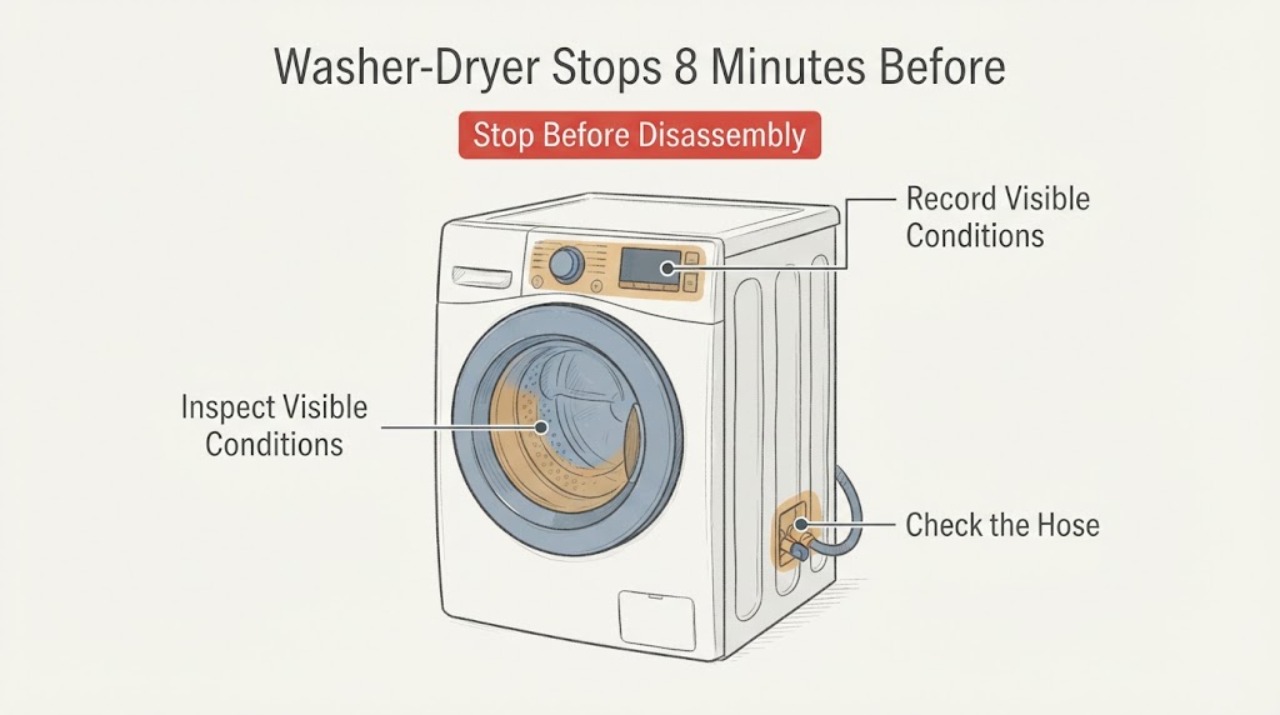
Work through in order
Diagnostic checks
Use only checks that match the exact appliance or system and its official guide.
-
Check 1
Watch one occurrence without opening the door or interrupting the appliance: record the selected wash, dry, or wash-and-dry programme, whether the displayed time changes, whether the drum turns or the machine is quiet, and whether the cycle later completes.
Expected result: The display recalculates and the cycle completes; the machine remains at eight minutes with no progress; or it finishes drying but continues a cool-down/anti-crease phase.
Next step: If the cycle completes, compare the result with the exact programme instructions and do not replace a part based on the timer alone. If it truly halts, continue with the water, drain, load, and code checks below.
Why this matters
Why: A changing estimate can be normal load sensing. An actual halt is a different symptom. The opened AEG washer-dryer manual documents a no-heat cool-down and anti-crease phase for its drying cycle, so quiet operation near the end may be a phase rather than a failed heater or motor.
-
Check 2
Check the display and visible drum state before changing settings: look for a flashing Start/Pause or door-lock indicator, a rinse-hold/no-drain option, and water remaining in the drum. Do not force the door open while water is present or the lock remains active.
Expected result: Water remains and the programme selected an option that keeps the final rinse in the drum; the door remains locked; or there is no water and the machine is genuinely stopped.
Next step: For the exact model, use its documented drain or spin option and wait for the door-lock indication to clear. If water cannot drain or the programme does not respond, deactivate the appliance and move to the drain and service checks; do not use a guessed emergency-release sequence.
Why this matters
Why: In the opened AEG L7WC84636BI manual, a programme that ends with water can be complete while the door remains locked and the drum turns periodically; a drain or spin command is then required. A locked door with water is not evidence of a failed door lock.
-
Check 3
After deactivating the appliance and following the exact manual's safety instructions, check the water tap, inlet hose, drain hose, sink connection, and accessible drain-filter area for a closed tap, kink, visible blockage, or leak. Do not reach into a wet appliance or open electrical covers.
Expected result: A tap is closed, an inlet or drain hose is kinked, the sink connection is blocked, the accessible filter is clogged, or all visible connections are clear but the stop repeats.
Next step: Correct a visible hose, tap, or connection issue and run one supervised model-appropriate test. If the filter is inaccessible, the drum remains full, water leaks, or the stop repeats with clear connections, stop and arrange service rather than diagnosing a pump or valve yourself.
Why this matters
Why: AEG links an unexpected mid-cycle stop without a code to load imbalance, water supply, or drains. Its opened manual also lists inlet and drain restrictions and a clogged drain filter as checks; clear visible external restrictions only when safe and model-authorised.
-
Check 4
Check the load size and distribution, then record the complete display message, symbols, beeps, or flashes before any reset. Do not assume that an eight-minute stop is a heater, motor, or control-board failure.
Expected result: The load is tightly packed or uneven; a code/indicator appears; or the same programme stops with a correctly sized load and no code.
Next step: Redistribute or reduce the load only within the exact manual's limits and retry once. Search the complete code in AEG Support or the exact manual; if it returns, the machine cannot complete the programme, or no supported code-specific check exists, book authorised service.
Why this matters
Why: AEG says imbalance can prevent the spin phase, and its error-code guide states that different codes point to different systems such as intake, drainage, heating, motor, door lock, or power. Without the full code and model, a component diagnosis is unsupported.
Use your observations
Decision map
Find the observation that best matches what you see, then follow the next safe action.
-
PATH 01Next step
What you see
The displayed time changes after load sensing and the programme completes, or the remaining time is part of a documented cool-down/anti-crease phase.
Do this next
Use the exact model manual to confirm the phase and assess drying or washing results. Monitor the next cycle rather than replacing a part from the eight-minute display alone.
Why this path and its safety boundary
Why it matters: The observed timing can be normal estimation or an end-of-drying phase; it does not by itself prove a failed component.
-
PATH 02Next step
What you see
The drum is still periodically turning, water remains, and the exact manual shows a rinse-hold or no-drain option.
Do this next
Select the exact model's drain or spin continuation and wait for the door-lock indicator to clear; do not pull the door or use an undocumented release.
Why this path and its safety boundary
Why it matters: The opened AEG manual treats this as a completed programme that retains the final rinse, so the door stays locked until the water is drained.
-
PATH 03Next step
What you see
The programme is genuinely stopped, there is no code, and water remains or a supply/drain restriction is visible.
Do this next
After deactivation, correct only the visible tap, hose, connection, load, or model-authorised filter issue and retry once. Escalate if water will not drain or the stop returns.
Why this path and its safety boundary
Why it matters: AEG identifies load imbalance, water supply, and drains as common causes of an unexpected stop without a code.
-
PATH 04Next step
What you see
The same early stop repeats, a code or multiple flashes return, the appliance leaks, smells burnt, shows damage, or cannot complete any programme.
Do this next
Stop using the appliance if there is leakage, burning smell, smoke, or visible damage. Record the model and complete code, then book AEG authorised service; do not open electronic covers or test internal components.
Why this path and its safety boundary
Why it matters: AEG treats repeated codes, inability to complete a wash, persistent intake/drain faults, leakage, burning smells, or visible damage as conditions needing professional diagnosis.
Helpful context
Understand the symptom
Separate a changing estimate from a stopped programme. AEG says the first displayed duration is a best guess and that sensors can recalculate it from the load and fabric water absorption. A timer that changes to a shorter value is different from a drum, timer, or drain phase that remains inactive at the same point.
A washer-dryer can also appear quiet near the end of drying. In the opened AEG L7WC84636BI manual, the final drying stage includes a cool-down period without heat and may be followed by an anti-crease phase. Treat that as a model-specific explanation to verify in the exact manual, not as proof that every AEG washer-dryer stops normally at eight minutes.
When checks do not resolve it
Need a professional?
The same programme stops at the same point after visible load, water-supply, and drain checks., An error code, repeated beeps/flashes, locked door with undrainable water, or multiple functions failing appears., There is a leak, burning smell, smoke, damaged cord, visible damage, or a need to open the housing or test internal parts., Do not diagnose a heater, thermistor, pump, motor, door lock, or control board from the eight-minute display alone.
Common questions
FAQ
Is eight minutes remaining always a fault on an AEG washer-dryer?
No. AEG says the displayed programme time is an estimate that sensors can adjust. An opened AEG washer-dryer manual also documents a no-heat cool-down and an anti-crease phase near the end of drying. Treat it as a fault only when the appliance truly stops, cannot drain, shows a code, or repeatedly fails to complete the cycle.
What if the timer is stuck at eight minutes and there is water in the drum?
Check the exact model's options and visible drain path after deactivating the appliance. AEG's opened manual says a no-drain or rinse-hold option can leave the programme complete while the door remains locked until a drain or spin operation is run. If the water will not drain, arrange service.
Should I replace the heater or pump because the cycle stops eight minutes early?
No. AEG's support material separates load imbalance, water supply, drainage, heating, motor, door-lock, and power conditions, and says to use the complete error code and model manual. Check only supported external conditions; use authorised service for a repeated stop or internal diagnosis.
Read the exact guide
Official sources
- Why does my washing machine or tumble dryer program end / finish time change and vary?AEG · AEG washing-machine, tumble-dryer, and washer-dryer programme-time estimation and variation.
- User ManualAEG · This is a model-specific manual. Its cool-down, anti-crease, rinse-hold, drain, and troubleshooting details are conditional examples and must be confirmed against the user's exact AEG model.
- Washing machine stops in the middle of a cycleAEG · AEG washing-machine and washer-dryer unexpected mid-cycle stops without an error code.
- Washing Machine Troubleshooting: Common Problems and DIY FixesAEG · AEG general washing-machine troubleshooting, mid-cycle stops, drainage, and service boundaries.
- AEG washing machine error codes – causes and solutionsAEG · AEG washing-machine and washer-dryer error-code scope, model-specific lookup, and service boundaries.
Community feedback
Share a repair observation
Share a plain-text repair observation. Accepted observations are published automatically; this page may take a moment to update.