
On this page
Start here
Quick answer
Stop using the air conditioner through the extension cord until the power symptom is identified. The words power surge can describe a breaker trip, a brief light flicker, a hot or loose cord or outlet, or a true supply event; they do not prove that the air conditioner itself caused a voltage surge. If there is smoke, sparking, a burning smell, a hot or damaged cord, a hot/discolored receptacle, water near electrical parts, or a breaker that will not stay on, leave the equipment off and get electrical help from a safe location. Do not keep resetting the breaker, add another extension cord or power strip, open the air conditioner, or measure live voltage. For a room or through-wall unit, Department of Energy installation guidance says the supplied cord should reach a compliant outlet without an extension cord. For any other form factor, follow the exact manual and have an electrician or qualified HVAC/appliance technician assess the dedicated outlet, cord, circuit load, and appliance only after the external safety checks.
Before you begin
Safety first
- Do not use a hot/damaged cord, power strip, or outlet; do not chain cords, bypass ground or protection, repeatedly reset the breaker, open the air conditioner, or perform live voltage tests. Keep the setup off until qualified service clears it.
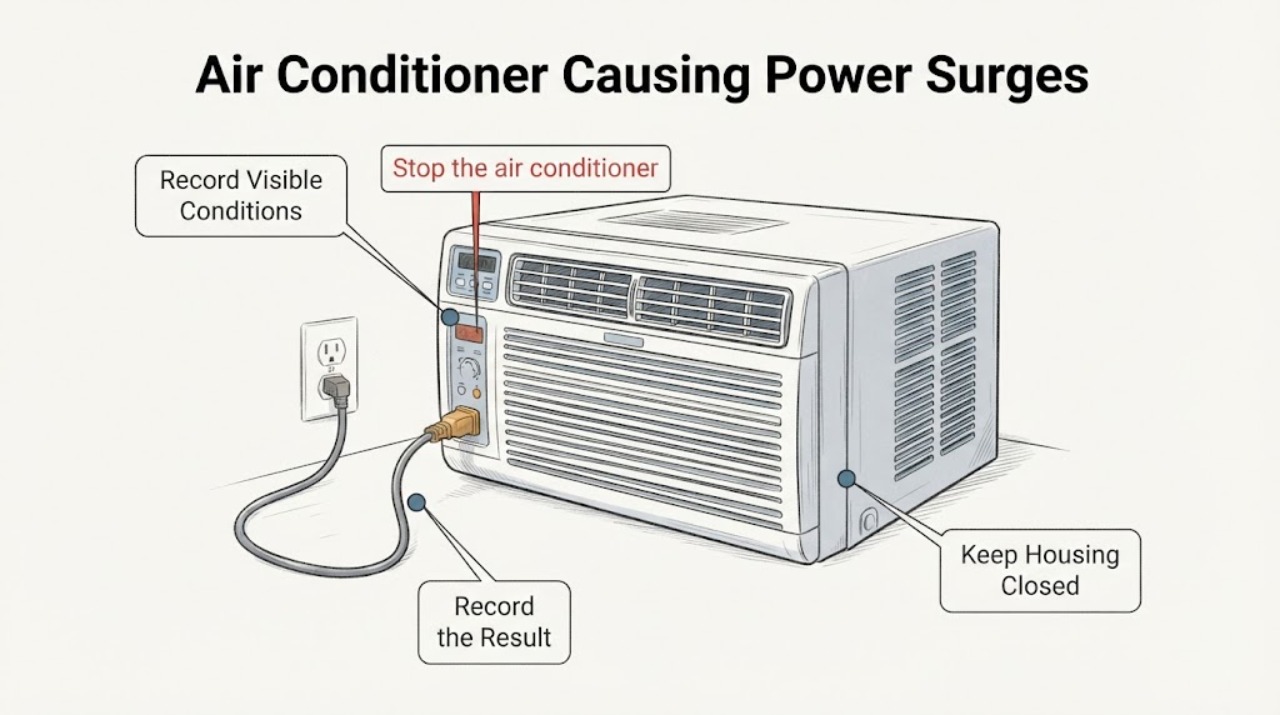
Work through in order
Diagnostic checks
Use only checks that match the exact appliance or system and its official guide.
-
Check 1
Stop the air conditioner and avoid the cord, plug, power strip, and receptacle if any part is hot, wet, damaged, discolored, sparking, smoking, or smells burned.
Expected result: There is a heat mark, melting, exposed conductor, odor, smoke, water contact, visible arc, or a breaker that will not remain on; or none of those signs is present.
Next step: Keep the setup out of service. If safe from a dry location, isolate the circuit and arrange qualified electrical help; do not unplug a sparking or wet connection by hand.
Why this matters
Why: A physical electrical warning is a fire or shock hazard and cannot be diagnosed by repeated resets. The absence of a visible warning does not establish that an extension cord is suitable.
-
Check 2
Identify the appliance form factor, read the nameplate and manual for its voltage/current and cord instructions, and record whether it is portable, window, or through-wall without opening the unit.
Expected result: The manual requires a direct receptacle, the unit is a room/through-wall model covered by DOE's installation guidance, or the model and cord requirement remain unknown.
Next step: Remove the extension cord from service and follow the exact manual. If the supplied cord cannot reach, have the unit relocated or a compliant outlet installed by qualified electrical service.
Why this matters
Why: Connection rules are model and installation dependent. For a through-wall room AC, DOE explicitly says the supplied cord must reach a compliant outlet and an extension cord is not allowable; unknown requirements cannot be replaced with a guessed cord rating.
-
Check 3
From a safe position, write down the exact event: breaker/GFCI trip, lights dimming, power strip cutoff, visible outlet flicker, or suspected utility surge; note whether it occurs at startup, during cooling, after another load turns on, or randomly.
Expected result: The breaker/GFCI trips at startup or with other loads, only the extension setup cuts out, lights change across the home, or no repeatable event can be described.
Next step: Give the timeline and all concurrent loads to an electrician or utility provider as appropriate. Do not reproduce the event by changing outlets or adding loads.
Why this matters
Why: These observations point to different next owners: a circuit/cord/outlet load issue, a power-strip/extension issue, a broader supply issue, or an unverified perception. They do not identify a compressor, capacitor, or control-board fault.
-
Check 4
With power isolated and no live testing, inspect only the accessible cord and receptacle face for loose fit, cracked insulation, discoloration, heat damage, missing ground, or cord routing under rugs, through doors, or under furniture.
Expected result: The cord is damaged or covered, the plug does not fit firmly, the receptacle is discolored/hot, the ground is altered, or the visible setup is intact.
Next step: Do not repair, tape, splice, or force the plug. Keep the circuit out of service for the hazard and arrange an electrician; otherwise continue only with the exact installation instructions and direct-cord requirement.
Why this matters
Why: A damaged, loose, covered, ungrounded, or overloaded path is unsafe regardless of whether the air conditioner still runs. A visually intact path still requires the appliance's manual and circuit rating to be followed.
-
Check 5
Prepare a service handoff containing the air-conditioner make/model, nameplate rating, appliance type, extension-cord and power-strip details, outlet/circuit behavior, timing, other loads, photographs of any damage, and whether the symptom appears elsewhere in the home.
Expected result: The direct, manual-compliant connection still causes a repeat symptom, or the electrical path is implicated; no safe direct test is available.
Next step: Keep the air conditioner off until the responsible professional clears the path. Do not order a cord, surge protector, compressor, capacitor, or control part from the symptom alone.
Why this matters
Why: The remaining question is installation/circuit safety versus an appliance fault, and answering it may require licensed electrical or qualified HVAC/appliance diagnosis. The generic phrase power surge is not a parts diagnosis.
Use your observations
Decision map
Find the observation that best matches what you see, then follow the next safe action.
-
PATH 01Next step
What you see
The extension cord, plug, power strip, or receptacle is hot, damaged, discolored, wet, smoking, sparking, or smells burned.
Do this next
Do not touch or reuse it. Isolate power only if safe from a dry location and arrange qualified electrical or emergency help.
Why this path and its safety boundary
Why it matters: The power path itself presents a fire or shock hazard, regardless of whether the air conditioner is still running.
-
PATH 02Next step
What you see
The unit is a room or through-wall air conditioner and its supplied cord cannot reach a compliant outlet without an extension cord.
Do this next
Do not add another cord or power strip. Relocate the unit or have a compliant outlet installed by qualified electrical service according to the unit requirements.
Why this path and its safety boundary
Why it matters: DOE's through-wall installation guidance does not allow an extension cord for that installation.
-
PATH 03Next step
What you see
The breaker or GFCI trips at startup, after another load turns on, or whenever this cord setup is used.
Do this next
Leave the air conditioner off and give the event sequence and concurrent loads to an electrician. Do not repeatedly reset or move the load among outlets.
Why this path and its safety boundary
Why it matters: The circuit, connection, extension path, or appliance may be overloaded or faulted; the observation does not identify an internal component.
-
PATH 04Next step
What you see
The air conditioner is on a manual-compliant direct connection, the visible electrical path is cool and intact, and the same power symptom recurs.
Do this next
Stop operating it and arrange professional electrical and, if the circuit is cleared, qualified HVAC/appliance diagnosis. Do not open the unit or guess a part.
Why this path and its safety boundary
Why it matters: The extension cord is no longer a sufficient explanation; circuit quality and appliance service both remain possible.
Helpful context
Understand the symptom
First separate the observation from the diagnosis. A breaker trip, lights dimming at compressor start, a power strip shutting off, a warm plug, and a utility voltage event are different symptoms. Because the assigned situation includes an extension cord, remove that cord from the troubleshooting plan until the appliance type and its manual are known.
Make the electrical setup safe before observing anything
If the cord, plug, receptacle, or power strip is hot, melted, discolored, wet, sparking, or smells burned, do not handle it or plug it into another outlet. Move away from the equipment, disconnect the circuit only if that can be done without approaching a hazard, and use qualified electrical or emergency help as appropriate. Never cover a cord, run it under a rug, chain cords, or keep resetting a trip to make the air conditioner run.
Remove the extension cord from the decision
Record whether the appliance is a portable, window, or through-wall unit and read its nameplate and manual without opening it. DOE's through-wall installation job aid requires the supplied cord to reach the nearest compliant outlet and says an extension cord is not allowable. USFA likewise warns against extension cords with major appliances. Do not solve a short cord by using a second cord, a power strip, or a guessed heavy-duty cord; the exact manual, appliance rating, and outlet/circuit design control.
Describe what actually changed
From a safe, dry position, note whether the breaker or GFCI trips immediately, only when cooling starts, after another appliance is used, or not at all; whether lights flicker in the room or throughout the home; and whether the problem follows the extension cord, the receptacle, or the air conditioner. Do not swap outlets as a live experiment and do not use a meter inside the panel or appliance. These observations help an electrician distinguish a cord/outlet/circuit problem from an appliance service problem without claiming a component failure.
Choose electrical or appliance service
Use electrical service first when the receptacle, extension cord, breaker, or other household loads are implicated. Use qualified HVAC/appliance service when a correctly installed, model-approved direct connection still produces a repeat symptom, or when the air conditioner has a damaged cord, smoke, burning odor, water intrusion, or mechanical/electrical abnormality. Do not open the cabinet, bypass a protector, replace a plug, or select a compressor/start component from the phrase power surge alone.
When checks do not resolve it
Need a professional?
Call qualified electrical service before further use for any hot, damaged, sparking, wet, discolored, or repeatedly tripping cord/outlet/circuit, and involve HVAC/appliance service if the symptom persists on a manual-compliant direct connection after the circuit is cleared.
Safety scope: Do not use a hot/damaged cord, power strip, or outlet; do not chain cords, bypass ground or protection, repeatedly reset the breaker, open the air conditioner, or perform live voltage tests. Keep the setup off until qualified service clears it.
Have this ready
- Exact make/model and nameplate, appliance type, manual connection requirements, cord/power-strip details, breaker/GFCI behavior, event timing, concurrent loads, photos of any damage, and whether lights or other outlets changed.
Common questions
FAQ
Can I solve the surge by buying a heavier extension cord?
Do not guess. DOE's through-wall AC installation guidance says the supplied cord must reach a compliant outlet and an extension cord is not allowable. For other forms, the exact manual and nameplate control; a heavier cord does not repair a bad outlet, circuit, or appliance.
Does a breaker trip prove the air conditioner is bad?
No. A trip can involve the extension cord, receptacle, circuit load, installation, or appliance. Record when it trips and what other loads were running, then have the electrical path assessed without repeatedly resetting it.
Can I use a surge protector or power strip instead?
Do not substitute one without the exact installation guidance. USFA warns not to overload power strips, and DOE's through-wall AC guidance requires a direct compliant outlet without an extension cord.
What should I do if the outlet or cord is hot?
Stop using the setup and do not touch a sparking, wet, or energized hazard. Isolate the circuit only if safe from a dry location and arrange qualified electrical help; never tape, splice, cover, or continue operating a hot or damaged cord.
Read the exact guide
Official sources
- Pictograph: Plug Major Appliances Into a Wall OutletU.S. Fire Administration · General safety message used to reinforce the direct-outlet decision; it does not establish the correct circuit or cord for an unidentified AC model.
- Island Grantee Job Aid: Install an AC (Through Wall)U.S. Department of Energy · Applies specifically to through-wall room air-conditioner installation. It is used only for the direct-cord and compliant-outlet boundary; it is not transferred to every portable or central AC form factor.
- Extension Cord Safety TipsElectrical Safety Foundation International · General electrical safety source used for temporary use, cord routing, matching cord rating, damage/heat, grounding, and certification; it does not authorize an extension cord for an unidentified AC model.
- Appliance and Electrical Fire SafetyU.S. Fire Administration · General home electrical safety source used for direct-outlet, overload, damaged-cord, power-strip, and cord-routing boundaries; it is not a diagnosis of an air-conditioner component.
- CPSC Warns Consumers About Faulty Extension Cords, Power Strips and Surge ProtectorsU.S. Consumer Product Safety Commission · General electrical safety source used for high-wattage AC cord, certification, damaged/hot cord, overload, grounding, and temporary-use boundaries; it does not diagnose this unidentified AC.
- Consumer Room Air ConditionersU.S. Department of Energy · Used only to distinguish room/window/through-wall AC scope from portable or central systems; it does not provide a repair or extension-cord rating.
Community feedback
Share a repair observation
Share a plain-text repair observation. Accepted observations are published automatically; this page may take a moment to update.