
On this page
Start here
Quick answer
Turn off cooling when an air conditioner is frozen and let the ice thaw naturally. Check the accessible filter, open vents, and outdoor coil for dirt after power is isolated. Ice that returns or weak airflow needs qualified HVAC service; do not run with a frozen coil or handle refrigerant.
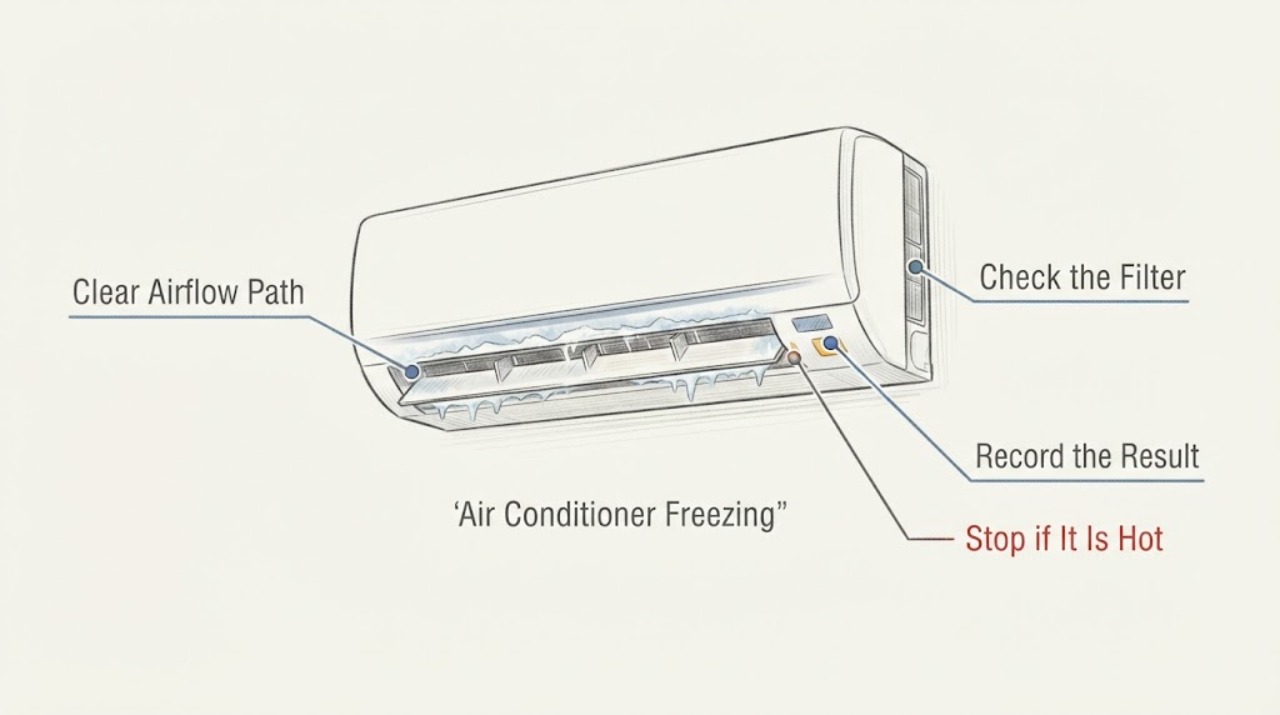
Work through in order
Diagnostic checks
Use only checks that match the exact appliance or system and its official guide.
-
Check 1
Turn cooling off and note where ice appears and whether airflow is weak.
Expected result: Ice covers the indoor coil or refrigerant line.
Next step: Leave cooling off and let it thaw naturally.
Stop if: Do not run frozen equipment or apply direct heat.
Why this matters
Why: A frozen coil is a damage risk; airflow restriction or refrigerant/mechanical faults are possible.
-
Check 2
Inspect the accessible return filter and open supply registers after power is safe.
Expected result: Filter is dirty or vents are blocked.
Next step: Clean or replace the filter and clear vents per the equipment instructions.
Stop if: Do not remove the evaporator cabinet.
Why this matters
Why: Restricted airflow can freeze the evaporator coil.
-
Check 3
Check the outdoor condenser area for leaves, dirt, or blocked airflow.
Expected result: The condenser is obstructed.
Next step: Clear loose debris and use professional cleaning for coil access.
Stop if: Do not service energized equipment.
Why this matters
Why: Restricted outdoor airflow reduces heat transfer.
-
Check 4
After complete thawing, observe one normal cooling cycle.
Expected result: Ice returns or cooling remains poor.
Next step: Shut cooling down and call an HVAC technician.
Stop if: Do not add refrigerant yourself.
Why this matters
Why: Recurring freeze points to refrigerant, coil, blower, or control diagnosis.
Use your observations
Decision map
Find the observation that best matches what you see, then follow the next safe action.
-
PATH 01Next step
What you see
Ice covers the indoor coil or refrigerant line.
Do this next
Leave cooling off and let it thaw naturally.
Why this path and its safety boundary
Why it matters: A frozen coil is a damage risk; airflow restriction or refrigerant/mechanical faults are possible.
-
PATH 02Next step
What you see
Filter is dirty or vents are blocked.
Do this next
Clean or replace the filter and clear vents per the equipment instructions.
Why this path and its safety boundary
Why it matters: Restricted airflow can freeze the evaporator coil.
-
PATH 03Next step
What you see
The condenser is obstructed.
Do this next
Clear loose debris and use professional cleaning for coil access.
Why this path and its safety boundary
Why it matters: Restricted outdoor airflow reduces heat transfer.
Helpful context
Understand the symptom
Start with the observable symptom
Turn off cooling when an air conditioner is frozen and let the ice thaw naturally. Check the accessible filter, open vents, and outdoor coil for dirt after power is isolated. Ice that returns or weak airflow needs qualified HVAC service; do not run with a frozen coil or handle refrigerant.
Use the exact model guidance
Appliance models differ in controls, access, and parts. Record the model and serial information before any replacement or service request.
When checks do not resolve it
Need a professional?
Provide the exact model, serial information, symptom timing, and observations to the manufacturer or a qualified service provider. Do not open gas, refrigerant, high-voltage, or sealed assemblies.
Common questions
FAQ
What should I do first?
Turn off cooling when an air conditioner is frozen and let the ice thaw naturally. Check the accessible filter, open vents, and outdoor coil for dirt after power is isolated. Ice that returns or weak airflow needs qualified HVAC service; do not run with a frozen coil or handle refrigerant.
When should I call service?
Use qualified service when the accessible checks fail or a safety hazard is present.
Read the exact guide
Official sources
- Troubleshoot an Air Conditioner | CarrierCarrier Corporation · Air-conditioner frozen evaporator coil, airflow, refrigerant, and service guidance
Community feedback
Share a repair observation
Share a plain-text repair observation. Accepted observations are published automatically; this page may take a moment to update.