
On this page
Start here
Quick answer
Do not force an air-conditioner plug into a different receptacle, cut or change the plug, use a travel adapter, or add an extension cord. Read the unit's rating label and model-specific installation instructions, then compare the required voltage, current, grounding and plug style with the receptacle. If the plug and outlet do not match, leave the unit disconnected and have a qualified electrician verify the circuit and local-code options, or choose a unit that is designed for the available supply. A plug shape by itself does not prove the voltage or safe compatibility.
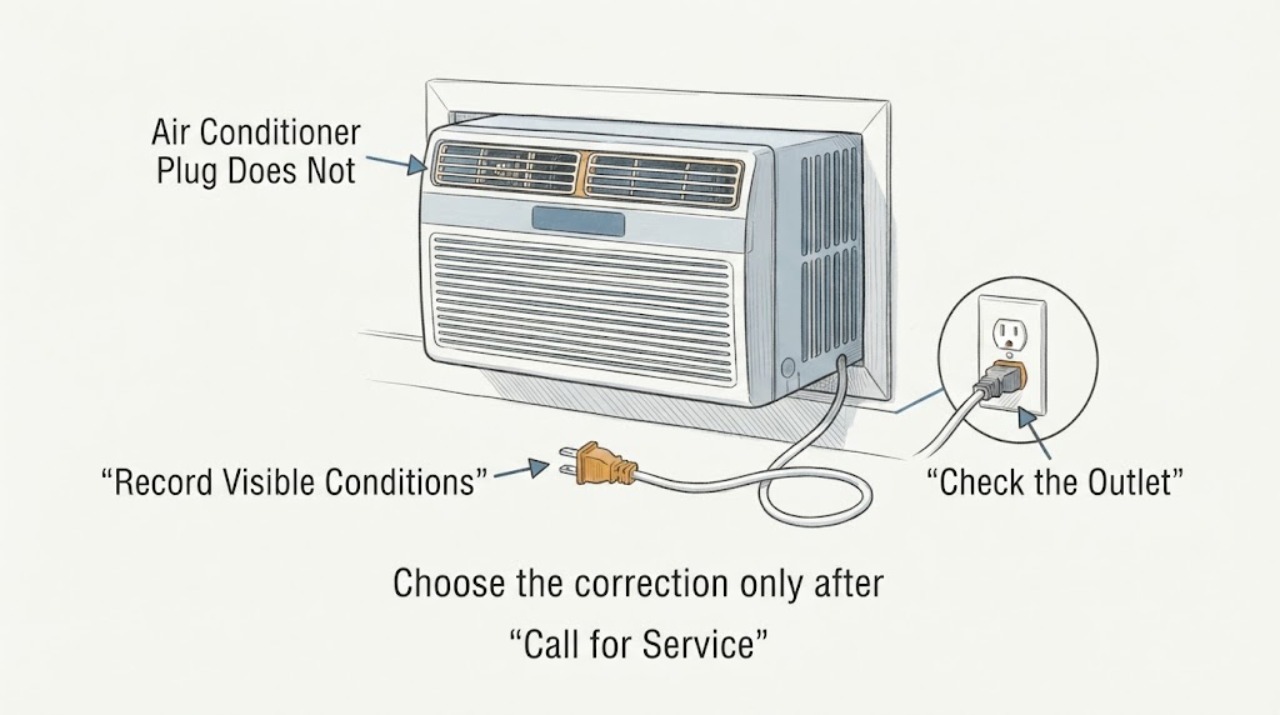
Work through in order
Diagnostic checks
Use only checks that match the exact appliance or system and its official guide.
-
Check 1
Read the air conditioner's rating label and locate the exact owner or installation manual. Record the model, rated voltage, current or circuit requirement, grounding requirement and the plug style shown for that model. Do not rely on the plug shape alone.
Expected result: The model documentation gives a clear electrical requirement and plug style, or the model/rating information cannot be found.
Next step: If the label or manual is missing, keep the unit disconnected and ask the manufacturer or installer for the exact documentation before involving the receptacle.
Why this matters
Why: Air-conditioner plug styles and electrical requirements vary by model. Without the rating information, compatibility cannot be established safely.
-
Check 2
With the appliance disconnected, compare the documented requirements with the receptacle's visible configuration and any circuit labeling. Check only for external damage, looseness, scorching or signs of overheating; do not remove the cover or probe the outlet.
Expected result: The plug fits and the documented rating and grounding requirements match, the plug does not fit, or the outlet/circuit shows damage or uncertain grounding.
Next step: If the plug does not fit or the circuit is uncertain, leave the unit disconnected and have a qualified electrician verify the supply and code-compliant options. If there is scorching, heat, arcing or a damaged receptacle, do not use it.
Why this matters
Why: A physical fit is only one condition and does not prove correct voltage, current capacity or grounding. Damage or uncertainty raises an electrical safety concern.
-
Check 3
Choose the correction only after the circuit has been verified: use the documented matching grounded receptacle, have a qualified electrician install or move a correctly rated receptacle where permitted, or select an air conditioner designed for the available supply.
Expected result: The electrician confirms a suitable circuit and receptacle can be provided, or the available supply cannot meet the air conditioner's documented requirements.
Next step: Proceed only with the electrician's code-compliant installation or return/replace the unit for a compatible model. Do not energize the unit through an adapter, extension cord or altered plug.
Why this matters
Why: A professional circuit check separates a receptacle replacement decision from an incompatible appliance choice; the plug cannot be made safe by changing its prongs.
-
Check 4
Stop and keep the air conditioner out of service if the cord or plug is cut, cracked, loose, hot, sparking or otherwise damaged, or if the outlet smells burned or shows scorching. If safe to do so without touching damaged equipment, isolate power from the electrical panel and arrange qualified electrical or appliance service.
Expected result: There is visible electrical damage, heat, smoke, arcing, repeated tripping or a failed test/reset device, or there are no warning signs and the only issue is a documented plug mismatch.
Next step: For damage, smoke or arcing, do not reconnect or test the air conditioner. For a clean mismatch, keep it disconnected until the circuit and installation are assessed by a qualified professional.
Why this matters
Why: Damage and arcing create a fire or shock hazard; a clean mismatch remains an installation decision and does not justify improvised power conversion.
Use your observations
Decision map
Find the observation that best matches what you see, then follow the next safe action.
-
PATH 01Next step
What you see
The rating label and exact manual identify the required supply, the receptacle is grounded and correctly rated, and the factory plug fits without force.
Do this next
Connect directly to the documented grounded receptacle according to the exact installation instructions. Do not add an extension cord, surge protector or multi-outlet adapter unless the exact manual explicitly permits it.
Why this path and its safety boundary
Why it matters: The basic documented connection conditions are present; appearance alone was not used to decide compatibility.
-
PATH 02Next step
What you see
The factory plug will not fit the intended outlet, or the outlet's voltage, current, grounding or circuit rating cannot be confirmed.
Do this next
Leave the appliance disconnected and have a qualified electrician verify the circuit and any code-compliant receptacle option, or select a model made for the available supply. Do not alter the plug or use an adapter.
Why this path and its safety boundary
Why it matters: The installation is not verified as compatible; a plug mismatch is not proof that the air conditioner or receptacle is defective.
-
PATH 03Next step
What you see
The cord or receptacle is hot, scorched, sparking, damaged, loose, or the air conditioner trips protection when connected.
Do this next
Stop using the equipment, avoid touching damaged parts, isolate power only from a safe position if possible, and contact a qualified electrician or appliance service provider. Do not retry the connection.
Why this path and its safety boundary
Why it matters: This may indicate an electrical fault or overload and is outside safe plug-identification troubleshooting.
Helpful context
Understand the symptom
Treat a plug mismatch as an installation compatibility question
An air conditioner that will not plug into the available receptacle is not automatically defective. The visible prong pattern may correspond to a different voltage, current rating or grounding arrangement. Because the task has no confirmed brand or model, do not identify the plug by appearance alone or infer a safe adapter.
What to verify before connecting anything
Find the rating label and the exact installation instructions for the air conditioner. Record the stated voltage, frequency, amperage or circuit requirement, grounding requirement and plug type. Inspect the receptacle only from the outside and note its configuration, labeling and any visible damage. Do not open the receptacle or test live terminals yourself. Compare the two sets of requirements; do not assume that a receptacle that looks similar is electrically suitable.
What a safe correction looks like
If the plug and receptacle do not match, keep the air conditioner disconnected. A qualified electrician can verify the existing circuit, grounding and local-code requirements and determine whether a correctly rated receptacle can be installed. If the supply cannot support the appliance, the practical option may be a model designed for that supply. Do not modify the factory plug, cut off a grounding prong, use a travel adapter, or run the unit from an extension cord or multi-outlet adapter.
When checks do not resolve it
Need a professional?
Use a qualified electrician for any outlet replacement, circuit or grounding verification, voltage/current assessment, or installation where the factory plug does not match. Use appliance service or the manufacturer when the cord, plug, leakage-protection device or air conditioner is damaged.
Have this ready
- Provide the exact model and rating-label photo, the installation manual or documented electrical requirement, the receptacle configuration, the country/region, whether the outlet is dedicated, and any heat, smoke, arcing, breaker or GFCI symptoms.
Common questions
FAQ
Can I use an adapter so the air-conditioner plug fits?
Do not use an adapter as a workaround for this mismatch. The opened Whirlpool air-conditioner manual specifically says not to use an adapter plug and directs owners to a qualified electrician when the plug does not match the outlet.
Can I cut off the plug and install a different one?
Do not alter the factory plug or remove the grounding prong. The correct next step is to verify the circuit and have a qualified electrician determine the code-compliant installation, or choose an air conditioner designed for the available supply.
Does a plug that looks close enough mean the unit is safe to connect?
No. Plug style, voltage, current, circuit capacity and grounding must match the model documentation and the installation. GE notes that room/window air conditioners use multiple plug styles and requires the appropriate wall outlet for the model.
Read the exact guide
Official sources
- GE Room Air Conditioner Owner's Manual and Installation InstructionsGE Appliances · The official manual is used only for family-level safety boundaries: match the rating plate, maintain grounding and use a qualified electrician when grounding or outlet requirements are uncertain.
- Room Air Conditioners - How does the power cord work on my air conditioner? When should I test the plug?Frigidaire · Family-level Frigidaire guidance used only for the external damaged-cord/test-failure stop boundary; it does not identify the assigned unit or authorize a repair.
- Air Conditioner - Power CordGE Appliances · Family-level guidance used for direct grounded connection and model-dependent cord requirements; it is not evidence for an unspecified brand or model.
- Air Conditioner - Plug Type and AmpsGE Appliances · Family-level guidance used to establish that plug styles and requirements vary by model; no GE model is being assigned to this topic.
- Whirlpool Room Air Conditioner Owner's Manual and Installation InstructionsWhirlpool · The official manual provides a directly relevant manufacturer example: no extension cord or adapter, and a qualified electrician should replace a mismatched outlet. It is not being treated as proof of the unspecified unit's exact electrical rating.
Community feedback
Share a repair observation
Share a plain-text repair observation. Accepted observations are published automatically; this page may take a moment to update.