
On this page
Start here
Quick answer
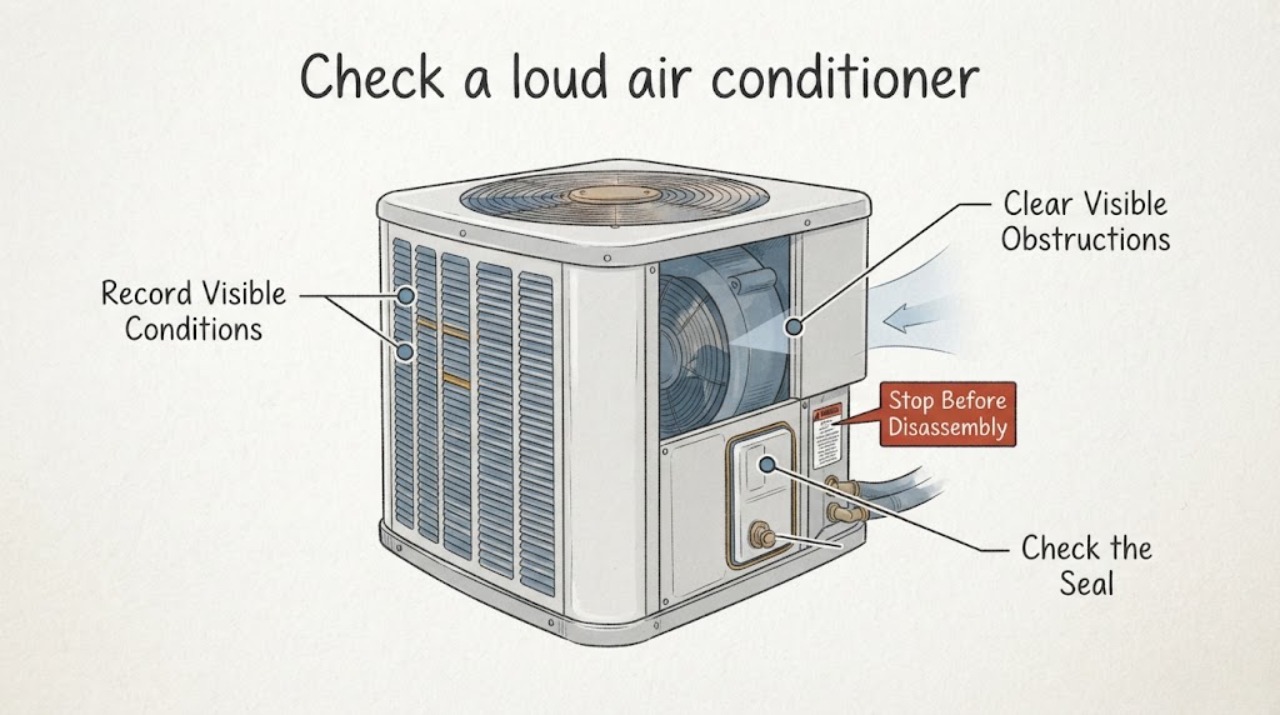
First identify the sound and the air-conditioner format. Airflow, thermostat clicks, water striking a condenser, casing vibration, and some compressor hums can be normal, while a new rattle, grinding, scraping, electrical buzz, or loud outdoor-unit noise needs closer attention. With power off, check only accessible filters, grilles, louvers, panels, installation stability, and visible obstructions. If there is ice, burning odor, damaged wiring, repeated breaker tripping, refrigerant or water leakage, or a high-voltage outdoor-unit noise, turn the system off and arrange qualified HVAC service. Do not open electrical panels, handle refrigerant, or diagnose a compressor, capacitor, or motor from noise alone.
Work through in order
Diagnostic checks
Use only checks that match the exact appliance or system and its official guide.
-
Check 1
Identify the air-conditioner format and record when the sound occurs: startup, compressor cycling, fan-only operation, continuous operation, shutdown, or changes with fan speed. Note whether the sound is indoors, outdoors, at the window or cabinet, or in the duct path.
Expected result: The sound matches airflow, a thermostat click, water ping, a brief compressor hum, or a new rattling, grinding, scraping, buzzing, or strong vibration.
Next step: Continue only with the accessible checks below when there is no smoke, burning odor, electrical symptom, ice, or refrigerant concern. Otherwise turn the unit off and call qualified service.
Why this matters
Why: Whirlpool and GE describe several quiet clicks, airflow sounds, water noises, compressor hums and installation vibrations as potentially normal, while a new or worsening mechanical or electrical sound needs further inspection.
-
Check 2
With the air conditioner off and safe to approach, inspect and clean or replace the user-accessible air filter according to the exact manual, and look for leaves, dust, packaging or other visible obstructions at the grilles and outdoor air path.
Expected result: The filter is visibly dirty or airflow is obstructed, or the filter and visible inlets and outlets are clear.
Next step: Restore only the manual-specified filter and clearance conditions, then observe whether the sound changes. If the noise remains loud or unusual, stop troubleshooting at the external level and arrange service.
Why this matters
Why: A dirty filter or blocked airflow can strain operation and make airflow noise more noticeable. A clear filter does not rule out a fan, compressor, bearing, refrigerant, or electrical problem.
-
Check 3
Inspect the accessible front grille, louvers, cabinet or window panels, mounting surfaces, and visible fasteners for looseness, breakage, contact, or vibration; do not remove sealed or electrical covers.
Expected result: A grille, louver, side panel, window installation or cabinet visibly vibrates or is loose, or no accessible installation issue is found.
Next step: Correct only an obvious accessible installation or grille issue using the exact owner or installation manual. If the part is broken, the noise persists, or access would require a cover removal, arrange service.
Why this matters
Why: GE identifies loose grilles, louvers and improper window installation as possible sources of rattling or vibration. No visible loose part shifts the concern toward internal or system-level service, but does not identify a specific component.
-
Check 4
Check the thermostat mode and fan setting, and note whether the noise changes when the compressor cycles or when fan-only operation is selected by the manual; do not repeatedly cycle a unit showing an electrical fault.
Expected result: The fan is set to run continuously, the noise is only a normal airflow or cycle click, or the loud noise occurs at startup, during compressor operation, or continuously despite the documented setting.
Next step: Use the exact control instructions to select the intended fan mode. If the abnormal sound remains or the system cannot operate without it, turn it off and schedule HVAC service.
Why this matters
Why: GE says continuous fan operation can be normal in cool or fan mode, and Carrier notes that a thermostat fan set to On can run continuously. A new loud mechanical sound that follows compressor or outdoor-unit operation needs professional diagnosis.
-
Check 5
Look only for visible ice, water leakage, smoke, burning odor, damaged wiring, repeated breaker trips, or a loud unusual sound from the outdoor condensing unit; leave electrical-panel and refrigerant work to qualified service.
Expected result: Ice, electrical or burning symptoms, refrigerant or water leakage, repeated trips, or loud outdoor-unit noise is present, or none of these warning signs is present.
Next step: If any warning sign is present, turn off the air conditioner and arrange qualified HVAC service. If none is present but the noise remains loud or unexplained, provide the sound recording and model information to the technician.
Why this matters
Why: Carrier associates ice, loud outdoor-unit noise and electrical symptoms with conditions requiring professional attention; the absence of a visible warning sign does not prove the system is healthy.
Use your observations
Decision map
Find the observation that best matches what you see, then follow the next safe action.
-
PATH 01Next step
What you see
The sound is airflow, a thermostat click, water ping, or a brief hum that follows normal fan or compressor cycling, with no warning sign.
Do this next
Keep the filter, grilles and installation clear and monitor whether the sound changes or becomes mechanical or electrical.
Why this path and its safety boundary
Why it matters: The sound can be a normal operating characteristic for the unit format, although exact model behavior still controls.
-
PATH 02Next step
What you see
A grille, louver, filter, window panel, cabinet or visible installation surface is loose, dirty, obstructed or vibrating.
Do this next
Correct only the manual-permitted external condition. If the sound persists or the part is broken, stop and arrange service.
Why this path and its safety boundary
Why it matters: An accessible airflow or installation condition may be amplifying the sound.
-
PATH 03Next step
What you see
Ice is visible, the system has a burning odor or damaged wiring, the breaker trips repeatedly, or the outdoor unit makes a loud unusual mechanical sound.
Do this next
Turn the system off and contact qualified HVAC service. Do not open panels, test live components or handle refrigerant.
Why this path and its safety boundary
Why it matters: The condition may involve airflow, refrigerant, electrical, compressor, fan or other service-level causes that cannot be diagnosed safely from sound alone.
-
PATH 04Next step
What you see
The air conditioner remains loud after the filter, visible obstruction, installation and control checks, but no warning sign is visible.
Do this next
Stop repeated testing, record the sound and operating conditions, and arrange a model-appropriate HVAC diagnosis.
Why this path and its safety boundary
Why it matters: The remaining issue is unresolved and cannot be narrowed to a capacitor, motor, bearing, compressor or refrigerant fault from the symptom alone.
Helpful context
Understand the symptom
Start with the type and the sound
A window or room unit, a central split system, and another installed air conditioner do not have the same fan, cabinet, compressor, or installation sounds. Note whether the sound is airflow, clicking, pinging, humming, rattling, scraping, grinding, buzzing, or vibration, and whether it comes from indoors, outdoors, the cabinet, or the duct or window surround. A sound label alone does not prove a failed part.
Check only accessible causes
After switching the unit off, inspect the filter, front grille, movable louvers, visible debris and installation panels. GE says a loose grille, dirty filter, loose louvers, or improper window installation can cause rattling or vibration. Carrier likewise recommends checking thermostat, filter, power and visible outdoor-unit conditions before professional diagnosis.
Noise with ice, burning odor, or electrical symptoms is a stop condition
Ice on lines or the unit, burning odor, damaged wiring, repeated breaker trips, or a loud unusual outdoor-unit noise changes the decision. Turn the system off and obtain professional HVAC service; do not open panels, test high-voltage components, or add refrigerant.
When checks do not resolve it
Need a professional?
Turn the air conditioner off and arrange qualified HVAC service for ice, burning odor, smoke, damaged wiring, repeated breaker trips, refrigerant or water leakage, loud unusual outdoor-unit noise, or a persistent new mechanical sound. Do not open electrical panels, test high-voltage components, handle refrigerant, or replace a compressor, capacitor or motor based on sound alone.
Have this ready
- Provide the air-conditioner format, model and serial information if available, a description or recording of the sound, when it occurs, indoor and outdoor location, filter and installation observations, thermostat/fan settings, visible ice or leakage, and any electrical symptoms.
Common questions
FAQ
What air-conditioner sounds can be normal?
Depending on the format and mode, airflow, thermostat clicks, water striking the condenser, some compressor hums, and vibration from a window or wall installation can be normal. A new or worsening rattle, scrape, grind, buzz or strong vibration needs further evaluation.
Can a dirty filter make an air conditioner loud?
A dirty filter can restrict airflow and make airflow or system operation abnormal. Check or replace only the user-accessible filter according to the exact manual; if the noise persists, the filter is not proof of a failed part.
Should I open the unit to check the compressor or fan?
No. Compressor, capacitor, motor, electrical and refrigerant work require qualified service. Record the sound and visible symptoms, turn the system off for warning conditions, and provide the model information to an HVAC professional.
Read the exact guide
Official sources
- Common Noises and Sounds for Air ConditionersWhirlpool Product Help · Opened Whirlpool's official air-conditioner noise page. It supports normal airflow, water, thermostat, vibration, compressor and defrost-related sounds and directs unresolved concerns to service; the task has no Whirlpool model, so the examples remain conditional.
- Air Conditioner - Rattling NoiseGE Appliances · Opened GE's official rattling-noise guidance. It supports checking a loose grille, filter, louvers and window installation; it is used as a room/window AC example and does not assign GE-specific parts or behavior to the unbranded task.
- Troubleshoot an AC Not WorkingCarrier · Opened Carrier's official residential AC troubleshooting page. It supports thermostat, filter, power, ice, outdoor-unit and loud-noise observations and explicitly reserves refrigerant, electrical, compressor and high-voltage work for qualified service; it does not assign Carrier equipment to the unbranded task.
- Air Conditioner - Normal NoisesGE Appliances · Opened GE's official normal-noises page. It supports conditional interpretations for airflow, thermostat clicks, fan mode, water dripping, loose grille and installation vibration; exact model and format remain controlling.
Community feedback
Share a repair observation
Share a plain-text repair observation. Accepted observations are published automatically; this page may take a moment to update.