
On this page
Start here
Quick answer
An indoor fan that keeps running does not prove that the cooling equipment is operating. First record whether the thermostat is actually calling for cooling, whether the fan is set to Auto or continuous operation, whether the air is merely moving or becoming cooler, and whether the outdoor equipment starts. Check only user-accessible airflow items: replace or clean the filter as its instructions permit, keep supply and return openings clear, and look from a safe distance for water near the indoor unit or unusual outdoor-unit behavior. ENERGY STAR says thermostat settings, condensate drainage, filters, coils, blower airflow, and safe controls belong in an air-conditioning maintenance check, while electrical measurements and refrigerant work belong to a contractor. If the indoor fan continues with cooling off, the room does not cool, ice or water appears, a breaker trips, or there is smoke or an electrical odor, stop testing and arrange qualified HVAC service. Do not open panels, touch the disconnect, handle refrigerant, or test a capacitor.
Work through in order
Diagnostic checks
Use only checks that match the exact appliance or system and its official guide.
-
Check 1
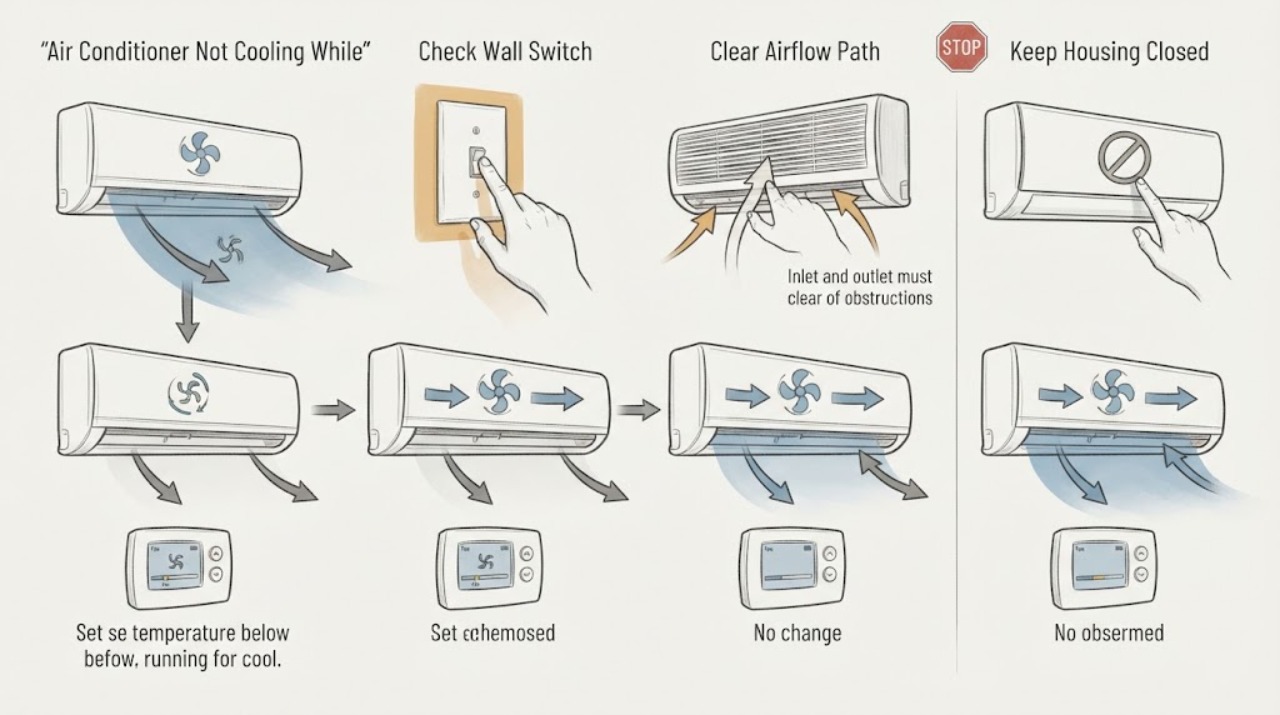
Set the thermostat to its normal cooling mode with the target temperature below the room temperature, and check whether the fan command is Auto rather than an intentional continuous-fan setting. Do not repeatedly switch power at the breaker to force a diagnosis.
Expected result: The fan stops when the thermostat is off or Auto, the fan keeps running with cooling off, or the thermostat display is blank/incorrect.
Next step: If the setting was wrong, monitor one normal cooling cycle. If the fan ignores the setting or the display is unreliable, leave the system off and arrange HVAC service; do not open the thermostat or air-handler wiring.
Why this matters
Why: A change with the fan setting points to a control or schedule state rather than proving a refrigeration fault. A fan that runs despite cooling and fan commands being off is an unresolved control/system symptom; a blank display may be a power or thermostat issue.
-
Check 2
Inspect the accessible return filter and supply/return openings without removing panels. Replace or clean the filter only according to its labeling or the exact equipment manual, and move furniture or curtains that block airflow.
Expected result: The filter is visibly loaded, airflow is blocked, airflow is weak, or the filter and openings are clear but the air remains warm.
Next step: Correct only the accessible filter or obstruction and observe a normal cycle. If airflow remains weak or cooling does not return, stop escalating the DIY checks and call a qualified technician.
Why this matters
Why: ENERGY STAR says a dirty filter can increase energy costs and damage equipment, and that blower airflow problems reduce efficiency. A clear filter does not identify a refrigerant, compressor, motor, or control fault.
-
Check 3
Look from a safe distance around the indoor unit and drain outlet for water, and look at the outdoor unit without touching it for obvious non-operation, ice, smoke, or damage. Keep hands away from fans, panels, disconnects, and wiring.
Expected result: Water is near electrical equipment, ice is visible, the outdoor unit is silent while the indoor fan runs, or no hazard is visible.
Next step: For water near wiring, ice, smoke, a burning/electrical odor, exposed damage, or repeated breaker trips, turn the system off and arrange prompt professional service. Otherwise record the observation for the technician and do not open the outdoor unit.
Stop if: Do not scrape ice, clear a concealed drain with tools, touch the disconnect, or restore power after a repeated trip.
Why this matters
Why: ENERGY STAR identifies condensate drainage, controls, coils, and airflow as professional maintenance items. Water, ice, or an outdoor section that does not respond to a cooling call needs a system-specific assessment; observation alone cannot select a component.
-
Check 4
Record the system type if known, thermostat mode and fan mode, supply-air feel or measured temperature, indoor temperature trend, outdoor-unit behavior, filter condition, visible water/ice, and any display message. Use the exact manual only after the model is identified.
Expected result: The fan runs alone, the outdoor equipment also runs but the room does not cool, or the evidence is incomplete because the equipment type and model are unknown.
Next step: Give the record to a qualified HVAC technician and keep the system off when a hazard is present. Refrigerant, electrical, compressor, capacitor, relay, and control-board diagnosis requires professional equipment and authorization.
Why this matters
Why: These patterns represent different service paths. The exact community case also lacked a brand or model, so online replies cannot establish a universal fault or repair procedure.
Use your observations
Decision map
Find the observation that best matches what you see, then follow the next safe action.
-
PATH 01Next step
What you see
The indoor fan stops after the thermostat is set to the normal Auto mode and the cooling call is satisfied or turned off.
Do this next
Monitor one ordinary cooling cycle and keep the filter and airflow clear. Arrange service if the room still does not cool or the fan again ignores the setting.
Why this path and its safety boundary
Why it matters: The continuous operation was consistent with the prior fan command or schedule; it does not prove that the cooling system was faulty.
-
PATH 02Next step
What you see
The filter or airflow path is blocked, but there is no ice, water near wiring, smoke, odor, or repeated breaker trip.
Do this next
Correct the documented filter or obstruction condition and observe a normal cycle. Escalate if airflow or cooling remains abnormal.
Why this path and its safety boundary
Why it matters: The accessible airflow condition can reduce cooling performance and make the system run longer, but it does not identify an internal part failure.
-
PATH 03Next step
What you see
The fan keeps running with cooling off or Auto selected, the outdoor unit does not respond, or cooling remains absent after accessible checks.
Do this next
Stop user-level diagnosis and arrange qualified HVAC service. Do not open equipment, test live voltage, handle refrigerant, change a capacitor, or bypass a safety control.
Why this path and its safety boundary
Why it matters: An unresolved control, airflow, electrical, condensate, or refrigeration problem is possible, but the evidence does not identify which one.
Helpful context
Understand the symptom
Separate airflow from cooling
Moving air and removing heat are separate observations. A blower can run while the outdoor cooling section is off, while a thermostat schedule or fan setting can also request continuous circulation. Record the thermostat display, fan mode, air temperature at a supply register, and whether the outdoor equipment is visibly operating from a safe distance. These observations narrow the service call without naming a failed electrical or refrigeration part.
Keep the checks outside the equipment
This topic has no brand, model, or system type. The safe scope is therefore limited to thermostat settings, accessible filter and register airflow, visible moisture or ice, and a description of outdoor-unit behavior. Central systems, heat pumps, window units, and ductless systems can use different controls; use the exact manual for any model-specific behavior.
Common questions
FAQ
Does a continuously running indoor fan mean the compressor or capacitor failed?
No. The fan command, thermostat behavior, airflow, condensate condition, outdoor-unit response, and cooling performance need to be separated first. The exact case has no model or confirmed repair result, so do not name or replace a component from the fan symptom alone.
What can I safely check when the AC blows air but does not cool?
Check the thermostat mode and fan setting, an accessible filter, clear supply and return openings, and visible water, ice, smoke, or electrical damage from a safe distance. Stop and call a qualified technician for equipment, electrical, refrigerant, or concealed-drain work.
Should I keep resetting the breaker to make the AC start?
No. A repeated breaker trip or a system that ignores the thermostat is a service condition. Leave it off when there is a hazard and do not open the disconnect or panels to test the system.
Read the exact guide
Official sources
- Maintenance ChecklistENERGY STAR · Opened the official ENERGY STAR checklist. It is general HVAC maintenance guidance rather than a model-specific repair manual; the article uses its user-accessible filter/settings guidance and directs electrical, refrigerant, coil, blower, and control work to a contractor.
- Air conditioner not working and indoor fan constantly runsReddit r/Appliances · Opened the exact Reddit search result. It has no brand or model and no repair outcome, so it supports only symptom context and does not prove a component failure.
Community feedback
Share a repair observation
Share a plain-text repair observation. Accepted observations are published automatically; this page may take a moment to update.