
On this page
Start here
Quick answer
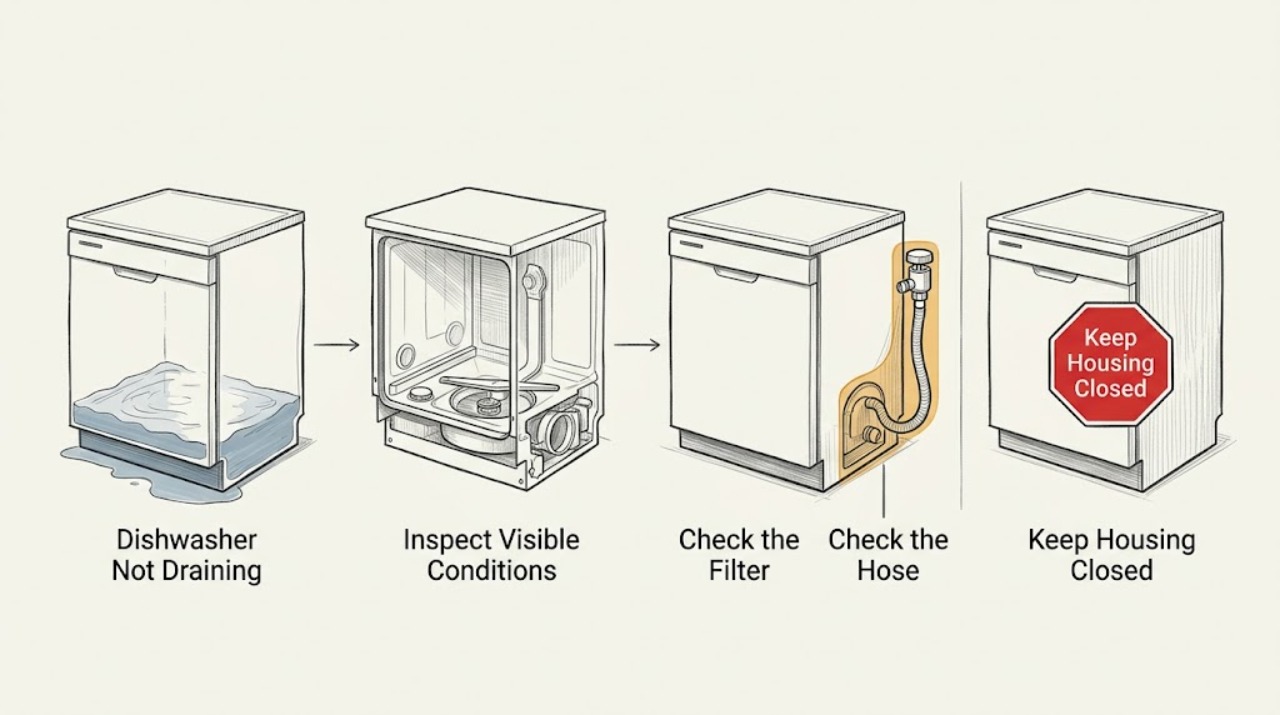
First distinguish a small amount of water in the filter cup from water covering the tub floor or reaching the door. Amana says a small amount in the filter area can be normal, but substantial or recurring water usually points to a restricted filter/sump, kinked or incorrectly routed drain hose, blocked air gap or sink connection, a garbage-disposer knockout plug on a new installation, suds, or a pump/control fault. Switch the dishwasher off and disconnect power before removing racks, cleaning filters, or looking into the accessible sump; use towels and a cup for standing water, and never pour drain-opening chemicals into the dishwasher. Check only visible hose routing and sink/air-gap conditions, and do not dismantle a pump, electrical panel, or sink trap. If the dishwasher has a burning odor, damaged wiring, repeated breaker trips, a leak near electrical parts, standing dirty water that cannot be safely removed, or it still will not drain after the model-approved external checks, leave it off and arrange Amana or qualified appliance/plumbing service. Use the exact model manual for filter layout, drain controls, and any installation-specific high-loop or air-gap requirement.
Work through in order
Diagnostic checks
Use only checks that match the exact appliance or system and its official guide.
-
Check 1
Observe the amount and location of water after the cycle without starting another cycle: note whether it is only in the filter cup, spread across the tub, near the door, dirty, foamy, or flowing back from an air gap.
Expected result: Only a small amount remains in the filter area, substantial water covers the tub floor, water is near the door, suds are present, or water backs up from the air gap or sink connection.
Next step: If water is substantial, dirty, hot, foamy, or leaking, stop the dishwasher and prepare for the safe external checks only. Do not run another cycle to force a drain or reach into water while power is connected.
Why this matters
Why: Amana says a small amount in the filter area can be normal. Water near the door suggests a more severe blockage or non-running pump, while suds can cause poor drainage or leakage. Air-gap backup points downstream in the hose or household drain path.
-
Check 2
Switch the dishwasher off and disconnect power before removing the lower rack, cleaning the removable filter assembly, or inspecting the accessible sump area; use towels and a cup to remove standing water if needed.
Expected result: The filter contains food, grease, glass, plastic, labels, or other debris; the filter is damaged or will not seat; the sump edge is obstructed; or these areas are clean and secure.
Next step: Rinse the filter under running water and use only a soft brush or the method in the exact manual. Remove only loose, safely accessible debris; do not probe the pump, use sharp tools, or run the dishwasher without every filter correctly seated and locked.
Why this matters
Why: Amana identifies clogged filters and sump debris as common restrictions. Hard debris can also damage or jam the pump. A filter that is not correctly seated can allow debris into the pump and reduce wash or drain performance.
-
Check 3
Inspect the visible drain hose under the sink or behind an accessible opening for a kink, crush point, sag, leak, or low routing; do not pull the dishwasher out or disconnect the hose yourself.
Expected result: The hose is sharply bent, pinched, crushed, sagging, leaking, or appears to form the required high loop/air-gap arrangement; alternatively, it looks clear and correctly routed.
Next step: Do not force or reroute a hose attached to the appliance. Photograph or record the visible routing and ask an installer, plumber, or appliance technician to correct it when it does not match the exact installation instructions.
Why this matters
Why: Amana says a kinked, crushed, sagging, or incorrectly routed hose can prevent drainage or let wastewater return. A clear visible hose does not rule out an internal obstruction or pump/control issue.
-
Check 4
If the dishwasher drains through a garbage disposer or air gap, inspect only the visible inlet/air-gap condition and recent installation history; do not insert tools into the disposer, open the sink trap, or dismantle the air-gap body.
Expected result: A disposer was recently installed or replaced, the knockout plug may still be present, the air gap is visibly blocked or backing up, the sink connection has an obstruction, or no external issue is apparent.
Next step: Keep the dishwasher off and have a qualified installer/plumber or appliance technician clear or verify the connection when a plug, air gap, or sink restriction is suspected. Do not improvise with a screwdriver or run repeated drain cycles.
Why this matters
Why: Amana identifies a retained disposer knockout plug as a complete post-installation drain block and a blocked air gap as a cause of poor drainage. Downstream sink restrictions can also send water back toward the dishwasher.
-
Check 5
Check whether foam or bubbles are present and whether hand dish soap or excessive detergent was recently used; do not add more detergent, vinegar, bleach, or drain cleaner to counteract it.
Expected result: Foam remains in the tub, the wrong detergent was used, rinse aid spilled, or there is no foam and the water still does not drain.
Next step: Turn the dishwasher off and allow suds to dissipate; follow the exact manual for any rinse-only recovery. Do not use chemical drain-opening products. For persistent water or leaks, leave it off and request service.
Why this matters
Why: Amana says dish soap or excess detergent can create suds that push water out and cause leaking or poor wash performance. No foam shifts attention back to the filter, hose, air gap, pump, or control path.
-
Check 6
After the filter is secure and no leak, foam, or electrical warning exists, use the exact Amana manual's documented cancel/drain or short rinse procedure once; do not repeatedly cycle a suspected blockage or pump.
Expected result: The pump runs and water leaves, the pump hums with no water movement, there is no pump sound, or an error/indicator returns.
Next step: Stop for a hum-without-flow, no-pump-sound, recurring-error, or repeated no-drain condition and arrange qualified service. Do not touch the impeller, probe wiring, remove panels, or test pump voltage yourself.
Why this matters
Why: Drainage after filter or hose correction supports a removable restriction. A hum without movement can indicate debris or a jammed impeller, while no pump sound or a recurring error can involve the door switch, wiring, pump, timer, or control.
-
Check 7
Record the full Amana model number, whether the dishwasher is newly installed, the water location/amount, drain connection type, error code or light pattern, filter condition, hose routing, foam, leaks, and all safe checks performed.
Expected result: The problem began after installation or disposer work, returns after each cycle, occurs only with foam or a particular programme, or remains unexplained after the external checks.
Next step: Arrange Amana service for an appliance-side concern or qualified plumbing/installation service for the drain connection, and provide the complete model and observations. Keep the dishwasher off when water or electrical safety conditions apply.
Why this matters
Why: Installation history and exact timing help distinguish a knockout plug/high-loop or downstream plumbing problem from an appliance-side filter, pump, or control fault. A symptom alone cannot select a compatible part.
Use your observations
Decision map
Find the observation that best matches what you see, then follow the next safe action.
-
PATH 01Next step
What you see
Do this next
Do not remove more parts solely because this small amount is present. Follow the model manual if water spreads across the tub, becomes dirty, or remains after a completed cycle.
-
PATH 02Next step
What you see
Do this next
Disconnect power, clean and correctly seat the filters as the exact manual directs, and remove only loose accessible debris. If the water remains or the pump symptom persists, arrange service without opening the pump.
-
PATH 03Next step
What you see
Do this next
Leave the dishwasher off and have the installation or plumbing connection checked by a qualified professional. Do not disconnect the hose, insert tools, or repeatedly run drain cycles yourself.
-
PATH 04Next step
What you see
Do this next
Turn the dishwasher off, let the suds dissipate, and follow the model's safe rinse guidance. Do not add drain cleaner or more detergent; arrange service for persistent water or leakage.
-
PATH 05Next step
What you see
Do this next
Leave the dishwasher off and arrange qualified appliance or electrical service. Do not probe wiring, access the pump, reset a repeatedly tripping breaker, or replace a pump/control part from the symptom alone.
Helpful context
Understand the symptom
Not all water left in an Amana dishwasher means a clog
Amana explains that a small amount of water in the filter area can remain to keep seals from drying and may be replaced during the next cycle. Water spread across the tub, water near the door, dirty water that returns, or water that remains after repeated cycles is a different pattern. Start by describing how much water remains and where it is, then work through the accessible drain path rather than assuming the drain pump has failed.
The drain path has several user-visible boundaries
At the end of a cycle, the drain pump pushes water through the hose toward a sink drain, air gap, or garbage disposer. A filter or sump obstruction, kinked hose, blocked air gap, incorrect high-loop routing, or an unremoved disposer knockout plug can prevent water from leaving or allow it to return. Amana model and installation details vary, so the matching manual and installation instructions control the exact layout.
Disconnect before cleaning; stop for electrical or water hazards
Turn the dishwasher off and disconnect power before filter or sump cleaning, and close the water supply if the model instructions call for it. Do not reach into a running or hot appliance, probe the pump, remove an electrical cover, detach hidden wiring, or pour chemical drain opener into the tub. A burning odor, damaged wiring, repeated breaker trips, or a leak near electrical parts requires qualified service rather than more cleaning.
When checks do not resolve it
Need a professional?
Stop and arrange service for smoke, burning odor, damaged wiring, water near electrical parts, repeated breaker trips, a leak that cannot be safely contained, substantial standing dirty water, a pump that hums without flow, no pump sound during drain, a recurring error, or no improvement after the exact manual's external filter and drain-path checks. Use a qualified plumber or installer when an air gap, disposer inlet, sink connection, or hose routing is involved. Disconnect power only when the plug, floor, and surrounding area are dry and safe to approach.
Common questions
FAQ
Is a little water in the bottom of my Amana dishwasher normal?
A small amount in the filter area can be normal because it helps keep seals from drying and may drain when the next cycle starts. Water spread across the tub, near the door, dirty water that remains, or recurring water after a completed cycle is different and should lead to filter, visible drain-path, and service checks.
What should I check first when my Amana dishwasher will not drain?
Switch it off and disconnect power before cleaning the removable filters or accessible sump. Check for food or hard debris, then inspect the visible drain hose, air gap, and disposer/sink connection for kinks or blockage. Do not dismantle the pump or plumbing; arrange service if the water remains or a leak/error appears.
Why did my new Amana dishwasher stop draining after installation?
Amana identifies a disposer knockout plug that was not removed, incorrect or low hose routing, a missing high loop, or a blocked air gap as post-installation causes. Have the installation checked against the exact instructions. Do not disconnect the hose or probe the disposer inlet yourself.
Can dish soap make an Amana dishwasher stop draining?
Yes. Amana says hand dish soap or too much detergent can create suds that push water out, causing leaking or poor wash performance. Turn the dishwasher off, let foam dissipate, and follow the model's safe rinse guidance. Never use chemical drain opener in the dishwasher.
What does a humming Amana dishwasher with water still inside mean?
A hum with no water movement can indicate debris or a jammed drain-pump impeller, while no pump sound can involve a pump, door switch, wiring, timer, or control. These are not safe homeowner component tests. Leave the appliance off and arrange qualified service after the external filter and hose checks.
Read the exact guide
Official sources
- Dishwasher Not DrainingAmana Product Help · Direct Amana guidance for drain symptoms, filters, sump, hose, sink connection, pump clues, and service boundaries; exact access and controls vary by model.
- Dishwasher Not Draining? 3 Reasons WhyAmana · Direct Amana consumer guidance on normal filter-area water, garbage-disposer connections, and air gaps; model-specific installation instructions control.
- Amana Dishwasher User GuideAmana / Whirlpool Corporation · Model-family manual used for general filter, cycle-completion, drain-hose, disposer, suds, and circuit-protection examples; the user's exact manual takes precedence.
- Newly Installed Dishwasher Not DrainingAmana Product Help · Direct Amana installation guidance; do not generalize its connection layout or high-loop details beyond the exact model and installation instructions.
Community feedback
Share a repair observation
Share a plain-text repair observation. Accepted observations are published automatically; this page may take a moment to update.