
On this page
Start here
Quick answer
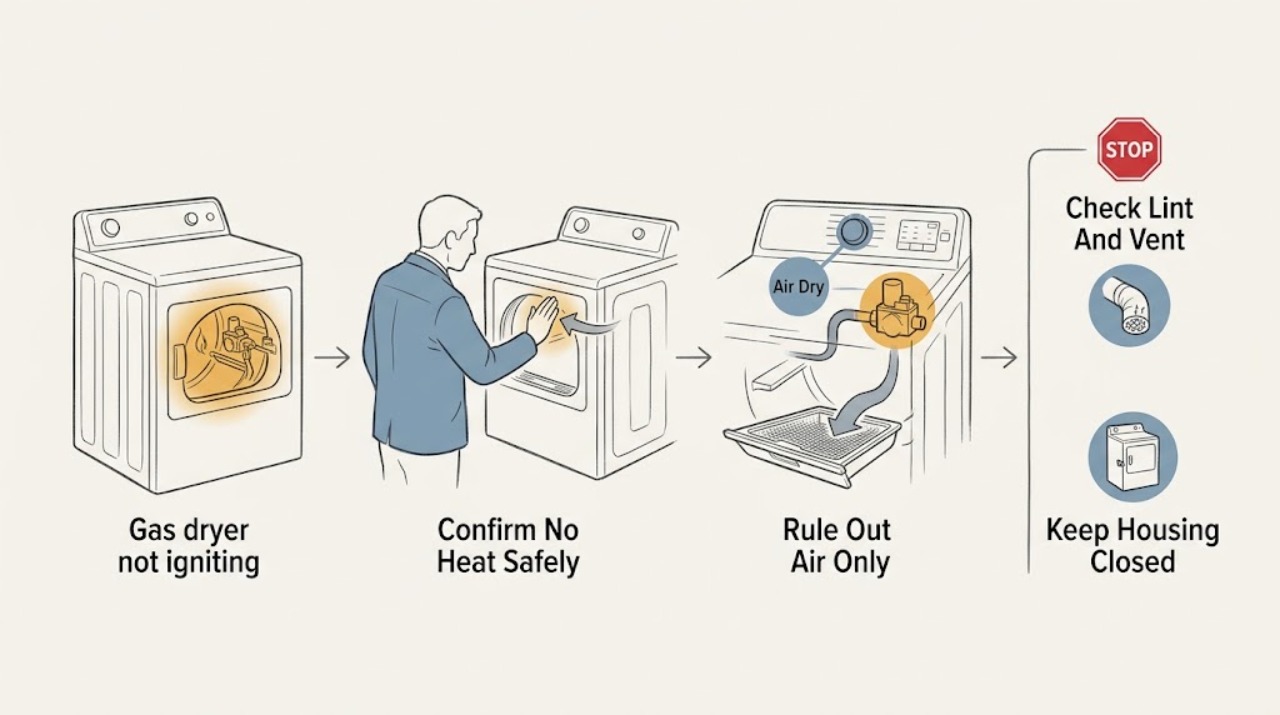
First confirm the symptom on a heated timed cycle: run the empty Amana gas dryer for about five minutes, stop it, and check for warmth only after the drum stops. Air Only or Air Fluff never adds heat. If the drum turns but the dryer stays cold, and there is no gas odor, check the accessible gas shutoff position and the household breaker without moving the dryer or opening a panel. Clean the lint screen and inspect the visible vent path. If the valve is open, the cycle is correct, or the dryer still will not ignite, stop repeated attempts and arrange qualified gas-appliance service; never diagnose the igniter or burner by opening the cabinet.
Work through in order
Diagnostic checks
Use only checks that match the exact appliance or system and its official guide.
-
Check 1
Empty the dryer, select a heated timed cycle, and run it for about five minutes as Amana describes. Stop the cycle before opening the door and check for warmth only after the drum has stopped; do not reach into a moving drum.
Expected result: The interior is warm, the interior is cold, or the dryer cannot start the heated cycle.
Next step: If warm, inspect venting and load performance. If cold, rule out Air Only, then continue with gas-supply and safe power observations. If it cannot start, stop repeated attempts and arrange service.
Stop if: Stop immediately for gas odor, hissing, smoke, burning odor, sparking, a hot cord, water near the appliance, or any need to access the drum while it moves.
Why this matters
Why: Warmth means the heating system operated during that observation and the problem may be drying performance or airflow. A cold interior supports a no-heat or ignition branch; failure to start adds an operating or power issue.
-
Check 2
Read the selected temperature and cycle. Confirm that Air Only or Air/Fluff Only is not selected when heat is expected, and consult the model manual if the control names differ.
Expected result: An air-only setting was selected, or a heated setting is selected and the dryer remains cold.
Next step: Select a model-appropriate heated cycle and make one supervised observation. If the dryer remains cold, continue to the gas, airflow, and power branches instead of changing multiple controls at once.
Stop if: Stop if controls are unresponsive, an error code returns, or the dryer produces an unsafe smell or noise.
Why this matters
Why: Amana states that Air Only and Air/Fluff Only do not add heat at any time. A cold heated cycle is not explained by the setting once it is correctly selected.
-
Check 3
Turn the dryer off and clean the lint screen. Inspect the visible vent hose, wall connection, and exterior hood for crushing, kinks, lint, debris, or a flap that cannot open freely. Do not dismantle a concealed vent run or remove a cabinet panel.
Expected result: The lint screen or visible vent is restricted, outside airflow is weak during permitted operation, or the visible path looks clear.
Next step: Remove only loose, accessible lint and correct a visible kink without moving the dryer or gas line. If airflow remains weak, the dryer overheats, or no heat persists, stop and arrange professional vent or appliance service.
Stop if: Stop if lint is packed inside an inaccessible section, the hose is damaged, the area becomes unusually hot or smoky, or inspection requires moving the appliance.
Why this matters
Why: Amana identifies poor ventilation and restricted airflow as causes of poor drying performance and advises checking the vent path and outside airflow. A clear screen does not prove the concealed duct or burner path is clear.
-
Check 4
Only when there is no gas odor and the external shutoff is already accessible, observe its position without moving the dryer or loosening any connection. Amana’s guidance shows the valve open when its handle is parallel to the gas pipe.
Expected result: The shutoff appears closed, appears open, or cannot be identified safely; the drum may still turn while no heat is produced.
Next step: If the valve is clearly closed and there is no gas odor, follow the model installation instructions or have qualified service verify the supply. If it appears open, its position is uncertain, or no heat persists, stop and arrange service.
Stop if: If you smell gas, hear hissing, see damage, or would need to touch or disconnect a fitting, leave the area and contact the gas supplier or emergency responders from a safe location.
Why this matters
Why: Amana says a gas dryer drum can turn without heat when the gas shutoff is closed. An apparently open valve does not rule out supply, ignition, combustion, or control faults.
-
Check 5
Look at the household electrical panel and note whether the dryer’s breaker is visibly tripped. Reset it only once if there is no odor, heat, damage, or other hazard; do not open the dryer or its terminal area.
Expected result: The breaker is tripped, the breaker appears normal but the dryer tumbles without heat, or the breaker trips again.
Next step: After one safe reset, make one supervised heated observation. If there is still no heat, the breaker trips again, or the cord or outlet is damaged, stop and use a qualified electrician or appliance technician.
Stop if: Do not open a terminal cover, handle conductors, probe the outlet, or continue after buzzing, sparking, scorch marks, a hot cord, or a repeated trip.
Why this matters
Why: Amana includes a household breaker or fuse check in its gas-dryer no-heat guidance. A gas dryer still needs electrical power for its controls and ignition, while a normal-looking breaker does not verify the complete circuit.
-
Check 6
Record the model number, gas type if known, selected cycle, whether the drum turns, whether any warmth was felt, the shutoff and breaker observations, vent condition, error codes, recent installation or gas work, and whether the problem is new or recurring. Do not recreate the failure to watch the burner.
Expected result: No heat persists after the safe checks, the shutoff is open, an error code appears, the dryer shuts down, or the symptom returns after a prior repair.
Next step: Keep the dryer off as appropriate and give the record to qualified gas-appliance service. Use the gas supplier for a supply-side concern and qualified vent service for a concealed restriction.
Stop if: Do not remove panels, bypass an ignition or flame safety, use a flame to test gas flow, or repeatedly restart a dryer that remains cold or shuts down.
Why this matters
Why: This history helps a technician distinguish a supply, airflow, ignition, burner, sensor, control, or safety issue. It does not identify a failed part without model-specific testing.
Use your observations
Decision map
Find the observation that best matches what you see, then follow the next safe action.
-
PATH 01Next step
What you see
The heated-cycle test produces warmth
Do this next
Check the lint screen, visible vent path, load, and cycle. Arrange service if the dryer later becomes cold or performance remains abnormal.
Why this path and its safety boundary
Why it matters: Ignition and heating occurred during that test; the remaining issue may be airflow, cycle selection, load, or drying performance.
-
PATH 02Next step
What you see
Air Only or Air Fluff is selected
Do this next
Select a model-appropriate heated cycle and make one supervised observation.
Why this path and its safety boundary
Why it matters: That setting intentionally provides no heat.
-
PATH 03Next step
What you see
A lint screen, visible hose, exhaust hood, or outside airflow is restricted
Do this next
Correct only accessible obstructions and arrange professional vent inspection or cleaning if airflow remains weak.
Why this path and its safety boundary
Why it matters: Poor ventilation can cause long drying and an unsafe operating condition even when the burner can ignite.
-
PATH 04Next step
What you see
The gas shutoff appears closed and no gas odor is present
Do this next
Follow the model installation instructions or have qualified service verify the supply; do not loosen fittings.
Why this path and its safety boundary
Why it matters: A closed valve can allow the drum to turn while preventing heat.
-
PATH 05Next step
What you see
The gas shutoff appears open, the breaker is normal, and the dryer remains cold
Do this next
Keep the dryer off as appropriate and arrange qualified gas-appliance service.
Why this path and its safety boundary
Why it matters: An ignition, burner, sensor, control, safety, or supply fault remains possible; the symptom does not identify which one.
-
PATH 06Next step
What you see
Gas odor, hissing, smoke, sparking, scorch marks, overheating, or repeated breaker trips occur
Do this next
Leave the area or switch the appliance off only if safe, then contact the gas supplier, emergency responders, or a qualified professional from a safe location.
Why this path and its safety boundary
Why it matters: This is a safety issue, not a routine ignition adjustment.
Helpful context
Understand the symptom
Not igniting versus not heating
A gas dryer can tumble while producing no heat. The safest first distinction is whether a correct heated cycle produces warmth at all, not whether a homeowner can see the burner. A wrong no-heat setting, closed gas shutoff, power interruption, restricted vent, or internal ignition/control fault can lead to similar cold clothes. The exact model manual controls the details for any code or component test.
Keep the burner and gas line closed to the user
A homeowner can select a cycle, clean an accessible lint screen, inspect the visible vent, and observe an already accessible shutoff only when there is no gas odor. Do not remove the lower panel, loosen a connector, bypass a safety, use a flame to look for ignition, or reach into a moving drum. A gas odor, hissing, smoke, or scorch marks is an immediate stop condition.
What the symptom cannot identify
No ignition does not by itself prove a failed igniter, solenoid, flame sensor, thermal device, control, or gas valve. A technician needs the model, fuel supply context, heat-test result, vent observations, error codes, and whether the drum turns before selecting a repair path.
Safety boundary
Stop conditions
- Stop immediately for gas odor, hissing, smoke, burning odor, sparking, scorch marks, a hot or damaged cord, exposed wiring, water, overheating, or a breaker that trips again.
- Do not remove the lower or rear panel, loosen gas fittings, use a flame to test ignition, bypass an ignition or flame safety, reach into a moving drum, or attempt internal component testing.
- Stop repeated test cycles when a heated cycle remains cold after the safe checks, an error returns, the gas valve position is uncertain, or the dryer shuts down unexpectedly.
Only after diagnosis
Potential parts
- gas igniter or ignition assembly
Only consider this category if qualified testing confirms an ignition fault after the gas supply, airflow, and control conditions are assessed.
Confirm the complete dryer model and manufacturer fit information; no-ignition symptoms do not identify an igniter by themselves. - gas valve or burner component
Only consider this category when a qualified professional confirms a valve, burner, or combustion fault and rules out a closed supply or unsafe vent.
Gas components require model-specific fit and professional safety checks; never choose or install one from the symptom alone. - thermal or flame-safety component
Only consider this category after qualified diagnosis links repeated shutdown or failed ignition to a safety component.
Do not bypass a safety device or infer compatibility from a no-heat symptom; verify the model-specific diagnosis.
When checks do not resolve it
Need a professional?
Use qualified gas-appliance service for persistent no ignition on a heated cycle, an open-valve no-heat condition, recurring shutdowns, error codes, or any internal burner or ignition concern. Use the gas supplier or emergency responders for an active gas hazard and qualified electrical or vent service for those separate conditions.
Common questions
FAQ
How do I know whether my Amana gas dryer is igniting?
Use Amana’s safe heat check: select a heated timed cycle, run the empty dryer for about five minutes, stop it, and feel for warmth only after the drum stops. Do not open the cabinet to watch the burner.
Can an Amana gas dryer tumble without igniting?
Yes. Amana states that the drum can turn while a gas dryer does not heat when the gas shutoff is closed. Electrical power, airflow, controls, and internal ignition faults can also be involved.
Could Air Fluff make my Amana dryer seem unable to ignite?
Yes. Air Only or Air/Fluff Only does not add heat. Select a model-appropriate heated cycle before treating the symptom as an ignition fault.
Can a blocked vent stop an Amana gas dryer from heating?
A restricted vent can cause weak airflow, long drying, overheating, and poor performance, even if the burner can operate. Clean the accessible lint screen and inspect the visible vent path; have persistent or concealed restrictions professionally handled.
When should I stop troubleshooting an Amana gas dryer that will not ignite?
Stop for gas odor, hissing, smoke, burning odor, sparking, scorching, exposed wiring, a hot cord, overheating, or a repeated breaker trip. Also stop repeated cycles when a correct heated cycle stays cold after the safe checks or an error returns, and arrange qualified service.
Read the exact guide
Official sources
- Not Starting or Not Operating - DryerAmana Product Help · Amana dryer breaker, controls, door, and starting context
- Dryer is not Drying or Experiencing Long Dry TimesAmana Product Help · Amana dryer vent, airflow, lint, cycle, and service handoff guidance
- Not Heating - Gas DryerAmana Product Help · Amana gas dryer heat test, Air Only behavior, gas shutoff, breaker, and service guidance
- Error Codes in DryersAmana Product Help · Amana dryer error-code and service escalation context
- Not Heating - Electric DryerAmana Product Help · Amana dryer heated-cycle and Air Only reference plus household supply boundary
- Checking the Gas Supply and the Shutoff ValveAmana Product Help · Amana gas dryer supply connection and shutoff-valve function
Community feedback
Share a repair observation
Share a plain-text repair observation. Accepted observations are published automatically; this page may take a moment to update.