
On this page
Start here
Quick answer
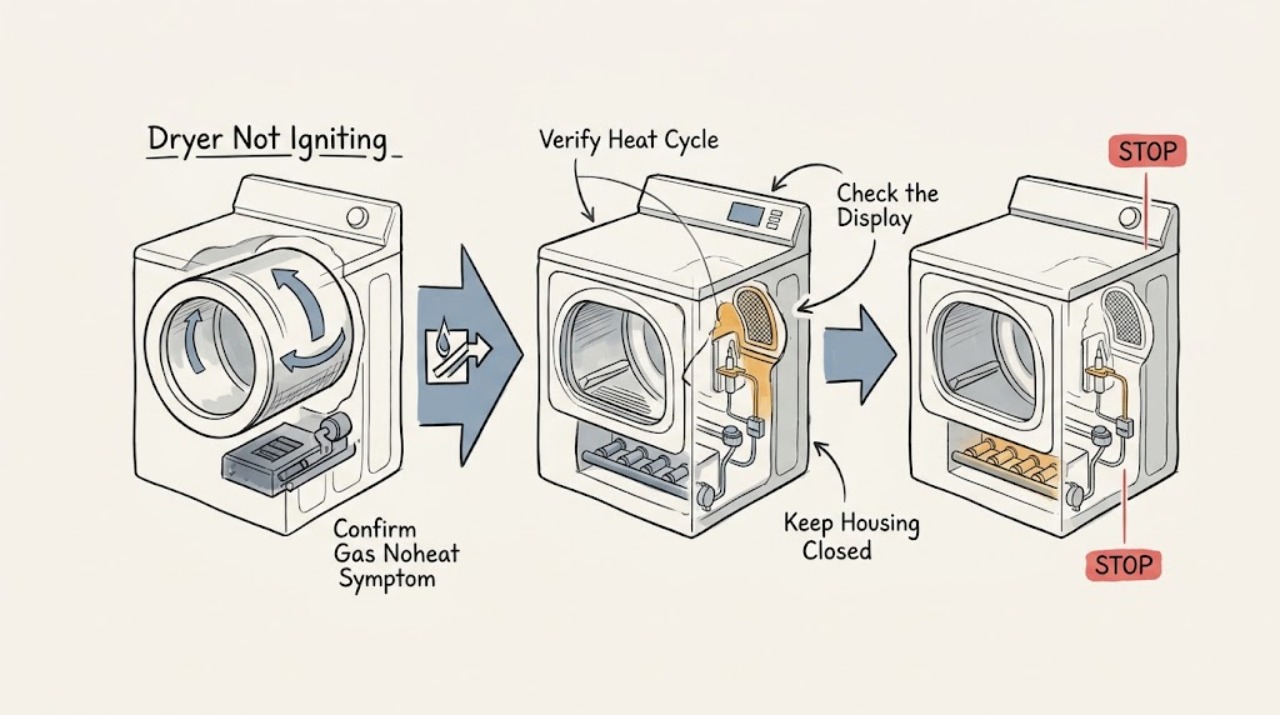
Confirm first that this is a gas Kenmore dryer that runs or starts but has no heat, not an electric dryer or a no-start problem. Select a heat-producing dry cycle rather than air-only or cool-down, check that the external gas shutoff is open and that the dryer has its required grounded power, and make sure the front and exhaust path are not obstructed. Gas dryers use an automatic ignition system; do not look for or light a standing pilot with a match. If the gas supply is confirmed but the burner still does not ignite, if ignition is intermittent, or if there is a gas smell, flame rollout, smoke, overheating, damaged wiring, or a tripped breaker, stop using the dryer and arrange qualified service. Do not remove panels or test gas components yourself.
Before you begin
Safety first
- User checks are limited to model identification, visible cycle selection, safe external power and clearance checks, and confirming an accessible gas shutoff only when there is no gas odor. Do not light the burner, use an open flame for leak testing, remove panels, disconnect gas fittings, bypass sensors or switches, test live circuits, or operate a dryer with gas, fire, overheating, or electrical symptoms.
Work through in order
Diagnostic checks
Use only checks that match the exact appliance or system and its official guide.
-
Check 1
From a safe position, confirm the dryer type and symptom: note whether the drum tumbles, whether the cycle is a heat-producing dry cycle, whether clothes remain cold or damp, and whether the problem is no start rather than no ignition.
Expected result: The drum runs with no heat, the dryer is in air-only or cool-down, the dryer does not start at all, or a gas odor or electrical symptom is present.
Next step: Photograph the model tag and controls, select the matching branch, and keep the dryer off if any safety symptom is present.
Stop if: Stop immediately for gas odor, flame outside the burner area, smoke, burning odor, sparking, exposed wiring, a hot cord or outlet, or repeated breaker trips.
Why this matters
Why: A gas ignition/no-heat path differs from a no-start, wrong-cycle, or safety-emergency path. A dryer that starts but never heats needs external cycle, airflow, gas, and service checks.
-
Check 2
Set only a model-supported heat-producing dry cycle and temperature, not Air Fluff, No Heat, or Cool Down, then start one supervised test with the door closed normally.
Expected result: The cycle is a heat-producing program and the drum runs, or the dryer remains in an air-only/cool setting, will not start, or stops unexpectedly.
Next step: Correct only the visible cycle or temperature setting and observe one short test. If the correct program still produces no heat, stop repeated testing and continue to power, airflow, and gas checks.
Stop if: Do not open the door to watch the burner, bypass the door switch, or continue if the dryer smells of gas or overheats.
Why this matters
Why: GE notes that the wrong cycle or temperature selection can make a gas dryer appear not to heat. A correct heat cycle with no ignition moves the diagnosis to supply, airflow, ignition, sensing, or service.
-
Check 3
Check that the plug is fully seated in the correct grounded outlet and that the dryer controls respond normally; if the model manual permits a simple external breaker check, verify the dedicated supply without opening the terminal block or control panel.
Expected result: The display and motor work normally, the outlet or breaker is off or abnormal, the plug or cord is damaged or hot, or the dryer has normal apparent power but still no heat.
Next step: Have an electrician or qualified servicer correct abnormal power. If power is normal, continue only with visible airflow and external gas-shutoff checks.
Stop if: Do not reset a repeatedly tripping breaker, touch damaged wiring, remove the terminal cover, or work on energized parts.
Why this matters
Why: Ignition depends on the dryer controls and electrical supply even on a gas model. A damaged cord, hot outlet, or abnormal breaker is an electrical stop, not a reason to inspect the igniter live.
-
Check 4
With the dryer off, inspect only the visible front clearance, lint screen, and exhaust connection for blockage, crushing, or an obstructed outlet; do not push tools into the burner or cabinet and do not operate with the exhaust disconnected unless the exact manual explicitly permits a safe service test.
Expected result: The lint screen or visible exhaust path is blocked, the front is obstructed, airflow at the outlet is weak, or the visible path is clear.
Next step: Clear only accessible lint and external obstruction, then perform one supervised heat-cycle test. If heat is still absent, stop and arrange service.
Stop if: Stop for a hot cabinet, smoke, lint ignition, burning smell, or an exhaust path that cannot be safely inspected.
Why this matters
Why: GE says proper airflow is needed for drying and instructs checking that the front is not blocked. Restricted exhaust can raise heat and trigger safety protection, but a clear external path does not prove an igniter or gas valve is healthy.
-
Check 5
For a new installation or after gas work, confirm from outside the appliance that the dryer gas shutoff and the home's accessible supply are open as shown in the exact Kenmore installation instructions; do not loosen a connector, remove a valve, or test with a flame.
Expected result: The external shutoff is closed, the supply is interrupted or the tank is empty where applicable, the connection or room smells of gas, or the supply appears normal.
Next step: Correct only a clearly closed accessible shutoff when there is no gas odor and the manual supports it, then test once. If supply is normal or the problem persists, request qualified service.
Stop if: If gas odor is present, do not operate switches, use a phone in the area, light a flame, or continue testing; leave immediately and contact the appropriate gas emergency or qualified service provider from a safe location.
Why this matters
Why: An off or interrupted supply can explain no ignition. A gas smell or uncertain connection is a leak emergency, not a troubleshooting branch. A normal supply with no ignition requires internal diagnosis.
-
Check 6
Use the model manual to confirm that the dryer uses an automatic ignition sequence, but do not remove panels or attempt to watch, touch, or manually light the igniter or burner; note only the safe external result of one short supervised heat-cycle test.
Expected result: The dryer tumbles and produces no heat, heat is intermittent, the cycle heats briefly then stops, or ignition is accompanied by gas odor, flame noise outside normal operation, or smoke.
Next step: Stop after one safe observation and give the technician the sequence and timing; do not infer a failed igniter or valve from sound alone.
Stop if: Never use a match or lighter, defeat a safety switch, bypass a sensor, or open the burner compartment as a homeowner check.
Why this matters
Why: An automatic system coordinates igniter, sensor, gas valve, and control. The same no-heat symptom can come from several components, while gas odor or abnormal flame behavior is an immediate stop.
-
Check 7
If the dryer is newly installed or the gas service was recently changed, record whether the no-heat symptom began immediately and provide the installer with the model and installation details; do not repeatedly start the appliance to purge a line or alter gas connections.
Expected result: No heat began after installation or supply work, the gas supply has been interrupted, or the dryer previously ignited normally and then failed.
Next step: Have a qualified installer or servicer verify the gas installation and appliance configuration. Keep the dryer off until the supply is confirmed safe.
Stop if: Do not convert gas type, loosen fittings, bleed a line, or test for leaks with a flame; leave for any gas odor or suspected leak.
Why this matters
Why: A new installation may have a supply, conversion, connection, or air-in-line issue that requires a qualified installer or gas technician. A sudden failure after normal operation points to a dryer component or supply fault.
-
Check 8
Stop user troubleshooting and arrange qualified appliance or gas service when the correct cycle, power, airflow, and external gas supply are confirmed but the burner still does not ignite, or whenever the symptom is intermittent or accompanied by heat, electrical, flame, or gas concerns.
Expected result: The no-ignition symptom repeats with normal external conditions, or the dryer presents a safety hazard; alternatively, one visible setting correction restores reliable heat without recurrence.
Next step: Leave the dryer off and provide the technician with the model, gas type, cycle, timing, supply status, vent observations, and exact safety symptoms.
Stop if: This is a hard stop for gas odor, flame outside the burner, smoke, burning smell, sparking, hot wiring, or repeated breaker trips; do not restart or open the cabinet.
Why this matters
Why: Persistent no ignition can involve the igniter, flame sensor, gas valve coils, burner, thermal protection, control, wiring, or vent-related protection. These are model-specific and potentially hazardous to test.
Use your observations
Decision map
Find the observation that best matches what you see, then follow the next safe action.
-
PATH 01Safety boundary
What you see
The dryer is in Air Fluff, No Heat, or Cool Down, or it does not start or tumble.
Do this next
Verify the exact model's heat cycle, controls, door closure, and power instructions; service a persistent no-start fault.
Why this path and its safety boundary
Why it matters: This is a cycle or no-start path, not proof of an ignition failure.
Safety stop: Stop for damaged cord, hot outlet, smoke, sparking, or repeated breaker trips.
-
PATH 02Safety boundary
What you see
No heat began after installation or gas work, or the accessible external gas shutoff is closed.
Do this next
Have the qualified installer or gas technician verify the configuration and supply; do not alter fittings or repeatedly purge the line.
Why this path and its safety boundary
Why it matters: An external supply, connection, conversion, or air-in-line issue may prevent ignition.
Safety stop: Leave immediately for gas odor or suspected leak and seek gas-emergency help from a safe location.
-
PATH 03Safety boundary
What you see
The cycle, power, visible airflow, and external gas shutoff are correct, but the burner does not ignite.
Do this next
Stop after one supervised confirmation and arrange qualified service; do not replace an inferred part.
Why this path and its safety boundary
Why it matters: An internal ignition, sensing, gas-valve, control, or safety component needs diagnosis.
Safety stop: Do not remove panels, manually light, bypass sensors, or test energized gas components.
-
PATH 04Safety boundary
What you see
The dryer ignites briefly, heat is intermittent, or it stops heating after warming.
Do this next
Record when heat starts and stops, then arrange service rather than repeatedly restarting.
Why this path and its safety boundary
Why it matters: A sensing, gas-valve, airflow, thermal-protection, or control condition may be cycling out of operation.
Safety stop: Stop for overheating, smoke, burning odor, gas odor, flame outside the burner, or electrical signs.
-
PATH 05Safety boundary
What you see
There is a gas smell, flame outside the burner area, smoke, burning odor, sparking, or a hot electrical connection.
Do this next
Do not operate switches or use a flame; leave the area, contact emergency or gas utility help from a safe location, and keep the dryer off.
Why this path and its safety boundary
Why it matters: This is an immediate gas, fire, or electrical safety problem.
Safety stop: Do not restart, open the cabinet, test for leaks with an open flame, or attempt a DIY ignition repair.
Helpful context
Understand the symptom
No ignition is a gas-appliance safety issue
A gas dryer may tumble while producing no heat, and its burner can cycle off after the load warms. The user-safe checks are external: cycle selection, visible airflow, power, and the accessible gas shutoff. Kenmore's manual index is the correct place to retrieve the exact model's installation and use instructions. Do not open the burner compartment to watch ignition.
Automatic ignition is not a pilot-light procedure
Manufacturer guidance describes an automatic electric igniter that warms before the gas valve opens. A gas dryer is not safely restored by holding a match or lighter near the burner. If gas odor is present, do not operate switches or create a flame; leave the area and use the appropriate gas-emergency or qualified service route from a safe location.
A confirmed supply with no heat needs diagnosis
If the cycle, power, airflow, and external gas shutoff are correct but the burner never ignites, the fault may be in the igniter, sensing, gas valve, burner, control, wiring, or a safety limiter. Those components are model-specific and can involve gas and electrical hazards. Stop after the safe external checks and give the technician the model and exact symptom rather than trying a guessed part.
When checks do not resolve it
Need a professional?
Safety scope: User checks are limited to model identification, visible cycle selection, safe external power and clearance checks, and confirming an accessible gas shutoff only when there is no gas odor. Do not light the burner, use an open flame for leak testing, remove panels, disconnect gas fittings, bypass sensors or switches, test live circuits, or operate a dryer with gas, fire, overheating, or electrical symptoms.
Common questions
FAQ
Why does my Kenmore gas dryer run but not ignite?
Confirm a heat-producing cycle, normal power, visible airflow, and an accessible gas shutoff that is open. If those are correct and the burner still does not ignite, the automatic ignition, sensing, valve, control, or safety system needs qualified diagnosis.
Does a Kenmore gas dryer have a pilot light?
Many modern gas dryers use automatic electric ignition rather than a standing pilot. Use the exact Kenmore manual for your model, and never try to light the burner with a match or lighter.
Can a clogged vent prevent a Kenmore gas dryer from igniting?
Restricted airflow can raise heat and activate safety protection, and GE advises checking that the front and exhaust path are not blocked. Clear only accessible lint or external obstruction; persistent no heat needs service.
What should I check after installing a Kenmore gas dryer?
Use the exact model installation instructions to verify the gas type, qualified connection, accessible shutoff, grounded power, and unobstructed ventilation. Do not loosen fittings, convert gas type, or repeatedly start the dryer to purge a line.
When should I stop using a Kenmore dryer that will not ignite?
Stop for any gas odor, flame outside the burner, smoke, burning smell, sparking, hot wiring, a hot outlet or cord, overheating, or repeated breaker trips. Do not operate switches or use a flame in a suspected gas leak; leave and obtain appropriate qualified or emergency help from a safe location.
Read the exact guide
Official sources
- GE Gas Dryer Installation and Safety ManualGE Appliances · Official GE gas-dryer manual used for general safety boundaries; it is not a Kenmore model manual and exact local requirements apply.
- Kenmore ManualsKenmore · Official Kenmore manual index; the exact model manual controls gas type, installation, ignition, and service instructions.
- Gas Dryer - Ignition SystemsGE Appliances · GE and related automatic-ignition gas-dryer guidance used for general principles; exact Kenmore construction varies by model.
- Gas Dryer - Runs But Does Not HeatGE Appliances · GE gas-dryer guidance used for general gas-dryer principles; Kenmore's exact model manual and qualified service control the Kenmore repair.
Community feedback
Share a repair observation
Share a plain-text repair observation. Accepted observations are published automatically; this page may take a moment to update.