
On this page
Start here
Quick answer
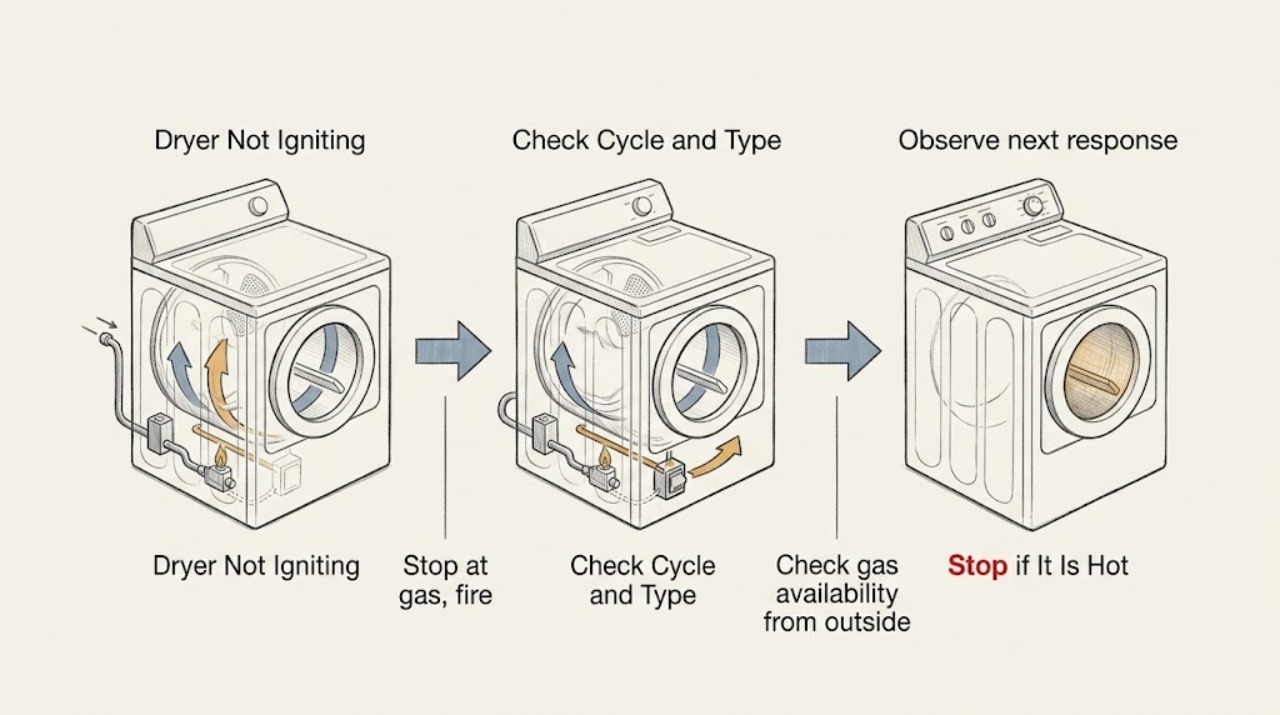
First confirm that this is a gas Electrolux dryer and that the drum runs but no heat is produced. Stop immediately for gas odor, smoke, an unusual flame, a hot electrical connection, or repeated failed ignition. From a safe, cool, external position, verify the selected cycle is not a no-heat setting, the gas supply valve is open, the gas supply is available, and the lint screen and accessible exhaust path are not blocked. Do not open the cabinet, handle the igniter or gas valve, bypass a thermal device, or keep retrying ignition; persistent failure needs qualified service.
Work through in order
Diagnostic checks
Use only checks that match the exact appliance or system and its official guide.
-
Stop at gas, fire, or electrical warning signs
Turn the dryer Off. If there is a gas odor, smoke, flame outside the expected burner area, a hot or damaged cord/outlet, unusual electrical buzzing, or repeated failed ignition, do not retry the cycle. Avoid operating switches or handling plugs in a gas-filled or wet area; leave and contact the gas supplier, emergency help, or qualified service from a safe location.
Expected result: There is no warning sign and the dryer is cool and safe, or a warning sign is present.
Next step: For any warning sign, keep the dryer out of service and do not open the cabinet. If the appliance is safe, continue by confirming its type and recording the symptom without repeatedly starting it.
Why this matters
Why: A warning sign makes continued ignition testing unsafe. A normal, odor-free, cool appliance permits only the external checks below.
-
Confirm the dryer type and heat setting
Read the model information and confirm whether the dryer is gas or electric. Select a documented heated cycle rather than Air Fluff or another no-heat setting, close the door fully, and start the programme according to the owner's guide. Do not use a cycle from another model as a substitute.
Expected result: The dryer was on a no-heat setting, the door or start control was not correctly engaged, or a documented heated cycle runs but produces no heat.
Next step: If the setting was the cause and heat returns normally, monitor the dryer. If there is still no heat, stop before internal ignition checks and continue with the external gas and vent checks.
Why this matters
Why: A setting or start condition can look like a failed ignition. If a correct heated cycle tumbles without heat, the gas, airflow, or heating system needs further differentiation.
-
Check gas availability from outside the appliance
With the dryer Off, verify from a safe external position that the dedicated gas supply valve is in its normal open position and that the household or propane supply has not been interrupted. Do not disconnect gas fittings, remove a burner panel, adjust a regulator, or attempt to light the burner manually.
Expected result: The valve is closed, the gas supply is empty or interrupted, the valve/connector is corroded or damaged, or supply appears available but the dryer still does not ignite.
Next step: Restore a normal supply condition only through the approved household or installation procedure and then make at most one supervised start if the manual permits. For damaged fittings, odor, or a persistent no-ignition symptom, leave the dryer off and arrange service.
Why this matters
Why: A closed or unavailable supply can prevent ignition without proving a dryer-component failure. A damaged fitting or persistent failure after supply is confirmed requires qualified assessment.
-
Check lint and exhaust airflow without bypassing safety
After the dryer cools, clean and replace the lint screen as directed. Visually inspect the accessible exhaust tube and outside hood for a crushed section, heavy lint, restriction, or a flap that cannot open during normal operation. Do not operate a gas dryer with the exhaust duct disconnected or venting indoors, and do not reach inside the cabinet.
Expected result: The lint screen or exhaust path is blocked, sharply bent, disconnected, or poorly ventilated, or the accessible path appears clear.
Next step: Correct only an obvious external lint or routing issue according to the installation guide. If the path is damaged, indoor-vented, or the no-heat symptom remains, stop use and obtain qualified service.
Why this matters
Why: Restricted airflow can reduce burner performance and create overheating or combustion risk. A clear external path does not rule out an internal ignition or sensor fault.
-
Record the safe ignition sequence without repeating it
If there is no gas odor, smoke, abnormal flame, hot connection, or prior repeated failure, make one brief supervised observation from outside the appliance while using the exact heated cycle. Note whether the drum turns, whether there is a click or hum, whether heat appears at the exhaust, and whether the dryer stops. Do not remove panels or look into the burner compartment.
Expected result: The dryer produces heat normally, tumbles with no heat, clicks repeatedly, starts heat and then loses it, or stops with an error or thermal symptom.
Next step: Stop and record the sequence. If heat is absent, intermittent, or accompanied by a warning, keep the dryer off and arrange qualified service rather than retrying ignition.
Why this matters
Why: Normal heat after an external correction suggests a setting, supply, or airflow issue. Repeated clicking without heat or heat that drops out points toward an ignition, flame-sensing, gas-flow, or thermal-control fault that cannot be separated safely by further user tests.
-
Use the exact code and service path
Record the model, gas/electric type, selected cycle, supply status, lint and exhaust observations, click or flame observations, time to heat or stop, and any display code. Compare a code only with the exact Electrolux owner's guide or support page; do not substitute a code from another model or attempt to clear a safety fault by bypassing a component.
Expected result: A ventilation, wiring, power, door, or other code remains, the dryer repeatedly fails to ignite, or the cause is inside an inaccessible area.
Next step: Keep the dryer out of service and provide the full sequence to Electrolux support or an authorized technician. Do not open the cabinet, adjust gas components, or make energized measurements.
Why this matters
Why: A recurring or inaccessible fault may involve the igniter, flame sensor, gas valve, burner, wiring, control, or thermal limiter. The external checks cannot identify which one.
Use your observations
Decision map
Find the observation that best matches what you see, then follow the next safe action.
-
PATH 01Next step
What you see
Gas odor, abnormal flame, smoke, repeated failed ignition, or a damaged gas connection is present.
Do this next
Arrange qualified service and follow the exact model guidance.
Why this path and its safety boundary
Why it matters: The dryer remains out of service until the gas and appliance safety condition is assessed.
-
PATH 02Next step
What you see
The dryer was on a no-heat cycle, the gas valve was closed, or the household gas supply was interrupted, with no hazard sign.
Do this next
Arrange qualified service and follow the exact model guidance.
Why this path and its safety boundary
Why it matters: Heat may return if the cause was external; persistent no-ignition moves to service.
-
PATH 03Next step
What you see
The lint screen or accessible exhaust path is restricted, crushed, disconnected, or poorly ventilated.
Do this next
Arrange qualified service and follow the exact model guidance.
Why this path and its safety boundary
Why it matters: A ventilation-related heating problem may be removed; no-heat or ignition failure after correction requires service.
-
PATH 04Next step
What you see
A correct heated cycle has gas available and an apparently clear vent, but there is no flame/heat, repeated clicking, intermittent heat, or a thermal shutdown.
Do this next
Arrange qualified service and follow the exact model guidance.
Why this path and its safety boundary
Why it matters: Internal ignition and safety components are assessed without repeated fuel or electrical testing by the user.
Helpful context
Understand the symptom
No heat is not always an ignition fault
A gas dryer can tumble without heat because the selected cycle is intentionally unheated, gas is unavailable, airflow is restricted, or a safety or ignition component is not allowing the burner to run. The useful distinction is whether the drum turns, whether any heat ever appears, and whether the issue is accompanied by odor, clicking, a shutdown, or a displayed code. Do not infer a failed igniter from a single failed cycle.
The gas and electrical boundaries are strict
Gas ignition combines fuel, combustion, airflow, electrical controls, and thermal protection. A user can check the model, settings, supply availability, lint screen, and accessible vent path. Internal ignition, flame-sensing, gas-valve, burner, wiring, and thermal components require qualified service. If gas is smelled or combustion looks abnormal, stop using the dryer and leave the area rather than trying another ignition attempt.
When checks do not resolve it
Need a professional?
Contact Electrolux support or an authorized service provider for persistent no-ignition, intermittent heat, repeated thermal shutdown, a gas or electrical warning, or any fault inside the burner or cabinet area.
Common questions
FAQ
Why does my Electrolux gas dryer tumble but not ignite?
Check that the selected cycle provides heat, the gas supply is available, and the lint screen and accessible outdoor exhaust path are clear. If it still has no heat, repeated clicking, or intermittent ignition, stop using it and arrange qualified service rather than accessing the burner or igniter.
Can I relight the burner manually?
No. Do not remove panels or manually light a dryer burner. Internal ignition, flame-sensing, gas-valve, and thermal systems require model-specific qualified service, especially after repeated failed ignition.
Could a blocked vent prevent ignition or heat?
Restricted lint or exhaust airflow can affect dryer heating and create an overheating or combustion hazard. Clean the lint screen and inspect only the accessible exhaust path; never operate a gas dryer without an exhaust duct vented outdoors.
What if I smell gas while the dryer is trying to ignite?
Stop the dryer and do not try again. Avoid switches or plugs in the area, leave if necessary, and contact the gas supplier or emergency help from a safe location. Keep the appliance out of service until the gas and appliance safety condition is assessed.
Read the exact guide
Official sources
- What should I do if my dryer stops operating?Electrolux · Electrolux dryers; motor-overheat and thermal-limiter service boundary.
- My dryer is running, but does not seem to be heating. What should I do?Electrolux · Electrolux dryers; gas-supply, cycle, ventilation, and no-heat guidance applies only with the exact model's installation and owner information.
- Dryer - Not Drying and Extended Drying TimeElectrolux · Electrolux dryers; lint, exhaust, ventilation, and gas-dryer exhaust safety guidance relevant when ignition fails with no-heat symptoms.
- Laundry Dryer Error Code GuideElectrolux · Electrolux laundry dryers; use codes only when they match the reader's exact model and display.
Community feedback
Share a repair observation
Share a plain-text repair observation. Accepted observations are published automatically; this page may take a moment to update.