
On this page
Start here
Quick answer
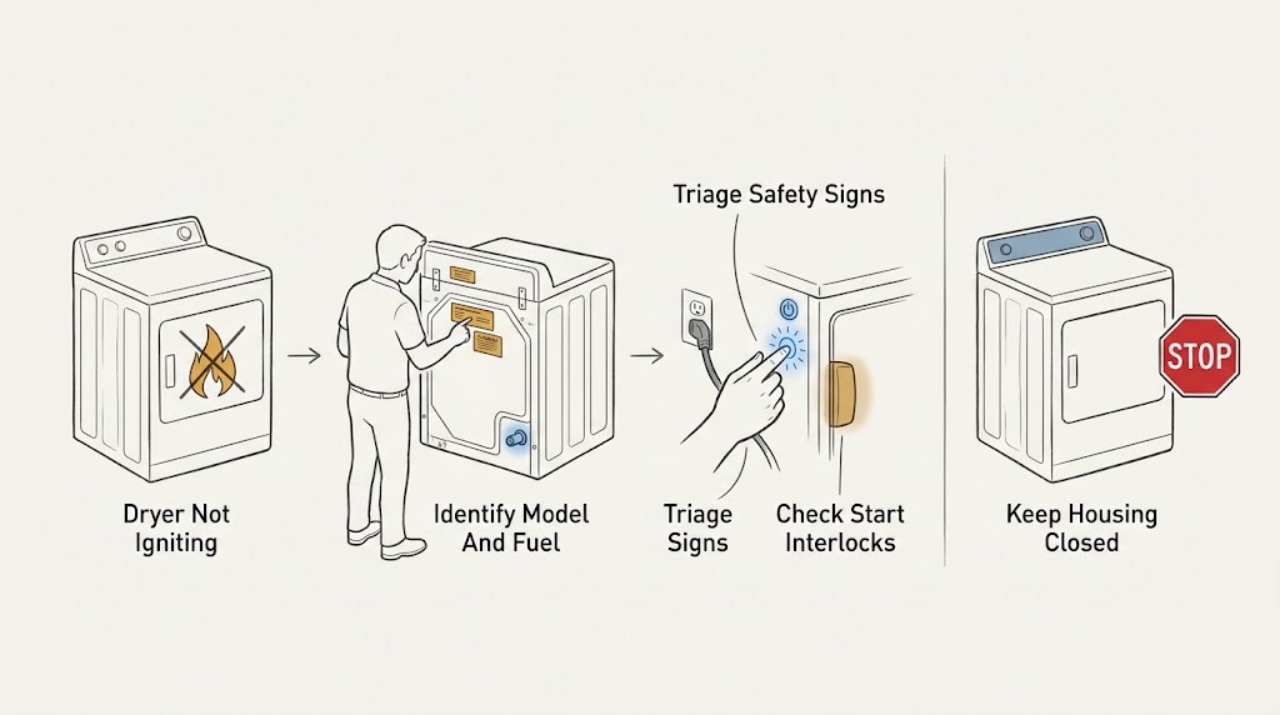
First confirm the exact Bosch model and whether the dryer is gas or electric: an electric dryer has no burner to ignite. If it is a gas model, do not try to light the burner, open a gas connection, or test for a leak with a flame. With no gas odor, smoke, or electrical hazard, check the cord, door, selected program, breaker or fuse, accessible lint filter, and any displayed code. If the drum tumbles but there is no heat, a gas dryer repeatedly fails to ignite, a heating code appears, or the fuel type is unclear, stop user troubleshooting and arrange qualified Bosch dryer service.
Before you begin
Safety first
- This article supports model identification and ordinary-access observation only. Do not manually ignite the burner, test gas with a flame, loosen gas fittings, open panels, test live wiring, bypass protection, or replace an ignition or heating part without qualified diagnosis.
Work through in order
Diagnostic checks
Use only checks that match the exact appliance or system and its official guide.
-
Check 1
From a safe position, read the Bosch dryer's rating label for the E-Nr and use Bosch's owner-manual search to identify whether that exact model is gas or electric; do not remove a panel to find it.
Expected result: Record the complete E-Nr and whether the manual or rating label identifies a gas connection, or instead identifies an electric heating system; note if the label is missing or unreadable.
Next step: Use the exact manual for the remaining checks. If the E-Nr or fuel type cannot be established, stop and give the model-label details to Bosch or a qualified appliance technician.
Stop if: Do not open the cabinet, disconnect a gas line, or infer fuel type from a generic picture or another Bosch model.
Why this matters
Why: Only a confirmed gas model has a burner-ignition question. An electric model's no-heat complaint needs heating-circuit diagnosis, while an unknown fuel type is not safe to guess from appearance.
-
Check 2
Before starting another cycle, check from outside the appliance for gas odor, smoke, sparks, or a burning electrical smell; if any is present, stop, leave the area, and follow the applicable gas or emergency procedure.
Expected result: Classify the area as clear, or as having gas odor, visible smoke or sparks, an electrical smell, or another abnormal safety sign.
Next step: For any hazard, do not try to light an appliance, operate electrical switches, restart the dryer, or investigate behind panels; contact the appropriate gas or emergency service from a safe location. Continue only when the appliance has been cleared by the appropriate professional.
Stop if: Stop immediately for any gas odor, smoke, sparks, scorching, or burning electrical odor.
Why this matters
Why: A gas odor can indicate a leak or unburned gas, and smoke or electrical odor can indicate a fire or shock hazard. These are safety events, not ordinary ignition checks.
-
Check 3
With no safety sign present, verify that the power cord is seated, the door is fully closed, a drying program is selected, and the controls respond; check the household fuse or breaker only from the normal user-accessible panel.
Expected result: Record whether the display responds, the drum starts, the door is accepted as closed, and a fuse or breaker is tripped; do not bypass a protective device.
Next step: Correct only an obvious cord, door, program, or tripped-breaker condition described by Bosch. If it still will not start or the protective device trips again, arrange professional diagnosis.
Stop if: Stop for a damaged cord, repeated breaker operation, loose outlet, exposed wiring, or any need to open the appliance.
Why this matters
Why: If the dryer never starts, the symptom is a power, door, program, or control-start problem rather than an isolated burner ignition observation. If it starts and tumbles, continue by recording heat and code behavior.
-
Check 4
For a confirmed gas model with no odor or other hazard, visually compare the external gas shutoff position and connection area with the exact Bosch installation instructions, without loosening fittings, removing covers, or trying to light the burner.
Expected result: Record whether the shutoff position is clearly identified and normal, closed, damaged, or uncertain; note any odor, visible damage, or sign of a disturbed connection.
Next step: Leave a closed or uncertain supply unchanged and have a qualified installer or appliance technician verify the fuel supply and dryer installation. Do not restore gas flow as an experiment.
Stop if: Stop for gas odor, damaged tubing or fittings, a loose connection, an unknown fuel conversion, or any need to touch or open the gas system.
Why this matters
Why: A closed or uncertain gas supply can explain repeated failure to ignite, but the observation does not identify a failed igniter, valve, sensor, or burner. A damaged or disturbed connection is a safety boundary.
-
Check 5
Clean the accessible lint filter according to the model manual and, from outside, look for an obviously restricted exhaust outlet; do not dismantle the duct or reach into the heating or burner area.
Expected result: Record whether the filter is blocked, whether the outlet has normal airflow, and whether the display shows a lint-filter code; do not use a flame or heat source as an airflow test.
Next step: Run only the model-approved care step and then record whether the dryer heats normally. If no heat remains, arrange service rather than cleaning deeper inside or changing a part.
Stop if: Stop for heavy lint at the outlet, scorching, smoke, abnormal heat, damaged ducting, or any need to remove covers or duct sections.
Why this matters
Why: Bosch identifies a blocked lint filter as a dryer error condition, so cleaning it can remove an airflow-related cause or code. A clean filter or normal outlet does not prove that the gas ignition system is healthy.
-
Check 6
Only when the area is clear and the preceding checks found no hazard, start one normal cycle using the exact manual and remain nearby to record whether the drum tumbles, warm air develops, and a code appears; stop at once if a safety sign returns.
Expected result: Classify the result as no start, drum tumbles with no heat, heat returns, a code appears, or the cycle stops abnormally; record the exact code and timing without opening the appliance.
Next step: Provide the E-Nr, fuel type, cycle result, filter result, and exact code to qualified service. Do not repeat cycles to force ignition or watch for an internal flame.
Stop if: Stop for gas odor, smoke, sparks, burning smell, loud abnormal operation, repeated failed starts, or any need to observe internal components.
Why this matters
Why: Tumbling with no heat confirms a heating complaint but does not identify a safe user-replaceable part. Bosch says a heating-circuit fault and several electronics faults require an authorized technician, while a no-start result follows a different branch.
-
Check 7
If the display shows an error, write down the exact code and compare it with the Bosch dryer error-code page or the manual for the E-Nr; do not clear a recurring code by repeatedly restarting the machine.
Expected result: Record no code, a lint-filter code, E06, E08, E09, E24, E25, E28, E90, or a code not covered by the generic page.
Next step: Arrange qualified diagnosis for a heating or electronics code, and provide the exact code and E-Nr. For an unlisted code, stop troubleshooting until the model manual or Bosch technician identifies it.
Stop if: Stop for a recurring code, a code with smoke or odor, or any request to test live wiring or gas components.
Why this matters
Why: Bosch describes the listed heating-circuit and electronics codes as faults for authorized-technician resolution. A different or model-specific code must be interpreted from the exact manual rather than mapped to an ignition part by name.
Use your observations
Decision map
Find the observation that best matches what you see, then follow the next safe action.
-
PATH 01Safety boundary
What you see
Gas odor, smoke, sparks, scorching, or burning electrical odor is present.
Do this next
Do not try to light an appliance, operate electrical switches, restart the dryer, or open panels. Leave the area and use the applicable gas or emergency procedure, then arrange qualified assessment.
Why this path and its safety boundary
Why it matters: The situation is a gas, fire, or electrical safety event, not a routine ignition diagnosis.
Safety stop: Keep the dryer out of service until the appropriate professional clears the hazard.
-
PATH 02Safety boundary
What you see
The E-Nr and manual identify an electric Bosch dryer.
Do this next
Use the safe power, door, program, lint-filter, and code checks, then arrange professional diagnosis if heat does not return.
Why this path and its safety boundary
Why it matters: There is no burner-ignition step; the no-heat symptom belongs to the electric heating circuit and airflow path.
Safety stop: Do not open the heating circuit or test live wiring as a user check.
-
PATH 03Safety boundary
What you see
The dryer is confirmed gas, but the shutoff position, connection, or fuel setup is closed, damaged, converted, or uncertain.
Do this next
Leave the gas connection unchanged and request a qualified installer or appliance technician to verify it against the exact manual.
Why this path and its safety boundary
Why it matters: Fuel-supply and installation status must be established before an ignition diagnosis is safe.
Safety stop: Do not loosen fittings, restore gas as an experiment, or attempt manual ignition or leak testing.
-
PATH 04Safety boundary
What you see
The dryer does not start or the drum never tumbles after the cord, door, program, and normal fuse or breaker checks.
Do this next
Stop repeated resets and provide the E-Nr and start behavior to qualified service for diagnosis.
Why this path and its safety boundary
Why it matters: The evidence points to a start, power, door, or control issue rather than proving a burner failed to ignite.
Safety stop: Stop for a damaged cord, repeated breaker operation, or exposed wiring.
-
PATH 05Safety boundary
What you see
The drum tumbles but the Bosch dryer does not produce heat, with no immediate gas or electrical hazard.
Do this next
Arrange Bosch or qualified appliance service and provide the E-Nr, fuel type, filter result, cycle result, and any code.
Why this path and its safety boundary
Why it matters: This confirms a no-heat symptom but not a failed igniter or another particular part; Bosch says an expert must determine the source.
Safety stop: Do not open the burner or heating area, test a flame, or replace a part based only on this observation.
-
PATH 06Safety boundary
What you see
The accessible lint filter is blocked or the display shows the Bosch lint-filter code.
Do this next
Clean the filter as directed, observe the result once, and request service if the code returns or the dryer still has no heat.
Why this path and its safety boundary
Why it matters: A restricted lint filter is a documented Bosch dryer condition and can affect drying performance, but it does not establish a gas ignition failure.
Safety stop: Stop for scorching, smoke, heavy lint at the outlet, or a need to dismantle the vent or dryer.
-
PATH 07Safety boundary
What you see
The display identifies E06, E08, E09, E24, E25, E28, E90, or another model-specific heating or electronics fault.
Do this next
Stop further troubleshooting and provide the exact code and E-Nr to qualified service.
Why this path and its safety boundary
Why it matters: Bosch directs these fault categories to authorized-technician resolution; the code is not permission to test live or gas components.
Safety stop: Keep the dryer out of service if the code recurs or is accompanied by heat, odor, smoke, or electrical symptoms.
Helpful context
Understand the symptom
“Not igniting” may describe two different Bosch dryer problems
A gas dryer uses a burner ignition system; an electric dryer uses an electric heating circuit and has nothing for the user to light. Because the task has no model number, identify the E-Nr and fuel type before interpreting the symptom. The E-Nr is printed on the rating label, and Bosch's manual search uses that number to retrieve model-specific instructions. A drum that turns without warm air is a no-heat symptom, not proof that a particular ignition part has failed.
Treat gas odor and electrical odor as stop conditions
If you smell gas, see smoke or sparks, or notice a burning electrical odor, do not continue the cycle or open the dryer. Bosch gas-dryer manuals warn not to try to light an appliance or operate electrical switches when gas is smelled, and state that installation and service belong to a qualified installer or service agency. Move away from the appliance and use the applicable gas or emergency procedure for the location.
What a professional needs to know
Record the E-Nr, fuel type, whether the drum starts, whether heat is absent, any displayed code, and what happened immediately before the failure. Do not buy or install an ignition component from the symptom alone: Bosch's support pages distinguish a blocked lint filter, heating-circuit fault, and electronics fault, and model-specific manuals determine the safe diagnostic boundary.
Safety boundary
Stop conditions
- Do not try to light a Bosch gas dryer manually, view an internal flame, or test a gas leak with a flame.
- Do not operate electrical switches, restart the dryer, or open panels when gas odor is present; leave the area and use the applicable emergency or gas procedure.
- Do not loosen gas fittings, alter fuel conversion parts, test live wiring, bypass a fuse or breaker, or open the heating or burner compartment.
- Stop for smoke, sparks, scorching, burning electrical odor, a damaged cord, repeated breaker operation, heavy lint, abnormal noise, or a recurring fault code.
- If the drum tumbles without heat, a code requires authorized service, or fuel type and model identity remain uncertain, arrange qualified appliance diagnosis rather than choosing an ignition part from the symptom alone.
When checks do not resolve it
Need a professional?
Arrange qualified Bosch or appliance service when the dryer tumbles without heat, a gas model repeatedly fails to ignite, the gas supply or fuel setup is uncertain, a heating or electronics code appears, the filter check does not restore heat, the dryer will not start after Bosch's basic checks, or any panel, live electrical, gas, or burner access would be required. Treat gas odor, smoke, sparks, and burning electrical odor as urgent safety conditions and keep the dryer out of service until cleared.
Safety scope: This article supports model identification and ordinary-access observation only. Do not manually ignite the burner, test gas with a flame, loosen gas fittings, open panels, test live wiring, bypass protection, or replace an ignition or heating part without qualified diagnosis.
Common questions
FAQ
How can I tell whether my Bosch dryer has an ignition system?
Find the E-Nr on the rating label and use Bosch's owner-manual search. The exact manual or rating information identifies whether the model is gas or electric. An electric dryer has no burner to light.
Can I manually light a Bosch gas dryer to see whether the burner works?
No. Do not manually light the burner, view an internal flame, loosen gas fittings, or test for a leak with a flame. If gas odor is present, do not operate electrical switches or restart the appliance; leave the area and use the applicable gas or emergency procedure.
What if the Bosch dryer tumbles but does not heat?
Record the E-Nr, fuel type, lint-filter result, cycle behavior, and any code, then arrange qualified service. Bosch says a no-heat source must be determined by an expert; the symptom alone does not identify an ignition part.
Does an error code prove that the igniter failed?
No. Bosch's generic page distinguishes a blocked lint-filter code from heating-circuit and electronics fault categories, and the exact model manual may define additional codes. Provide the exact code and E-Nr to qualified service instead of choosing a part from the code name.
When should I stop troubleshooting a Bosch dryer that is not igniting?
Stop for gas odor, smoke, sparks, scorching, burning electrical odor, a damaged cord, repeated breaker operation, an uncertain gas setup, a recurring fault code, or any need to open panels or access gas or live electrical parts. Arrange qualified assessment and keep the dryer out of service when a safety sign is present.
Read the exact guide
Official sources
- Search for Owner Manuals and Spec SheetsBosch Home Appliances · Bosch owner-manual lookup used to identify the exact dryer instructions and fuel designation; it is not a substitute for the model manual.
- (9000321319_GAS U69 Dryer EN_FR_ES_05May01_1350_LED_LCD_Dryers)Bosch Home Appliances · Opened Bosch gas-dryer manual for safety principles; the assigned dryer has no model number, so its exact manual controls the appliance-specific details.
- Dryer Troubleshooting: Dryer is not getting warm or heating up at allBosch Home Appliances · Bosch US dryer support guidance for a dryer that is not warming; the assigned topic lacks a model number, so exact model instructions still control.
- Dryer Troubleshooting: Dryer is not turning onBosch Home Appliances · Bosch US dryer support guidance for a dryer that does not turn on; it does not diagnose an internal gas ignition component.
- Bosch Dryer Error CodesBosch Home Appliances · Bosch US generic dryer error-code page; exact model manuals govern codes not listed or model-specific behavior.
Community feedback
Share a repair observation
Share a plain-text repair observation. Accepted observations are published automatically; this page may take a moment to update.