
On this page
Start here
Quick answer
First confirm that the Samsung dryer is actually a gas model. Electric and heat-pump dryers do not have a gas burner or igniter, so a no-heat complaint on those models follows a power, cycle, airflow or heater path instead. On a gas model, record whether the drum turns, whether the cycle is one that should heat, whether you hear ignition, whether the exhaust becomes warm and whether a code appears. With no gas odor, smoke, sparks, burning smell, abnormal heat or repeated breaker trip, check that the gas supply is on, the door is fully latched, the correct cycle is selected and the lint filter and vent are clear. Samsung notes that air in a newly connected gas line can delay first ignition; its installation guidance limits that check and says to turn the dryer off if ignition does not occur within the specified first-use interval. Do not adjust gas parts, repeatedly attempt ignition or open the cabinet. If there is gas odor, delayed ignition, abnormal flame, smoke, carbon-monoxide alarm, electrical odor, scorching or overheating, stop immediately, leave the area when necessary and obtain emergency or qualified help. A returning HC2 gas-ignition code or no heat after the accessible checks needs model-specific service.
Before you begin
Safety first
- Do not loosen gas fittings, adjust gas pressure, open the cabinet, probe live wiring, bypass a thermal or door interlock, repeatedly attempt ignition, run with a damaged filter or continue after gas odor, smoke, sparks, scorching, abnormal heat or a carbon-monoxide alarm.
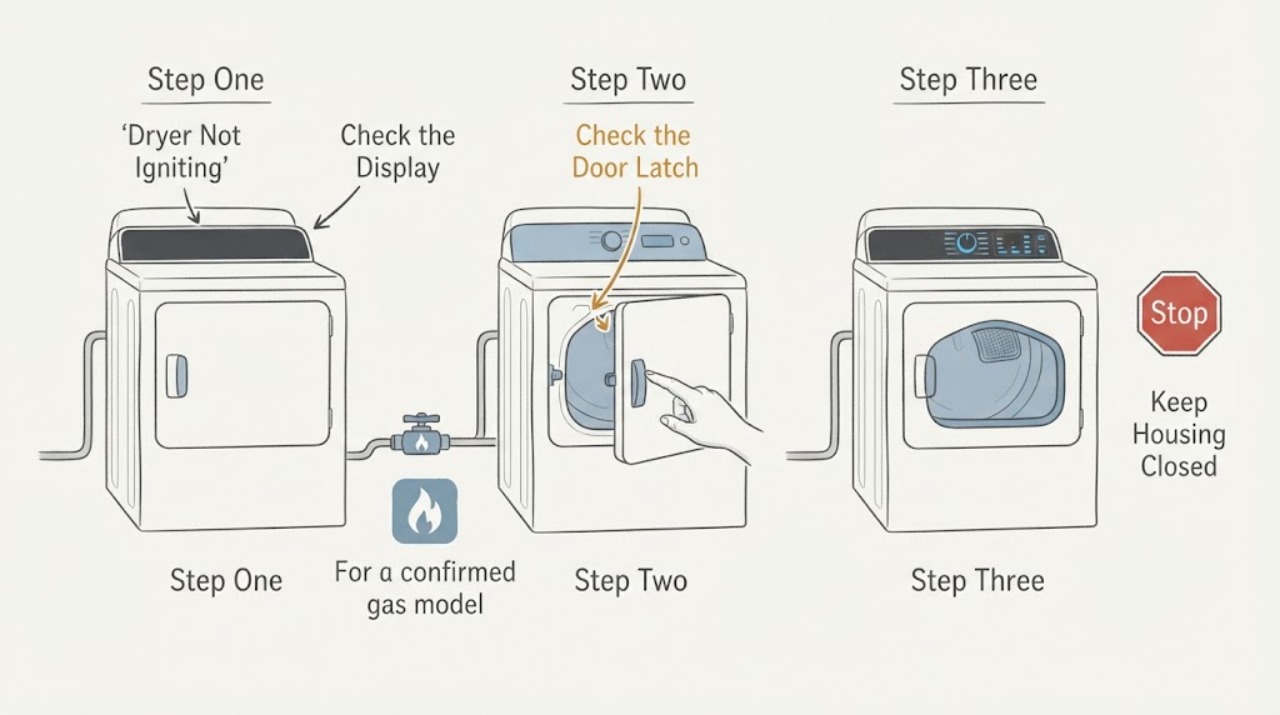
Work through in order
Diagnostic checks
Use only checks that match the exact appliance or system and its official guide.
-
Check 1
Stop the dryer and identify the exact symptom and model. Read the model label, confirm gas, electric or heat-pump type, and note the cycle, door state, drum movement, display or blinking pattern, ignition sound, exhaust warmth and when the failure occurs. Stop without another attempt if there is gas odor, smoke, sparks, burning or electrical odor, scorching, abnormal heat, a carbon-monoxide alarm, water near electrics or a repeated breaker trip.
Expected result: The machine is electric or heat-pump, the drum does not turn, the drum turns with no heat, a gas-ignition code appears, ignition is delayed, or a hazard sign is present.
Next step: For gas odor, smoke, a carbon-monoxide alarm or active fire sign, do not operate switches or appliances; leave the area and contact emergency help from a safe location. For other hazards, isolate power only when safe. Otherwise follow the matching fuel and symptom path.
Why this matters
Why: Only a gas model can have a gas igniter or burner. No drum movement is a start or door path; a turning drum with no heat points to cycle, power, gas, airflow or heating components. A hazard requires immediate stop and help.
-
Check 2
Check the safe start conditions. Confirm the door is fully closed and latched, choose a cycle that should heat, disable a setting that intentionally reduces or delays heat when the manual says it applies, and hold Start as the model requires. If the panel is locked or unresponsive, use only the control-panel indication and model-specific Child Lock sequence. Do not force the door or repeatedly press Start after a failed ignition.
Expected result: The door indication clears, the wrong or no-heat cycle was selected, Child Lock or another control state was active, the drum starts but stays cold, or the start command is accepted without heat.
Next step: Correct only the door, cycle or model-specific control state. If a damaged latch, unresponsive panel, no drum movement or no heat remains, keep the dryer off and arrange service rather than opening the cabinet.
Why this matters
Why: A door, lock or cycle condition can prevent a heat command from being issued. Some cycles intentionally use little or no heat. If a valid heated cycle runs with a turning drum but no warm air, continue to fuel, airflow and code checks.
-
Check 3
For a confirmed gas model with no gas odor or smoke, check only the accessible gas-supply condition described by Samsung: the appliance gas supply must be turned on and the installation must match the model manual. If this is the first run after installation, use the manual's one-time first-use ignition guidance; Samsung says air in the line can delay ignition and directs turning the dryer off if the burner does not ignite within the stated interval. Never loosen a gas connector, adjust a valve or inspect the burner inside the cabinet.
Expected result: The supply is intentionally off, the dryer is newly installed, ignition occurs and exhaust becomes warm, ignition does not occur within the first-use interval, or ignition clicks repeatedly without normal heat.
Next step: If gas odor, abnormal flame, delayed ignition, smoke or a carbon-monoxide alarm occurs, stop, leave the area as needed and obtain emergency help. Otherwise stop after the permitted first-use check and arrange qualified Samsung service for repeated no-ignition.
Why this matters
Why: An off supply or air after installation can explain a limited first-use delay. Repeated failure, clicking without heat, delayed ignition or an ignition code points to a gas, igniter, valve, sensor or control issue that is not a safe user repair.
-
Check 4
With the dryer cool, clean and fully reinstall the lint filter. Inspect the visible exhaust connection and outside hood for lint, debris, animal entry, crushing, kinks and weak airflow. Follow the exact model manual for a vent-blockage test, and record any temperature, heating or HC2 indication. Do not run the dryer with a missing or damaged filter and do not disassemble the vent or heater to reach a hidden blockage.
Expected result: The filter or duct is restricted, the hood has little airflow, a vent test reports a clog, an HC or temperature code appears, or the accessible airflow path is clear.
Next step: Clean the user-accessible filter and arrange safe full-duct cleaning when needed. If the dryer was unusually hot, a code returns or no heat remains after a clear path, leave it off for qualified service.
Why this matters
Why: Restricted airflow can trap heat and moisture, trigger protective behavior and prevent safe heating. A clear visible outlet does not rule out an internal heater, igniter, blower, sensor or control fault.
-
Check 5
After a non-hazardous correction and full cooldown, perform at most one supervised check using a correct heated cycle and suitable load. Observe whether the drum turns, ignition occurs without delay, exhaust becomes warm, heat cycles normally and no code returns. Do not repeat ignition attempts, run an unattended test, reset a tripping circuit, open panels or bypass a thermal, door or gas safety device.
Expected result: The dryer heats normally, it turns with no heat, ignition fails again, HC2 or another code returns, the cabinet is unusually hot, or smoke, odor, sparks, a carbon-monoxide alarm or a breaker trip occurs.
Next step: Stop immediately for gas odor, smoke, sparks, burning or electrical odor, scorching, abnormal heat, carbon-monoxide alarm or repeated trip. Otherwise keep the dryer off for recurrence and give service the model, fuel type, code, cycle, ignition and airflow observations.
Why this matters
Why: A single normal run after a confirmed supply, cycle, filter or vent correction supports an external cause. Recurring no-ignition or no heat indicates a gas, heater, igniter, sensor, control or power fault. Any hazard ends testing.
Use your observations
Decision map
Find the observation that best matches what you see, then follow the next safe action.
-
PATH 01Next step
What you see
The model is electric or heat-pump rather than gas.
Do this next
Confirm the correct cycle, power and airflow, then use the exact model manual. Request service for persistent no heat or a returning code; do not search for or add a gas part.
Why this path and its safety boundary
Why it matters: There is no gas ignition system to test; no heat follows a power, cycle, airflow, heater or sensor path.
-
PATH 02Next step
What you see
The gas dryer is newly installed, the gas supply is on, there is no gas odor or smoke, and ignition is only delayed on the first use.
Do this next
Follow the exact model's one-time first-use procedure and its stated stop interval. If ignition does not occur within that interval or fails again, turn the dryer off and request qualified service.
Why this path and its safety boundary
Why it matters: Air in the newly connected line may account for a limited first-use delay under Samsung's installation guidance.
-
PATH 03Next step
What you see
The drum turns but there is no heat, the selected cycle does not require heat, or the dryer is in a cooling stage.
Do this next
Use a model-supported heated cycle and compare the behavior after the correct start command. If the heated cycle stays cold, continue with power, gas, vent and error checks.
Why this path and its safety boundary
Why it matters: No heat is not proof of an ignition failure; some cycles or cooling stages intentionally have little or no heat.
-
PATH 04Next step
What you see
An HC2 gas-ignition code, recurring temperature code or other fault returns after one model-specific reset.
Do this next
Keep the dryer off and arrange Samsung or qualified appliance service. Record the exact code, model, cycle, fuel type and whether the drum turned or exhaust warmed.
Why this path and its safety boundary
Why it matters: Samsung treats the recurring code as a service condition involving ignition, temperature sensing or another component.
-
PATH 05Next step
What you see
The lint filter, exhaust duct or outside hood is blocked, crushed or has weak airflow, or the dryer is unusually hot.
Do this next
Cool the dryer, clean the user-accessible filter and arrange safe full-duct inspection or cleaning. Do not operate with a damaged filter or continue if heat or no-ignition returns.
Why this path and its safety boundary
Why it matters: Restricted airflow can trap heat and trigger protective heating behavior or a fault.
-
PATH 06Next step
What you see
There is gas odor, delayed ignition, abnormal flame, smoke, a carbon-monoxide alarm, burning or electrical odor, sparks, scorching, abnormal heat or a repeated breaker trip.
Do this next
Do not operate switches or appliances during suspected gas leakage. Leave the area and contact emergency help from a safe location. For other hazards, isolate power only if safe and obtain qualified service.
Why this path and its safety boundary
Why it matters: This is a gas, fire, combustion or electrical safety event, not a routine igniter diagnosis.
Helpful context
Understand the symptom
Confirm the appliance identity before looking for an igniter
A Samsung electric or heat-pump dryer has no gas ignition path. Use the model label and manual to confirm the fuel type, then record whether the problem is no heat, no drum movement, a cycle that ends early or an ignition code. Do not infer fuel type from the outlet alone.
A normal first-use delay has a narrow boundary
Samsung explains that air in a newly connected gas line can delay the first burner ignition. That is not permission to keep cycling the dryer: use only the model's first-use installation guidance, stop if ignition does not occur within the stated interval, and stop immediately for gas odor, delayed ignition, abnormal flame or smoke.
Do not bypass a heat or gas safety system
Lint, a restricted vent, a temperature fault, a failed igniter, a valve, wiring or the control can all produce no heat, but the same symptom does not identify a part. User checks should stay at the cycle, door, supply, filter, visible vent and model-supported test level.
Safety boundary
Stop conditions
- Gas odor, delayed ignition, abnormal flame, smoke or a carbon-monoxide alarm
- Burning, electrical or plastic odor, sparks, melting or scorched fabric
- Abnormal cabinet or drum heat, a recurring HC2 or temperature code
- Repeated breaker trip, damaged power connection or water near electrical parts
- A blocked or crushed vent path that cannot be safely cleared
- Any need to open the cabinet, adjust gas components, test live parts or bypass safety protection
Only after diagnosis
Potential parts
- gas igniter or ignition electrode
Consider only when a qualified technician confirms a gas-model ignition fault after supply, cycle, door, airflow and code checks.
Confirm the complete model and fuel type; never test or replace an ignition part with the cabinet energized. - gas valve coil or temperature sensor
Consider only when qualified diagnosis links repeated no-ignition or abnormal temperature to the valve or sensor rather than airflow or settings.
Gas and temperature-control parts are model-specific and safety-critical. - lint filter, exhaust duct or thermal limiter
Consider a replacement only for visible filter or duct damage, or after a qualified diagnosis confirms a thermal-protection fault once airflow is corrected.
Do not run with a missing filter or bypass a thermal device; match the model and vent configuration.
When checks do not resolve it
Need a professional?
Arrange Samsung or qualified appliance service for repeated no-ignition, an HC2 or recurring temperature code, no heat on a correct heated cycle, failed first-use ignition, abnormal flame, delayed ignition, gas odor, smoke, carbon-monoxide alarm, burning or electrical odor, sparks, scorching, abnormal heat or a repeated breaker trip.
Safety scope: Do not loosen gas fittings, adjust gas pressure, open the cabinet, probe live wiring, bypass a thermal or door interlock, repeatedly attempt ignition, run with a damaged filter or continue after gas odor, smoke, sparks, scorching, abnormal heat or a carbon-monoxide alarm.
Common questions
FAQ
Does a Samsung electric dryer have an igniter?
No. Electric and heat-pump dryers do not use a gas burner or igniter. Confirm the model and fuel type first, then follow the correct power, cycle, airflow and heater path for that model.
Why does my Samsung gas dryer turn but not heat?
Check that a heated cycle is selected, the gas supply is on, the lint filter and exhaust are clear, and no code is displayed. A newly installed gas line can contain air, but repeated no-ignition, HC2, delayed ignition or no heat after the permitted first-use check requires qualified service.
What does HC2 mean on a Samsung dryer?
Samsung lists HC2 as a gas-ignition error. Record the exact model and code, check only the model-supported gas, cycle and airflow conditions, and request service if the code returns. Do not open the cabinet or adjust gas components.
Can a blocked vent stop a Samsung dryer from heating?
Yes. Samsung links lint-filter or vent blockage with trapped heat and heating errors. Clean the user-accessible filter, follow the model's vent guidance and arrange safe duct cleaning when needed. Persistent no heat or a returning code requires service.
When is a Samsung dryer ignition problem an emergency?
Stop immediately for gas odor, delayed ignition, abnormal flame, smoke, carbon-monoxide alarm, burning or electrical odor, sparks, scorching, abnormal heat or a repeated breaker trip. Do not operate switches during suspected gas leakage; leave the area and contact emergency help from a safe location.
Read the exact guide
Official sources
- Samsung dryer setup and installationSamsung Support US · Samsung dryer gas and electric identity, first-use gas ignition, power and vent installation
- Clothes are not dry after using Samsung dryerSamsung Support US · Samsung dryer cycle, heat, lint, vent and model-supported vent test guidance
- Samsung dryer smells or smokesSamsung Support US · Samsung dryer gas odor, smoke, burning and electrical safety guidance
- Samsung dryer displays an error codeSamsung Support US · Samsung dryer gas-ignition, heating, temperature, vent, door and power error guidance
- Control buttons on Samsung dryer do not respondSamsung Support US · Samsung dryer cycle controls, door-start behavior and Child Lock guidance
Community feedback
Share a repair observation
Share a plain-text repair observation. Accepted observations are published automatically; this page may take a moment to update.