
On this page
Start here
Quick answer
An Amana freezer that is not cooling may be off at the power or control path, in a cooling-off or demo state, unable to circulate air, or losing cold air through a blocked or poorly sealed door or lid. Check the outlet and cooling state, inspect only visible airflow and seal conditions, and follow the model manual for any stabilization period after a setting change or large load. If a breaker trips, the compressor or fan stays silent after safe checks, frost blocks the interior, food is thawing, or the cause is unclear, protect the food and arrange qualified appliance service; do not open the sealed refrigeration system or repeatedly reset a tripped circuit.
Before you begin
Safety first
- Do not open the sealed refrigeration system, add refrigerant, remove electrical covers, bypass a control, or repeatedly reset a tripped circuit.
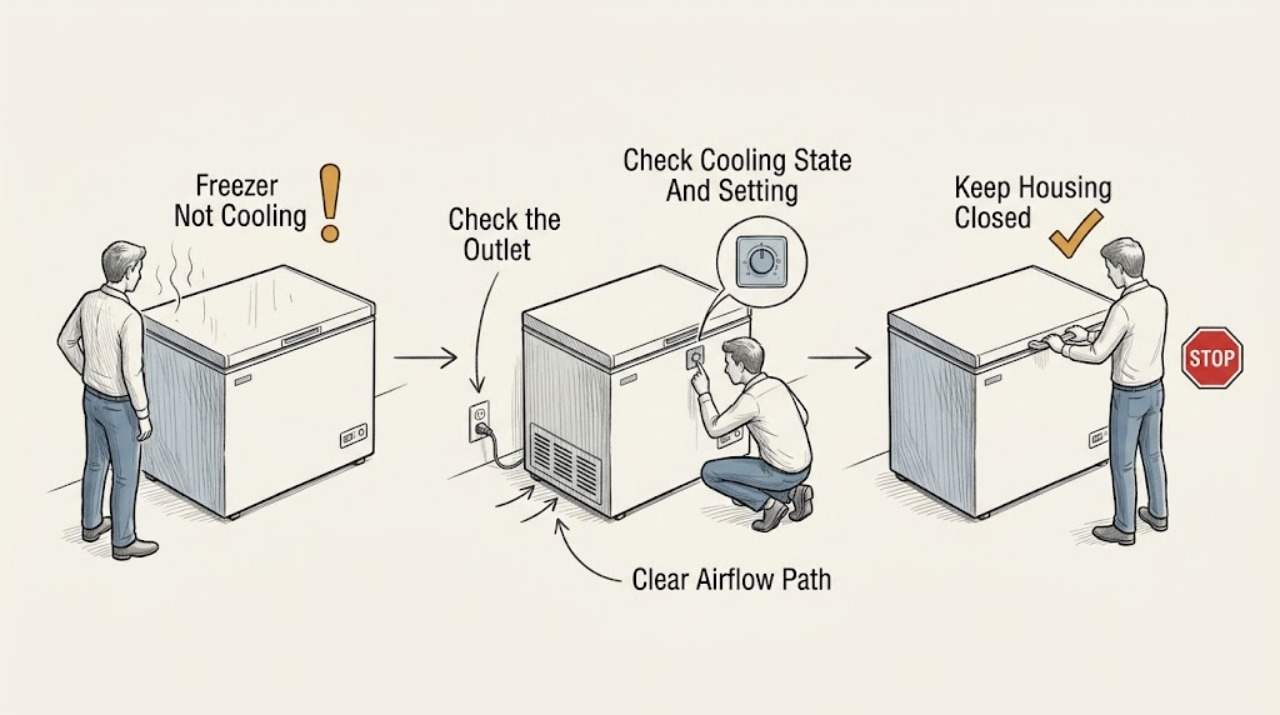
Work through in order
Diagnostic checks
Use only checks that match the exact appliance or system and its official guide.
-
Check 1
Confirm that the freezer's plug is fully seated in the intended outlet and that the outlet is live. Check that a wall switch has not turned the outlet off; a safe lamp test can distinguish a dead outlet from a freezer fault. Check the breaker or GFCI once, and do not use an extension cord or a damaged cord.
Expected result: The outlet is dead, the breaker or GFCI is tripped, the freezer has no lights or display, or the outlet and controls are live.
Next step: If a single reset restores power, continue to the control check. If the breaker or GFCI trips again, or there is heat, arcing, or cord damage, stop and use a qualified electrician or appliance professional rather than resetting repeatedly.
Stop if: Stop for a repeated trip, burning smell, visible arcing, hot outlet, or damaged cord.
Why this matters
Why: A dead outlet or repeated trip is an electrical supply problem. If the outlet is live but the freezer remains unresponsive, the appliance control or power path may be at fault. Lights alone do not confirm cooling.
-
Check 2
Verify that the freezer is switched on and that any cooling-off, vacation, showroom, or demo state is not active. Check the temperature control against the model manual; if a setting is changed, make only one change and follow the manual's wait period before judging the result.
Expected result: Cooling was off, the product shows a demo or showroom indication, the control was moved from its normal position, or the control state is correct but the cabinet remains warm.
Next step: Restore cooling only through the documented control sequence for the model, then keep the door or lid closed while it stabilizes. If there is still no cooling after the manual's stabilization period, continue with the visual checks and prepare the model number for service.
Stop if: Stop if the control is damaged, a reset sequence is unknown, or the appliance enters an unexpected mode; do not guess at a model-specific key sequence.
Why this matters
Why: An off or demo state can explain a warm cabinet even when lights or a display work. A correct control state with no temperature improvement points toward airflow, door or lid sealing, or a mechanical or sealed-system fault.
-
Check 3
With the appliance powered normally, inspect visible vents and air passages, package placement, and the interior for frost that blocks circulation. Move only packages that visibly obstruct a vent or prevent closure. Do not remove panels or attack ice with a knife or other sharp tool.
Expected result: Packages block a vent, the cabinet is overpacked, a thick frost layer covers passages, or there is no obvious obstruction or frost.
Next step: Reorganize packages and keep vents clear. If frost is substantial, follow the model manual's defrost procedure only when food can be protected and the procedure is clear; recurring or extensive frost requires professional diagnosis of the sealing or defrost condition.
Stop if: Stop if ice must be chipped, panels must be removed, water could contact live parts, or the cabinet has an abnormal odor or leak.
Why this matters
Why: Obstructed airflow or frost can prevent cold air from reaching the cabinet. No visible obstruction makes a simple loading issue less likely but does not prove a compressor, fan, defrost, or sealed-system diagnosis.
-
Check 4
Check the full visible gasket or lid seal, the cabinet level, and the position of packages, baskets, or shelves. Remove only debris that visibly prevents closure, clean the seal as the model manual allows, and close the door or lid without forcing it.
Expected result: A package or basket prevents closure, the freezer is visibly out of level, the gasket is cracked or brittle, frost surrounds the seal, or the seal appears continuous and the door or lid closes evenly.
Next step: Correct the obstruction and monitor the cabinet while minimizing openings. If the gasket is damaged, identify the exact model before considering a replacement; if the door or lid still will not seal or frost returns, arrange appliance service.
Stop if: Stop if the door or lid is warped, the hinge is damaged, the gasket cannot be positioned safely, or a repair would require disassembly.
Why this matters
Why: A closure obstruction or damaged seal can admit warm moist air, causing temperature rise and frost. A good visible seal shifts attention toward the control, airflow, fan, compressor, or sealed refrigeration system.
-
Check 5
From outside the appliance, note whether a normal cooling sound starts after the control and obstruction checks, whether the interior temperature is trending colder, and whether food is thawing. Record the model number and what changed before the failure; do not remove covers to reach a fan, compressor, wiring, or refrigerant circuit.
Expected result: Cooling resumes and temperature trends colder, the appliance runs but the cabinet stays warm, it is completely silent, or it cycles off with repeated electrical trips or abnormal noise.
Next step: Keep the door or lid closed and move vulnerable food to a known-safe cold appliance if it is thawing. Give the technician the model number, symptom timeline, control state, frost and seal observations, and any breaker behavior.
Stop if: Stop all DIY work for smoke, burning smell, refrigerant-like odor or leak, exposed wiring, repeated trips, or a need to open the sealed system.
Why this matters
Why: Improvement after a safe control, airflow, or seal correction supports that branch. Persistent warmth with a running appliance, complete silence after power is confirmed, or abnormal electrical behavior needs component-level diagnosis by a qualified professional.
Use your observations
Decision map
Find the observation that best matches what you see, then follow the next safe action.
-
PATH 01Next step
What you see
The outlet is dead or the breaker or GFCI trips again.
Do this next
Stop repeated resets, keep the freezer closed, and have the electrical supply checked; use appliance service if the supply is sound but the freezer is not responding.
-
PATH 02Next step
What you see
Lights or a display work, but cooling-off, demo, showroom, or an incorrect control state is found.
Do this next
Use the model-specific owner manual to restore cooling and then allow its documented stabilization period.
-
PATH 03Next step
What you see
A package blocks an air passage or frost visibly covers vents or interior surfaces.
Do this next
Reorganize the load without overpacking and use only the manual's safe defrost procedure; never chip ice or remove panels as a first-line fix.
-
PATH 04Next step
What you see
A package, basket, level condition, or damaged gasket prevents the door or lid from closing and sealing.
Do this next
Clear the obstruction, correct the organization, clean the visible seal as directed, and identify the exact model before considering a gasket replacement.
-
PATH 05Next step
What you see
Power and controls are correct, visible airflow and seal conditions are acceptable, but the freezer remains warm or food is thawing.
Do this next
Stop disassembly and sealed-system work. Preserve the model number and symptom observations for a qualified appliance technician.
Helpful context
Understand the symptom
Start with observations that do not require removing a panel: whether the outlet and controls are live, whether cooling is enabled, whether air passages or the cabinet are visibly obstructed, and whether the door or lid closes evenly. Amana's instructions vary by model, so use the model-specific owner manual whenever a control label or reset sequence is not obvious.
A freezer that still has lights but no cooling is not necessarily receiving a refrigeration command; a display, light, or fan observation alone does not prove that the sealed system is healthy. Do not chip ice with a sharp tool, apply direct heat, open the sealed system, add refrigerant, or bypass a safety device.
For a standalone chest or upright freezer, prioritize its own lid or door, control, and airflow layout. If the freezer is the compartment of an Amana top-freezer refrigerator, the refrigerator-specific demo-mode and vent guidance below applies only to that format.
Safety boundary
Stop conditions
- The breaker or GFCI trips again after one safe reset.
- There is smoke, burning smell, arcing, a hot outlet, damaged wiring, or a damaged power cord.
- Ice would need to be chipped, a panel removed, or a live component exposed.
- The door or lid is warped or damaged and cannot be made to seal without disassembly.
- Cooling does not return after the model manual's documented stabilization period, or food is thawing.
- The suspected repair involves refrigerant, a sealed system, compressor, or bypassing a safety control.
Only after diagnosis
Potential parts
Only if the exact model's seal is visibly cracked, brittle, or unable to close correctly.
Only after power, cooling mode, and the control's documented operation have been tested by a qualified technician.
Only when professional electrical and refrigeration diagnosis identifies the failed component.
When checks do not resolve it
Need a professional?
Call a qualified appliance professional when power and controls are confirmed but the freezer remains warm., Arrange service for recurring heavy frost, a damaged gasket or lid, abnormal compressor or fan behavior, or a condition requiring disassembly., Use an electrician when the outlet, breaker, GFCI, cord, or household wiring is the part that fails the safe check.
Safety scope: Do not open the sealed refrigeration system, add refrigerant, remove electrical covers, bypass a control, or repeatedly reset a tripped circuit.
Common questions
FAQ
Why does my Amana freezer have lights but not cool?
Lights or a display show that some electrical functions are present, not that cooling is enabled. Check the cooling control and, for an Amana top-freezer refrigerator, whether demo or showroom mode is active. If the cabinet stays warm after the manual's stabilization period, use the service boundary.
Can frost make an Amana freezer stop cooling?
Yes. Amana explains that accumulated frost can block airflow and make the freezer work harder. Clear packages from visible passages and follow the exact model manual for defrosting; do not chip ice or remove panels, and escalate recurring or extensive frost.
What should I check if the freezer lid will not close?
Check packages, baskets, shipping material, excessive frost, level, and the visible gasket. A lid that does not seal lets warm moist air in and can cause temperature fluctuation and frost buildup.
When should I stop troubleshooting an Amana freezer that is not cooling?
Stop for repeated breaker trips, smoke or burning smell, a hot or damaged cord or outlet, exposed wiring, a need to chip ice or remove panels, or persistent warmth after the documented stabilization period. Protect thawing food and arrange qualified service.
Read the exact guide
Official sources
- Checking for Items Preventing Door or Lid ClosureAmana · Amana freezer chest-lid closure, level, gasket, package, basket, and frost checks
- Not Cooling - Top Freezer RefrigeratorAmana · Amana top-freezer refrigerator cooling mode, temperature setting, airflow, load, and door-seal checks
- Setting the Controls for a FreezerAmana · Amana freezer control state, restart after outage or surge, and setting-change stabilization guidance
- How to Avoid Frost Build UpAmana · Amana freezer frost, airflow, door-seal, and organization guidance
- Not Powering On - Not Operating - Chest FreezerAmana · Amana chest freezer power, outlet, breaker, and operating-state checks
- Demo Mode - Top Freezer RefrigeratorAmana · Amana top-freezer refrigerator demo or showroom mode and its effect on cooling
Community feedback
Share a repair observation
Share a plain-text repair observation. Accepted observations are published automatically; this page may take a moment to update.