
On this page
Start here
Quick answer
Keep the freezer door closed while you determine whether the problem is a recent installation, a power or control issue, blocked airflow, a poor door seal, heavy frost, or a fault that needs service. Check the plug, normal temperature control, and any visible alarm only from a dry, safe position; do not repeatedly cycle power or open the cabinet. Remove only obvious packages blocking vents, check the door or lid seal for gaps or damage, and inspect for frost. If your exact Beko model permits manual defrosting, follow its user manual and never use a knife, heater, or hairdryer. If the freezer remains warm after these checks, has a persistent alarm, damaged seal, unusual electrical or compressor symptoms, a damaged cord, or needs internal or sealed-system access, stop and arrange qualified Beko appliance service.
Before you begin
Safety first
- User checks are limited to dry-position power and control observation, brief closure and seal inspection, moving obvious package obstructions, viewing vents and frost, and manual-approved external cleaning or defrosting. Internal panels, live wiring, refrigerant, compressors, fans, controls, and recurring or hazardous warming require qualified service.
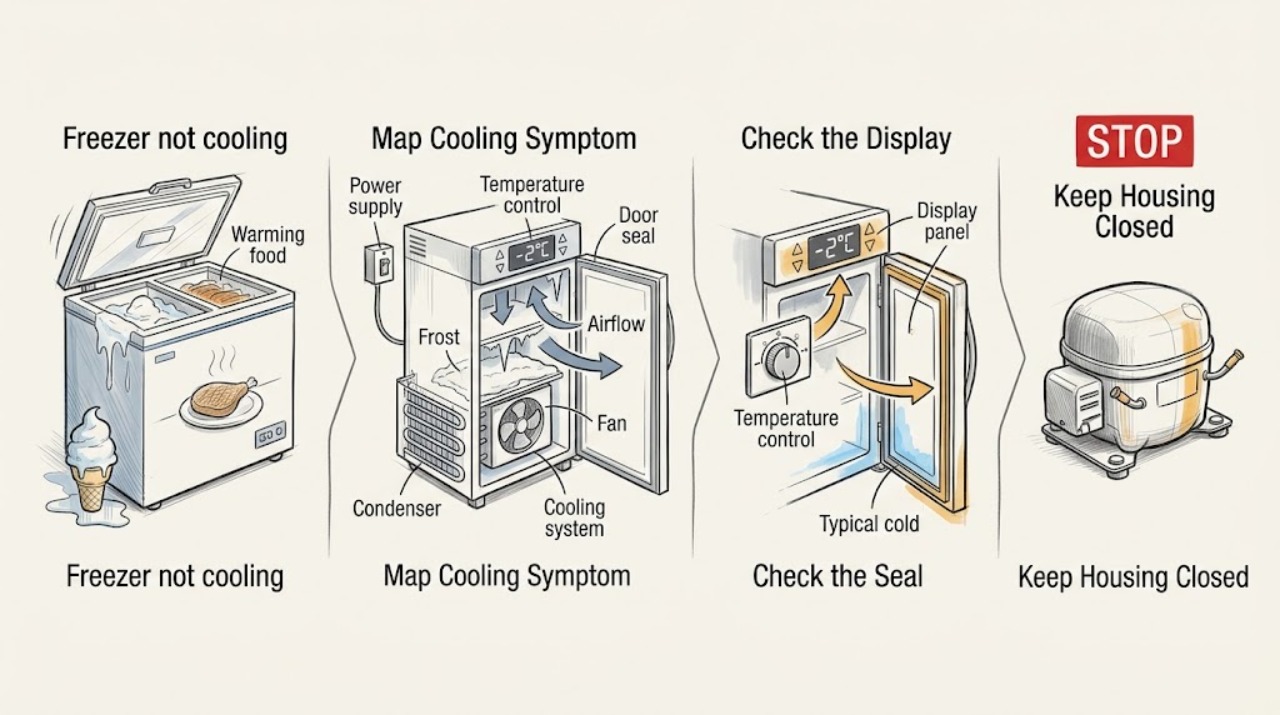
Work through in order
Diagnostic checks
Use only checks that match the exact appliance or system and its official guide.
-
Check 1
Keep the door or lid closed and note whether the freezer is completely warm or only part of the cabinet is warming, whether a high-temperature alarm or indicator is active, whether the compressor or fan sound is normal, and whether the problem began after installation, a power interruption, a large loading, or a long door opening.
Expected result: The freezer is newly installed; the door was left open; an alarm is active; the freezer is silent; only some areas are warm; or all contents are warming.
Next step: Keep the door closed and continue only with safe power, control, seal, and airflow observations. For widespread warming, a persistent alarm, or abnormal electrical noise, limit door openings and arrange qualified service if the condition does not recover.
Stop if: Stop for smoke, burning odor, damaged cord, water near electrical parts, or a cabinet or compressor area that is unsafe to approach.
Why this matters
Why: A new installation, open door, or heavy load can require time to stabilize. A silent appliance, persistent alarm, or widespread warming makes power, control, airflow, or cooling-system diagnosis more relevant than a single blocked vent.
-
Check 2
From a dry, safe position, confirm that the plug is fully seated, the socket has power using only a normal safe household check, and the freezer's thermostat or electronic control is not set to OFF. Do not use an extension lead, force the plug, open the control panel, or repeatedly unplug and reconnect the appliance.
Expected result: The plug is loose; the socket or household circuit has no power; the control is OFF or mis-set; the supply and control appear normal; or the plug, cord, or socket is hot, wet, scorched, or damaged.
Next step: Correct only an obvious normal control or plug position if it moves freely and the supply area is safe, then allow the freezer to operate with the door closed. For no power, damaged supply, or persistent warmth with normal power, arrange qualified appliance or electrical service.
Stop if: Do not handle a wet or hot plug, socket, or cord, and do not open electrical covers or repeatedly cycle the supply.
Why this matters
Why: A lost supply or OFF control can mimic a cooling failure. Normal power and control with continued warming shifts attention to airflow, frost, door sealing, fan, compressor, or another service-level condition. A damaged electrical supply is a safety boundary.
-
Check 3
Inspect the door or lid from the outside for a package preventing closure, a dirty gasket, a visible gap, crack, tear, or section that is not seated against the cabinet. Clean only the accessible gasket with a soft cloth and warm water if the manual permits; do not pull hard, glue, or remove the seal.
Expected result: The door or lid is blocked; the gasket is dirty but intact; there is a gap or tear; the seal is loose or displaced; or closure and the gasket appear normal.
Next step: Remove only an obvious package obstruction and close the door or lid normally. If the gasket is cracked, torn, or will not seal evenly, arrange model-matched service; do not continue running a freezer that cannot stay closed and cold.
Stop if: Do not force the door or lid, peel off a bonded gasket, or continue if the cabinet or hinge is damaged.
Why this matters
Why: A door that cannot close or a damaged seal allows warm air in and can promote frost and longer running. A normal seal and closure make airflow, power, frost, ambient conditions, or internal cooling faults more relevant.
-
Check 4
With the door open only briefly, look for food packages pressed against visible vents or blocking air circulation. Remove or rearrange only manageable items without covering vents, overfilling the cabinet, or placing hot food inside; do not remove internal duct covers or fan guards.
Expected result: Packages block vents; the freezer is overfilled; hot food was recently loaded; some areas are colder than others; or airflow appears unobstructed.
Next step: Restore clearance around visible vents and keep the door closed while cooling stabilizes. If the freezer remains warm or airflow is absent or abnormal, stop at the external check and arrange qualified service.
Stop if: Do not reach into a fan, remove duct covers, or operate the freezer with a damaged or exposed internal component.
Why this matters
Why: Beko identifies restricted circulation and warm loads as reasons a freezer can take longer to reach or maintain cold. Uneven temperatures with clear vents may indicate a fan, frost, sensor, or duct problem that requires model-specific diagnosis.
-
Check 5
Inspect the inner walls and accessible vents for a heavy frost or ice layer. If frost is present, identify whether the exact Beko model is a frost-free/no-frost design and follow only the user manual's defrost procedure; keep food handling and cold-storage decisions separate from the repair check.
Expected result: Heavy frost blocks vents; light frost is present; the model is frost-free; the manual permits user defrosting; or the frost returns quickly after a manual-guided defrost.
Next step: Follow the exact manual if user defrosting is allowed and monitor cooling afterward. Arrange service for frost on a frost-free model, rapid recurrence, inability to defrost safely, or persistent warming.
Stop if: Never use a knife, sharp tool, hairdryer, heater, or other unapproved electrical appliance to remove frost.
Why this matters
Why: Beko notes that visible frost can restrict airflow and that frost-free models should not be manually defrosted as a routine fix. Rapid recurrence or frost on a frost-free appliance can indicate a seal, fan, defrost, or control fault.
-
Check 6
Check that the freezer has ordinary ventilation around its outside and is not installed in an ambient location outside the range described in its model manual. If the manual identifies accessible condenser coils and the plug and floor are dry, switch off and unplug only as directed, then remove loose dust with a gentle dry brush or low-suction vacuum; do not use damp cloths or move a heavy appliance.
Expected result: The freezer is in a very cold or hot location; external airflow is blocked; coils are visibly dusty; the coils are inaccessible; or the external area appears normal.
Next step: Restore only safe external clearance and clean accessible coils as the manual permits. If cooling does not recover, the location cannot be corrected safely, or the rear area is hot, wet, or damaged, arrange qualified service.
Stop if: Do not move the appliance, touch hot condenser or refrigerant tubing, use water on coils, or remove rear covers.
Why this matters
Why: Beko says ambient conditions, restricted external airflow, and dust-covered condenser coils can reduce cooling performance. An inaccessible or normal external area with continued warming points to service-level diagnosis.
-
Check 7
Record the Beko model, power and control observations, alarm or indicator, door-seal condition, loading and airflow, frost pattern, ambient location, coil condition, sounds, and when food began to soften. Do not select a fan, thermostat, sensor, compressor, or refrigerant part from the symptom alone.
Expected result: Cooling returns and remains stable; the freezer stays warm; warming returns after a short recovery; the alarm persists; or the sound, smell, cord, cabinet, or frost pattern is abnormal.
Next step: Keep the door closed and limit use if the freezer is warming. Give the complete record to qualified Beko appliance service; do not continue with internal disassembly or repeated power cycling.
Stop if: Stop using the freezer for persistent warming with electrical damage, burning odor, smoke, refrigerant-circuit damage, or any need to open internal or sealed components.
Why this matters
Why: Stable recovery after a normal setup, airflow, seal, or manual-guided defrost check supports an external operating condition. Persistent or recurring warmth, alarm, abnormal noise, or damage needs diagnosis of controls, airflow, compressor, defrost, or sealed-system components.
Use your observations
Decision map
Find the observation that best matches what you see, then follow the next safe action.
-
PATH 01Next step
What you see
The freezer was recently installed, had a long door opening, or received a large or warm load and no damage or alarm persists.
Do this next
Keep the door closed and monitor according to the model manual. Arrange service if the freezer does not cool or the high-temperature indication persists after the normal stabilization period.
Why this path and its safety boundary
Why it matters: The cabinet may need time to stabilize, and warm air or warm contents can temporarily raise the temperature.
-
PATH 02Next step
What you see
The plug, socket, circuit, or temperature control is off, mis-set, or not supplying power.
Do this next
Correct only an obvious safe plug or control position. For no power, damaged supply, repeated trips, or continued warmth with normal power, arrange qualified appliance or electrical service.
Why this path and its safety boundary
Why it matters: The appliance may not be cooling because it is not energized or its normal control is disabled.
-
PATH 03Next step
What you see
A package blocks the door, the door or lid does not close evenly, or the gasket has a gap, tear, or displacement.
Do this next
Remove only the obstruction and clean an intact gasket as the manual permits. Arrange model-matched service for a damaged or persistently loose seal.
Why this path and its safety boundary
Why it matters: Warm air can enter continuously, causing frost, longer running, and poor cooling.
-
PATH 04Next step
What you see
Packages block visible vents, the cabinet is overfilled, hot food was loaded, or temperature is uneven around obstructed areas.
Do this next
Restore clearance around visible vents and keep the door closed. Arrange service for absent or abnormal airflow or continued warming with clear vents.
Why this path and its safety boundary
Why it matters: Restricted internal air circulation or a warm load can delay or prevent uniform cooling.
-
PATH 05Next step
What you see
Heavy frost blocks vents, the appliance is not frost-free, or frost returns quickly after a manual-guided defrost.
Do this next
Follow only the exact model manual for user defrosting. Arrange service for a frost-free appliance with heavy frost, rapid recurrence, or persistent warmth.
Why this path and its safety boundary
Why it matters: Frost can restrict airflow; rapid recurrence can indicate a seal, fan, defrost, or control issue.
-
PATH 06Next step
What you see
The freezer is in an unusually hot or cold location, external airflow is restricted, or accessible condenser coils are heavily dusty.
Do this next
Correct only safe external clearance and clean accessible coils as the manual permits. Arrange service if the location cannot be corrected or cooling remains poor.
Why this path and its safety boundary
Why it matters: Ambient conditions or poor heat release can reduce cooling performance.
-
PATH 07Next step
What you see
Power, control, closure, airflow, frost, and safe external checks are normal but the freezer remains warm, alarms, or the problem returns.
Do this next
Keep the door closed, document the symptoms, and arrange qualified Beko appliance service. Do not open panels or select internal parts from the symptom alone.
Why this path and its safety boundary
Why it matters: A fan, sensor, defrost control, compressor, electrical, or sealed-system fault may be involved.
Helpful context
Understand the symptom
Separate a setup or airflow issue from a cooling fault
A newly installed freezer, a door left open, warm food, a crowded cabinet, or heavy frost can temporarily raise the internal temperature. A weak seal can let warm air in and keep the appliance running. A freezer with normal closure, clear airflow, no excessive frost, and continued warming may have a fan, control, compressor, or sealed-system issue that cannot be identified safely from outside.
Keep the check at normal user access
Do not open the rear cover, touch refrigerant tubing, test live wiring, bypass a safety control, or remove internal panels. Do not use sharp objects, heaters, or hairdryers to remove frost. If the cord, socket, cabinet, or compressor area is wet, scorched, damaged, or unusually hot, stop using the freezer and arrange qualified service from a safe position.
Do not choose a part from warmth alone
If clearing a package obstruction, correcting a normal control position, cleaning a seal, or following the manual's defrost procedure restores stable cooling, monitor the result. If the freezer stays warm, the symptom returns, an alarm remains, or cooling is uneven after airflow checks, the cause may be electrical, mechanical, control-related, or sealed-system work. Record the model and observations for service rather than buying a thermostat, fan, or compressor part from the symptom alone.
Safety boundary
Stop conditions
- Stop immediately for smoke, burning odor, a damaged or hot cord or socket, water near electrical parts, a damaged cabinet, or a compressor or rear area that is unsafe to approach.
- Do not use knives, sharp tools, hairdryers, heaters, or other unapproved electrical appliances to defrost; do not pierce ice or touch refrigerant tubing.
- Do not open rear or interior panels, test live wiring, bypass controls, move a heavy appliance, or attempt fan, compressor, sensor, defrost, refrigerant, or sealed-system repair.
- Arrange qualified Beko appliance service when cooling remains poor, warmth or alarms recur, frost returns rapidly, the seal is damaged, the external area is inaccessible, or the required work is beyond the exact user manual's safe checks.
Only after diagnosis
Potential parts
- freezer door gasket
Consider this only if the exact model's gasket is visibly torn, loose, or unable to seal evenly after cleaning and correcting closure obstructions.
Confirm the exact Beko model and manufacturer fit information before ordering; a gasket will not repair a fan, defrost, control, compressor, or sealed-system fault.
When checks do not resolve it
Need a professional?
Call promptly for persistent high-temperature alarms, widespread warming, damaged seal or cord, smoke or burning odor, repeated power faults, absent or abnormal fan/compressor behavior, rapid frost recurrence, or any work requiring panels, wiring, refrigerant, or sealed-system access.
Safety scope: User checks are limited to dry-position power and control observation, brief closure and seal inspection, moving obvious package obstructions, viewing vents and frost, and manual-approved external cleaning or defrosting. Internal panels, live wiring, refrigerant, compressors, fans, controls, and recurring or hazardous warming require qualified service.
Have this ready
- Provide the exact Beko model, power and control results, alarm or indicator, door-seal and closure condition, loading and airflow observations, frost pattern, ambient location, coil condition, sounds or odors, and when the temperature began to rise.
Common questions
FAQ
Why is my Beko freezer not cooling enough?
Check safe basics first: power and control, door or lid closure, package blockage, internal airflow, frost, ambient location, and accessible condenser dust. Follow the exact manual for any defrosting. Persistent warmth, alarms, abnormal sounds, or damage needs qualified Beko service.
Can a bad Beko freezer door seal cause warming?
A gap, crack, tear, or poor closure can let warm air in and contribute to frost and longer running. Check the seal and remove only obvious package obstructions. Clean an intact gasket as the manual permits; arrange model-matched service for a damaged or persistently loose seal.
What should I do if my Beko freezer has heavy frost?
Heavy frost can restrict airflow. Check whether the model is frost-free and follow only its user manual for defrosting. Never use a knife, sharp tool, hairdryer, or heater. If frost returns quickly or appears on a frost-free model, arrange service.
Can overloading stop a Beko freezer from cooling properly?
Overfilling or placing packages against visible vents can restrict internal circulation, and warm food can delay stabilization. Remove only manageable obstructions, keep the door closed, and arrange service if cooling remains poor with clear airflow.
When should I stop troubleshooting a warm Beko freezer?
Stop for smoke, burning odor, damaged or hot electrical parts, a persistent alarm, widespread warming, rapid frost recurrence, abnormal compressor or fan behavior, or any need to open panels or access refrigerant or live wiring. Keep the door closed and arrange qualified appliance service.
Read the exact guide
Official sources
- TroubleshootingBeko · Beko manual guidance on power, compressor safeguards, temperature settings, door closure, gaskets, frost, ambient condensation, unusual operation, and contacting authorized service when problems persist.
- How to fix a freezer that's not working?Beko · Beko guidance on plug and thermostat checks, condenser-coil cleaning, internal airflow, frost, ambient temperature, and door-seal inspection.
- How to fix a freezer that is not cold enoughBeko · Beko guidance on newly installed freezers, warm food, door seals, opening frequency, frost buildup, frost-free operation, and model-manual defrosting.
Community feedback
Share a repair observation
Share a plain-text repair observation. Accepted observations are published automatically; this page may take a moment to update.