
On this page
Start here
Quick answer
If a Bosch freezer is not cooling, first check the plug or external switch, confirm the temperature setting was not changed, and look for a blocked door seal, ventilation opening, or heavy frost. If those visible checks do not restore cooling, or the freezer is warm with a fault indication, repeated trip, damaged cord, or unusual odor, stop and arrange qualified Bosch or appliance service rather than opening the cabinet.
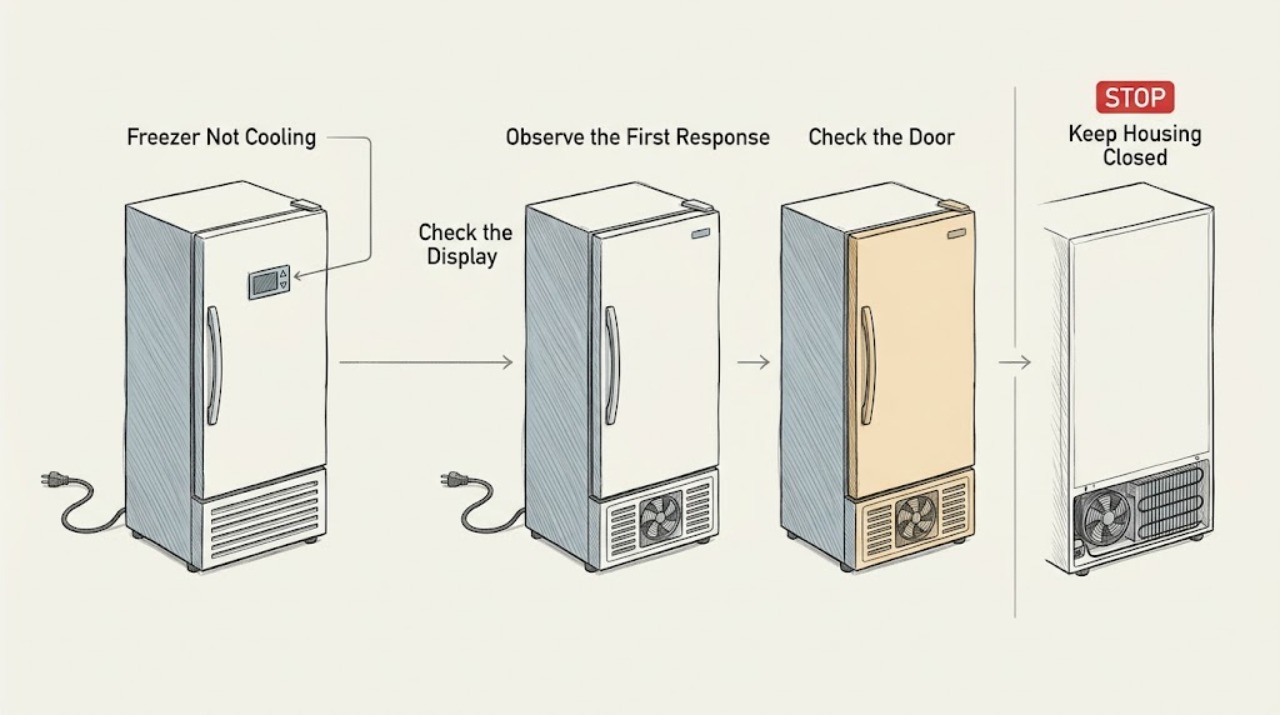
Work through in order
Diagnostic checks
Use only checks that match the exact appliance or system and its official guide.
-
Check 1
Look at the control display and interior light, then check from outside that the plug is fully seated and the appliance switch or isolator is on. If the household breaker has tripped, reset it no more than once while no hazard is present.
Expected result: The display/light is blank; or power returns after the switch/breaker correction; or the breaker trips again.
Next step: If power returns, continue with settings and airflow. If the display stays blank with a working supply, or the breaker trips again, leave the freezer isolated when safe and arrange qualified service.
Stop if: Do not remove outlet, switch, or appliance covers and do not inspect exposed terminals.
Why this matters
Why: A blank appliance may have no supply or an internal power fault. A repeated trip indicates a fault that should not be chased by repeated resets.
-
Check 2
Read the set freezer temperature and any alarm or fault indicator on the control panel; compare it with the owner's manual and note whether the setting changed after a cleaning, power event, or child interaction.
Expected result: The control is set warmer than intended, a temperature alarm is active, or the setting appears correct but the cabinet remains warm.
Next step: Restore only the manual's documented setting and monitor recovery. If an alarm remains or the temperature does not recover, record the indicator and move to the service decision.
Stop if: Do not guess a reset combination or change hidden service parameters; use the manual for the exact model.
Why this matters
Why: An accidental setting change can explain weak cooling. A correct setting with persistent warmth points toward airflow, door, defrost, sensor, or refrigeration faults rather than another control adjustment.
-
Check 3
Close the freezer door slowly and inspect the accessible gasket around its full perimeter. Remove only packages that prevent closure, and check that drawers are pushed in and food is not pressing against the door or blocking a visible internal air path.
Expected result: The gasket contacts continuously and the door latches, or there is a gap, torn section, obstruction, or drawer/load preventing full closure.
Next step: Correct a simple package or drawer obstruction and monitor recovery. If the gasket, hinge, or cabinet is damaged, arrange service rather than forcing the door.
Stop if: Stop if the door is warped, the cabinet is damaged, or the gasket cannot seal without force.
Why this matters
Why: Warm room air entering through a gap can raise the cabinet temperature and create frost. A load that blocks closure or circulation can produce uneven cooling without a compressor failure.
-
Check 4
Inspect the outside of the appliance for blocked ventilation openings, excessive dust around an accessible grille, or a new obstruction caused by cabinetry or stored items. Clean only the surfaces the manual identifies as user-accessible, with power isolated when required.
Expected result: Ventilation openings are covered or visibly clogged, or the airflow path is clear but the freezer remains warm.
Next step: Remove the external obstruction and monitor the temperature according to the manual. If the issue persists, do not pull the appliance out or remove panels unless the manual explicitly permits it; arrange service.
Stop if: Do not use tools to reach internal coils, bend tubing, or work around a built-in appliance without safe access and model instructions.
Why this matters
Why: Restricted heat removal can reduce cooling capacity. A clear exterior with continuing poor cooling makes a deeper airflow, fan, control, or sealed-system problem more likely.
-
Check 5
Look for a thick or localized frost layer, ice around the door edge, or a blocked internal cover without prying at it. Note whether the problem began after a door was left open, a power interruption, or a large fresh-food load.
Expected result: Frost is heavy or concentrated behind an inaccessible cover; frost is limited and the door was recently open; or no significant frost is visible.
Next step: For user-permitted defrosting, follow the exact manual and disconnect power as directed; never force ice off. For inaccessible or rapidly recurring frost, arrange service. Otherwise continue temperature monitoring after correcting the triggering condition.
Stop if: Do not chip, pierce, melt with an unapproved heater, or remove an internal cover to reach ice.
Why this matters
Why: Heavy frost can restrict airflow and may signal a door-seal or defrost problem. A recent open-door or power event can cause temporary warmth, while no frost with persistent warmth leaves settings, airflow, fan, or refrigeration faults in consideration.
-
Check 6
Record the complete Bosch model/E-Nr, display and alarm behavior, set temperature, visible frost location, door/gasket result, external airflow result, recent power or door event, and how long the freezer has been warm.
Expected result: Cooling does not recover after the visible checks and model-approved waiting period, an alarm/fault persists, or the symptom returns after a temporary recovery.
Next step: Contact Bosch or a qualified appliance service provider with the record and the manual for the exact model. Keep the door closed and move vulnerable food only as needed for safe handling.
Stop if: Stop using the appliance for damaged power parts, smoke, burning odor, exposed wiring, water near electrical parts, or suspected refrigerant-tube damage.
Why this matters
Why: Persistent or recurring loss of cooling is beyond a safe external diagnosis and may involve a fan, defrost circuit, sensor, control, compressor, or sealed refrigeration system.
Use your observations
Decision map
Find the observation that best matches what you see, then follow the next safe action.
-
PATH 01Next step
What you see
The display and light are blank, or the external switch/outlet is off.
Do this next
Correct the external switch or plug seating once if safe. If the supply is available but the freezer stays blank, arrange qualified service.
Why this path and its safety boundary
Why it matters: The freezer cannot cool without a stable supply, and a blank display may also indicate an internal electrical fault.
-
PATH 02Next step
What you see
The circuit breaker or appliance supply trips again after one safe reset.
Do this next
Leave the appliance isolated when safe and arrange qualified electrical/appliance service; do not keep resetting the supply.
Why this path and its safety boundary
Why it matters: A repeated trip is evidence of an electrical or appliance fault, not a temperature-setting problem.
-
PATH 03Next step
What you see
The power is stable, the temperature setting was changed, or the door was left open or a large load was recently added.
Do this next
Restore the manual's setting, close the door, avoid unnecessary openings, and monitor recovery for the model-specified period. Escalate if it stays warm.
Why this path and its safety boundary
Why it matters: The cabinet may be recovering from a user setting or temporary heat load rather than a failed component.
-
PATH 04Next step
What you see
External ventilation is blocked, or heavy frost is restricting a visible airflow path.
Do this next
Remove only external obstructions and follow the exact manual for any user defrost. If frost is behind a cover or returns quickly, arrange service.
Why this path and its safety boundary
Why it matters: Heat rejection or internal circulation may be impaired; frost can also be a symptom of a door or defrost issue.
-
PATH 05Next step
What you see
The display and setting appear normal, visible checks are clear, but the freezer remains warm or loses cooling again.
Do this next
Stop changing settings and arrange Bosch or qualified appliance service with the model/E-Nr and symptom timeline.
Why this path and its safety boundary
Why it matters: The remaining possibilities include fan, defrost, sensor, control, compressor, or sealed-system faults that require model-specific diagnosis.
-
PATH 06Next step
What you see
There is a damaged cord, smoke, burning odor, exposed wiring, water near electrical parts, or suspected damage to refrigerant tubing.
Do this next
Stop using the freezer. Disconnect power only if this can be done without contacting water or damaged wiring, then arrange qualified service.
Why this path and its safety boundary
Why it matters: This is an immediate safety condition, not a routine cooling adjustment.
Helpful context
Understand the symptom
Start by separating a power problem from a cooling problem. A blank display or interior light points toward the supply or an internal electrical fault; a lit display with a warm cabinet points toward settings, airflow, door sealing, frost, or the refrigeration system. Bosch recommends using the appliance's own manual for model-specific troubleshooting because controls and reset behavior differ.
Keep the first diagnosis external: inspect the plug, switch, breaker status, door closure, visible ventilation openings, temperature setting, and frost pattern. Do not dismantle the appliance to reach a fan, sensor, compressor, sealed system, or electrical board. A freezer may need several hours to return to its set temperature after startup or a long door opening, so judge recovery using the manual and the food's condition rather than a quick touch of one shelf.
If the freezer remains warm after the basic checks, or cooling fails again after a documented model-specific reset, arrange service. Protect food during the fault, avoid repeatedly resetting a tripping supply, and stop immediately for a damaged cord, smoke, burning smell, exposed wiring, water near electrical parts, or a damaged refrigerant circuit.
Safety boundary
Stop conditions
- Do not remove covers, expose terminals, bypass controls, or take electrical readings while the appliance is energized.
- Do not repeatedly reset a breaker or fuse that trips again; leave the freezer isolated and arrange qualified service.
- Do not chip, pierce, pry, or drill ice or tubing, and do not use an unapproved heater to force a defrost.
- Stop immediately for smoke, burning odor, arcing, a damaged cord or plug, exposed wiring, water near electrical parts, or suspected refrigerant-tube damage.
- Do not rely on a warm freezer to protect food: keep the door closed as practical and follow current food-safety guidance for food that has thawed.
When checks do not resolve it
Need a professional?
Arrange Bosch or qualified appliance service when the freezer remains warm after the external power, setting, door, airflow, and model-approved frost checks; when a fault/alarm persists; when cooling returns only temporarily; or whenever an electrical, water, or refrigerant safety hazard is present.
Have this ready
- Complete Bosch model/E-Nr, display and alarm behavior, set temperature, frost pattern, door/gasket and ventilation observations, recent power or door events, elapsed warm time, and any manual-approved steps attempted.
Common questions
FAQ
What should I check first if my Bosch freezer is not cooling?
Check the plug or external switch, display/light, breaker state, temperature setting, door closure, visible ventilation openings, and heavy frost. Do not open the appliance for these checks.
Can a door or gasket problem make a Bosch freezer warm?
Yes. A door that cannot close or a gasket with a gap can let warm air in and promote frost. Remove a simple package obstruction; arrange service for a damaged gasket, hinge, or cabinet.
Can blocked ventilation reduce freezer cooling?
Yes. Bosch identifies blocked or dirty ventilation/condenser areas as a possible reduction in cooling capacity. Clear only the accessible area described by the manual; do not remove panels to reach internal components.
How do I know whether a warm Bosch freezer is still recovering?
Consider whether it was recently powered on, left open, interrupted by a power event, or loaded with fresh food. Follow the model manual's recovery guidance and keep the door closed as practical; persistent warmth or an alarm needs service.
When should I stop troubleshooting and call for Bosch freezer service?
Call when visible checks do not restore cooling, frost returns or is inaccessible, an alarm persists, the supply trips again, the display is blank despite external power, or there is any electrical, water, or refrigerant safety concern.
Read the exact guide
Official sources
- Information for Use KIN86..Bosch Home Appliances · This is a model-family example, not a universal procedure. It documents model-specific temperature-alarm behavior, ventilation checks, power cycling, food-safety warnings, and trained-specialist repair boundaries.
- Fridge freezer not coolingBosch Home Appliances · Bosch's support checklist covers visible power, temperature setting, condenser/ventilation condition, and escalation to the manual or repair service.
- Freezer repair | Freezer TroubleshootingBosch Home Appliances · Bosch distinguishes common user-guide troubleshooting from more serious freezer problems requiring professional Bosch assistance.
- Common Freezer problemsBosch Home Appliances · Bosch's general freezer guidance covers a freezer not running, excessive frost, and a freezer that is too warm; it directs users to check supply, door closure, thermostat, and the owner's manual.
- Maintenance of work equipmentHealth and Safety Executive · HSE states that equipment must be made safe before maintenance, electrical supplies isolated, manufacturer instructions followed, and maintenance performed by competent persons.
Community feedback
Share a repair observation
Share a plain-text repair observation. Accepted observations are published automatically; this page may take a moment to update.