
On this page
Start here
Quick answer
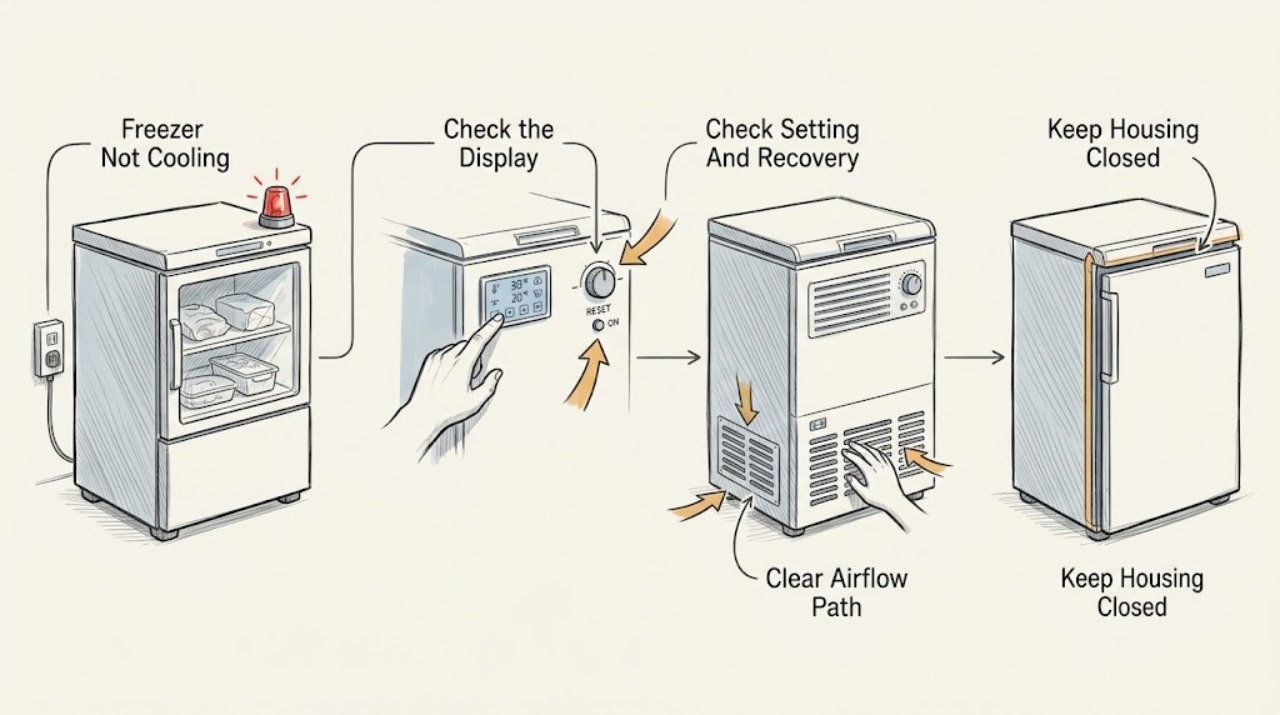
If your Frigidaire freezer is not cooling, keep the door or lid closed and first confirm that it has power and the control is not set to off. Then verify the temperature setting, clear food from interior vents, check that the door or lid closes and seals, and look for heavy frost that restricts airflow. A recently installed or power-restored freezer may need time to stabilize. Compressor hum, fan noise, or refrigerant gurgling means the unit is attempting to cool; if it still is not cold after the stabilization period, or it has no power, repeated trips, heavy frost, or unusual noises, stop guessing at parts and arrange qualified appliance service.
Work through in order
Diagnostic checks
Use only checks that match the exact appliance or system and its official guide.
-
Check 1
Check the interior light or control display, confirm the power cord is firmly seated in its normal wall outlet, and verify the freezer control is not off; do not use an extension cord.
Expected result: There are no lights or display, the outlet or GFCI has no power, the control is off, or the circuit has tripped; alternatively the freezer has power and the control is active.
Next step: If the home circuit repeatedly trips or power cannot be safely restored, stop and arrange electrical or appliance service. If power is present, continue with the setting, airflow, and seal checks.
Stop if: Do not open electrical panels, use an extension cord, or repeatedly reset a circuit that trips again.
Why this matters
Why: A missing power supply or off control can stop cooling before any refrigeration diagnosis is relevant.
-
Check 2
Check the freezer temperature control against the model's use-and-care guidance, and note whether the unit was newly installed, recently disconnected, or recovering from a power outage.
Expected result: The control is warmer than intended, or the freezer has just been installed, reconnected, or power-restored; alternatively the setting is correct and sufficient recovery time has passed.
Next step: Make only a small model-appropriate setting adjustment, keep the door or lid closed, and allow the stated stabilization period. If it remains warm afterward, continue to service evaluation.
Stop if: Do not keep changing the setting repeatedly or assume a setting change fixes a freezer that remains warm after stabilization.
Why this matters
Why: A setting or recent interruption can explain a warm compartment temporarily. Frigidaire says a unit can need up to 24 hours for temperature to stabilize after installation or a power issue.
-
Check 3
Look inside without removing covers and move only loose food items that are touching vents or packed tightly against the walls; keep space for cold-air circulation.
Expected result: A vent is blocked, the cabinet is overpacked, or food is preventing the door or lid from closing; alternatively vents are clear and the load is not obstructing circulation.
Next step: Clear the visible obstruction, close the door or lid, and allow the compartment to recover. If airflow is clear but cooling does not return, use the frost, seal, and service branches.
Stop if: Do not remove an interior rear cover or chip at ice to reach a hidden fan or coil.
Why this matters
Why: Restricted airflow can leave the freezer warm even when the cooling system is running.
-
Check 4
Inspect the door or lid perimeter for gaps, dirt, cracks, or anything preventing closure, and look for heavy frost on interior surfaces that could restrict airflow.
Expected result: The gasket does not make consistent contact, the door or lid remains ajar, or thick frost is covering surfaces; alternatively the seal is clean and continuous and frost is not excessive.
Next step: Remove the visible obstruction and clean the gasket with the care instructions if it is dirty. If the gasket remains damaged or heavy frost returns, arrange service for the seal or defrost system rather than removing hidden components.
Stop if: Do not use sharp tools, heat guns, or an open flame to remove frost, and do not remove panels to access the defrost system.
Why this matters
Why: A leaking seal admits warm air, while over-frosting can prevent closure and reduce airflow; either can make the freezer fail to hold temperature.
-
Check 5
After the visible checks, listen briefly with the door or lid closed for compressor hum, fan movement, or refrigerant gurgling, and note whether the freezer has been allowed to run through stabilization time.
Expected result: The unit is silent, makes repeated clicks or unusual noises, runs but remains warm after stabilization, or has normal cooling-related sounds but no adequate cold; alternatively it is recovering and temperature is improving.
Next step: Keep the door or lid closed, document the sound and temperature trend, and arrange qualified appliance service for persistent lack of cooling, unusual noise, or no operation.
Stop if: Stop using the freezer for burning odor, exposed wiring, repeated circuit trips, liquid leakage, or any sign that hands-on work would be unsafe.
Why this matters
Why: Sounds can show an attempt to cool but cannot prove the compressor, fan, refrigerant circuit, or controls are working correctly. Frigidaire recommends service when the unit still has no cooling after the stated run time.
Use your observations
Decision map
Find the observation that best matches what you see, then follow the next safe action.
-
PATH 01Next step
What you see
The freezer has no lights or display, the outlet is dead, or the circuit trips again.
Do this next
Stop repeated reset attempts and arrange safe electrical or appliance service; do not open the freezer's electrical area.
Why this path and its safety boundary
Why it matters: Power delivery is the immediate problem or a fault is protecting the circuit.
-
PATH 02Next step
What you see
The freezer was newly installed, recently reconnected, or just recovered from an outage and its temperature is beginning to fall.
Do this next
Keep the door or lid closed, use the model-recommended setting, and allow up to the manufacturer's stabilization period before judging the cooling result.
Why this path and its safety boundary
Why it matters: The unit may still be stabilizing rather than failing.
-
PATH 03Next step
What you see
Food blocks vents, the cabinet is overpacked, or the door or lid cannot close fully.
Do this next
Clear only visible obstructions, confirm closure, and monitor recovery. If the gasket or closure remains defective, arrange service.
Why this path and its safety boundary
Why it matters: Air circulation or warm-air leakage is preventing the freezer from holding cold air.
-
PATH 04Next step
What you see
The gasket has gaps or heavy frost is covering interior surfaces.
Do this next
Clean a dirty gasket according to care guidance and arrange service for a damaged seal or recurring heavy frost; do not chip ice or remove panels.
Why this path and its safety boundary
Why it matters: A sealing or defrost-related airflow problem is plausible.
-
PATH 05Next step
What you see
The freezer runs or makes cooling-related sounds but remains warm after stabilization time.
Do this next
Keep the door or lid closed, record sounds and visible symptoms, and arrange qualified appliance service rather than replacing a guessed part.
Why this path and its safety boundary
Why it matters: The unit is attempting to cool, but the remaining fault may involve a fan, control, compressor, defrost function, or sealed cooling system.
-
PATH 06Next step
What you see
The freezer has a burning smell, liquid leak, exposed wiring, repeated clicking, or an unsafe cabinet condition.
Do this next
Stop using it and arrange prompt qualified service; use electrical or emergency help when the condition presents an immediate hazard.
Why this path and its safety boundary
Why it matters: The symptom exceeds a low-risk user check.
Helpful context
Understand the symptom
Protect the cold air while you check
Keep the freezer closed as much as possible while checking it. A long-open door, a load of warm food, or a recent power interruption can raise the temperature without proving that a sealed cooling component has failed. If the unit has no power, is repeatedly tripping the circuit, or has a burning smell, stop using it and use qualified electrical or appliance service.
Airflow and sealing are common decision points
Cold air must circulate around the stored food, and the door or lid must seal against the cabinet. Food touching vents, excessive frost, or a gasket that is dirty, damaged, or not making contact can all make the freezer warm. Correcting a visible obstruction is a reasonable user check; removing panels or dismantling a defrost or sealed-system component is not.
Use sounds and elapsed time to decide on service
Frigidaire describes compressor hum, fan movement, and refrigerant gurgling as signs that the unit is attempting to cool. Those sounds do not confirm that cooling capacity is adequate. If the freezer has run through the stated stabilization period and is still warm, record the sounds and visible symptoms for a technician rather than repeatedly changing settings or replacing a guessed part.
Safety boundary
Stop conditions
- Stop and arrange service for a burning smell, exposed wiring, liquid leak, or a circuit that trips again.
- Do not open electrical or rear interior panels to reach fans, coils, controls, or defrost parts.
- Do not chip frost with sharp tools or use flame or high heat to defrost the freezer.
- Do not keep changing the temperature control repeatedly when the freezer remains warm after stabilization.
- Keep the door or lid closed and stop using the unit if it remains warm after the manufacturer's stabilization period.
- Do not select or replace a compressor, fan, control, or sealed-system part from the symptom alone.
Only after diagnosis
Potential parts
- door or lid gasket
Consider this category only if a qualified diagnosis or a persistent visible gap confirms that the seal is damaged or cannot make contact after cleaning and correct closure.
Confirm the complete freezer model, door or lid style, and model-specific fit before selecting a gasket. - evaporator or condenser fan motor
Consider this category only if qualified diagnosis links absent or abnormal fan operation to the cooling failure after airflow obstructions are ruled out.
Fan layout differs by freezer design; verify the complete model and have a technician confirm the failed motor. - defrost system component
Consider this category only when recurring heavy frost and qualified diagnosis indicate a defrost fault that restricts airflow.
Do not remove hidden panels to identify this category; model-specific diagnosis and fitment confirmation are required.
When checks do not resolve it
Need a professional?
Arrange qualified appliance service if the freezer remains warm after the manufacturer's stabilization period, has no cooling-related operation, has recurring heavy frost, a damaged or non-sealing gasket, unusual noises, repeated circuit trips, liquid leakage, or an unsafe electrical condition. Stop using it immediately for a burning smell, exposed wiring, or a hazard that cannot be safely isolated.
Common questions
FAQ
What should I check first when a Frigidaire freezer is not cooling?
Check for power and an active control, then look for blocked vents, a door or lid that does not close, a poor gasket seal, heavy frost, and a recent installation or power interruption. Keep the door or lid closed while the unit recovers.
How long should a Frigidaire freezer take to cool after an outage or installation?
Frigidaire says the temperature may need up to 24 hours to stabilize after installation, reconnection, or a power issue. If it is still not cooling after that period, schedule service.
Can blocked food or frost make the freezer warm?
Yes. Frigidaire says food blocking vents can restrict airflow, and over-frosting can reduce airflow or prevent the door from closing. Clear only visible obstructions and arrange service for recurring heavy frost; do not chip the ice.
What does it mean if the freezer hums but is not cold?
Compressor hum, fan movement, and refrigerant gurgling show that the unit is attempting to cool, not that it is cooling adequately. If it remains warm after stabilization, provide those observations to a qualified technician.
Could the door gasket cause a Frigidaire freezer to stop cooling?
A dirty, damaged, or poorly fitting gasket can let warm air in and make the temperature unstable. Clean a dirty gasket according to the care guidance and arrange service if the seal still has gaps or does not make contact.
When is a freezer that is not cooling a service issue?
Use qualified service when it remains warm after stabilization, has no operation, recurring heavy frost, unusual noises, repeated circuit trips, liquid leakage, or an unsafe electrical condition. Do not remove panels or replace refrigeration parts based only on symptoms.
Read the exact guide
Official sources
- Freezer Runs Too MuchFrigidaire · Frigidaire guidance on installation, power recovery, warm food, door closure, and gasket condition
- Freezer - Not Freezing or Not CoolingFrigidaire · Frigidaire support for freezer power, settings, airflow, seals, frost, sounds, and service escalation
- What does the alarm or “buzzer sound” mean?Frigidaire · Frigidaire guidance on elevated freezer temperature and checking door closure and seal
- What should I do if my freezer isn’t running?Frigidaire · Frigidaire guidance for off controls, power cord, circuit, and outage checks
- Freezers - How can I set my freezer to run less frequently, or for shorter intervals?Frigidaire · Frigidaire guidance on doors, gaskets, warm loads, and temperature recovery
Community feedback
Share a repair observation
Share a plain-text repair observation. Accepted observations are published automatically; this page may take a moment to update.